


Dudda
-
Posts
487 -
Joined
-
Last visited
-
Days Won
1
Everything posted by Dudda
-
Natural will always look better. As markc said manufactured can be 'too uniform' in places. Just want to add that the colour of a natural slate will never fade. Manufactured slates and tiles will. This doesn't happen often but does happen. If you check the small print manufactured tiles and slates might have a 20 or 30 year warranty but that's a structural warranty. As in they won't fall off the roof but the colour warranty is usually much shorter at about 5 years, and 10 years if you're very lucky. We had one project where the slates looked crap after 15 years and are now replaced with Blue Bangor natural slates (very expensive top of the range natural slates - Spanish is a lot cheaper).
-

How much compressive strength is enough for a subfloor
Dudda replied to Adsibob's topic in Floor Structures
Have you detailed drawings with a specification and does it specify Cellecta or a compressive strength of 250 kPa? If it does I'd probably stick with it. First question I'd be asking the builder is what's the saving in going for warmup instead of Cellecta as he's proposing. Its rare a builder suggests something that doesn't benefit his own pocket rather than yours. -
Practical experience of ceiling acoustic performance sought
Dudda replied to dnb's topic in Plastering & Rendering
I'm sorry, but I have to disagree in that over a height of circa 2.5 meters you won't notice 12.5mm. It's only half of one percent in height. Adding a rug to the floor would make more of a difference. What is the exact height from the underside of the joists to your finished floor level currently? Look at the 'White Book' and the options it gives. They go through every possible combination from a single layer of 12.5mm standard board, 15mm board, 12.5mm acoustic board, and multiple layers of these. You might find one layer of 12.5mm acoustic board will be enough as that has a much better acoustic rating than 12.5mm of standard board which it sounds like you were originally planning. -
Practical experience of ceiling acoustic performance sought
Dudda replied to dnb's topic in Plastering & Rendering
Unless it makes the room non compliant in terms of head height the additional 12.5mm won't be noticed in the overall height of the room. -
Practical experience of ceiling acoustic performance sought
Dudda replied to dnb's topic in Plastering & Rendering
Why not resilient bars with two layers of acoustic board? Additionally on the first floor side you can have the silent floor system with the floor chanels that sit on top of the joists. https://www.gyproc.ie/sites/default/files/GypFloor SILENT_1.pdf I've used this successfully in a Black Box Theatre in a listed building where we obviously had to have excellent acoustic properties. I've also used it to separate a plant room from the main church so silent prayer was still silent and you couldn't hear all the plant equipment. -
Kingspan insulated panels are the most common available form of these. Almost every sports hall, industrial unit and warehouse are made of these. They're quick and easy but I wouldn't call them cheap or pretty. The other issue is I think they're very poor acoustically. Driving rain echoes through them and you won't get a great nights sleep. Noise isn't usually an an issue in any of the above places they're used.
-
That insulation would be better than the Isover sleeve type insulation the MVHR company intend to use. You could put the Kooltherm on the incoming and external ducts first and then get them to fit the Isover. Hard to have to much insulation. As for other locations the only places I can initially think that you can't use it would be the floor. Everywhere else, if fitted correctly, should be fine.
-
You have to have some wiring as they need power to work. You can't have them 100% battery like 20 years ago. They need to be mains powered with battery backup. If going mains powered you may as well have them interlinked and not use wireless. If it's a refurbishment and just taking a power spur from the nearest light then fair enough but if it's a new build I'd consider it madness to not just have them interlinked with a proper fire cable. Fire alarms are supposed to be replaced every 10 years. I know this doesn't happen currently but in the future I think you may have to prove these types of things to get house insurance or rent our a room (airBnB or childminder) for example. Things like Grenfell are having a huge impact on new regulations and standards and more will come. Even if you push this to 15 years having them wire interlinked gives you far more options in the future. I'd expect by then houses will have alarms more like commercial premises where you've a battery in the fire alarm control panel and then it's a lot cheaper to replace the smoke heads as they don't have built in batteries. It's a bit like running data cables now to various locations trying to future proof the house. Can't see why, when you're life might depend on these, that you also wouldn't future proof.
-
Strangely this issue of costs and what's included only happens on smaller private housing projects where people include and omit things. I think it's because on other projects such as an office buildings, schools, healthcare, etc that I work on you'd always have a Quantity Surveyor. In every cost report no matter what the project or who the QS is you'll always find a summary sheet that lists the actual build, the design team fees, any planning contributions, fixtures and fittings/fitout, abnormal's(additional rock/unusual foundation/long entrance road/etc) and then the total cost. You've a construction contract which is what the builder is paid but that's far from the total cost when everything else is included. Particularly an anything that receives funding from the EU (education, healthcare, infrastructure, etc) these things are all listed in a certain way and have to be included. This might change slightly now with Brexit but similar rules apply if it's government funding. On one off private housing, it really is a case of anything goes as you're only reporting costs to yourself or the other half.
-
Don't know anything about the RHI but I've installed a few DIN rail meters for my own knowledge and information about the energy I use. Have them on hot water, space heating and general electricity. Will add one for car when we go electric. It does give some fascinating info. Hot water is constant all year (thought it would be slightly more in winter as mains water might be colder but it's not) but increased when I took up running and had more showers and then reduced when I gave it up. It's just over 10% of all electricity used. General electricity usage has gone up 5.3% of overall since covid and working from home. Heating takes up 45.3% of all electricity even if it's only a few months per year. Heating actually dropped a tiny bit since covid began. Pointless info yet interesting. Similar to these but paid £7:50 ish each https://www.ebay.ie/itm/324745034691
-
Just because I've included the data about rooflights doesn't mean I expect her to get up on the roof and fix a leaking rooflight.
-
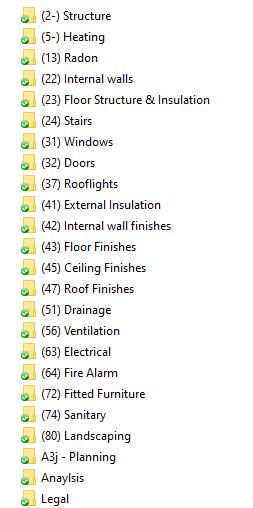
Google have an 'Google's Inactive Account Manager'. In this it allows you transfer over what you want to your next of kin, eg all your photos, google drive, emails, etc. I've a 'house' folder in google drive that has a all of the data sheets and information for the different things. It was the folder I used as we renovated so contains everything from the radon sumps and their locations at the bottom all the way to the ridge capping and rooflights at the top. The folder structure is CI-Sfb (https://www.ribacpd.com/subjects.aspx) which we use at work and as an architect I'm used to 'Safety Files' and 'Building Manuals' that are handed over to the clients at the end of a project. For our own house I've taken it a bit further in that it contains all the data sheets and warranties of appliances like cookers, hobs, washing machines, etc that are often client supplied and the builder wouldn't include. It also contains a copy of the planing application and all planning correspondents, the energy, PHPP and u-value analysis and a copy of all legal folios, land registry maps, certificate of compliance, etc. Basically everything to maintain, run or sell the property if I were to pass.
-
If you've any left over external airtight tape that's incredibly sticky and durable. Not exactly sure what you're trying to do. If it's fixing lagging to pipes can you use cable ties? They'll be still there long after we've all passed.
-
About one bar pressure. You won't need to worry about thermal cut outs but you still want to heat the slab up slowly. What I did was left it on for 3-4 hours, then a break for the same and then on again for the same. I built up the temperature slowly. I did have a polished concrete floor and was paranoid about it cracking. The manifold will have a flow and return temperature and use these to judge. Eg If the flow is 16 degrees flow on Monday, 18-20 on Tuesday and 22-25 on Wednesday. Then by Thursday on full time. Depending on how well and insulated the house is and how cold it is outside, I don't think you'll need to leave it on full time as after a few days the house should be up to 21 degrees inside. My house is very well insulated and the one wills heater heats all 240sqm
-
You can connect up an external wills heater. They're very cheap, readily available and easy to fit. A few people here have such low heating requirements we actually use these instead of ASHP's. Depending on the house, airtightness and level of insulation it mightn't bring the house up to 21 degrees throughout but it will definitely help drying out and take the cold out of the house.
-
Nonsense. That can happen on any project and is down to getting a good contractor and supervision onsite. I got the grant for external insulation in Ireland but it's probably different elsewhere. Here you've to pick from a list of approved contractors who are registered for the grant process. The work has to be signed off and any issues you can go to SEAI (Sustainable Energy Authority Of Ireland) who oversee the grant process. We had one wall we didn't think was great quality and they came back and redid it. If they don't reach a certain standard they risk getting removed from the list of approved contractors. I know several projects where the SEAI made them come back and do additional or rectification work. The problem in Ireland is the oversight, sign off and additional paperwork involved pushes up the contractors cost which they have to factor into their costs. This means if the grant covers eg 50% you're probably getting a 40% saving on doing it yourself without the grant. The advantage is you've great power in getting them to come back and fix issues which would be incredibly difficult on a non grant project. On a regular non grant job If the builder is finished and paid its very hard to get them back to fix something. One example on a project I was working on is the external render was black. Natural salts came out and left patches of white like you often see on new brickwork. You only noticed it as the render was black. They were made come back 18 months later after all the salts, calcium or whatever it is had come out and acid wash the elevations for free. Good luck getting that done on another project. As I said this is in Ireland and not sure how it works elsewhere.
- 15 replies
-
- 1
-

-
- insulation
- exterior
- (and 1 more)
-
In the cavity if you've it half filled with insulation you still have air which can circulate and move about. Old houses have draughts and it's possible for the cold air outside to get into the cavity, eg at the roof, and circulate in the air cavity in the wall. It's basically bypassing the external insulation. If the cavity is fully filled this can't happen. As for continuing the insulation underground externally this is useful particularly where you're not able to replace or insulate the existing floor. It's not perfect but does help. If you are moving a lot of rain water pipes you might be having to take up parts of the footpath anyway. Obviously if you've tiles in a patio or expensive paving instead of a gravel path or cheap standard concrete this option of continuing the insulation underground becomes more expensive. It is a relatively easy DIY job so breaking out part of the footpath and digging the trench is something you can do yourself to save money. I did it on my house. If you go for 100mm of external insulation or 150mm or 200mm the different in cost isn't massive as the main costs are in the labor, scaffolding hire, plastering, moving rainwater pipes, etc which are needed for each. The additional cost of insulation thickness isn't a lot and well worth adding as much as you can. If you're going to the effort of temporarily removing the fascia and soffit to continue the insulation up to the roof you should have nothing stopping you going for 200mm in thickness for example.
-
If going the external insulation you've different levels that you can go to. Obviously the more you do the better the job. These apply to detached, semi detached and terrace. If you take out the footpaths around the base of the house this will allow the external insulation to continue underground say 300mm or more if possible. Removing the fascia and soffit will allow you to continue the external insulation up further between the timber rafters and connect with the attic roof insulation eliminating any cold bridge. Leave just enough of a gap to ventilate the attic if you've a cold roof buildup. Replacing the windows at the same time as external insulation allows you to move the windows out so they're in the line of the insulation. You'll have deeper reveals internally which is better than the deeper reveals externally which will be a cold bridge. This looks a lot better too as avoid old looking windows with a new fresh rendered house. If you externally insulate you still need to pump the remaining cavity of the wall to prevent thermal looping.
- 15 replies
-
- 1
-
-
- insulation
- exterior
- (and 1 more)
-
What type of screed are you using? Can you reduce that to 50mm liquid screed and get up to 120mm insulation? That 20mm will help a lot. Alternatively are windows and doors fitted? Have you a stairs and what height is the ceiling? Any potential to raise the floor level by 20-30mm for example?
-
If you like gardening you can make a polytunnel with leftover pipes. Fairly easy and can make it any size to suit. Here's an example I've just googled. https://sharpenyourspades.com/2018/07/26/how-to-build-your-own-polytunnel-for-under-100/
-
You can have a hybrid which I've used on a number of projects for various reasons (protected buildings with ceilings we had to retain, refurbishments working from one side, phased projects, etc). A WUFI test would be better as it takes into account the hygric behavior and moisture contained within the materials. eg the plywood deck and timber frame could have a moisture content of 20% if constructed over a wet winter. We had a hybrid roof on one large roof (passive house) and got a WUFI test. It was a complicated timber frame roof that was designed to accommodate a sedum roof at a later date when funds became available. Anyway internally when the building was sealed (windows in roof on) we had to wait until the plywood deck and structural timbers dropped below a certain moisture content internally before we were allowed to add the vapour control layer. Later this void was pumped with cellulose. The roof had PIR on top of the plywood deck. Most major suppliers of airtight membranes will provide a WUFI test if you're buying your vapour control membranes and tapes from them.
-
If you find it can you also post where you found it, any reference code, how you replaced it yourself etc. Any info that you think could help. I've a SunAmp about the same age and I'd have nobody anywhere here either that would know anything about them so will also probably have to do it myself if this fails also.
-
Don't forget you need a CO2 alarm in any room that the flue passes through. eg if you've a bedroom upstairs and the chimney flue is boxed out and passes through this room it also needs a carbon monoxide alarm. As for the type and location I put mains wired Aico alarms in every single room and have LD1 protection in my house. I pay huge attention to detail to ensure everything is as clean, simplified and as designed as possible but I felt the life of me and my family was more important so compromised on smoke alarms and carbon monoxide alarms. Also install these if going the Aico route. They're very useful for false alarms, testing, etc.
-
Get whatever services you need put down, eg pipes to a kitchen island or trunking to allow you pull cables later to the island. A gas or electrical feed if you've a free standing fireplace wall, etc. Then you can put the 40mm PIR down and cut around the pipes. Hopefully the insulated pipes will be about the same thickness making it very easy for you. Then the 150mm with fit nicely on top of everything.
-
Internally I'd go 50mm PIR fixed to the 140mm timber frame, airtight vapor layer, 25mm battens and then the plasterboard. You don't have to have OSB on both sides. You do on twin stud walls and in some other cases but if you've only a 140mm stud then you generally don't need it. Obviously check with your engineer. The reason I'd go this route with the airtight vapor control layer is you can see it and patch it. eg if an electrician drills a hole for an external light you can seal the penetration or if an area wasn't taped correctly you can easily see and repair it. If you use an internal OSB layer as the airtight layer, then have PIR and the battens forming the service cavity you'll have to rip a chunk of the PIR off to enable you tape the electrical cable to the OSB or repair the poorly taped joint, etc. Also the airtight vapor control layer is a lot cheaper than an additional unnecessary layer of OSB. As a separate item I'd consider 35mm battens otherwise wider battens if using 25mm eg 65x25. When overlapping two sheets of plasterboard you're adding a lot of screws and the thin batten can split. It needs a bit more rigidity as it's the 50mm PIR between it and the main timber support structure.

