


Dudda
-
Posts
487 -
Joined
-
Last visited
-
Days Won
1
Everything posted by Dudda
-

What products do you think will be banned/worth avoiding using?
Dudda replied to CalvinHobbes's topic in Ireland
I'm finding it's the commercial sector that's pushing the sustainability and improvement of products for fitout anyway. If you've a large multinational company taking over a floor of an office building they have all these LEED, BREAM and other requirements they want to meet to present this green sustainable image to their staff and customers. They're looking to use low VOC products (trying to avoid that new car smell which are the chemicals coming out of the materials). Things like carpet tiles, paints, fabrics and foams in furniture, ceiling tiles, etc. Another thing they're looking for is that these are recyclable which is good as offices can get refurbished very often with layouts changing, partitions coming down and going up regularly. Carpet tiles are ripped up, ceiling tiles removed and they can now be recycled. In a domestic situation these products eg floor finishes are usually designed to last a lot longer so the requirement or desire of recycling them at their end of life isn't as great. I think this will change as more recycling options become available and move into the domestic sector. The thing is these companies usually rent the buildings so the push to have these as sustainable or recyclable isn't as great. Personally I think gas boilers will go but it will take time. I'm working on a third level university who's looking to replace all their current gas boilers with heat pumps. These are industrial scale heat pumps with a district heating system that will take place over the next 15-20 year plan to convert all the buildings. Some of the buildings are 1960's which require extensive thermal upgrading. In time carbon tax will deter gas boilers and force people to use other sustainable models. Gas boilers won't be banned but they'll become uneconomical. -
A street scene is a lot more work and can vary a huge amount depending on the level of detail. Did you get three quotes like others have suggested?
-
I'm guessing you don't have heat recovery @MortarThePoint I'd definitely get a quote for the MF ceiling. It's very quick as stated by others.
-
You need the extra insulation. No point having a thicker screed if the heat goes into the ground and not the room. Have you windows and doors in? What stage are you at exactly to see if we can change floor level. Eg if you've a service cavity planned for the ceiling could that be reduced slightly to keep the same floor to ceiling height. I'd also check with who's signing this off and the BER. The whole house has to meet a standard which the floor feeds into. If they had 150mm PIR originally in the floor and you've the external 200mm insulation finished that can't now be increased to offset the reduced floor insulation.
-
That's not enough insulation in Ireland. Your floor has to be 0.15 if using UFH. The Part L regulations for insulation and energy performance are a lot higher in Ireland. You should have a preliminary BER certificate done. That will say what you need to achieve. Get rid of the screed and put the UFH pipes in the slab. That gives you 70mm extra insulation. Also don't know why if it's a new build you can't just dig down another bit. That will allow you to use cheaper but thicker EPS insulation instead of PIR which is a lot more expensive and currently in short supply in Ireland. UFH pipes are cheap and easy to install but impossible to install later. Put them in everywhere. You don't even have to connect them up in the bedrooms but you can very easily later if needed.
- 20 replies
-
- 1
-

-
- sunamp
- dhw ( domestic hot water )
- (and 2 more)
-
Welcome. I'm based in Mayo and have a Sunamp. Think I was the first in the Ireland to get one. Where on the 'westcoast' are you? You don't need a SunAmp for the UFH. If you've decent insulation (which you should have if building to Irish regs) then you just can use a Wills Heater to heat the floor at night/off-peak and it will slowly release the heat throughout the day. This is what I have with 100mm of polished concrete floor that acts as a large mass and slowly releases this heat. The SunAmp just provides hot water. A wills heater is very cheap at about 50 euro compared to a Sunamp that costs thousands. Even if the wills heater fails after 5 years (and mine hasn't yet) it's a cheap replacement.
-
Dual MVHR Units
Dudda replied to DanJepp's topic in Mechanical Ventilation with Heat Recovery (MVHR)
It also depends on the layout of these large houses. If the layout results in very long runs then it might be better to have two smaller units. I worked on a very large house which was made up of three different wings so we had three small MVHR units. One in each wing. The house was very airtight at 0.39 air changes. -
Planning permission Letter of objection - challenge inaccuracies?
Dudda replied to Digger1's topic in Planning Permission
Have to agree with epsilonGreedy here. The first thing I'd do is get the whoever did the drawings to make sure they haven't made any mistake and the building will fit and for them to review it. eg if the site is 10 meters wide and the site plan shows the house at 8 meters wide then it fits. If the Ground Floor plan drawing shows the house as 11 meters wide (even if it's a typo) then you've a problem as it won't fit. Another project I worked on the boundary was at a very slight angle like 87 degrees instead of 90 degrees. The back of the building didn't fit on the site and had to resubmit planning. Simple errors and mistakes are made. Get them to check all dimensions. Make sure everything is correct before sending anything to the planners. -
Double storey wraparound extension
Dudda replied to RoseD's topic in House Extensions & Conservatories
I still think everyone is thinking about this the wrong way and need to take a step back and look at the bigger picture before bolting on the most economical extension where they think it will fit. The garden faces north ish. The part of the house that gets the most light and evening sun is the garage. That's such a shame. Personally my initial thoughts would be to knock and rebuild the garage or convert part of it and extend into the garden on the west side of the site. Break out the snug into the extension this way. The existing kitchen can become the new sung or kids den opening onto the garden, the existing dining area a new utility and ground floor bathroom and flip the kitchen and dining area to the opposite side of the house in a brand new purpose built open plan kitchen, living, dining area that could have lovely high ceilings, rooflights, etc as you've no bedrooms above on that side of the house above the garage. If you want more room upstairs you extend the small bedroom 2 over the new garage and open plan living area creating a new purpose built master suite. Bedroom 2 is a tiny box room and this is the perfect way to grow it. The other advantage of this is you can very easily phase the work. You live in the existing kitchen, dining, living area etc while the new open plan kitchen living dining area is built. Then when it's finished you convert the old kitchen. You may need planning depending if you decide to rebuild the garage but I think you're better off getting planning if needed and doing something right rather than a bolt on. -
Double storey wraparound extension
Dudda replied to RoseD's topic in House Extensions & Conservatories
As an architect the first question that's asked is where's south. If that Red extension you're proposing was going to put the right hand side of the house into shadow and darkness then you shouldn't build there no matter how much cheaper it would be. At such an early stage you need to get an architect to think about light and shadow, flow of the space, orientation, connection between the different spaces and the garden, functions, etc. This will decide where the extension goes and what shape it takes on. -
It it time consuming and that price is about right. As Conor said above I'd seriously consider using thicker insulation if you can. If the area is tight and you can only fit the 40mm on one elevation I'd still consider increasing the thickness on the remaining elevations. The cost of materials will only go up a bit but labour shouldn't.
-
You need a structural engineer. Wind posts have to be designed for the building. They can be steel, reinforced concrete, etc and need to be sized to suit. Often they may be sized to suit the buildup. eg 100mm steel post in a 100mm blockwork wall. A project I'm working on is an exposed elevated site in the west of Ireland a few hundred meters from the Atlantic and has 450 x 215mm reinforced concrete windposts. The 215mm is to match the block on flat wall. In other areas the windposts are 215x215mm. That's an extreme case but gives you the idea of how they need to be specially designed.
-
You'll have to get more support under that steel first before you do anything. That steel is about an inch above the concrete and will have to be filled with structural concrete or grout. It's only resting on a few shims. If you can fit some structural insulation between the steel and concrete (compacfoam or similar) that would be good but really the structural insulation should have being fitted first, not trying to squeeze it in now. Once that issue is resolved you can then do as PeterW suggested above by coating the steel in foam and then concrete. EDIT: sample image from Google to prevent cold bridge:
-
I just modify the shelves and rails as I'm told. I know better than to ask questions.
-
We (as in she) designed as best we could our dressing room. Due to budgets and only two of us in the house it was the only dressing room getting fitted. The idea was to see what worked and then later as the Ikea pax system is all adjustable and interchangeable, we moved some unwanted trouser rails and other bits that didn't work for us into the guest bedroom wardrobe when fitting that out. This allowed us to get additional shelves and drawers for the main dressing room. My wardrobe hasn't changed really. I think I added another £5 shelf. Her wardrobe has changed a lot but we've probably only spent an extra £80 and it was all easy to modify. Things that changed were handbags hanging on rails were now put on shelves. Her jeans are now folded on a shelf where previously they were on a trouser rail. The area and way large boots was changed. All minor things you wouldn't know in advance when designing the layout. If you go for a custom fitted wardrobe by a carpenter while you'll probably have a nicer finish you won't have the flexibility I think of modifying it as much or going back later when you know what works. Purchasing an additional drawer to replace a shelf or rail for about £15 and 10 minutes of your time is very easy with the Ikea Pax system. At the start we didn't have doors. They were also added later and came in the same delivery with the guest bedroom 18 months later.
-
House is overheating
Dudda replied to Savage87's topic in Mechanical Ventilation with Heat Recovery (MVHR)
If you can get temperature sensors put into the four ducts at the MVHR unit it will give you a great indication of how it's working. It will show the following: Incoming air temperature (what it actually is outside) Air exhaust to outside (the temperature the air leaving the house is) Supply air temperature to rooms (if summer bypass is on and this is higher than incoming air temp it suggests the attic is warming the air) Extract air from rooms to MVHR unit (this will give an indication of the internal heat gains) I'd use this as a starting point. Other people have done this but you don't have to go to the level of technicality they've done in this thread -
Architect plans - opinions welcome
Dudda replied to deancatherine09's topic in New House & Self Build Design
Looks good. Shame for the downstairs WC not to have a window. I'd look at modifying the utility, plant room and that WC to try and get it a window. Still think I'd steal a tiny bit off the master bedroom or it's ensuite to make Bedroom 3 a tiny bit bigger. I preferred the location of the hallway door. It's now off a sub circulation nook rather than the main hallway route. The wall between the larder and stairs. I'd have that a double wall that a large sliding door could slide out of and close off the main living area to the entrance hallway (It could also be the utility family wall side). More elegant that double glass doors. It will probably be open 95% of the time but if kids are playing or a party is going on in the family room it will provide another layer of separation if someone was working in the study or trying to sleep upstairs. You've a void over the front door and the stairs so noise can travel from the main kitchen family area around the whole house. -
Yes it will import it... but as a PDF. If you wanted to move a wall or door you can't unless you go messing with wipeouts or a white hatch which is a disaster and very messy. That's why you want the PDF in DWG format.
-
They probably just don't know how to convert it. I'm in an office of 30 architects and I'd say two of us know how to convert them. If you want you can message me the file I'll and try and convert it to AutoCAD for you.
-
Yes you can. With a programme such as Adobe Illustrator you can import the PDF into illustrator and then export it as an AutoCAD .dwg file. Two types of PDF files exist. Vector based and raster based. Vector are lines and text that would be printed from AutoCAD. A scanned pdf or image is made up of pixels and can't be converted back. When converting PDF back to AutoCAD with illustrator you'll lose some of the autocad layers but that's fine as some companies strip this out anyway when sending you the original AutoCAD file. It will also be to a particular scale. eg 1:50 so after you convert it back to .dwg file format you'll have to scale it by 50. Some other annoying stuff happens like hatches are all converted to lines. If used to AutoCAD commands it's the same as everything in the drawing is exploded. This can make hatches difficult to modify. Text is also converted and not editable. It's all still fine though as you strip out the hatches and text and have all the lines of the house or building perfectly which is what you want.
-
No difference. Now if you were comparing the Kingspan Kooltherm or other higher spec insulation there is a difference but not with the Kingspan thermowall. The biggest difference will be in the installation rather than insulation. A well installed insulation board with no gaps will perform much better than a poorly cut and fitted board.
-
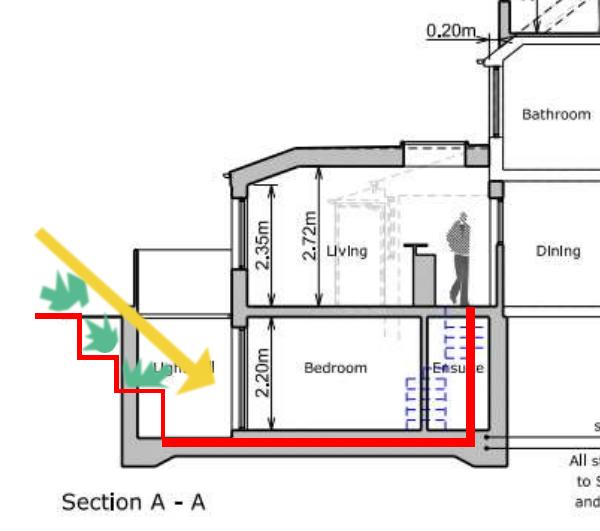
I'd try and keep the basement wall out a bit from the existing house. It will work out easier to build (and therefore cheaper) not having to underpin the existing house as much. My crude overlay also shows how more light can get into the basement if you've the wall stepped and it will look a hell of a lot better than a 2.7/2.8m high retaining wall. The loft will definitely work out cheaper. Basements are expensive and you've a lot of earth to carefully dig out and have only a 2m existing access to the side of the house. I think you need to speak to a structural engineer and builder about this to get a grasp of the costs involved. I'd definitely do that before getting an environmental engineer or wasting time perfecting the layout or size and shape of a lightwell.
-
Would you consider a brick cill? Similar to the below image I found on Google (ignore the head and style of the window, only looking at the cill).
-
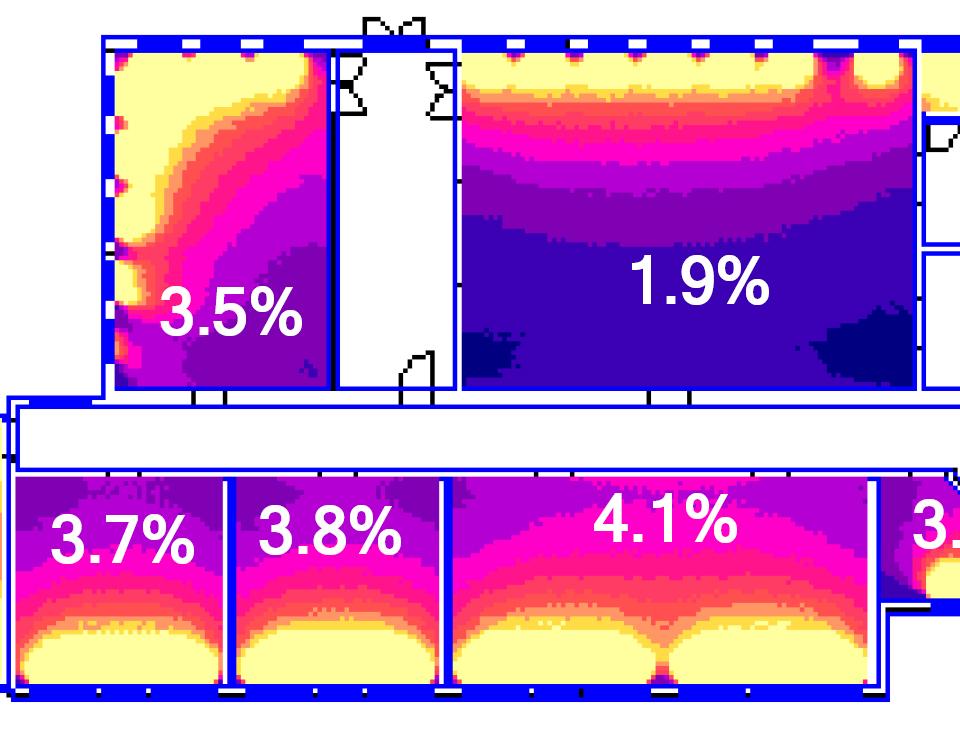
Ignoring the cost as requested which is my biggest concern, it's a balancing act. You could get a daylight analysis study done. It's a 3D version of the house done by an environmental engineer and measures the daylight available. We get them done a lot (for larger projects not houses) and they're very useful. We always get them for schools and offices so you can work with natural light without needing additional artificial light. They give great insight in the difference of increasing a window 200mm or moving a wall slightly makes. The below example shows a room with only 1.9% which has multiple but small windows that needs review and will be dark compared to the others which are well lit naturally. With the amount you're going to invest in a basement this could be money very well spent. Have you a section? Could you look at stepping the light basement lightwell so at the base it might be only 1.2m but it steps up in raised planters to somehow merge and incorporate into the garden. It will also make it a lot less depressing to look out of a bedroom onto a massive retaining wall. EDIT: I also think the daylight analysis would be good as I've concerns about you're kitchen.
-
From looking at the photo I've made some assumptions. The existing slab is old and not insulated but dry so probably has a layer of plastic under it. Maybe 70's or 80's? The door looks to be circa 150mm above this slab. You're probably planning on putting down 100mm of insulation and then 50mm liquid screed with UFH pipes. The timber stud walls therefore will be touching the cold concrete and not insulated where you're worried about the condensation. Ideally these studs would be built on top of a thermal block. I don't think I'd be worried as you're limited to the 100mm or whatever amount of insulation you can fit is and won't have a lot of air circulation within the stud wall so little chance of vapor which can condense.

