.jpg.c21f3ac78c9b7efd90cbdcb312744dc5.jpg)
jack
-
Posts
7352 -
Joined
-
Last visited
-
Days Won
38
Everything posted by jack
-
.jpg.c21f3ac78c9b7efd90cbdcb312744dc5.thumb.jpg.7adcad4c0e384f5ecd7d56b0618df6e5.jpg)
Grand Designs Gravenhill - Budget vs Reality
jack commented on Ferdinand's blog entry in God is in the Details
We bought a tiny (89m2) bungalow for just under £500k in 2012, and knocked it down to rebuild. This is Hampshire/Surrey borders <60 mins on the train to London. It seemed expensive and a risk at the time, but with hindsight we got very lucky. No way the sums would work out doing something similar now. -
Back boxes and noggins (these are a few of my favourite things)
jack replied to ToughButterCup's topic in Electrics - Other
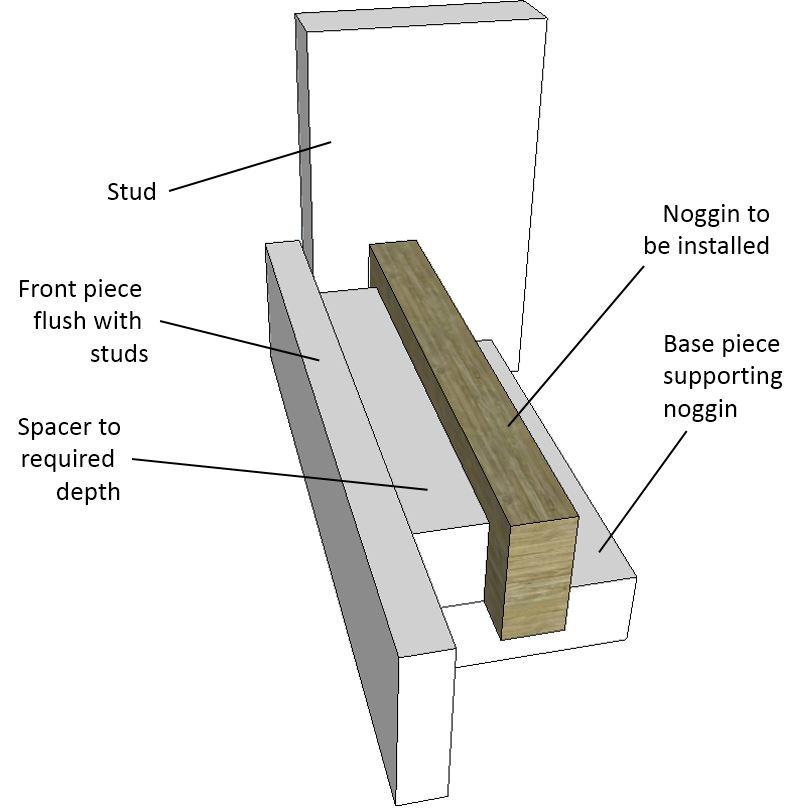
We have metal boxes throughout - my electrician was damning of plastic backboxes, but I don't know whether he'd tried the Appleby ones mentioned by @ProDave One thing I did that made things a lot easier was to knock up a jig: The front piece is held against the front face of the studs (the nearer stud is omitted for clarity), and the cut-to-length noggin dropped into place and pulled forward against the spacer. This ensures the noggin is installed square. Optionally, you can add a bit of wood to the bottom to rest on the floor or base of the studwork. Saves you holding the jig in place while you install the noggin, and ensures consistent heights without the need for a measuring tape.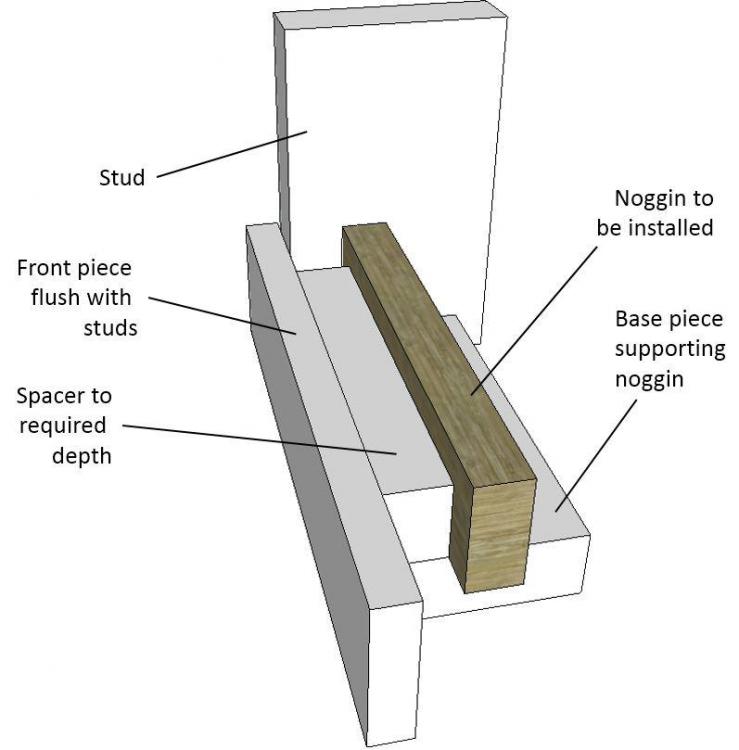
-
Take a look at shower water waste heat recovery units. I believe they provide a good number of SAP points for the cost. Also, I'm sure you know this, but you don't need battery storage to be carbon neutral across the year. You'll make way more than you can use in the summer months, and give back to the grid in winter. You just need to be a net contributor over the course of the year. I'm sure the last thing you need budget-wise at this point in time is to be spending a pile of cash on a battery system. You should, however, think about where you'd put batteries in the future, and include cabling or at least ducts for if and when you install them. One other thing: if there is a new government scheme (and I think it's unlikely with this government), how can anyone be sure that existing owners will be asked to join it? It may well be limited to installations completed after any such scheme comes in.
-
Sound, and particularly impact noise. It's something I find infuriating. There's definitely a cost implication as you still need a fully boarded floor to support the screed. So you need to add the cost of the screed to the cost of a standard upstairs floor. Just did a quick search that said £17-18/m2 for a liquid screed.
-
As discussed briefly in this thread:
-
Go on @JSHarris , sort it for them.
-
Hi @Big Neil No photos at the moment, but I used a rack from here: https://www.futureautomation.co.uk/Product/Details/LXN They're designed for use with Loxone. Not cheap, but pretty well built. It does get crowded very quickly if you wire the way Loxone suggests. You can imagine having to bring in a CAT 6 cable for every single input and output, when you're usually only using one pair from each cable (eg, you wire to a light switch, using one pair, but you bring the whole cable back to the cabinet). I don't know how people manage to keep things neat without spending a lot of money and time on termination hardware.
-
We went MBC timber frame, and arranged our own follow-on trades. I'm mostly happy with the result, but I'd do some things differently if I were to start over. If I had more money, I'd get a decent builder or project manager to run the job under my close supervision. If I had less money and/or more time, I'd consider doing more myself. Either way, I think I'd go with some form of concrete construction. Most likely this would be ICF, possibly with separately-applied external insulation. I'd insist on a screed or concrete flooring upstairs. MVHR would be the first thing I'd immediately spec in any new house. I don't think I could live in a house without it again. I'd definitely shoot for similar levels of insulation and airtightness as I have now (0.6 ACH, U-values of 0.10, 0.11 and 0.12 for the floor, roof and walls respectively). I think the Passivhaus standards in these areas aren't a bad starting point. I'd probably go for cheaper windows (we definitely overspent) and I'd make sure that the window suppliers were responsible for installation. I'd include heating in the bathrooms (one of our biggest oversights) and would provide proper cooling via the MVHR system along with the very effective floor cooling we have at the moment. I might actually move away from carpets in the bedrooms and use rugs that could be taken up in summer. That would allow floor cooling upstairs too. I'd definitely consider a basement if the site were in any way tight. I have external blinds on most windows - doing this again, I'd have even more, and despite living in a safe area, I'd make them security versions in a few key places. I'd add concealed flyscreens to bedroom windows to allow for overnight purge venting without insects coming in. I'd make sure to allow for concealed blackout blinds in all bedrooms. I'd get a lighting designer involved. While we have more than the standard ceiling warts (downlights), I'm sure a decent designer could have provided us with a much nicer result.
-
We have passivhaus levels of insulation and airtightness. When it's more than about 22 degrees, it's too warm. 25 degrees would be unbearable (although my wife, too, would be fine with that).
-
Welcome to BuildHub. Before going any further, take a look at the definition of acceptable overheating in PHPP. It actually allows for quite a lot of time spent at uncomfortable temperatures in my opinion. You can reduce the values - both the temperature defined as overheating, and amount of time you're willing to accept - in PHPP. I'd start by halving the number of hours, and knocking at least a degree or two off the overheating temp. You might be surprised by the results.
-
We have Scolmore Click Definity (screwless) in stainless. The covers have little divots in the metal along the sides to hold them in place. I find the divots more distracting than screws would have been. I'm also not crazy about the retention system - some of them more "mush" into place than "click". It does depend somewhat on the rear insert being perfectly flat, which will only be the case if the surrounding wall is perfectly flat. We have brick slips on some internal walls, and it was hard to get the rear inserts fitted flush in some of these areas. The stainless steel finish is also far more noticeable on white walls than white plastic would have been. I'd go for white if I were doing it again. I know you're planning ordinary switches, but for others, I'll share our experience of the retractive (ie, momentary contact, spring-loaded) switches we used, which were needed to work with our home automation system. For my money the mechanism is far heavier than ideal. It's hard to double-click due to how heavy the spring is, and they're quite noisy unless you're very careful. No way I'd spend the extra money on screwless switches if I were doing this all again! I think I'd go for high quality white plastic and spend the difference on something else.
-
Removal of Openreach equipment
jack replied to vivienz's topic in General Self Build & DIY Discussion
I think the point is that they aren't meant to be a consumer-accessible organisation. You're supposed to go through a phone line supplier like BT (others are available), who communicate with Openreach on your behalf. It's very annoying that it's like this. When we had our line reconnected, I wanted to talk to someone about how it would all be done, because we wanted to go underground from the pole on our land. Literally couldn't get anyone who knew anything to actually talk to me. BT assured me that they'd pass on the notes of my conversation, but of course the first engineer who turned up hadn't heard anything and (allegedly) didn't have the tools necessary to do the job. It got done in the end but would have been far simpler for everyone - and certainly less effort for Openreach - if I'd been able to have a sensible conversation with an engineer before they came onsite. -
Extra fee to PPQ for paying a planning fee?
jack replied to Mr Punter's topic in Planning Permission
I don't doubt that they're passionate about taking your fees. -
Extra fee to PPQ for paying a planning fee?
jack replied to Mr Punter's topic in Planning Permission
Where's the "I laughed so hard my head fell off" emoji? They apparently "add value" by hitting users with a £20 surcharge just for making a payment! And passionate? Really? -
The Great Thermal Mass Myth................
jack replied to Jeremy Harris's topic in Boffin's Corner
It might be a subtle point, but to me the critical starting point is that "thermal mass" has no agreed definition. Without such a definition, there's no point even considering units imo. If "thermal mass" is used as shorthand for something like "real-world structural thermal buffering capacity", then it potentially does have units - ie, the units that apply to the factors you listed above, although we still need to define how they can be combined in a way that allows comparisons. Unfortunately, many people - including architects and builders - use "thermal mass" to refer to some ill-defined combination of mass and perceived heat capacity. That's the real issue imo. -
The Great Thermal Mass Myth................
jack replied to Jeremy Harris's topic in Boffin's Corner
I know what you mean Ian. I'd personally prefer it if we got less bogged down complaining about the phrase itself. In my opinion, it would be more helpful to concentrate on the fact that the phrase is currently used as a shortcut to a poorly-defined concept or set of concepts. If there were a clearer definition, then the phrase itself would be perfectly fine. Indeed, since it's actually shorthand for a number of factors, I think it's useful to have a phrase that doesn't refer to any individual factor (okay, "mass" is in the phrase, but I don't have an issue with that given the context). It's a fact that the general public - and even the building trade - is never going to dig into the details of a multi-factorial heat-buffering model. All anyone cares about is whether the house or extension meets building regs. Hence, short of building regs changing, nothing is going to improve on this front - not linguistically and not practically. To be fair, the document talks repeatedly about the importance of insulation, airtightness and solar gain control over the course of the year. Page 3 even shows decrement delay in graph form (note the time offset of the damped temperature curve). Okay, they don't talk about high-decrement delay insulation, but other than here and a couple of other forums, I've never heard any self-builder or anyone in the building industry discuss the decrement delay of different insulation types. I'm sure that's at least partly because high decrement delay insulation is relatively expensive, takes up more room for a given U-value (compared to rigid insulation), is difficult to explain to the average person, and - perhaps most importantly - isn't compatible with current standard construction methods used by the big builders and most smaller builders.- 122 replies
-
- 2
-

-

-
- thermal mass
- heat capacity
- (and 4 more)
-
Passivhaus certified roof lights with electric opening
jack replied to joth's topic in Skylights & Roof Windows
Cool, thanks. Next question: why do you need them to be PH certified? From memory, PH-certified windows aren't a requirement even if you're going for PH certification. It's just that you get a little more leeway in the numbers (can't remember how it works for windows, but as an example, for MVHR you need to put in a penalty factor of something like 15% if the unit isn't PH-certified). If you aren't going for certification, I'd just look at the specs and make sure you're happy with them. The PH-certified product will be more expensive than the same spec non-certified, because of the fees paid to the PH Institute for certification. If you are going for certification, then it's only one window, and using a non-certified product in this position will likely make no difference to your ability to achieve certification (assuming appropriate specs otherwise). -
Passivhaus certified roof lights with electric opening
jack replied to joth's topic in Skylights & Roof Windows
What do you mean by "Passiv"? Do you mean PassivHaus certified? Is it on a flat or pitched roof? We have an electric opening quad (I think!) glazed Fakro rooflight on our flat roof. Not PH certified, but the numbers are fine. -
I absolutely love that look and was disappointed it wasn't on the cards for our build. It's definitely something I'll be insisting on for the next(!) one.
-
Passive Haus on a budget?
jack replied to bobberjob's topic in Energy Efficient & Sustainable Design Concepts
I can't tell you how disappointed I am to learn this @Ferdinand. You'd have been my "phone a friend" on a question like this. -
It - or something very like it - was posted a few weeks ago. Expensive but effective, I seem to recall.
-
Being completely honest, I think that's a worryingly optimistic budget for a house like this unless you're doing an awful lot of the work yourself. A sharp, modern building like this needs very crisp detailing and finishing or it risks not looking right, imo. Even if you choose to sell - or at some point need to sell it - cheap finishes on a house like this will put a lot of people off.
-
Passive Haus on a budget?
jack replied to bobberjob's topic in Energy Efficient & Sustainable Design Concepts
It still needs to be on the list. Our house would have been intolerable last year if we hadn't been able to cool the ground floor slab. We have external blinds on a lot of windows, but with a bit more foresight, external shading on a few more key windows would have reduced a lot of the overheating issues we face. -
Passive Haus on a budget?
jack replied to bobberjob's topic in Energy Efficient & Sustainable Design Concepts
You couldn't pay me enough to have that plaque on view anywhere in my house. From logo to colours to font selection to layout, I can't imagine how it could be made any uglier. Edited to add:
-
Passive Haus on a budget?
jack replied to bobberjob's topic in Energy Efficient & Sustainable Design Concepts
All up? That really surprises me. As you say, the architect's particular situation is probably contributing to the cost being lower, but that seems to be a fraction of the cost I'd expect for full certification. It's been a long time but I'm sure we were expecting to pay three or four times that amount (including all modelling and inspections, etc), not taking into account the cost of more expensive hardware such as a PH-certified MVHR unit.