

.jpg.c21f3ac78c9b7efd90cbdcb312744dc5.jpg)
jack
-
Posts
7462 -
Joined
-
Last visited
-
Days Won
41
Everything posted by jack
-
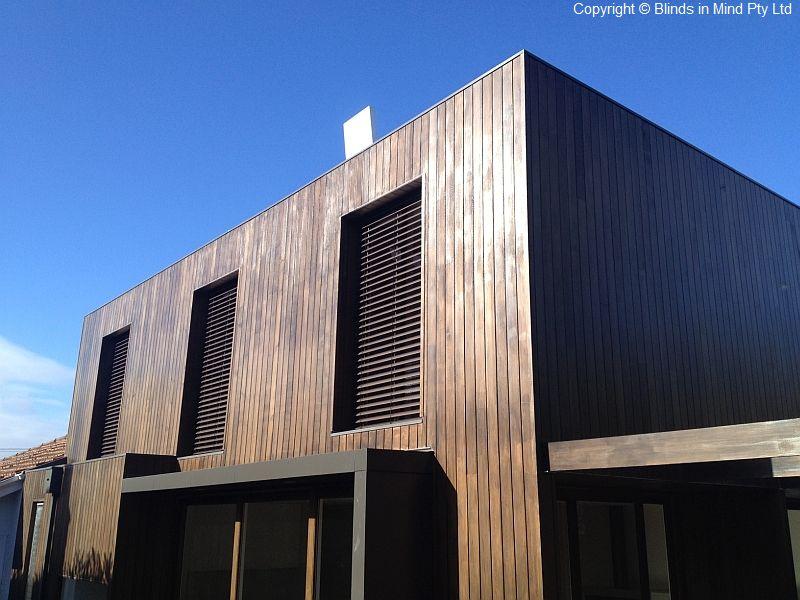
I don't really share pics of my house on t'internet, but they look something like this (albeit with horizontal larch cladding, and with the windows/blinds recessed about another 400mm inwards): In the white-painted brick sections of the house, they're set back about as much as in the photo above. As shown in this photo, you don't need to close the blinds completely to get most of the benefit. I prefer them slightly open like this, and only close them when it's very hot and the sun is directly on them, and at night. I think they look "elegant", as you put it, but our house is extremely modern, so I think it works. I can't see how awnings are a replacement for some sort of per-window solution like blinds or roller shutters in all but very limited areas. There are about three places in our house where some sort of awning might work. One of those is outside a big south-facing slider, but the height of the slider means that the awning would need to be huge to keep out the spring and autumn sun. We're lucky to have a tree that provides some shade in this area, so for the moment we don't have any shading treatment on that opening. The other two points have 1.2m overhangs due to balconies above them, so already have a decent bit of solar control. They also have blinds, which helps on summer mornings (they're east-facing). I can't see how awnings are a solution for first floor windows, windows along the side of a property or street-facing windows. If you don't much like the look of blinds, that's fine - just leave them fully retracted (they're invisible) unless you actually need them.
-
They're the company I've been looking at for the retrofit. Happy to hear anyone's experiences with them.
-
Ours are extraordinarily good at keeping the sun out. We have several large west-facing windows with external (uninsulated) aluminium venetian blinds. When they're down, there's no perceptible radiant heat, even with the western sun beating on them on a hot day. I don't doubt that some heat gets by, but it isn't particularly noticeable. Even fully closed, there're 5-15mm gaps at the sides, plus the holes for the guides and small gaps between the slats themselves, which I'm sure allows some of the heat between the window and blind to escape. Another thing is that they're quite useful for privacy. We very rarely retract the ones at the front of the house, because they help stop people seeing in. Something I didn't expect is that we quite like the look of the house when the blinds are down but open. They add to the look of the house imo. One thing they aren't at all good at is blocking out all light. On east-facing windows particularly, enough of the early morning sun in summer gets through the gaps at the slat edges, and even the holes for the guides, to make the room noticeably bright from very early in the morning. We mistakenly made no provision for recessed internal blockout blinds or curtains, thinking we wouldn't need them. This is the main disadvantage of this particular type of blind imo (that and the fact they provide literally zero security, since you can just lift them up like ordinary venetian blinds.
-
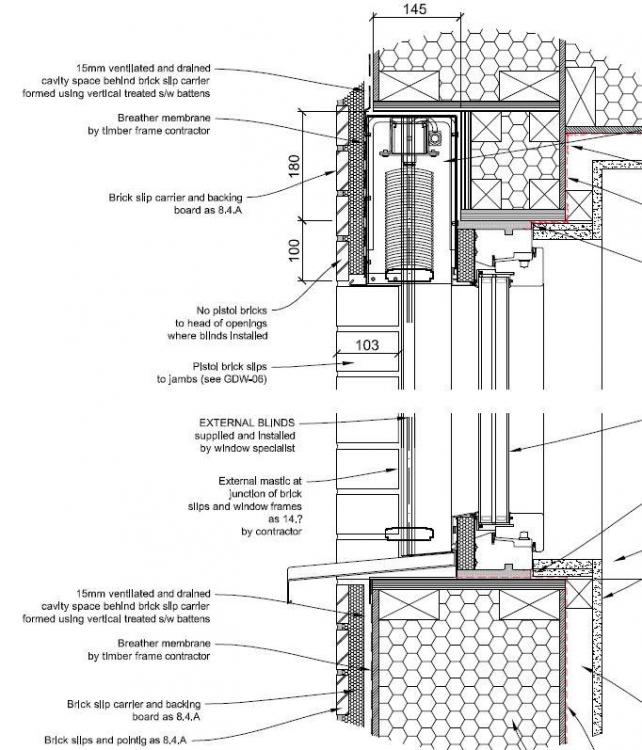
Ours aren't Gaulhofer, but the detail is probably similar. This is what we have where the house has brick slips on render board over a timber frame with cellulose insulation, and external venetian blinds:
-
Do you have any vertical sections through your windows?
-
I'll be interested in the answer to this, as I have two windows that I'd like to retrofit something like these to. Doesn't the French supplier have tech drawings they can give you?
-
Short answer: no. While I love hifi and home cinema, I just couldn't justify the extra costs of doing properly. That said, were I to build again, I'd spend more time on soundproofing the TV room and probably make it a bit bigger. I did put speaker cable into the walls, but only for 4 channels (on the assumption that wiring for a subwoofer and centre channel could be hidden behind furniture at the front of the room). Still haven't wired anything up - time and money yet to be allocated!
-
.jpg.c21f3ac78c9b7efd90cbdcb312744dc5.thumb.jpg.7adcad4c0e384f5ecd7d56b0618df6e5.jpg)
Bi-folds/Slide and Turn Patio Doors in a New Build
jack replied to Tony99's topic in Windows & Glazing
We have a 5.4m slider, and to be honest I'd rather have gone for a pair of wide French doors in the middle with horizontal windows along the rest of the space. In our case, such a large window drastically limits our options for furniture placement. That may not be an issue for other layouts. -
We use floor cooling downstairs during really hot periods, so for us stack cooling is all about bedrooms. We have a large centrally located electric skylight. Opening windows in the bedrooms does result in some air movement via the stack effect, but it feels to me that cross-ventilation is much more effective unless there's no air movement at all. It very much helps to open the windows as soon as the temperature outside drops below the internal temperature. Insects are the main issue with this strategy, and if I were doing this all again, I'd include retractable insect screens on the bedroom windows.
-
Our entire downstairs is open plan, with a 2.4m wide hallway straight through to the kitchen/dinner from the front door (which is a metre wide and 2.5 metres tall). There's almost no draft or heat loss if you open the front door. However, I think that's largely because the house is so airtight that there's nowhere for air to go. If you're planning to build airtight, I suspect it won't be a big issue.
-
Must be worth a DMCA complaint to the host company by now?
-
Scratches very easily and stains like a mofo (at least the white stuff we have on one surface does). So much for it being the requested maintenance-free, hard-wearing option for beside the sink!
-
VHS or BETAMAX the battle of two technologies relived.
jack replied to MikeSharp01's topic in Boffin's Corner
"Compression" in this context is waveform compression rather than data compression. Look up "Loudness War". -
VHS or BETAMAX the battle of two technologies relived.
jack replied to MikeSharp01's topic in Boffin's Corner
Aside from the practical difficulties and risks of using such an explosive substance as a fluid fuel source: https://www.roadandtrack.com/new-cars/car-technology/a25712588/why-dont-we-burn-hydrogen-instead-of-gasoline/ See also: https://en.wikipedia.org/wiki/Hydrogen_internal_combustion_engine_vehicle -
Features that are hard to add after the build is finished
jack replied to puntloos's topic in New House & Self Build Design
It's more that I'd consider providing additional cable to give more flexibility for locating things that need it. Classic example is the kitchen. We always resisted the idea of a kitchen TV, but installed an aerial outlet, power and 2 x CAT 6 cables in the most likely location in case we changed our mind. We did change our mind, but now that we think about it a little harder, I'm not sure that the current location is ideal. There's actually a better place, but no cables of any sort near it, so we're stuck with the original location. Same with our music streamer/radio. We've ended up moving it somewhere in the kitchen that makes a lot if sense, but only because there's a small side table there that we hadn't planned for. We now have to use wireless, and unfortunately this is at the very end of the house furthest from the wireless router. Fine most of the time, but it cuts out when the microwave is on! Again, there's no CAT cable anywhere near this new point. Of course, you can't predict where you need this sort of thing, and you need to draw the line somewhere. If I were doing this again I'd probably aim for two cable drops to each of the two most likely areas in each room that's likely to want an AV source. I have four CAT 6 cables behind the TV and another four where the small TV is in the lounge, and that seems to be more than enough at the moment. -
Features that are hard to add after the build is finished
jack replied to puntloos's topic in New House & Self Build Design
If you only need a small digger, some have retractable tracks that make them narrow enough to squeeze through doorways. We had one onsite yesterday digging a 40m long, 400mm deep trench, including getting through 100mm of compacted concrete crush along at least half the length in some places. There were also lots of large rocks in places, which took time to dig out. It took about five hours, with me wheelbarrowing away the spoil. A larger digger would have been better and faster, but unless you're moving a lot of earth around, this might be enough. -
Nails, silicon bronze, or stainless steel
jack replied to Russell griffiths's topic in Building Materials
Sorry @iSelfBuild, I suspect I and another mod have accidentally deleted different duplicates of your wooden nail posting at roughly the same time, leaving you with no post at all! Please post again and I'll delete this message. -
Features that are hard to add after the build is finished
jack replied to puntloos's topic in New House & Self Build Design
I installed a fair amount of redundant CAT 6 cable, but given my time again I'd add even more. I'd also include more ducts between important areas (eg, TV room) and our central wiring point. -
DHW and Heating Options for Passive House
jack replied to Conor's topic in Boilers & Hot Water Tanks
Have you asked her what the point is in having a fire you literally can't light? Take a look at that Grand Designs episode in Bath. That was a well-insulated, but not to PassivHaus standard, German prefab. They tried to talk the owner out of a woodburner but she wouldn't be convinced. Lit it once, never lit it again. You say it's in the budget, but if you never use it, you've still effectively thrown thousands of quid away. Why not spend that money on a heating system? I also don't get the general obsession people have with burning stuff in their houses (I didn't get it even before the health and environmental risks were known). I think it's often a hangover of living in cold drafty houses, where standing in front of a fire or woodburner is the only way to get properly warm. That feeling of never properly being warm won't happen in your house. The desire to stand in front of a hot woodburner just goes away when the whole house is a nice temperature. As for heating with post heaters only, we have PH level insulation and airtightness, but not a lot of solar gain. I turned off the heating in the hot spell a couple of weeks ago, and the slab has slowly cooled down. It reached 18 deg C the other day and the house was definitely feeling a little frostier than desirable. Much of the perceived coldness was due to the cold floor - it's much more comfortable if you put shoes on. I wouldn't be without UFH now I've lived with it. -
DHW and Heating Options for Passive House
jack replied to Conor's topic in Boilers & Hot Water Tanks
My first thought is that you don't want to spend money on a heating system, but you want to install a wood burner? How much will that cost to supply and install, including sealed air system, flue, heat-proofing etc? You say you won't use it much. In a house with passivhaus levels of insulation and airtightness, I suspect you'll use it once and then never light it again. They're also hugely unhealthy for you and your neighbours. Definite yes to low temp UFH in the bathrooms. We were talked out of bathroom heating and it was a mistake. Tiles at around 19-20 deg C are quite cold on the feet. I don't know how much warmer tiles would be with just a radiator. Maybe fine - others will share their experiences. Do keep thinking about overheating (I know it was discussed on your other thread). It may be something as simple as placing ducts and wiring for a ducted aircon system for the bedrooms, which you can retrofit if you find you need it. At the moment you have an estimated 4% above 25 deg C. That's 350 hours per year, which is actually quite a lot (bearing in mind you'll be spending a lot more time above, say, 22-23 deg C, which is still subjectively very warm in a PH environment). Is this before you account for brise soleil etc? -
I agree with every word of the first response in this thread. We didn't want the "line of stools" approach, so the dining table side of the island is cupboards and shelves along two thirds of its length. The remaining third is completely open on both sides (and closed on the end by a vertical support), so four people can sit comfortable facing each other without banging their knees. There are double power points underneath this section that can't be seen, but are easy to get to from both sides - good for plugging in a phone or a laptop (on the table side), or a kitchen mixer. We have the hob on the island and the sink against the wall behind and slightly offset so both can comfortable be used without standing back to back. It's planned so that you walk into the kitchen from one side with plates etc, scrape into the bins in the cupboard on the left of the sink, rinse if needed, then load into the dishwasher immediately to the right of the sink. Cups, glasses and crockery can all be put away from the dishwasher without any movement other than bending and pivoting. We've lived in the house for over three years, but it took us over two years to find stools we didn't hate that were the right height for the space under the island. Since getting them, we hardly ever sit at the dining table any more. It just seems more social to sit up at the island. In fact, we had a couple of friends over last night for supper. We all sat at the island with drinks and nibbles while dinner was being made, then it just seemed natural to stay where we were rather than moving everything over to the table. Obviously we're limited to doing this when there are only four people eating, but that often works out just fine. You do need to be scrupulous about not letting junk accumulate (we don't really manage it), but to be fair this is going to be a problem with all horizontal surfaces in a kitchen.
-
Save the world, install an LPG tank.
jack replied to epsilonGreedy's topic in Environmental Building Politics
Of course it could have. In the automotive would, smaller, less powerful cars would have helped, but there were easy wins across all industries and scenarios that just weren't taken up. -
I think he's taking about sheet wood insulation products like the one @ProDave used.
-
Save the world, install an LPG tank.
jack replied to epsilonGreedy's topic in Environmental Building Politics
I'd put is slightly differently and say that if people had listened and acted 20 years ago when the concerns started being raised, we'd all be completely used to it now and the impact on the world economy would have been absorbed and dealt with. But now, the amount that needs to be done is much greater. With the world economy already in a parlous state (despite record share indices and employment rates), doing what actually needs to be done risks shocking us into another great depression. If that's what you're saying, then I have some sympathy. But I also think the world economy is headed for the toilet at some point in the next 1-10 years anyway, and if this isn't the trigger, something else will be. I also don't share your pessimism about the models. You also seem to believe that the concept of consensus among scientists rests on a single study (I assume Cook et al.), but that was only one study from 2013. The claim for consensus is at least a decade older than that and is based on many more studies of varying types. I don't generally rely on Wikipedia for anything other than factual information, but these pages: https://en.wikipedia.org/wiki/Scientific_opinion_on_climate_change https://en.wikipedia.org/wiki/Surveys_of_scientists'_views_on_climate_change seem to list loads of studies, all of which show at least some degree of scientific consensus. Where the real questions lie is in what impact AGW will have in the coming decades. Even though there's consensus that AGW is real and some sort of threat, there's a range of estimates about how that threat will manifest itself. And of course, we could have some sort of mega-eruption that releases huge amounts of CO2 that swamps anything we've done. We could also have some sort of asteroid strike or eruption that releases tons of particles into the air, causing global cooling. But neither of these possibilities is predictable or can even be assumed will happen in the coming decades or even centuries. -
I'll tell you what's a nice sensation: coming into the house in the middle of summer after walking the dog on a baking hot day, taking your shoes off and walking on a concrete floor at around 19-20 degrees C. It's the sort of cool you get when you walk into a cave or a cathedral.
.jpg.c21f3ac78c9b7efd90cbdcb312744dc5.thumb.jpg.7adcad4c0e384f5ecd7d56b0618df6e5.jpg)


