

.jpg.c21f3ac78c9b7efd90cbdcb312744dc5.jpg)
jack
-
Posts
7462 -
Joined
-
Last visited
-
Days Won
41
Everything posted by jack
-
Ah yes, the skin effect. Beloved pseudo-scientific explanation of audiophiles who believe spending thousands on interconnects or (worse) power cables with the same resistance, capacitance and inductance as the components they're replacing will somehow "lift a veil" off the sound of your system. From memory, the contribution of the skin effect even at thousands of kHz is negligible.
-
I don't think battery storage is worth it with 2.5kW of PV. I'd pay the £7k and get a grid connection.
-
My only thought is that I don't have sufficient knowledge about any of this to give you advice - sorry! ?
-
Just as a point of comparison, we have 8.5kW of PV and there are often days in a row in winter where we generate sod-all power. Generator backup will help your electricity needs, but it's an expensive and inefficient way of heating water. Could you add oil or bottled gas to supplement your water heating needs when the sun doesn't shine?
-
.jpg.c21f3ac78c9b7efd90cbdcb312744dc5.thumb.jpg.7adcad4c0e384f5ecd7d56b0618df6e5.jpg)
Do people really not realise this?
jack replied to Jeremy Harris's topic in Networks, AV, Security & Automation
While I agree with most of what's been said in this thread, as I understand it this isn't what these companies do (at least in terms of what they say they do, and I'm not aware that anyone has yet detected transmission of audio when it isn't supposed to be being transmitted). I understand that they buffer audio locally and continually scan for an initiation phrase ("Okay Google", "Alexa", or whatever). When the phrase is detected, the audio from just before that phrase, and for some time afterwards, is streamed to their servers where speech recognition is applied. It's that audio that's stored. I'll admit that I don't know how long this streaming goes on for - you'd hope just long enough to identify a valid request. In the case you reference above, the police were not expecting evidence in the form of general conversation throughout the evening, or the sounds of the murder. They were hoping for incriminating search terms, and even better the audio of a voice requesting an incriminating search. I can imagine that this could be powerful evidence if it existed, because unlike a keyboard search, there's no question who was involved (there were several people in the house the night of the death I believe you're referring to). Of course, whether big companies can be trusted to do only what they say they'll do is another question. In some ways I trust very big companies more, because it's harder to keep a secret when you're massive and there are potentially hundreds of people involved in any particular project. For example, I believe Google is being looked at at the moment to see whether they continued location tracking when users turned that feature off. That said, I won't have one of these devices anywhere near me, despite how useful they are. Worse, my brother in law bought us one of these the Christmas before last. I thought it was an odd gift, but then I'm surprised how little people know and/or care about all this stuff. I don't think all executables are apps though. To me, "app" suggests a program optimised for doing only one thing. The BBC weather app is an app. A banking app is an app. A web browser isn't an app, because it's a general-purpose application. More importantly, the main alternative would be "program" (civvies don't use "executable"). The phrase "Have you seen the new BBC weather program?" is ambiguous, because the recipient doesn't know whether you're talking about the TV or software. So to me it's less trendy and more an example of the English language adapting as it always does. -
3 metal silos and one new build and one conversion
jack replied to hallega's topic in Introduce Yourself
One of the most stunning conversions in architectural history, and one of my favourite buildings of all time. -
3 metal silos and one new build and one conversion
jack replied to hallega's topic in Introduce Yourself
Welcome. What an exciting project! -
VAT or no VAT
jack replied to Yvonne's topic in Self Build VAT, Community Infrastructure Levy (CIL), S106 & Tax
Sorry, did my answer on my phone and completely missed the reference to MVHR! -
VAT or no VAT
jack replied to Yvonne's topic in Self Build VAT, Community Infrastructure Levy (CIL), S106 & Tax
It's a service, so VAT is chargeable and not reclaimable. -
That Roofers Been Signed Off Sick
jack replied to Triassic's topic in General Self Build & DIY Discussion
Benign positional vertigo. I had this about 25 years ago and it was horrible. If it's related to debris in the fluid of the balancing circuits, there's a sequence of rotations you can do that bring relief, basically by moving the debris to a stable position in the circuit. I think mine was just some inflammation due to a virus - the overwhelming sensation that you were moving when you clearly weren't was horrible. Exactly like being drunk to the point where you can't lie down because the room is spinning (what was it Dean Martin said? You're not really drunk if you can lie on the floor without holding on). -
That Roofers Been Signed Off Sick
jack replied to Triassic's topic in General Self Build & DIY Discussion
Is he able to come onsite and supervise/advise someone else doing the work? You could pay him something for his presence, which would help him out. Depends on whether you're able to get another roofer (or general builder) cheaply enough, and who's willing to work under such supervision. -
Where does your water come in? If it comes into the plant room, consider locating your water softener in here.
-
Never getting Building Control signoff.
jack replied to epsilonGreedy's topic in Building Regulations
Insurance is likely to be more difficult - maybe even impossible? -
Welcome Roger. As I'm sure you'll have seen, we have all types of building methods in use. Brick and block, timber frame, insulated concrete formwork, with all sorts of insulation types. The general mantra is more insulation than building regs require (high decrement delay preferred) and much better airtightness. Do you plan to do much of the work yourself?
-
Grand Designs Gravenhill - Budget vs Reality
jack commented on Ferdinand's blog entry in God is in the Details
Our house is very modern. Other than one other on a private road half a mile away, I think it's literally the only house with a flat roof for miles. According to an estate agent friend, it's modern enough to put off a lot of people, but the minority who would want to live in it will be willing to pay a significant premium. Haven't tried that theory out yet! It doesn't hurt that we lucked into the catchment area of two of the country's best state schools. There's very little housing turnover, so even when the market is slow, decent family homes on reasonable plots tend to sell when they come up. -
Grand Designs Gravenhill - Budget vs Reality
jack commented on Ferdinand's blog entry in God is in the Details
We bought a tiny (89m2) bungalow for just under £500k in 2012, and knocked it down to rebuild. This is Hampshire/Surrey borders <60 mins on the train to London. It seemed expensive and a risk at the time, but with hindsight we got very lucky. No way the sums would work out doing something similar now. -
Back boxes and noggins (these are a few of my favourite things)
jack replied to ToughButterCup's topic in Electrics - Other
We have metal boxes throughout - my electrician was damning of plastic backboxes, but I don't know whether he'd tried the Appleby ones mentioned by @ProDave One thing I did that made things a lot easier was to knock up a jig: The front piece is held against the front face of the studs (the nearer stud is omitted for clarity), and the cut-to-length noggin dropped into place and pulled forward against the spacer. This ensures the noggin is installed square. Optionally, you can add a bit of wood to the bottom to rest on the floor or base of the studwork. Saves you holding the jig in place while you install the noggin, and ensures consistent heights without the need for a measuring tape.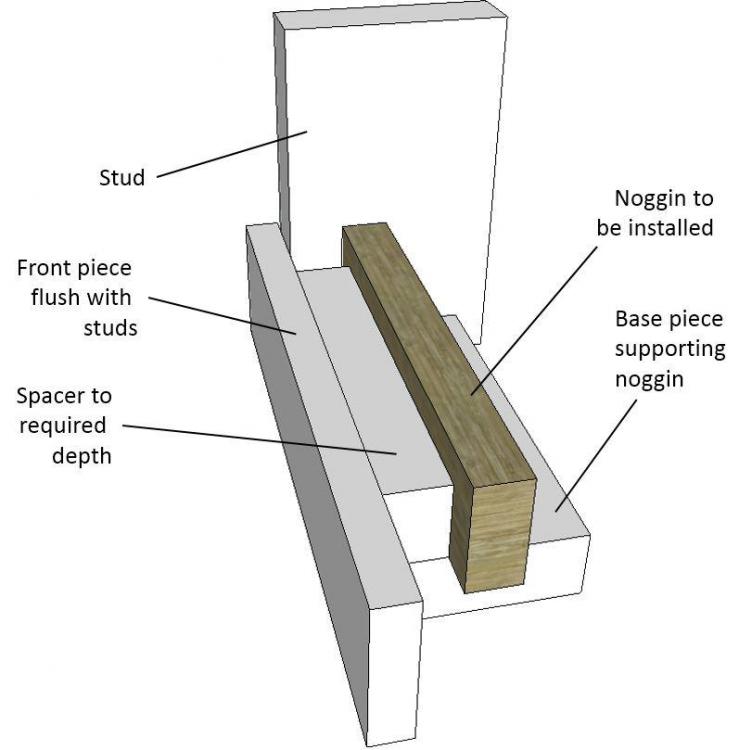
-
Take a look at shower water waste heat recovery units. I believe they provide a good number of SAP points for the cost. Also, I'm sure you know this, but you don't need battery storage to be carbon neutral across the year. You'll make way more than you can use in the summer months, and give back to the grid in winter. You just need to be a net contributor over the course of the year. I'm sure the last thing you need budget-wise at this point in time is to be spending a pile of cash on a battery system. You should, however, think about where you'd put batteries in the future, and include cabling or at least ducts for if and when you install them. One other thing: if there is a new government scheme (and I think it's unlikely with this government), how can anyone be sure that existing owners will be asked to join it? It may well be limited to installations completed after any such scheme comes in.
-
Sound, and particularly impact noise. It's something I find infuriating. There's definitely a cost implication as you still need a fully boarded floor to support the screed. So you need to add the cost of the screed to the cost of a standard upstairs floor. Just did a quick search that said £17-18/m2 for a liquid screed.
-
As discussed briefly in this thread:
-
Go on @JSHarris , sort it for them.
-
Hi @Big Neil No photos at the moment, but I used a rack from here: https://www.futureautomation.co.uk/Product/Details/LXN They're designed for use with Loxone. Not cheap, but pretty well built. It does get crowded very quickly if you wire the way Loxone suggests. You can imagine having to bring in a CAT 6 cable for every single input and output, when you're usually only using one pair from each cable (eg, you wire to a light switch, using one pair, but you bring the whole cable back to the cabinet). I don't know how people manage to keep things neat without spending a lot of money and time on termination hardware.
-
We went MBC timber frame, and arranged our own follow-on trades. I'm mostly happy with the result, but I'd do some things differently if I were to start over. If I had more money, I'd get a decent builder or project manager to run the job under my close supervision. If I had less money and/or more time, I'd consider doing more myself. Either way, I think I'd go with some form of concrete construction. Most likely this would be ICF, possibly with separately-applied external insulation. I'd insist on a screed or concrete flooring upstairs. MVHR would be the first thing I'd immediately spec in any new house. I don't think I could live in a house without it again. I'd definitely shoot for similar levels of insulation and airtightness as I have now (0.6 ACH, U-values of 0.10, 0.11 and 0.12 for the floor, roof and walls respectively). I think the Passivhaus standards in these areas aren't a bad starting point. I'd probably go for cheaper windows (we definitely overspent) and I'd make sure that the window suppliers were responsible for installation. I'd include heating in the bathrooms (one of our biggest oversights) and would provide proper cooling via the MVHR system along with the very effective floor cooling we have at the moment. I might actually move away from carpets in the bedrooms and use rugs that could be taken up in summer. That would allow floor cooling upstairs too. I'd definitely consider a basement if the site were in any way tight. I have external blinds on most windows - doing this again, I'd have even more, and despite living in a safe area, I'd make them security versions in a few key places. I'd add concealed flyscreens to bedroom windows to allow for overnight purge venting without insects coming in. I'd make sure to allow for concealed blackout blinds in all bedrooms. I'd get a lighting designer involved. While we have more than the standard ceiling warts (downlights), I'm sure a decent designer could have provided us with a much nicer result.
-
We have passivhaus levels of insulation and airtightness. When it's more than about 22 degrees, it's too warm. 25 degrees would be unbearable (although my wife, too, would be fine with that).
-
Welcome to BuildHub. Before going any further, take a look at the definition of acceptable overheating in PHPP. It actually allows for quite a lot of time spent at uncomfortable temperatures in my opinion. You can reduce the values - both the temperature defined as overheating, and amount of time you're willing to accept - in PHPP. I'd start by halving the number of hours, and knocking at least a degree or two off the overheating temp. You might be surprised by the results.
.jpg.c21f3ac78c9b7efd90cbdcb312744dc5.thumb.jpg.7adcad4c0e384f5ecd7d56b0618df6e5.jpg)



