

Ed Davies
-
Posts
1674 -
Joined
-
Last visited
-
Days Won
1
Everything posted by Ed Davies
-

Off the shelf non vented roof windows
Ed Davies replied to vivienz's topic in Skylights & Roof Windows
My house is currently specced as Velux but I looked into changing to Fakro to get rid of the vents. But AFAICS you could get them without vents but only on the lower spec 2G windows which seems back-to-front, it's people who're buying the higher spec windows who'd want to leave it to the MVHR. E.g., on the page @PeterStarck links to the only variant without the vent is the FTP R1 which is 2G 1.3 W/m²K as opposed to the FTP-V P5 which 3G 0.97 W/m²K with the vent. Or can you specify FTP P5 (without the “-V”), and get triple glazing without the vent, even though that's not listed there? -
Help with kitchen renovation/ 1st house.
Ed Davies replied to zoothorn's topic in Bathrooms, Ensuites & Wetrooms
It's mildly amusing to speculate what goes to the switch. Black = line, red = switched line, no earth? Or is this on two-way switches? -
My planning permission and warrant were issued with plans for a wooden ramp with no problem other than quibbles about the length and need for a rest place along the way. Actually, it's finished up with the floor level closer to the parking ground level than the plans assumed so the final ramp will be a lot shorter and straighter anyway. I'm thinking of having a drawbridge ? I can see why they want as many homes as possible to be wheelchair accessible. Partly a matter of keeping people out of the NHS. Also it's not just for people living there but also for random visitors. I do think the obsession with very flat access (10mm thresholds, etc) is a bit much - if you can't get over something, say, 30mm high then you probably couldn't get to the house in the first place. Also, the idea that disabled == wheelchair is a bit silly, there are plenty of other problems people can have with vision, balance, dexterity, etc, that would be helped by a bit of careful design (or, more often, harmed by thoughtless design).
-
@Ferdinand's link says: I know what Class II is (double insulated, doesn't need earthing) but what's Class III? SELV?
-
For my building warrant application the house designer included boiler-plate text like the following: presumably because building control would whine if something of the sort wasn't there. So perhaps the failure to document isn't just a personnel/contractual matter but also a building regs matter.

-
Presumably those tankless heaters will need their own circuit from the CU, though? Like an immersion or cooker circuit. Or would an FCU be sufficient?
-
Pitched roof thickness and insulation
Ed Davies replied to Moonshine's topic in Roofing, Tiling & Slating
Generally you want about 50mm of ventilation under the outer rainscreen (tiles in your case). For my roof that'll be made up of 38x12 counterbattens with 38x50 battens across. Both widest face up/down, of course, so total thickness = 12 + 38 = 50mm. Not sure why it's not 25+25 other than, I speculate, that the battens take the weight of the rainscreen crosswise and are only nailed at the counterbatten spacing so need to have as much wood as reasonably possible wrapped round the nails. -
Yes, that points very strongly to it being for the immersion. Watching the electricity meter should give a hint, too, as the 3 kW or so draw of the immersion should be noticeable on the LED or LCD display thingy which flashes every 1/100th of kWh or so. I was just saying why a timed pump for the tap wasn't quite a loony as @lizzie seemed to think.
-
Could, conceivably, be a circulation pump so hot water is available at taps quickly. Taps would still supply hot water when it's off, you'd just have to run off more cold water before it arrived.
-
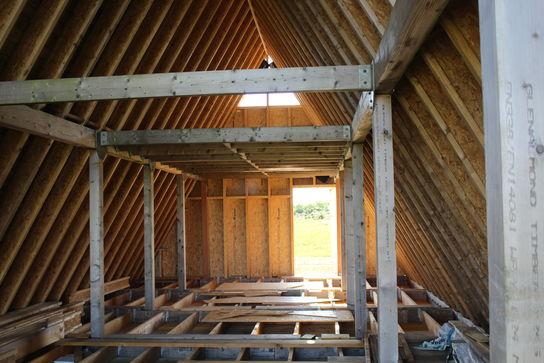
The PDF contains two images from a SketchUp sketch. There's a photo in my profile header of what exists so far in reality, not enough to help with this. As @JSHarris says, the problem with polythene is sticking to it. My plan is to overlap across the I-beams, staple and tape those then rely on the mechanical fixing of the PIR to keep it sealed.
-
i think it depends on how vapour open the outer layers of the build up are. If they allow the wall/roof to dry out easily then polythene on the inside is fine. If they put up a bit more resistance to water vapour then you need to be able to also dry out inwards into the house. My roof build up as specified for the building warrant: Perihelion Roof Buildup.pdf
-
They're two different functions which may or may not be combined in a single layer. The vapour control layer goes on the warm side (inside in the UK) to prevent water vapour getting into the wall/floor/roof and condensing there which would make them go black and slimy. There's really a need for two airtight layers. Firstly you need some sort of barrier on the outside (the wind-tight layer) to stop the wind blowing into the insulation and carrying heat away. It should be decent but doesn't need to be completely airtight. Also, for more modern builds you need a properly airtight layer somewhere in the build-up to prevent warm air in the house being lost through draughts. Also, you need some sort of layer on the outside to prevent liquid water which gets past the outer rainscreen or condenses on the back of it from getting into the structure. Typically for timber frame you have a “breathable” membrane on the outside which serves to prevent liquid water getting in but allows water vapour out and also serves as a windtight layer. Then there's a layer on or near the inside which provides airtightness and the vapour barrier. Intelligent membranes go on the inside and are supposed to stop water vapour from the house getting into the wall/roof while, somehow, allowing any water which does get into the wall/roof to evaporate out into the house as water vapour. I don't know any more about them. Anybody?
-
Does the Sunamp help track its heat content? I.e., does it have any electronic output which tells you what percentage of its capacity is in use?
-
Energy monitors don't need an app. They'll have their own displays with cumulative kWh used, etc.
-
I'm assuming a reasonably well-insulated house (above building regs) and hence a fairly small ASHP. The only time I can imagine it would make sense to use an immersion in the buffer tank would be if the PV is producing only a trickle of power, a lot less than the ASHP needs, and the Sunamp is full. Seems a bit of a marginal case. Most of the time it's a balancing act, how much of the available output of the PV to feed to the ASHP → buffer tank → slab and how much to the Sunamp. Presumably you wouldn't worry about doing both at the same time as that'd only work when the PV's producing close to peak power which will only happen for long on days when space heating isn't an issue and there's plenty of heat for DHW. Similarly, in January the PV isn't going to provide much towards your heating requirement, most will have to come from the grid anyway so not worth worrying about (other than thinking whether or not economy 7 or the like makes sense). So, what you're trying to do is get the right mix in the shoulder months. There's a certain amount of electricity that'll be needed, some will come from the PV and the rest will come from the grid. I guess, then, that the objective is to minimize the amount that comes from the grid. That'll depend on the capacities of your heating systems. E.g., does the Sunamp have just a day's worth of DHW or multiple days? Does that vary depending on guests, kids being at home, etc? Does the house cool down significantly in a day or can it be left for a couple of days. The failure would be starting a sunny day with the house as warm as is comfortable and the Sunamp full. You want to leave some storage capacity (Sunamp and slab) to use sunshine when it's available. Not an answer, I know, but hopefully a useful way of looking at the question.
-
DIY electrical work in downstairs toilet?
Ed Davies replied to 8ball's topic in Electrics - Kitchen & Bathroom
You can put a wall switch pretty much anywhere in the house except in the zones around the bath or shower or other special places like saunas. This includes in a bath or shower room outside the zones. No controversy at all for a cloakroom like that. There's no zone round the toilet or, contrary to some diagrams on the web, the basin. The only catch I can see if BC or anybody wants to be stroppy about it is that equipment should be specified by the manufacturer to be appropriate for the location. Looking around at specs from various manufacturers I couldn't find any that explicitly say they're OK for bath/shower rooms. -
Yep, probably not the right day to be fit checking the 6013 mm central stud for my east gable which I cut just before the rain arrived yesterday. 24 knots and increasing at Wick airport.
-
Ah, OK. I didn't have a lot. Three or four pieces about 1.5 metres by 0.3 metres as I remember it.
-
Can't you just take them to the right tip? There were some bits of corrugated roofing in my back garden in High Wycombe, which I think neighbours had thrown over years before and only came to light when I cleared some undergrowth, that I took to the local tip. Nope, they said, asbestos, take to the tip in Amersham. Amersham tip had a special box for them. They wanted them double bagged first but took them for free.
-
Option 2.5 (as I suggested before)? I.e. remove the membrane and ply then start again from there? I too would think creating a cavity would be a bad idea. Thought you could get insulation with the appropriate slope already cut? Seconds and Co used to have lots of it because people had it cut to specific (wrong) sizes.
-
All Electric House & DEAP (SAP-UK)
Ed Davies replied to mike2016's topic in Energy Efficient & Sustainable Design Concepts
Isn't there a thing about the assumed CO₂ intensity of grid electricity being brought down at some point soon? Sometime next spring? Don't remember. That'd make it easier to comply. -
Not so easy, apparently; Pocster wrote: Need a slim plumber. Tricky.
-
But, as ProDave says above, the blockage is likely above your toilet. Can you see the top of the soil pipe outside the building (on the roof)?
-
In England. OP is in Glasgow. AIUI in Scotland you'll always need detailed plans for a warrant.
-
Splitting into two lighting circuits (whether actually rings or not) so light can be “borrowed” if one trips seems a good idea. I have similar plans with the open-plan living room/study split between the two circuits and the hall (with the consumer unit on the side) on one but with all the rooms which open on to it on the other. Main loft with all the off-grid gubbins will have two lights, one on each circuit. It's probably sensible not to mix the two circuits in a switch gang so that'll likely result in more switch units on the wall than otherwise would be obvious.

