

Ed Davies
-
Posts
1674 -
Joined
-
Last visited
-
Days Won
1
Everything posted by Ed Davies
-

Building over a long period - Thoughts?
Ed Davies replied to soapstar's topic in General Construction Issues
Regarding CO₂ monitors https://www.gov.scot/Topics/Built-Environment/Building/Building-standards/techbooks/techhandbooks/th2017domenviro 3.14.2. As I say, it's something I'll be doing anyway so I've not taken any more interest than reading that. PS: I'll start another thread for any more discussion rather than derail this one. -
Building over a long period - Thoughts?
Ed Davies replied to soapstar's topic in General Construction Issues
Had my warrant extended by 9 months then another year (till October 2019) but the BCO did warn me that if I need another extension it'll need to be to new regulations “where practical”. AFAIK the only change that would affect my house would be the requirement for a logging CO₂ monitor [¹]. The BCO couldn't think of anything else which would matter off the top of his head, either. [¹] Actually, I already have a logging CO₂ monitor but whether my ESP8266 + Raspberry Pi setup which logs that as well as other parameters will be considered acceptable is another question. -
STROMA certification.
Ed Davies replied to TheMitchells's topic in Regulations, Training & Qualifications
I couldn't disagree more. Trying to remember arbitrary numbers is a waste of brain power and very unreliable; they should be looking things up on site and starting by doing so for the exam is probably a useful part of the training. It's what the On Site Guide exists for, for the common cases. Airline pilots have only a few very short checklists they're required to remember (engine failure on take off procedures and other actions which need to be done quickly); everything else is done from the book (or tablet nowadays). Similarly, there's been a bit of backlash in programming about expecting people to know details of libraries (e.g., in interviews) when in practice programmers look things up all the time. -
Prefab & MVHR
Ed Davies replied to Onoff's topic in Mechanical Ventilation with Heat Recovery (MVHR)
All depends on where the battens were ventilated to: indoor or outdoor or if they were ventilated at all. My guess would be that ventilating to outdoors would be best and trying seal the void completely would be worst. Ventilating to outdoors would effectively be using the concrete as a structural rain-screen cladding, as is done with the outer bricks in standard cavity walls. In that case the bitumen probably wouldn't help much. The other approach, which I was suggesting, would be to try to get the wall to dry out inwards, something which won't happen with PU foam, particularly if it's foil faced. -
Prefab & MVHR
Ed Davies replied to Onoff's topic in Mechanical Ventilation with Heat Recovery (MVHR)
Has she tried a more vapour open internal wall insulation? I know simple theory says you'd want something closed on the inside (hence PIR is the obvious choice) but people do put mineral wool, wood fibre or EPS on the warm side of vapour barriers and have it work - it's not 100% RH inside all the time so that gives the insulation/concrete interface a chance to dry out. I think it all depends on circumstances which might not be easy to determine and that you're probably limited to a fairly thin layer but it might be worth a try. -
Yes, there have been projects to store energy in the dryness of materials. It's not so much that they'd absorb or adsorb hot water but that they'd release heat as they turn water vapour in the air into liquid (or other non-gaseous) phases bound in the material. At around room temperature water has a latent heat of vapourisation of 2470 kJ/kg (0.68 kWh/kg). The heat released by a[d/b]sorption will be different but I don't think it'll be vastly different. Still, you'd quite a lot of material to get a lot of heat. Silica gel is one option. Another is various clays which absorb water readily. Like some types of cat litter. There was a system (done in the Netherlands) which used expanded clays of some sort, dried out in the summer, to absorb water vapour from ventilation extract air which was then used to warm inlet air. There was a long discussion about it on GBF started by somebody promoting it in the UK. What I couldn't see was how it wouldn't just be a complicated way of only slightly improving on a standard MHRV. A calculation I did on GBF suggested that if you had a timber lined house and could get it fairly well dried out during the summer then could get it to absorb water vapour over the winter you could get something like 20 watts of continuous heat output. Small but not completely irrelevant on Passivhaus scales. But it was pointed out that that's back to front - indoor humidity tends to be higher in the summer and lower in the winter.
-
Practical Help, Please : Simpson Strong Ties
Ed Davies replied to ToughButterCup's topic in Flat Roofs
I agree with Mr Punter, these are for noggins and to use them for I-beam joists would be a bad idea. The square tabs go under the flange of the I-beam but I-beams aren't designed to take much force as point loads on the flange, particularly not pulling them away from the web. I've got a lot of I-beams in my house but the only ones supported anything like this will be the trimmers for the windows for which the SE specified Simpson Strong-Tie ITB hangers. -
I'd agree with @JSHarrisand @PeterWthat the BT cable is not ideal for Ethernet but will probably work OK in practice. One thing you can do to help with this is use the cable for the whole length: don't, for example, use Cat5 from one end of the static to the other then plug the BT cable in there, take the BT cable all the way from the broadband modem/router to whatever it's plugged into in the garage. It's the changes in impedance causing reflections which will hurt. Personally, I'd just stick a few bits of Cat 5e (or Cat 6) in and be done with it.
-
Log Cabin To Mobile Home Regulations Scotland
Ed Davies replied to iSelfBuild's topic in Building Regulations
Also, double the area and you only increase the wall lengths by 41% (square root of the area multiplier). And the thickness of insulation needed for a given heating load per m² of floor increases. -
IVT Ecolane ASHP - any owners out there?
Ed Davies replied to readiescards's topic in Air Source Heat Pumps (ASHP)
Yep, not ideal. Maybe it evolved from a design which didn't have the relay in the box so the A1-A2 connectors would have gone to the A1-A2 coil inputs on an external relay. -
IVT Ecolane ASHP - any owners out there?
Ed Davies replied to readiescards's topic in Air Source Heat Pumps (ASHP)
But readiescard's photo looks more like an SBC_03 controller (for the non-electric UniQs). It's only got one big non-connector DIN-mounted thingy, for starters. AIUI they have two Sunamps, a PCM34 and a PCM58, and this is for the PCM34 (doing UFH and DHW preheat off an ASHP). Are you sure you're not thinking of their other one? Also, take care as there are two A1-A2s in play here: the labels on the relays for the coils and the connectors on the DIN rails. I feel safe in assuming readiescard's original question referred to the connectors on the DIN rail because they put a great big red circle round them on the photo. -
IVT Ecolane ASHP - any owners out there?
Ed Davies replied to readiescards's topic in Air Source Heat Pumps (ASHP)
I think it's the other way round: looking at UniQ manual 180719.pdf Figure 6.2 it looks like the black thing with an orange plastic bit on the front on the DIN rail to the right of the connector blocks in readiescard's picture is relay R2. The low-power relay on the PCB controls the coil of R2 (via J5-1 and J5-2) and those wires going to the bottom of the relay (splitting off from the main loom by the “o” of “controller” in the red writing) which then provides dry contacts to A1 and A2 via the black wires out of its top (assuming there are two there, difficult to see in the picture). I.e., A1-A2 are connected to the contacts, not the coil, of the DIN-mounted relay. Agree, though, there's room in there to put a beefier 16 amp relay with its coil driven either by A1 and A2 (taking live and neutral from other connectors), or perhaps even directly from the J5-1 and J5-2 wires, but that it might be better to just use A1 and A2 to drive a separate relay closer to the ASHP if the dry contacts don't make sense as a direct control input for the heat pump (which I think they probably do). -
IVT Ecolane ASHP - any owners out there?
Ed Davies replied to readiescards's topic in Air Source Heat Pumps (ASHP)
Where does the PCM34 call for heat other than on the A1-A2 connectors (assuming it's not an electric one)? So readiescard's question is whether or not those connectors have an appropriate rating to drive the heat pump “directly”. Doesn't that depend on the details of the heat pump and what “directly” means rather than any discussion of the logic of the overall heating system? A 3 amp relay isn't going to sufficient to take the whole current of the heat pump but is probably suitable for other control inputs in some manner. -
AndyT ( Andy Trewin ) formerly of Sunamp
Ed Davies replied to Nickfromwales's topic in General Alternative Energy Issues
Don't worry too much about thermosyphon; I was just using it as an example of not using electricity. It's not something any real person I know of plans to do. -
AndyT ( Andy Trewin ) formerly of Sunamp
Ed Davies replied to Nickfromwales's topic in General Alternative Energy Issues
Thanks @Nickfromwales, yes, I realise that you need to be sure of not going over the temperature limit. My doodles have this all controlled in software but I've just sketched in a normally-closed pipe thermostat in series with the valve motor controlling the heat input to the Sunamp as a backup. My main point, though, was that there's no electrical input needed to control the PCM's phase-change behaviour; as I understand it; that's purely a thermodynamic/chemical/mechanical thing, however it actually works? -
Log Cabin To Mobile Home Regulations Scotland
Ed Davies replied to iSelfBuild's topic in Building Regulations
Carbon Dynamic also do that sort of style of house. -
EDPM → EPDM Noticed that because I often make the same mistake. It seems quite common for some reason. R = resistance (not resistivity). Is it worth a note that mm² is (mm)² (not m(m²)) and that when people talk about 1, 2.5, 6 or whatever mm cable they usually mean mm² (i.e, cross-sectional area, not diameter)? There was a time when I was confused about that.
-
On the MBC site it says they've been around since 2002. That's weird as I've only come across them since joining this site though the name rings a bell from before. Are they a spin off from Viking House or some such (vague recollection of a dispute of some sort)? The reason for asking is that I'm pretty sure that getting something of the sort put up for me would have been a better plan than my current attempt. I did have a discussion in 2012 with Viking House but it didn't seem geographically practical at the time. With this year's weather wondering if that's still not a better plan. [Edit to add: my questions above are based on what seems to be a very misleading impression I got from conversations on another forum. Don't read anything into them.]
-
If you have a house sitting next to a bit of woodland and the owner starts cutting trees and burning them then, yes, initially there'll be a pulse of CO₂ emission. Once the setup is in a steady state, and assuming the cutting is done at a rate so that replacement growth happens quickly enough, then there will not be further net emissions, will there? There are all sorts of other problems associated with wood burning: especially particulate emissions but also, if it's not very locally harvested, then the embodied emissions from the cutting and transport and that removing wood from land removes other nutrients. I suppose putting the ash back on the land would help with that but have no idea if that really makes sense. People and animals have been breathing out for thousands of years without increasing the CO₂ content of the atmosphere. It's only when they (the people plus some of the animals) started clearing lots of land for agriculture about 6 or 7'000 years ago that the CO₂ content began to increase beyond what it would have been as a result of Milankovitch cycles - assuming you take William Ruddiman's theories seriously which many. but far from all, relevant scientists do.
-
Would it have been much more expensive to fill the hole with EPS? Depends on the area but quick calcs say not a lot in it. E.g., 150 m², 0.5 m depth, £87/m³ → £6525. That's for small quantities of EPS70. Stronger would be more expensive vs a large quantity.
-
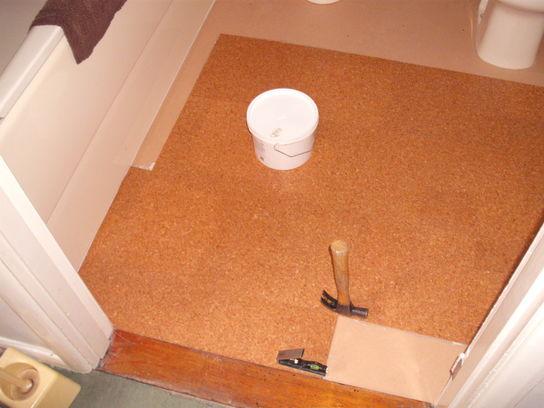
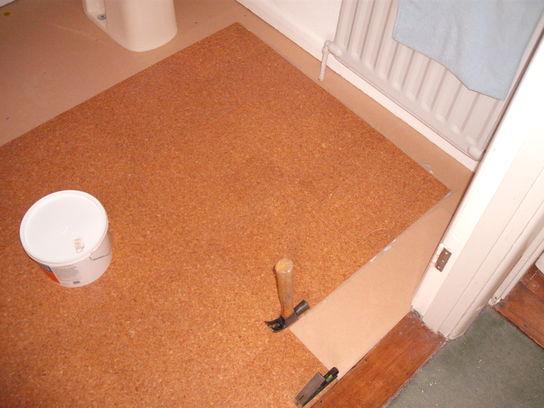
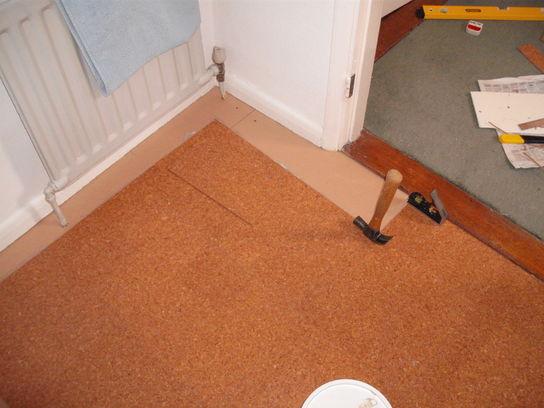
That's fine if the tiles and floor are reasonably parallel which we'd hope they are here, but in general it's not very accurate if they're not because the tile will be sitting at an angle to where it eventually winds up. E.g., bathroom in my old house where I got to choose whether to make the cork tiles parallel to the bath and door “cill” (what's the word?) or to the opposite walls. I chose the bath and door. Also, the one-tile-back-and-measure-tile-width approach works when the cut isn't straight, like round the edge of the door here.
-
Blutack or whatever the tile you're going to cut against the one above then use another tile (of the same size ?) to mark points along it the right distance from the floor.
-
AndyT ( Andy Trewin ) formerly of Sunamp
Ed Davies replied to Nickfromwales's topic in General Alternative Energy Issues
Anybody know if I'm right in thinking that a UniQ HW could be used without any electricity at all? E.g., in an Amish house (?) charge it via thermosyphon from a back boiler or solar thermal through the low-power circuit, with some sort of thermostatic valve to stop it overheating, and take heat out by flowing cold water through the high-power circuit. -
AndyT ( Andy Trewin ) formerly of Sunamp
Ed Davies replied to Nickfromwales's topic in General Alternative Energy Issues
Latent heat. You've obviously had much more to do with this than I have. Still, I'd be surprised if there's anything more than the temperature controlling the phase transition. With those clicky things in hand warmers once you've clicked it the whole lot transitions (over a period of half an hour or so). (BTW, just clicked one which had been in the draw since last winter - seems to run at 46 °C.) There's no way to stop it other than heating it up again. Doesn't the water come out at 50 something degrees immediately? That means it must be stored at that temperature, doesn't it? -
AndyT ( Andy Trewin ) formerly of Sunamp
Ed Davies replied to Nickfromwales's topic in General Alternative Energy Issues
It's still at 58 °C - there's nothing magic about that so heat will flow out of the box, albeit slowly with the vacuum insulation.
