
Ed Davies
-
Posts
1674 -
Joined
-
Last visited
-
Days Won
1
Everything posted by Ed Davies
-
One of the things preying on my mind is the worry that we might be in for a big lump of inflation, particularly in building materials prices, if the pound drops significantly against the euro in the not too distant future, say if a “no-deal” Brexit [¹] because more likely in October or whenever. My capital is currently just sitting in a bank savings account (with a bit in ISAs). An obvious hedge might be to buy some euros. Very irritating that it's a 400 mile round trip to my nearest bank branch to talk to somebody about the mechanics of doing that. Any other thoughts? [¹] Please, let's not get side-tracked on the pros or cons of Brexits or deals.
-
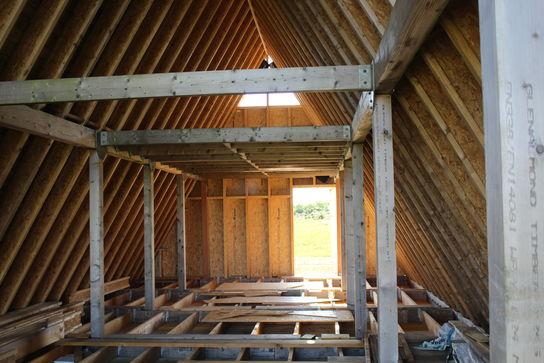
For lifting my rafters the digger driver unbolted one of the teeth and put a strop on it then I clipped my rope to that with a carabiner. He could then rotate the bucked up a bit until the rafter was almost against the jib. https://edavies.me.uk/2017/08/7-up/img_0490-medium.jpg
-
 Dunno, haven't looked inside a ASHP but wouldn't a well designed one use less energy to get rid of the ice than to freeze it because not all of it needs melting. Once the bit in contact with the pipes has melted the rest should fall off still solid, shouldn't it? Or do they try to avoid that in case it finishes burying itself in its own artificial snow drift?
 -
So why does the COP increase going below about -5 °C? I suspect it's because of the reduction in absolute and specific humidity at those temperatures so this is not assuming perfectly dry air.
-
Vague recollection that LSZH (low-smoke zero-halogen) cable is OK with polystrene. http://www.greenbuildingtalk.com/Forums/tabid/53/aff/4/aft/81523/afv/topic/Default.aspx seems to confirm. Apart from the normal PVC, LSZH is the only alternative I know of which is commonly available. It's usually specified for use in service voids in commercial premises so is usually in stock in at professional suppliers. Think I've seen it in DIY sheds, too.
-
I took my cutting list of C24 for the floor to a local timber merchant (branch of Rembrand Timber). To my surprise the manager there worked out a list of standard sizes by hand (didn't have software to do it). To be honest, though, I don't think it's worth trying to be too clever; in practice the wood will have dings and all sorts of practical issues like what's piled where means you won't use them in the right order anyway. Just pick a couple of standard sizes which mostly work and be a bit careful how you use those. E..g, for the joists for the last two rooms (http://localhost/2018/06/gable-start/) the bathroom needed a bit less than 2.4 m lengths and the small bedroom needed just over 2.4 m. I was short of the timber for a few joists so order half a dozen bits of 4.8 then had to remember not to just do all the bathroom ones as I couldn't get two bedroom ones out of a 4.8. If the bathroom ones had had to be paired up like that with the living room joists (the room I did first) then simply keeping track of which offcuts needed to be kept for what would have been tricky. Apart from anything else, extra offcuts will be useful as dwangs/noggins (see, I'm bilingual!).
-
Another week comes to an end
Ed Davies commented on recoveringbuilder's blog entry in Recoveringbuilder
Yep, had my own wobble this week. I tend to have a depressive episode around this time of year (second half of August, first half of September) and sort of know to discount it a bit. Last Sunday (19th) I went up to the site to try to finish off fitting the membrane on the west gable but what with the slight depression and it being the first day I'd been able to work at height for a week I was already feeling a bit frustrated. My safety glasses (needed most of the time for the reading bit on the bottom) kept misting up under the midge net and the scaffold tower was being awkward to put together and I rather lost it - threw a few bits of tower down pretty hard breaking one platform and one top ladder section. Haven't been up to the site since except to check that no other parts of the scaffold tower are damaged and to pick up post. Through the early part of the week I was pretty seriously thinking about giving up on the whole project. On Wednesday I went and had a look at the outside of a cheap ex-council house that's up for sale and started thinking through what I'd do with it, etc. Since then I've been thinking on two separate tracks at the same time: if or if not, while trying to do useful things to get out the depression cycle, which I am but still feeling a bit fragile. E.g., today moved most of my office stuff up from the living room to the small bedroom as that'll be a lot easier to heat in the winter. So, yeah, maybe this forum needs a Mental Health section. Whatever, reading and talking on here has helped. Thanks all. More amusingly, either I'm reading this wrong or you have very well-trained and dexterous dogs… -
Indeed, the rule is quite sensible in that there's a lot to be said for houses being easily adaptable to people getting infirm in various ways. But don't need the kitchen to be wheelchair friendly just now. My own hobby horse on things like this is taps and controls which are awkward to turn if you don't have good manual dexterity. My mother in her last year or two didn't eat very well at least is part because she found the cooker knobs difficult to turn because her hands didn't grip well. BiL got her a tool to help but it wasn't really practical. Siblings and I said to get a new cooker but she wouldn't. Something to think about with shower controls and the like which are often designed for “elegance” rather than ease of use.
-
That is an ellipse, though, not a rectangle and can be overhung to a certain extent by a worktop (at least 750 high, maximum 300mm horizontally) as it's intended to allow a wheelchair user to turn around. For my kitchen with nominal 1200 between the worktops on each side I'll just put shallow shelves under one side to get the 1400 width needed. Doesn't have to stay like that forever, of course.
-
Total energy consumption per m2 per annum
Ed Davies replied to NSS's topic in Energy Efficient & Sustainable Design Concepts
But then he'd have to keep paying for the landline anyway. -
Total energy consumption per m2 per annum
Ed Davies replied to NSS's topic in Energy Efficient & Sustainable Design Concepts
Sipgate, at least, can: https://www.sipgatebasic.co.uk/numbers Not sure if they always can, of course, but worth asking if you're considering going this way. -
Roof insulation. Internal,external
Ed Davies replied to Russell griffiths's topic in General Self Build & DIY Discussion
What's going on top of all this? If it's somehow well ventilated the VCL becomes a lot less critical; i.e., still a good idea but lack of perfection isn't disastrous. -
Total energy consumption per m2 per annum
Ed Davies replied to NSS's topic in Energy Efficient & Sustainable Design Concepts
Voice over IP works fine for me, but I'm a very low user of telephones anyway. I have a “wires-only” internet connection - that is, a normal Openreach copper pair to the exchange but with only internet on it, not voice. I then, separately, have a VoIP account (with http://sipgate.co.uk/) which allows me make and answer calls to the public switched telephone network via any convenient internet connection. I use Linphone on my laptop. The Sipgate account is free and incoming calls are free to me and charged as normal national-rate calls to the caller (Sipgate get a termination fee from the caller's carrier, I assume). You need to put some credit on the Sipgate account, though, for outgoing calls which are charged at a reasonable rate though without all the usual BT “friends & family” and weekend calls discounts. It's a bit like Skype but with better integration with the public phone network and not run by an NSA front. It's even free calls (including video) between other users of SIP phones (anybody can put Linphone or similar on their computer - you don't need an associated phone number as there are other providers of free SIP accounts. I have one with ekiga.net but, though I'm signed on all the time, I haven't actually used it.) You can have any area code you like. I chose to have the local one covering both where I'm renting at the moment and where I'm building just to avoid having to explain when I give local people my number. I also have an analogue telephone adaptor (ATA). This is a little box which has an ethernet connection which plugs into my router and a telephone socket into which I plug a normal BT cordless phone base station for incoming calls when the computer's off, etc. So, costs so far: approx £40 for the ATA plus about £20 credit put on the Sipgate account of which I've used less than £10 so far. Big advantage for self-builders is the portability. I anticipate a transition period when I might be wanting to answer landline calls in the almost complete house during the day but in the rented house in the evening. And when I finally move there'll be no need to deal with BT to get the number moved. Disadvantage is the landline doesn't work in a power cut. A UPS might be nice but I haven't bothered yet. A couple of years ago there was a 36 hour power cut here but since then the longest has been about 2 hours. Off grid they won't matter, of course. Update 2018-08-26: expanded this into a blog post: https://edavies.me.uk/2018/08/telephones/ -
I demolished your house, but I'm not moving the debris!
Ed Davies replied to laurenco's topic in Demolition
I think the way roads tend to go to towns (or towns are built where roads meet) gives the impression that an area is more crowded than it actually is: Apparent Crowding -
Hi again Ferdinand; yes, did get a welcome in my Introduce Yourself thread.
-
Total energy consumption per m2 per annum
Ed Davies replied to NSS's topic in Energy Efficient & Sustainable Design Concepts
Are you sure? My understanding (though I can't cite a reference which is specific - I think you'd have to look in the PHPP spreadsheet to be sure) is that the 15 kWh/(m²·a) or 10 W/m² figures were for final/delivered energy. It's the 120 kWh/(m²·a) for all energy use which is primary, I believe. Part of the reason I think this is that the 10 W/m² figure is based on the heat that can reasonably be delivered via the MHRV (without getting a burning smell and without forcing extra air through). That has nothing to do with the amount of primary energy involved. Also, the huge difference between 15 and 120 is not just a matter of non-space-heating energy use. Even including DHW I think it has to include headroom for the primary vs final multiplication as well. Yes, I think they have. The standard you're referencing is now called “Classic”, there are now “Plus” and “Premium” classes which are a bit more ambitious AIUI. -
If you're not interested in FiT then worth keeping an eye on https://bimblesolar.com/ for cheap second hand panels (usually off big installations which have upgraded for whatever reason). Not dealt with them myself (yet) but they've been around for a while.
-
Building in a Specially Protected Area (Scotland)
Ed Davies replied to a topic in General Self Build & DIY Discussion
What they might find is that they can build but there's some restriction like that outdoor work can only be done in months with an “r” in the name. -
AIUI you can't reclaim for labour (like scaffolding erection/dismantling) - it has to be zero rated at the time of invoice.
-
I had two invoices recently which incorrectly charged VAT. One was for scaffolding hire where the hire part should have VAT charged but the labour part for erection and dismantling shouldn't. I discussed this quite carefully with the boss when he priced the site but still it all came through with standard 20%. The other was getting a chap from local builder round with a digger to lift my rafters. In that case there shouldn't have been any VAT at all. In both cases I paid the non-VAT component of the invoice promptly with a note saying what was up. The scaffolder should really have issued me with another invoice splitting out the labour and hire (I gave him a worked example of the sort of arithmetic which could have been used so the result would come out to exactly what he'd originally quoted) in which case I'd have happily paid the VAT on the hire. I haven't heard anything more from either. Shrug. I then got another builder in to supply and fit sarking boards, etc. I reminded him in an email about zero-VAT: “yes, we know“ like I was teaching egg sucking. You can't win.
-
Reminds me of the story of the little girl helping out the brickies building an extension on her parents' house: she'd been bringing bricks round the side of the house in her toy pram. At the end of the week, as she'd actually been a bit useful, when they got their wage packets they'd clubbed together to give her some pocket money “wages”. Her mother was amused by this and asked if she was going to be working on the site next week. “Yes, if we can get the fucking bricks”. “Umm, maybe not”, says Mum.
-
Yes, quite plausible. The glass on solar thermal collectors is usually low-iron to make the best use of the available short-wavelength IR in the solar spectrum so perhaps your canopies were just thick ordinary glass or perhaps “high-iron” if that's possible. AIUI the sort of solar glass typically specified in places like California is designed to reflect short-wave IR but I'm not at all clear what these add-on solar films try to do.
-
The sun emits very little long-wave IR (longer than, say, 5 µm compared with its short-wave IR, visible and UV output). Of the little it does put out, most is absorbed by the atmosphere. The long-wave IR reaching a window will come from the local atmosphere and surrounding objects. This has implications for positioning of sunscreens: e.g., a glass canopy might only protect from some of the LW radiation from the sky but not that from the parts of the atmosphere at lower angles and nearby houses, trees, etc.
-
OK, I'll bite. The article says: Storing electricity for later use as heat, particularly low grade heat, is almost always a bad idea. Like many materials, concrete has a specific heat capacity of the order of 1000 J/(kg·K) (more than 500, less than 2000). In Earth's gravitational field all materials have a “specific potential energy capacity” of 9.81 J/(kg·m) (depending only slightly on where you are on the planet and how high you are). So raising the temperature of a block of concrete by 1 K (i.e., 1 °C) stores as much energy as raising it just over 100 metres. (Some calculations I did a while ago showed store energy for heat in a lead acid battery would have a higher capacity if you just heated them up to about 80 °C (IIRC) rather than charge them.) Water has many odd thermal properties including an unusually high specific heat capacity. It'd store about four times as much energy by being heated. Of course, the advantage of raising the concrete 100 m would be that it would stay there (baring settlement) whereas heated material tends to cool down over time. Also, if you store electricity you can then use a heat pump getting (say) three times as much heat out whereas if you use a heat pump then store the heat you need to store three times as much energy. One way to get longer-term energy storage is to use a phase change of the material so it's stored as latent rather than sensible heat. E.g., melt wax or salt or dry out some cat litter. Later you can allow the wax to solidify or the cat litter to absorb moisture releasing heat. I'm rather taken by the phase-change inter-seasonal energy store concept being pioneered by a couple of materials science PhDs in SE Austria: they use a heat pump to extract energy from a tank of water in a cellar under their house. During harder winters this freezes a large proportion of the tank but that's OK, as water freezes it gives off a lot of energy. They have a very large low-grade thermal collector (a fence made out of black pipes) which trickles ambient energy into the store and heat pump even when it's cloudy and the outside temperature is below zero so something like half their heat-pump input comes from the environment over the winter and it quickly melts and warms the store in the spring. They can also use the heat pump in reverse to move heat from the house into the water in summer for a bit of cooling. The latent heat of fusion of water (i.e., the amount of energy you need to extract to freeze it) is 334 kJ/kg so freezing an amount of water gives as much energy as lowering it from 34'000 metres (more than three times the height of Everest). In general, I'd say electrify all the things but think very carefully about storing energy for heat as some form of heat near its point of use.
-
There's a British company doing something similar lifting a block up and down an old mine shaft and an Australian company running a train up and down a track on a hillside. That crane idea is neat in that it could be put anywhere - e.g., places without mineshafts or hills. All depends, of course, on whether they really can get that efficiency.