
Ed Davies
-
Posts
1674 -
Joined
-
Last visited
-
Days Won
1
Everything posted by Ed Davies
-
Indeed. But when said VAT-registered company comes to sell the house they can zero rate the whole lot, can't they? They could, of course, reclaim the VAT on skip hire in just the way that any VAT registered company can reclaim the VAT on any inputs. So in the end the tiny proportion of the sale price which came from the skip hire would get zero rated. Or have I totally misunderstood something?
-
Why? They'll only be fairly small gussets of ply going right through so the bridging should be minimal.
-

How to deal with a noisy sewerage treatment plant
Ed Davies replied to joe90's topic in General Self Build & DIY Discussion
That's not just for shipping, is it? -
Would you ventilate that cavity? If so, to where? If the outside then it'll bypass the insulation nicely. I suppose you could ventilate to inside but that'd be a rather unusual thing to do.
-
Diameter of house mains electric supply cable
Ed Davies replied to Pete's topic in Electrics - Other
Just measured the incoming cable on the house I'm renting with calipers: 13.8 mm diameter. 100 amp main fuse, single phase but overhead directly off the transformer pole. -
A similar approach would be a Larsen truss with mineral-wool infill and some sort of render board on the outside. Not sure if you'd need a ventilated cavity behind the board, though.
-
hass io Anyone using Home Assistant
Ed Davies replied to readiescards's topic in Networks, AV, Security & Automation
I've got Python code writing to and reading from MQTT. There are libraries for that but it's simpler, and probably more robust, to just run the Mosquitto command line clients (mosquitto_sub and mosquitto_pub) as subprocesses. E.g., if the MQTT protocol is ever changed I think the CLI clients would be much more likely to be updated in sync with the broker in the Debian repos than separately developed libraries. I use MQTTDash on my phone for looking at what's happening sometimes but most of my debugging and testing was done with the CLI clients. I also input data (e.g., electricity meter readings) using mosquitto_pub. -
*rant* pre-application timescales *rant*
Ed Davies replied to Moonshine's topic in Planning Permission
I didn't have much time pressure because my plot purchase was hung up on a croft-law cock up anyway. I wanted to do something a bit odd which I thought the planners would either love or hate so it was worth getting some guidance before going to the expense of getting proper drawings and an application done professionally. As it was they were very supportive. The feedback from the pre-app did save a bit of time on the full application (route of the entrance track) which went through very smoothly as a result. So for me the pre-app made a lot of sense. It was free and done a week quicker than their target of 8 weeks. -
First time DIY: how many of us?
Ed Davies replied to ToughButterCup's topic in General Self Build & DIY Discussion
Absolutely. Somebody you could just get to help for a few 10-minute sessions a day then switch off in between would be ideal. -
First time DIY: how many of us?
Ed Davies replied to ToughButterCup's topic in General Self Build & DIY Discussion
Start of most of my conversations: “How's the build going?” “Slowly.” This year's it's mostly been the wind which has caused slowness. Had separate contractors/fabricators do: 0) House design details, planning and building warrant application. 1) Entrance track and site clearance. 2) Custom galvanized steel brackets for the frame. 3) Concrete pads for the posts and bolting on of the steel brackets. 4) Digger + driver for a few odd days to help put up rafters. 5) Sarking, membrane and counterbattens. Looking for somebody to do more on the roof (in the short term more membrane then later profile steel with some careful thought needed to details round the Veluxs so probably not any old roofing contractor); have somebody in mind to do the drains, BioPure, etc; will need an open-minded electrician for a few days at some point. I'm not sure what else I can comfortably sub out. It seems to me that often it's harder work to deal with the building trade than to do the job yourself. OK, they'll probably do it much quicker once they're actually on site and make a tidier job of it but still… -
OK, I realise we're wandering off the original question but I think that's been answered so it's open season now. It'd be interesting to know what the heat loss is. Just knowing the temperatures at each end of each of the pipes would give it as a proportion of the heat delivered. Assuming there's a reason the boiler isn't in the house then I'd think putting in a new outside boiler close to the house would be cheaper than replacing the pipes. If that's not feasible for some reason (restriction on tank placement or whatever|) then maybe a big thermal store in the house batch heated from the boiler would be a) more controllable and b) involve less heat loss.
-
Thank you @MrMagic that LeChacal range looks interesting. Just for giggles I integrated the output of my CurrentCost meter for the year getting a total of 5001675759.992456 watt·seconds (joules). Dividing by 3.6 million to get kilowatt hours that's 1389 kWh. From a meter reading this evening comparing with one done at 22:09 on the first of January I've used 1509 kWh. So the CurrentCost underread by about 8%. That's actually closer than I thought it would be.
-
To do this in a way which won't cause raised eyebrows perhaps you could get an electrician to put a normal 13 amp socket in the meter cupboard run off an appropriate (or new) circuit in the CU then plug a wall wart with a, say, 12V AC output into it. Half-wave rectify then off-the-shelf regulator or switch-mode down to 5 or 3.3 volts with separate voltage divider for voltage/phase measurement.
-
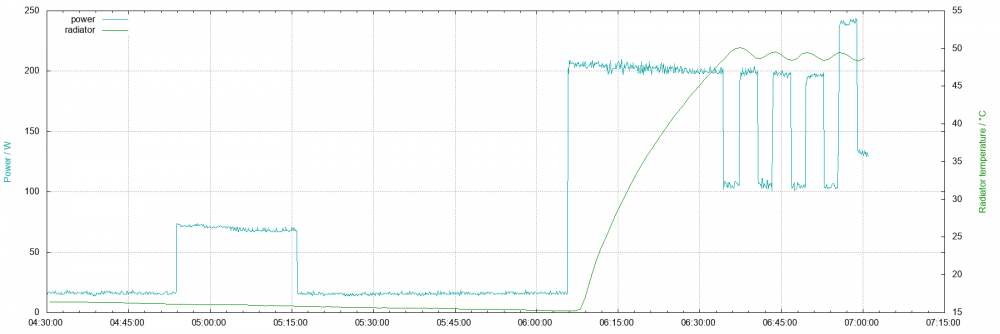
Ah, OK. Interesting point. Do you have to power the Wi-Fi modem on each wake up? There's a lot to be said for having higher temporal resolution than 30 minutes. My logging is done at 6 second intervals because that's what my CurrentCost meter gives which might be a bit quicker than is really necessary but still useful. E.g., I can see what the power consumption of the circulation pump and the oil pump and blower on the central heating is as the boiler short cycles. Also, the duty cycle of the fridge. I.e., with higher temporal resolution it's pretty easy to separate out the various power sinks in the house. The CurrentCost only measures current and assumes the voltage so is a bit inaccurate if the voltage is wrong but, probably more significantly, can't measure phase so only approximates VA rather than true watts. Still, that's a separate discussion. Except that if you have a transformer for voltage/phase measurement as @JSHarrissuggests then can't you also power the electronics off that and not worry quite so much about micropower? Seems odd to be worrying about a few mW when there's kW flashing by in the same box. Of course, this might be academic if it turns out your new meter has an LCD display and flashes a blib on that every 1 or 10 Wh. A lot harder to watch.
-
Could you have the pulse detector directly wake the ESP8266 then store the count in whatever registers are preserves in deep sleep? AIUI (not actually programmed either myself, yet) the ESP32 is better at wake up from external signals and simpler to preserve data during sleep so might be worth investigating. Most of my limited understanding comes from this video and a couple of others by the same chap:
-
I didn't even tell the planners I intended my house to be off grid. Said various things in the design statement about reducing consumption but that was it. Didn't see that it was any of their business how many phases I had: zero, one or three. I can imagine cases where the presence of a wires might be a planning consideration but not their absence or the number of conductors. (Only relevant effect was that it was the BCO, rather than the planning people as apparently it usually is, who referred me to environmental health to discuss the rainwater harvesting. Not a problem, though.)
-
Air blower treatment plants - power consumption.
Ed Davies replied to ProDave's topic in Waste & Sewerage
Sure, I meant low duty cycle. Well, for the 80 watts for the less power-saving ones that's 700 kWh/year, £112/year, so a 50% saving is £56/year. Off grid, though, the saving is much bigger. Roughly speaking, winter-time electricity costs upwards of £30/watt in capital cost so saving half of 80 watts would be worth £1200. That'd buy you an awful lot of little timers. Even with a low-power (27 W) pump it'd be about £400. My warrant specifies a BioPure so I was going to ask their advice on low power running closer to the time but this thread seems to have given most of the answers anyway. At Hinkley Point C prices (~ £20e9 for 3.2e9 W) it's still £6.25/W so the saving between an 80 W 100% duty cycle and a 27 W 50% duty cycle is £415 in capital costs. -
Air blower treatment plants - power consumption.
Ed Davies replied to ProDave's topic in Waste & Sewerage
I'd have thought you'd need to keep the pump running, maybe at a lower level, all of the time, not just when the unit is directly in use, in order to keep the aerobic wee beasties alive rather than have them replaced by smelly anaerobic ones. -
Roughly 78% nitrogen, 22% other gasses including small quantities of dihydrogen monoxide?
-
I currently have 22 million lines in a 1.8 GB sqlite database with entries since 2016 November. Most data is recorded every minute or two, power consumption every 6 seconds because that's what the Current Cost meter gives. Would be a bit awkward in most spreadsheet programs, I think. In the background on my second monitor I usually have a graph of various temperatures, humidities and overall electricity power consumption updated every 30 seconds from midday the previous day to the current time. I originally just put it up for fun but actually I find I use it quite a bit to see what the central heating's up to and for things like when the washing machine's finished. I've also learned what I think will be useful lessons for running an off-grid house. E.g., I plan on having 6 kW worth of inverters and had previously though of complicated schemes to make sure my consumption didn't go over that. What I've found in practice is that it doesn't anyway so they wouldn't be needed (except for use of the 7 kW electric shower and a few odd occasions when the central heating wasn't working and I was using the cooker and boiling a kettle with a 2 kW convector heater going at the same time). The last few minute's data, just as the central heating starts up: 2018-10-25T16:26:02.66Z ['cc', 'power'] 73 2018-10-25T16:26:03.77Z ['study', 'radiator', 'temperature'] 26.75 2018-10-25T16:26:08.75Z ['cc', 'power'] 71 2018-10-25T16:26:14.84Z ['cc', 'power'] 71 2018-10-25T16:26:21Z ['cc', 'power'] 71 2018-10-25T16:26:28.1Z ['cc', 'power'] 74 2018-10-25T16:26:33.1Z ['cc', 'power'] 73 2018-10-25T16:26:39.2Z ['cc', 'power'] 122 2018-10-25T16:26:40.61Z ['kitchen', 'temperature'] 16.04 2018-10-25T16:26:40.77Z ['kitchen', 'humidity'] 66.64 2018-10-25T16:26:41.69Z ['bedroom', 'temperature'] 18.69 2018-10-25T16:26:41.85Z ['bedroom', 'humidity'] 59.02 2018-10-25T16:26:41.95Z ['bedroom', 'co2'] 925 2018-10-25T16:26:42.06Z ['bedroom', 'pressure'] 1002.23 2018-10-25T16:26:42.17Z ['bedroom', 'altitude'] 92.15 2018-10-25T16:26:42.28Z ['bedroom', 'light'] 8 2018-10-25T16:26:42.39Z ['bedroom', 'eng', 'rssi'] 31 2018-10-25T16:26:45.36Z ['cc', 'power'] 127 2018-10-25T16:26:51.53Z ['cc', 'power'] 129 2018-10-25T16:26:58.12Z ['cc', 'power'] 129 2018-10-25T16:26:58.58Z ['study', 'temperature'] 22.47 2018-10-25T16:26:58.74Z ['study', 'humidity'] 57.95 2018-10-25T16:27:00.06Z ['study', 'radiator', 'temperature'] 26.6875 2018-10-25T16:27:03.71Z ['cc', 'power'] 132 2018-10-25T16:27:15.88Z ['cc', 'power'] 126 2018-10-25T16:27:22Z ['cc', 'power'] 125 2018-10-25T16:27:28.17Z ['cc', 'power'] 127 2018-10-25T16:27:33.96Z ['cc', 'power'] 129 2018-10-25T16:27:40.07Z ['cc', 'power'] 127 2018-10-25T16:27:45.94Z ['cc', 'power'] 130 2018-10-25T16:27:48.91Z ['kitchen', 'temperature'] 16.04 2018-10-25T16:27:49.07Z ['kitchen', 'humidity'] 66.64 2018-10-25T16:27:52.1Z ['cc', 'power'] 127 2018-10-25T16:27:56.45Z ['study', 'radiator', 'temperature'] 26.625 2018-10-25T16:28:04.39Z ['cc', 'power'] 126 2018-10-25T16:28:06.78Z ['study', 'temperature'] 22.44 2018-10-25T16:28:06.93Z ['study', 'humidity'] 57.89 2018-10-25T16:28:10.45Z ['cc', 'power'] 127 2018-10-25T16:28:16.29Z ['cc', 'power'] 129 2018-10-25T16:28:22.36Z ['cc', 'power'] 130 2018-10-25T16:28:28.44Z ['cc', 'power'] 127 2018-10-25T16:28:34.49Z ['cc', 'power'] 127 2018-10-25T16:28:40.6Z ['cc', 'power'] 126 2018-10-25T16:28:48.1Z ['cc', 'power'] 125 2018-10-25T16:28:52.74Z ['study', 'radiator', 'temperature'] 28.1875 2018-10-25T16:28:52.89Z ['cc', 'power'] 133 2018-10-25T16:28:55.55Z ['bedroom', 'temperature'] 18.68 2018-10-25T16:28:55.71Z ['bedroom', 'humidity'] 59.05 2018-10-25T16:28:55.81Z ['bedroom', 'co2'] 925 2018-10-25T16:28:55.92Z ['bedroom', 'pressure'] 1002.25 2018-10-25T16:28:56.03Z ['bedroom', 'altitude'] 92.02 2018-10-25T16:28:56.14Z ['bedroom', 'light'] 7 2018-10-25T16:28:56.25Z ['bedroom', 'eng', 'rssi'] 31 2018-10-25T16:28:57.24Z ['kitchen', 'temperature'] 16.03 2018-10-25T16:28:57.4Z ['kitchen', 'humidity'] 66.67 2018-10-25T16:28:58.96Z ['cc', 'power'] 127
-
Yeah, this domestic logging stuff can soon wander into TMI territory ? My original logging was to text files. Closed one and opened the next when they reached 500 kB, an arbitrarily chosen size which worked out quite well at about 10 hour's worth of data. About 500 MB for the roughly 13 months before I switched to Sqlite. I did wonder about encrypting, and therefore also compressing, the files more than a day or two old. Doing that's one minor reason why I'm considering switching back to flat files.
-
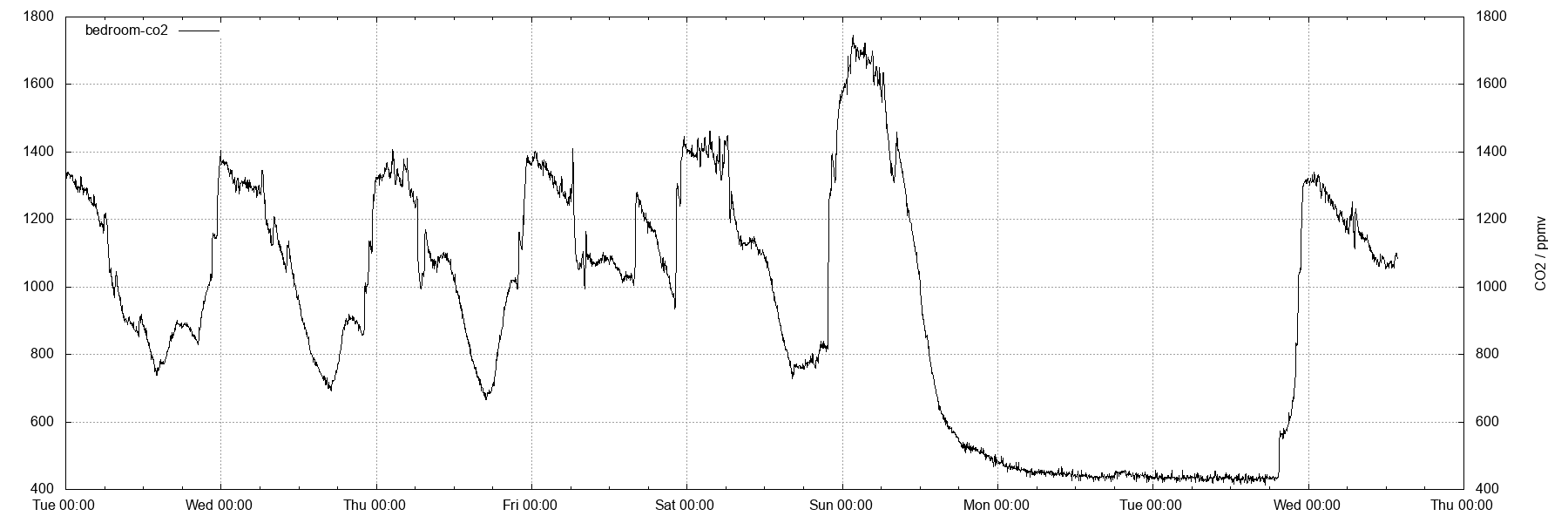
I don't leave the bedroom window open but usually leave the door ajar. Maybe the higher levels of CO₂ Sun/Mon night were due to not doing that, I don't remember. I'm really hoping that MHRV in the new house will give better CO₂ levels without needing the heat loss of an open window or door.
-
The one I'm renting? No, upstairs isn't too bad but downstairs has a wooden floor which provides sufficient ventilation that MHRV would be a tad redundant.
-
Dunno, you can read that as well as I can. Still, I assume what they're expecting is a little LCD in the hall with a graph of the last 24 hours so people can see what the levels were overnight, not just when they happen to glance at it when they get home at 18:00.
-
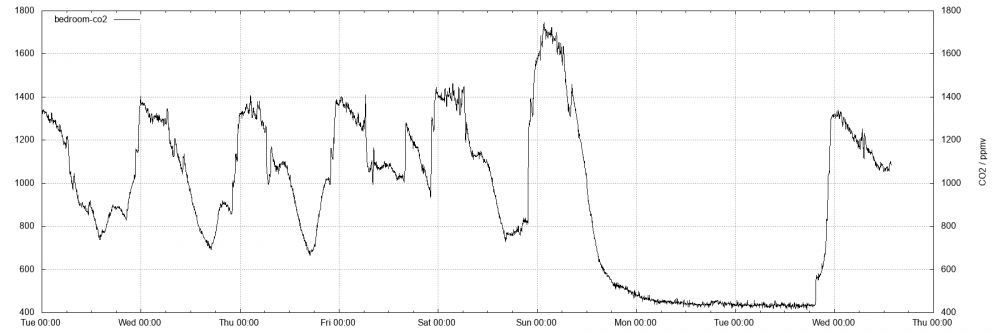
In another thread I wrote that the only known building regs change which would affect my house if I got a warrant extension which required updating to the more recent regs would be the one for a logging CO₂ monitor which I'm doing anyway. @PeterW expressed some surprise at this so I referenced the relevant (Scottish) building regs section part 3.14.2. In case anybody's curious, I have a few vAir monitors made by a chap in Sofia. Unfortunately, he's stopped doing them for the time being but they're fairly simple things with off-the-shelf sensors and Wi-Fi equipped processors (ESP8266). I have two with just temperature and humidity sensors (one in the small bedroom I use as my study and the other in the kitchen) and a more fully-loaded one in the bedroom with temperature, humidity, CO₂, pressure and light-level sensors. These and a couple of other sensors send reports to an MQTT broker running on a Raspberry Pi where some of my own software stashes them away in a Sqlite database then servers the data over HTML where some other programs of mine plot graphs from it. Here's the bedroom CO₂ level for last week or so. I was away Sunday and Monday and Tuesday so that gives a nice baseline. Note the non-zero base to the Y-axis. A little “research” project I've been meaning to get round to is comparing the overnight CO₂ levels (at, say, 04:00) with the winds at Wick airport (which I'm also logging) to get some idea of how much difference that makes to the ventilation. Note, this is all in my rented house, not the one I'm building which is still even more ventilated.