
Ed Davies
-
Posts
1674 -
Joined
-
Last visited
-
Days Won
1
Everything posted by Ed Davies
-

The tale of the sale of our old house
Ed Davies replied to Jeremy Harris's topic in General Self Build & DIY Discussion
Sui generis means of its own type, one of a kind. -
Strange how councils vary. Orkney were quite happy to talk - I went over for an hour's meeting with a planning lady which was quite helpful when I was looking seriously at a plot there. On the other hand, Highland refuse to talk - they just say put in a pre-app enquiry but at least that's free. For my house which is technically within the letter of what the planning permission in principle the plot already had specified but clearly not what either the original submitter (the chap selling the land) had in mind or how the council would have imagined it, I was very reassured by getting a (pretty positive) pre-app response before splashing out for the house designer's drawing and the planning application fee. One thing I do wonder though: are pre-app responses ever used to limit what people can do beyond what the planning frameworks allow. E.g., a planning officer could put something in a pre-app response which is basically personal prejudice without much risk of comeback or appeal as the whole thing's just advisory. Either the applicant will accept it and put in a different plan or, if they persist, then the planning officer can use the fact that it was submitted against their advice to help squish it even if it's not really justified.
-
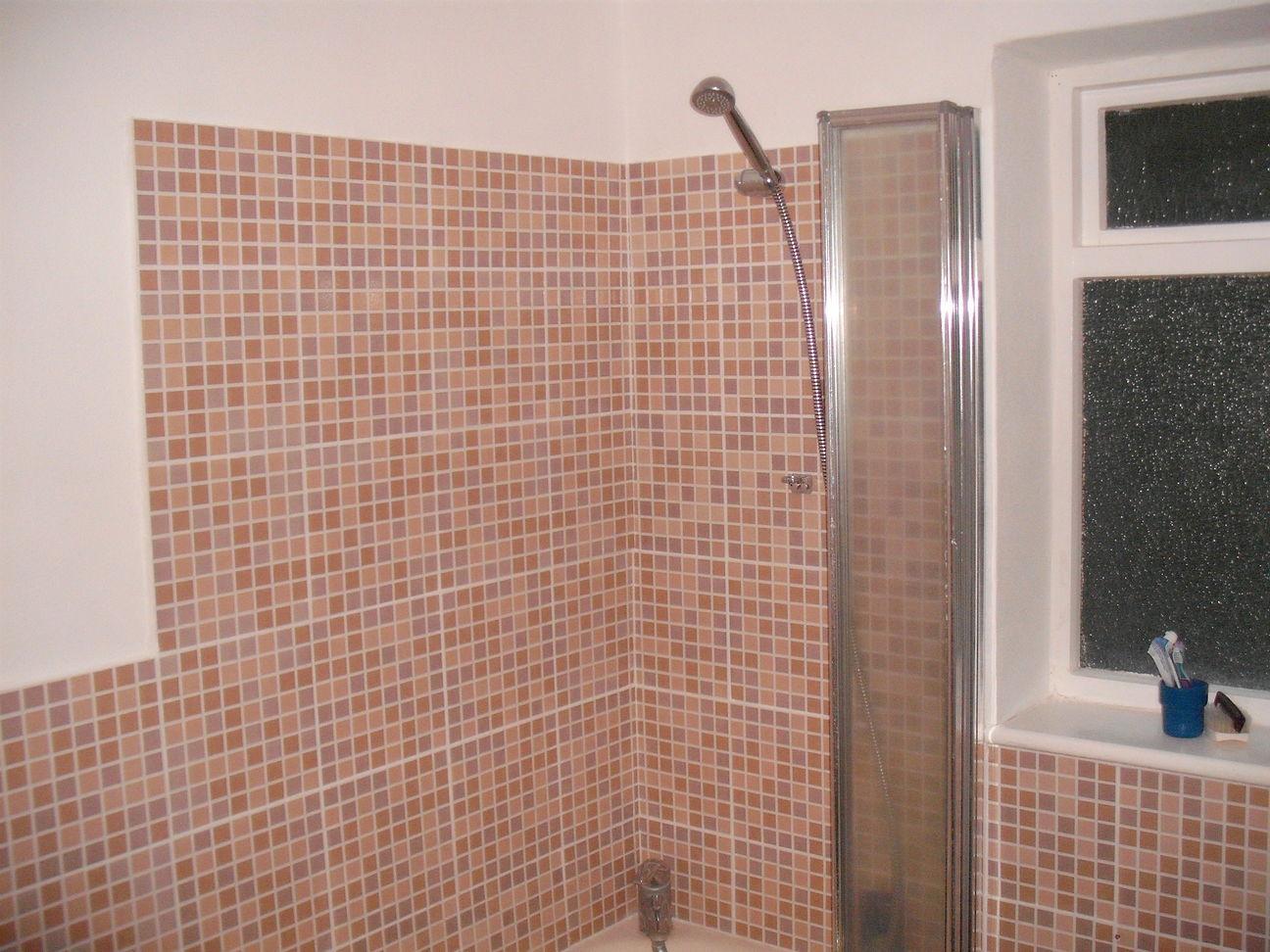
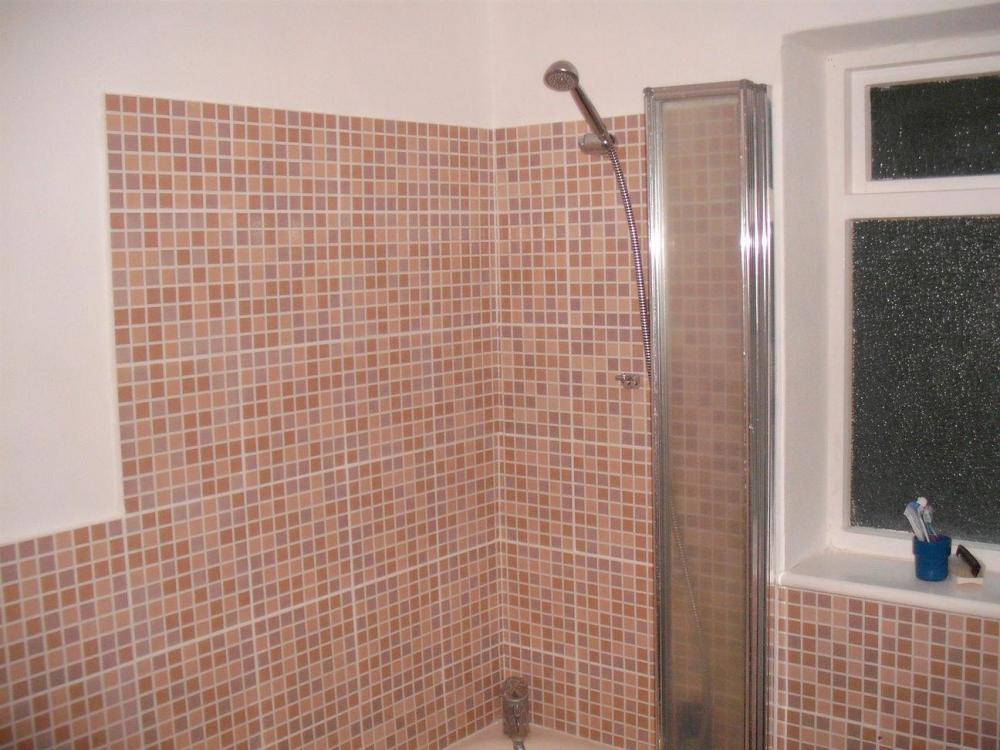
Good plan. Mosaic into a corner is hard. I was starting with not very flat walls so I'm not too displeased with my first attempt at tiling except at the corner:
-
AIUI there are two vent functions needed: 1) to let gasses forming in the soil pipe out rather than them building up enough positive pressure to push past the water in the U bends which would be very unpleasant. 2) to let air in so that a big wodge of solids and liquids sliding down the pipe doesn't create enough negative pressure behind it to suck the water out of the U bends (actually, pushed by the atmosphere on the basin or whatever side) which would also be less than ideal. A traditional soil vent pipe running up the side of the building and open above the gutter does both those functions. If you don't want that for any of various aesthetic or insulation reasons then the functions can be separated. A vent pipe further down the system does the first function. An air admittance valve inside the house lets air be sucked into the system for function 2 without letting any gases out (you really hope). AAVs which let air in but not out can also be used to break syphons in some systems. Confusingly, though, there's another sort of valve also called an AAV (but I can't remember what the letters stand for in that case but seem to remember the first A is “automatic”) which does exactly the opposite: it only lets air out (doesn't let it in and doesn't let liquid out - there's a little floating ball which seals it when liquid arrives) used to get rid of air in the top of the system. Typically used at the high point of solar thermal systems.
-
Love the way you determine the exact position of the bottom edges of the full tiles: size of a box of staples + the height of the laser.
-
Off-grid new-build timber A-frame in Caithness, NE Scotland
Ed Davies replied to Ed Davies's topic in Introduce Yourself
Membrane and tapes will go on top of the sarking. I think (and hope) I won't have to work under the house again [¹]. There'll be weatherboarding round the edges anyway and the space below will be ventilated so there's no more need to protect the sarking than, say, normal floorboards over a crawl space. Actually, I'm thinking of using 20mm EPS rather than membrane on top of the sarking, between the joists. Reason being is that it gives a tiny bit more insulation and costs about the same as using a membrane given that it saves 20mm of mineral wool and leaves me with a round 200mm gap to fill which can be done more easily with the mineral wool I have in mind. [¹] Edit to add: Other thread reminds me, will have to go under again for soil pipe. -
Off-grid new-build timber A-frame in Caithness, NE Scotland
Ed Davies replied to Ed Davies's topic in Introduce Yourself
I like the idea of that. Of course granite tends to have of the order of half the volumetric heat capacity of water. Not sure about blowing air through though as I'm not sure you'd want to breathe what comes out. That's an advantage of water as a store - it's relatively easy to circulate to extract heat if simple percolation out turns out not to be sufficient. The disadvantage of water is that it's a bit more spilly than granite. -
Off-grid new-build timber A-frame in Caithness, NE Scotland
Ed Davies replied to Ed Davies's topic in Introduce Yourself
Square Feet: yes, it's not easy as Segal really means a bit of a gap underneath which then has to be high enough to allow attaching whatever underfloor sheet you use to under the joists resulting in the house being yet taller. In my case I have nominal 400mm under the floor (bit more at the west end, bit less at the east), sarking boards, 220x45 joists which will be infilled with mineral wool then they'll be 145x45 joists running perpendicular also infilled with mineral wool, 22mm T&G chipboard then finish floor (probably cork tiles in bedrooms and shower room, laminate in hall, kitchen, living room and study). Result is that finish floor winds up nearly 800mm above ground level which is not insignificant. As it works out the ground level in the house area is some 400mm below the parking area so in this case an accessible ramp up to the level of the house is not a big deal but if things were the other way round that'd be quite a structure. An alternative which was suggested on another forum would be to have the joists closer to the ground, board round the sides, then fill the whole void with EPS beads. I'm not sure if you'd need a DPM or whether you could sensibly rely on the EPS not wicking. If I'd tried that with my joists at the height they are it'd needed about 600mm depth so 60m³ of beads which seems a lot but would have been cosy. Maybe next time ;-). -
Off-grid new-build timber A-frame in Caithness, NE Scotland
Ed Davies replied to Ed Davies's topic in Introduce Yourself
Site-made tanks. Timber frame with EPDM liners. Quite commonly done by people in the US. Not very deep as the there's a reasonable length to play with (about 13 metres) so the weight will be pretty spread out. It was, of course, taken into account in the structural engineering. -
Off-grid new-build timber A-frame in Caithness, NE Scotland
Ed Davies replied to Ed Davies's topic in Introduce Yourself
Indeed - your pseudonym is one I recognize from GBF (and also, longer ago, Navitron, perhaps, where I used the handle EccentricAnomaly) so hello again. Ditto Stones, SteamyTea, JSHarris, etc. -
Off-grid new-build timber A-frame in Caithness, NE Scotland
Ed Davies replied to Ed Davies's topic in Introduce Yourself
Yes, close to there. Other side of the A996 and a little way south. I think this is the entrance track to it: Street Map -
Earthing to ground spike.
Ed Davies replied to Russell griffiths's topic in Consumer Units, RCDs, MCBOs
John Ward, who seems to know about this sort of thing, would disagree. The 18th edition of the wiring regulations updates the rules on using the foundation rebar for earthing but not in any terribly significant way. See about 2 minutes of discussion starting here: -
Questions about Waste Transfer, Licenses etc
Ed Davies replied to Ferdinand's topic in General Self Build & DIY Discussion
Yep. Also for vans, whether sign written or not. The tip in Wick required it for my unmarked (other than rust and dirt) Hiace. -
Off-grid new-build timber A-frame in Caithness, NE Scotland
Ed Davies replied to Ed Davies's topic in Introduce Yourself
Absolutely, I'm always pleased to talk to people on site. There's a contact details page on my website. I do like Orkney and seriously considered a plot north of Finstown (went as far as making an informal offer). Combination of the seller wanting a bit more money (“offers over”) and restrictions on the building season due to breeding on the adjoining bird reserve put me off pursuing it further. Plus the probable extra cost of material shipped there. But I did find it a very friendly and pleasant place and admire the amount of renewable energy and joined-up projects there. -
Off-grid new-build timber A-frame in Caithness, NE Scotland
Ed Davies replied to Ed Davies's topic in Introduce Yourself
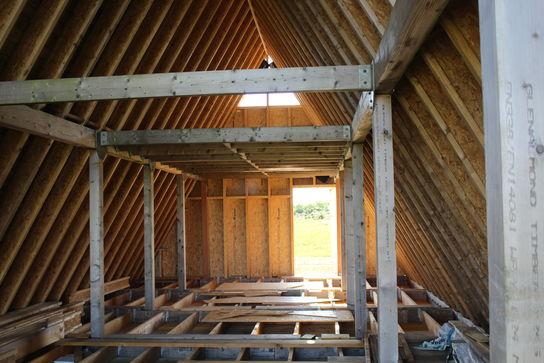
It's an east-west A-frame built over a post-and-beam frame. Here's a view looking towards the west gable at the end of last month when I hadn't yet put the last two triangular bits of OSB in the top. The thermal store will go along the north side (to the right of the posts). That's part of why I went for an A-frame, normally the “wings” there are considered a waste of space but I have a use for them. Window holes to be cut in the south roof later.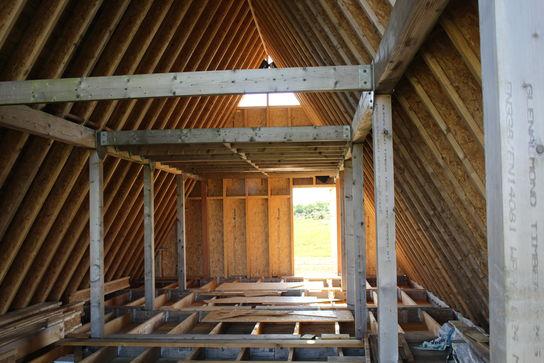
-
Questions about Waste Transfer, Licenses etc
Ed Davies replied to Ferdinand's topic in General Self Build & DIY Discussion
I'm guessing this is a can of worms [¹] but where's the boundary between “domestic” and “trade” waste? E.g., if you're doing some redecorating at home any waste is surely domestic. What about bigger renovations? Building an extension? Building a separate house on the same site? Building a house on a separate site? Specifically, if I take stuff like the plastic wrapping my timber I-beams came in to the local tip, is there anything I can quote to say, no, for my DIY build this is not commercial waste? [¹] An actual can of worms isn't waste - you want the worms but once they're out of the can the can will be waste. -
Hello all. And hello again to the many names I recognise from other forums. I'm currently in the process of building a new timber-frame (post and beam, sort of Segal method) A-frame house on a rather exposed hill top in NE Scotland, overlooking the Moray Firth. I have a blog (https://edavies.me.uk/blog/) with entries specifically about the house tagged Perihelion (the house's name). Apart from an Internet connection the house will be completely off grid. The notion is that it's a “no-combustion” house - no energy comes from burning stuff like oil, gas, coal, peat, wood or whatever, just (through a couple of levels of indirection) from fusion roughly one astronomical unit away either via solar thermal (hot water evacuated tube panels) and PV on the roof and, perhaps, from a small wind turbine though that's something I'd rather avoid. We'll see. Part of the idea is a large thermal store - roughly 10 tonnes of water in tanks within the thermal envelope to allow energy collected during late summer and autumn to supplement the small amounts collected in the short days of the core part of the winter. The water supply will be rainwater harvested from the roof. Drought is rarely a problem here though the dry ground a few weeks ago did give cause for thought: in particular it occurred to me that using water from the thermal store for toilet flushing during summer might stretch the store significantly. There's more about the design in the planning application Design Statement: 3rd from bottom PDF here: https://wam.highland.gov.uk/wam/applicationDetails.do?activeTab=documents&keyVal=N09ALOIH7R000 The whole build has been frustratingly slow mainly because of the weather. Rain has given plenty of rest days, of course, but the main problem has been wind. E.g., today looks like the last calm day for a while to allow me to put the last of the membrane up on the west gable but it's looking like it'll be raining pretty steadily all day. And so it goes.
-
I'm using JJI I beams for the studs in the gable ends of my A-frame house for the same reason as you: depth of insulation. The house designer, structural engineer, building control and JJI distributor technical/sales chap all happy with that. The one gotcha though is the choice of depth of the beams. I picked 235 mm off their list of available depths just because that was what I needed for my intended U-value. The distributor did warn me that that was uncommon (245 mm being the nearest standard one) so there'd be a bit more lead time. I didn't want to change at that point - the structural engineer had signed off and was being a bit uncommunicative then (been much better later) - so decided I could put up with ordering a few weeks early. I got most of the beams needed for the roof (two packs of 33) fine. However, when I came to order the last few I needed for the roof and the ones for the ends there was a problem: I wanted fewer than 20 (can't remember the exact number) but JJI only supply in packs of 33. For the common sizes the distributor would have been happy to split a pack as they'd sell the rest to somebody else quickly enough but for 235s they didn't want them hanging around. In the end they found a pile of 235s of various lengths and widths in their Glasgow depot which they supplied. They were a bit tatty and needed sanding but were OK for my purposes. Moral of this tale: pick the depth required carefully. As to length, they seem very flexible. I asked for 8 metre lengths and they didn't blink. The extras came in various lengths, the longest being 10m IIRC. If you want just over 2.4m then maybe it'd be best to ask for 5m lengths and cut them in two.