MikeSharp01
-
Posts
5693 -
Joined
-
Last visited
-
Days Won
16
Everything posted by MikeSharp01
-
No keep the support across the board side just rebate the backs of the battens in places to let the cable through.
-

Central Fan Coil Unit - run from ASHP
MikeSharp01 replied to wardie9025's topic in Other Heating Systems
I didn't recall that - my brain is getting less well connected every day - anyway I think it makes sense to provision for one in the main bedroom of our place as its only a couple of holes through the fabric. -
You can get RS485 twin pair cable if that helps. Over 30m there is almost no chance of any problems with RS485 although terminating resistors will help. I use this stuff . You can also use this cable to run your sensors all screened and drained.
-
Central Fan Coil Unit - run from ASHP
MikeSharp01 replied to wardie9025's topic in Other Heating Systems
Did he, I thought he was happy cooling the slab, I don't recall air con anywhere? We have lived with our build, not finished but windows / insulation in, pretty air tight and we nave not had a problem this summer / past couple of weeks with it over heating if we just put the upstairs windows in Tilt at night - and we cannot use the roof lights yet. I have planned a fan coil unit in the MVHR supply line and appreciate that this won't have a great effect but might be a valuable addition to slab cooling (50T concrete) for down stairs and, to be fair, our upstairs is only 50% of the downstairs floor area so maybe less work to do than many on the upstairs. -
Well Merlot o'clock anyway. I have found that the best way to deal with board ends, assuming the horizontal rafters are not on the 400/600 grid as if they are you can fix them to the rafters, is just to use off cuts of the batten behind the board ends where they join to allow the boards to get mutual support from each other and that has never been a problem. Just cut grooves in the back of the battens to get the cables through but make sure you keep fixing screws away from the cables.
-
Why would you get cross flow at 45 Degrees it (the fluids / solids) will get broken up by the bends before they get to the drop, start to fall as soon as the bend starts and worst case they hit the bend lower down on the other side and anything that might 'stick' will be washed away by the next flush on the other WC plus you have great rodding access down the top hole of the three way SP230.
-
House is Too Airtight
MikeSharp01 replied to Newlands Ian's topic in General Self Build & DIY Discussion
Just as an aside it is interesting how many posts we have seen on this topic, it must have hit the zeitgeist right on the head! -
You need to grout the joints tgat shoukd do it or if you do not want to do that the back the edging with a plastic sheet it to the soil top.
-
House is Too Airtight
MikeSharp01 replied to Newlands Ian's topic in General Self Build & DIY Discussion
Feels all wrong - the better the air tightness the better the insulation works and the less the house costs to run, in energy and financial terms, so better for the planet. People might, still seems wrong, suggest a reversible scheme, IE do the core drill operation suggested above, keep the cores, have the air test and then replace the cores. -
Sounds like you need some edge beams around that part of the patio to separate the lawn from the path. It will also stop run off from the lawn getting onto the patio.
-
Yes we are going Titon - the new HRV4 I am hoping.
-
New member - building a garden room
MikeSharp01 replied to plasteredric's topic in Introduce Yourself
As long as you have joist hangars everywhere and enough piers for the outer group and across the middle and you are not thinking of installing any heavy machinery - lathes and the like, you should be OK. -
Asking for a friend - this time, who has a single mixer tap with pull out spray nozzle that has broken. She wants a good brand but is bewildered by the range available - she does not want a Quooker or anything like that - just one with a pull out nozzle for washing vegetables. Any thoughts / ideas.
-
Not been on yet today and only once yesterday - maybe he is taking a bit of R&R in a darkened room away from the pressure of BH.
-
That's an odd one - is it four pipes, the one at the back looks like it might be going somewhere close?
-
You are allowed, but I wouldn't even think about doing it, to deal with asbestos yourself. The disposal is controlled but your local council will have a place where you can take small quantities of double bagged asbestos, round here - Kent, you need to book an appointment and its 5 doubled bags at a time. Depending on the grade you would need to ensure you take all the precautions - it differs by type. Best thing would be to find out what sort you have by getting a professional in to test it then you can decide how best to dispose of it.
-
Personal preference override automation
MikeSharp01 replied to Pocster's topic in Networks, AV, Security & Automation
More on the doppler radar sensor. It will pick up tiny movements, IE breathing, I have a module and when I get time I will experiment. More info here: https://www.frontiersin.org/articles/10.3389/frsip.2022.847980/full -
We used Cabershield with their recommended glue and protected all the exposed edges - with the same glue, think we went a little beyond 42 days in places with no ill effects although to be fair we covered it in DPC plastic to keep the worst of the weather off.
-
Critique this Loopcad design & report
MikeSharp01 replied to Post and beam's topic in Underfloor Heating
Loops look very fine. More worried about the U values of the fabric which, given the size of the property, means it will be relatively costly to heat. -
Clever / neat idea but I suspect @SteamyTea will tell you how much additional energy you are going to use in taking the coffee grounds up to 350DegC and then deduct form that the mass of concrete, and its carbon content, you won't need if the resulting concrete is 30% stronger. everything is connected to everything else!
-
+1 to that with steel you can reduce the bottom cord to 6mm thick provided the load is spread back to the rest of the beam correctly and the whole lot is fixed to the structure properly.
-
Double height void/ room thoughts
MikeSharp01 replied to Stonehouse's topic in New House & Self Build Design
What is in the cupboard beside the bed? Is it service duct or some such? We have vaulted everything, all of upstairs and 50% of downstairs not sure how it will turn out as not boarded yet but I am not allowed any cupboards in strange places, other than in the plant room / utility, so I have either built them behind built in wardrobes / storage - so I can remove the back panel to get at things, or under removable sills. -
Double height void/ room thoughts
MikeSharp01 replied to Stonehouse's topic in New House & Self Build Design
That's interesting / worrying we have a void above the kitchen, all of which will be lined with fireline - separating it from the bedroom above, no glass other than the two FAKRO windows that will be automatic for house stack cooling. Not sure where glass might fit in. Anyway looking into the above I found this quite interesting on houzz: "Is there sufficient kitchen ventilation? In open-plan kitchens, mechanical ventilation needs to be installed for the kitchen extractor. A recirculating design is not sufficient, because not only do extractors get rid of smells, CO2 and other harmful gases, they also remove water vapour, which is created when you cook. Without correct extraction, mould can grow, just as it would in a bathroom without ventilation." (https://www.houzz.co.uk/magazine/ask-an-architect-8-key-open-plan-building-regulations-questions-to-ask-stsetivw-vs~55681353 accessed 23.08.2023) We will have MVHR, extract in the void. Wondering if I have it right! -
No worries I have a bunch of the same sensors in the house so although I plan different way to do things. I thought it would be fun to pull out the address as a string. I convert the number to a meaningfull name in the code local code, MQTT the reading and store readings into a mysql db using node red.
-
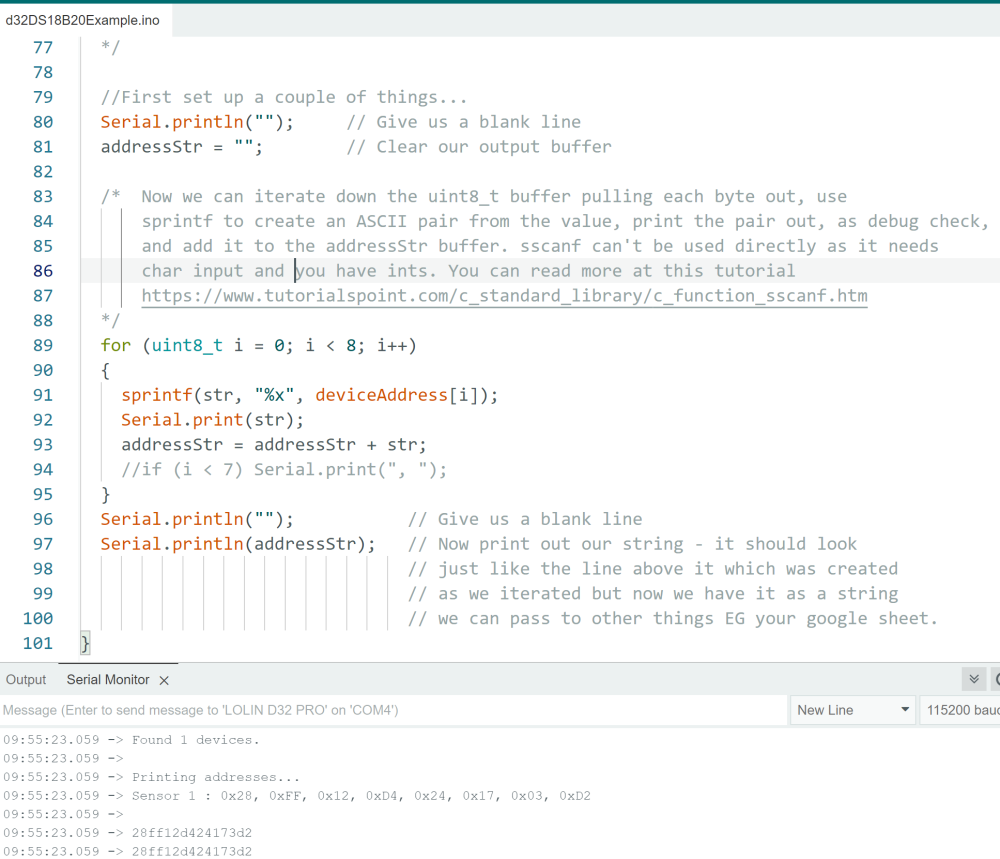
OK - I understand. So below is some example code I built to give you an idea to play with and links to some tutorial stuff. I connected a DS18B20 to an ESP32 board and ran the code below. It explains, very simply, why sscanf can't be used out of the box, you will need to pre process the int8_t buffer before you could use it and if you pre processed it you wouldn't need it - if you get my drift. The tutorials point link in the code is quite good at explaining the syntax for sscanf. In some ways sprintf also needs a bit of work but would be a much more elegant solution in my view. I have tried to explain it all in the code as we go along. My code, with output, full code is below. The bottom line is printed from a string built up by iterating across the int8_t buffer, the line above it by just printing our each byte value as HEX and the line above that is the raw code output from the tutorial mentioned. Hope it makes sense. My setup looks like this, just one DS18B20 Full code: #include <OneWire.h> #include <DallasTemperature.h> // FROM https://lastminuteengineers.com/multiple-ds18b20-esp32-web-server-tutorial/ // Data wire is plugged into port 15 on the ESP32 #define ONE_WIRE_BUS 15 // Setup a oneWire instance to communicate with any OneWire devices OneWire oneWire(ONE_WIRE_BUS); // Pass our oneWire reference to Dallas Temperature. DallasTemperature sensors(&oneWire); // variable to hold device addresses DeviceAddress Thermometer; int deviceCount = 0; char str[20]; // I added this bit - we will use this to create the bytes as hex. String addressStr; // and this - our final string will appear here void setup(void) { // start serial port Serial.begin(115200); // Start up the library sensors.begin(); // locate devices on the bus Serial.println("Locating devices..."); Serial.print("Found "); deviceCount = sensors.getDeviceCount(); Serial.print(deviceCount, DEC); Serial.println(" devices."); Serial.println(""); Serial.println("Printing addresses..."); for (int i = 0; i < deviceCount; i++) { Serial.print("Sensor "); Serial.print(i+1); Serial.print(" : "); sensors.getAddress(Thermometer, i); printAddress(Thermometer); } } void loop(void) { } void printAddress(DeviceAddress deviceAddress) { // This the original code I am playing with. It pulls each int out of the // int8_t buffer and really just uses the clever bits of the Serial.print // function to pop out the hex values. You can do very little from here to // create a string. Howevere the basic process can be used and that is what // I have done below. for (uint8_t i = 0; i < 8; i++) { Serial.print("0x"); if (deviceAddress[i] < 0x10) Serial.print("0"); Serial.print(deviceAddress[i], HEX); if (i < 7) Serial.print(", "); } Serial.println(""); // This is the additional bit: /* Our unit8_t[8] is an eight byte array / buffer each byte of which holds a number that represents the HEX value of the byte address in that position so we will need to handle them one after the other and build up our final string as we go. So we need to iteratively pull all the HEX values out one by one and then build up our string of all the chars. Sprintf with the %x format does this neatly. It will put every hex pair into our str buffer a pair at a time. We will then need to take that pair and pop it into the bigger address buffer so we can print / add it to our data line later. */ //First set up a couple of things... Serial.println(""); // Give us a blank line addressStr = ""; // Clear our output buffer /* Now we can iterate down the uint8_t buffer pulling each byte out, use sprintf to create an ASCII pair from the value, print the pair out, as debug check, and add it to the addressStr buffer. sscanf can't be used directly as it needs char input and you have ints. You can read more at this tutorial https://www.tutorialspoint.com/c_standard_library/c_function_sscanf.htm */ for (uint8_t i = 0; i < 8; i++) { sprintf(str, "%x", deviceAddress[i]); Serial.print(str); addressStr = addressStr + str; //if (i < 7) Serial.print(", "); } Serial.println(""); // Give us a blank line Serial.println(addressStr); // Now print out our string - it should look // just like the line above it which was created // as we iterated but now we have it as a string // we can pass to other things EG your google sheet. }