


MikeSharp01
-
Posts
5693 -
Joined
-
Last visited
-
Days Won
16
Everything posted by MikeSharp01
-
 Oh well - gone are the days of me pointing people at your Willis system I suppose. I think with the new grant at £7500K you should be able to get it almost free although as you say the unit will be hard to source because modulating a bigger one down to 2.5Kw output will be a challenge. The buffer tank issue is a can of worms as well. We have basically the same slab so I felt I did not need a buffer tank but I wonder how good the heat transfer is and I would want to know that - which you of course do for you place, before I opted for the Free heat pump without one.
 -
Landlord epc min c scrapped
MikeSharp01 replied to Pocster's topic in Environmental Building Politics
Been the case forever and for close to 50% of our young people - recent graduates, their real taxation rate is over 50% when you take into account the student loan repayments. How are they going to make a start when the rich pay less than their share and they pay more than their share. -
You cannot paint easily over oil, and danish oil is not water soluble so will creep through unless you paint over it with one of those oil based stain paints.
-
Hmmm - you will be suggesting bumper car technology next a pole and a wire net suspended above. Some rather basic elementary morphological analysis would, I hope, show that overhead and further below is much more complex than directly underneath in the road surface. There is almost nothing going on, a few sensors here and there perhaps, in the 300mm of the road surface while there is loads below and above. So in the surface becomes the ideal place to put it. Every parking spot in the services could have it, every parking spot everywhere in fact. It probably uses a version of, something like, the power handshake that PoE uses so the power supplied is agreed and then supplied in microseconds.
-
There are down sides to everything but suppose you had this along the kerbside in residential streets you could charge any cars that where parked there and solve the training leads problem that presents. Most of the time on motorways you are in one lane and sticking to it so you could easily get 30 minutes of charge along the way - it does not have to be perfect just enough to spark interest and then you can improve it.
-
Just read about this and found a BBC review of it. Charge your car Scalextric style while driving along - power is only on where the car if over the track - creative thinking at the very least.
-
Landlord epc min c scrapped
MikeSharp01 replied to Pocster's topic in Environmental Building Politics
Yes the ability of the planet to support the population is a problem. After all it takes only seconds to create a new persons zygote and that person may then need to rely on the planet to sustain them, and all that entails, for 80+ years. There we just over 700,000 births in the UK in 1994 - they will be 29 now. If they all live as couples and wanted to buy in 2022 we needed to have built 350,00 houses, yet we only managed to build 233,000 and this does not take into account migration / death rate and immigration numbers which will adjust it a bit. Yet again something is out whack even though the fact that 700,000 people born in the UK in 1994 might be expected to be wanting a home around now. Oh and the fact that the baby boomers will start to need care and the plant is warming up, people want to get away for the over hot places to cooler climes, get out from under difficult political & cultural situations and.... Sadly I feel we need to blame our politicians for not getting to grips with anything - or that is how it feels. -
Landlord epc min c scrapped
MikeSharp01 replied to Pocster's topic in Environmental Building Politics
The maths / economics are obvious looked at this way. The other side of the equation has some similar maths associated with it. The median (mean is higher but distorted by a small number of individuals earning very large amounts - don't forget the tax system is open ended above 40%, household disposable income (after direct taxes) was £32K (ish) in 2022 so for you to get a return on your investment this household would need to spend 75% of their disposable income on rent! I appreciate that a £400K house might be beyond the expectations of 50% of the UK's households but to get back to the 5 times your income mortgage test these families can only afford houses in the £200K region. Something is out of whack somewhere me thinks. -
Landlord epc min c scrapped
MikeSharp01 replied to Pocster's topic in Environmental Building Politics
Oftentimes an oxymoron one suspects. -
That's interesting - looking at the Q-Ton, details here, it seems to be able to supply only between 9 and 5 l/min, depending on season, at the temp rise and all the drawings I have found show unvented cylinders in the circuit. Still it sounds like start down the path of an instant hot water combi heat pump.
-
Just been listening to the R4 PM programme. They did a piece on Heat Pumps and one of the contributors said that Ground Source Heat Pumps (GSHP) can deliver instant hot water like a combi boiler. Did I hear that right?
-
Using quite a lot of coal.
-
Landlord epc min c scrapped
MikeSharp01 replied to Pocster's topic in Environmental Building Politics
Can we agree that whoever pays someone has to or the planet burns. The challenge is lack of forethought / planning for the carbon neutral future - like most on here we are trying to build a highly insulated home for ourselves where we use the minimum amount of energy to sustain us. In doing that I guess we are going some way to doing our bit. Essentially our politicians have cocked up and either way we will all have to pay - I would just rather it wasn't my grandchildren. -
So is off grid now on the same - non new boilers as the on grid?
-
Landlord epc min c scrapped
MikeSharp01 replied to Pocster's topic in Environmental Building Politics
Hmmmm maybe better for landlords but not, I suspect, better for tenants or the planet. -
That looks like a problem! Mortar might do a temporary fix but if its getting wider I would be worried that it will just open up again you need to find out what is causing this growing gap and fix that. Have you a picture of the whole wall down as far as the eaves so we can see what it looks like in a slightly bigger context.
-
Dry verges - needed on gable ends?
MikeSharp01 replied to elvis80's topic in Roofing, Tiling & Slating
It turns out I do have a pen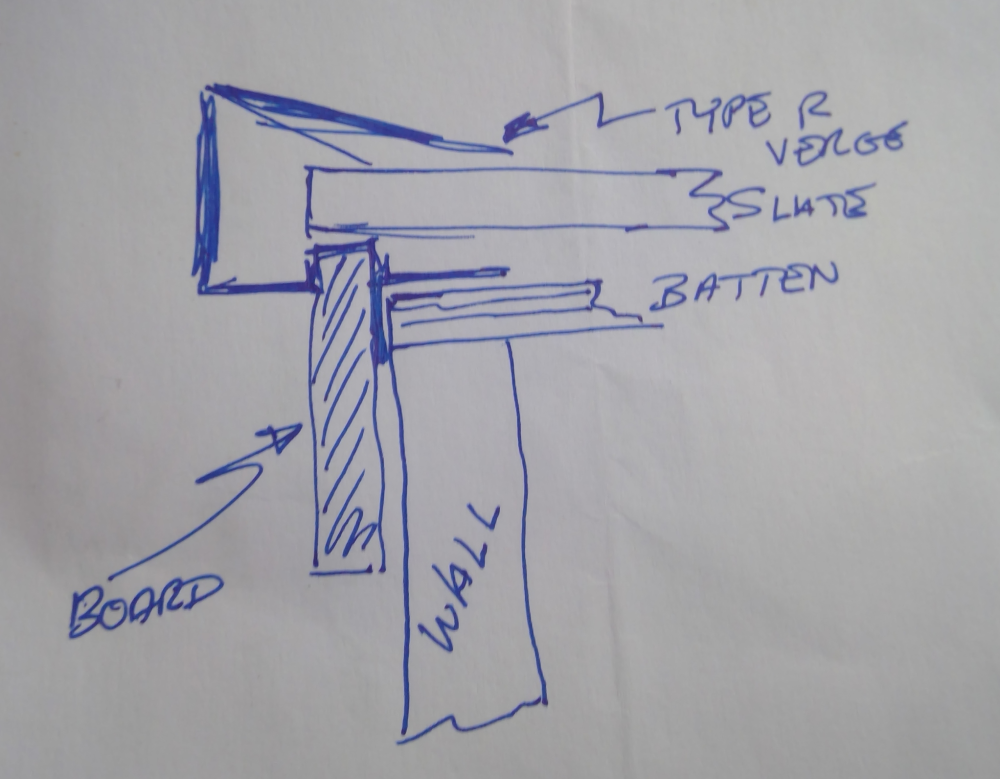
-
Dry verges - needed on gable ends?
MikeSharp01 replied to elvis80's topic in Roofing, Tiling & Slating
You are going to need a board in that groove of the type R down the wall - not sure what the correct architectural name is. If I had a pen I would draw it but I am on a train! The type R does not have enough cover down the wall to be sure the weather cannot get up under and into the battens area - a board would cure that. -
Dry verges - needed on gable ends?
MikeSharp01 replied to elvis80's topic in Roofing, Tiling & Slating
Cripes work to do here - You need to get protection down much deeper than type R will give you on the final pic, cannot see the ends of the others. I would use a board along the verge and fit the dry verge to that and try and get it under the tiles as best you can, looks like you will need to lift the edge of the tiles clear of the batten at the edge to make this work. The dry verge I looked at (here) has a feature to take the board to give you more depth down the wall. If you cut the verge round any fixings you will break the flow down the under shield and let water in. -
Hello - new member hoping to install air source heat pump
MikeSharp01 replied to Peter269's topic in Introduce Yourself
Welcome to THE forum for people like us! Systems thinking is a much neglected art in these days of great opportunity for complexity and chaos. -
They are, they fit in a smart looking, but still plastic, cage you can use them without the cage. Just so everybody knows you need to be aware that these traps only catch the male moths. So, if you understand the basic repro process you will understand that while you may catch many moths just one male surviving can fertilize many females while also having a whale of a time because the competition is all stuck up to your traps.
-
Running Ethernet cables on a drain vent box
MikeSharp01 replied to rhymecheat's topic in Networks, AV, Security & Automation
There must be something in that box or it would not be there so what ever you do don't go to hard as it is probably pipework. -
Running Ethernet cables on a drain vent box
MikeSharp01 replied to rhymecheat's topic in Networks, AV, Security & Automation
Camera would work or you could just gently remove the boxing and remake it when you have the cable through. -
Running Ethernet cables on a drain vent box
MikeSharp01 replied to rhymecheat's topic in Networks, AV, Security & Automation
I use a hole saw that I have adapted for this sort of thing. It has a jubilee clip around it that a set to what I think the thickness might be and then I drill very gently, once it bottoms out and I am not through I adjust the clip and go again until I am just through. You can then look in the hole and see what's there. -
Running Ethernet cables on a drain vent box
MikeSharp01 replied to rhymecheat's topic in Networks, AV, Security & Automation
You can't really drill safely anywhere there as the boxing in must be for something and it won't be a steel because it has no support at the front end. Where do you think the pipe comes down in that space - right in the corner?

