


MikeSharp01
-
Posts
5693 -
Joined
-
Last visited
-
Days Won
16
Everything posted by MikeSharp01
-

brave stone masonn /drystone dyke
MikeSharp01 replied to scottishjohn's topic in Landscaping, Decking & Patios
How structural does this need to be? -
Welcome to THE forum for people like us. Sounds like interesting project possibilities and lets face it the journey of 1000 miles starts with the just one step!
-
Our BC wanted the sweeps kept shallow so we do have some interesting pipework leading up to the chamber to avoid a 90 bend in the chamber. I have colleagues at the Uni doing some research work with one of the big pipe manufacturers and they are building a long drop (20m) to rest bend then into chamber all in clear plastic instrumented to death to research how these flows work, the forces involved and the challenges of transporting the stuff that regularly gets flushed that probably shouldn't.
-
Yes we all need to keep in mind the length of @Pocsters tentacles (I checked the spelling of that very carefully) when closing in on Bristol - best go incognito or an Abrams tank! So welcome @Brizzol but beware some of the locals can be seriously 'interesting'.
-
COP of MVHR
MikeSharp01 replied to Iceverge's topic in Mechanical Ventilation with Heat Recovery (MVHR)
Hmmmmmm .. Interesting spot and one wonders if these two factoids are conflatable in the way you have. One, the latter, refers, if I have it right, to the power consumption of the fan while the other has no input power of the rest of the unit while recovering the 1257 W and I guess it will be approximately 300-420W. If my estimations are correct then the fan around 10% of the power usage of the unit at this recovery and you are right 420W / 10 = 42 so that bit is right . -
Here is a bit more detail. Hope it helps.
-
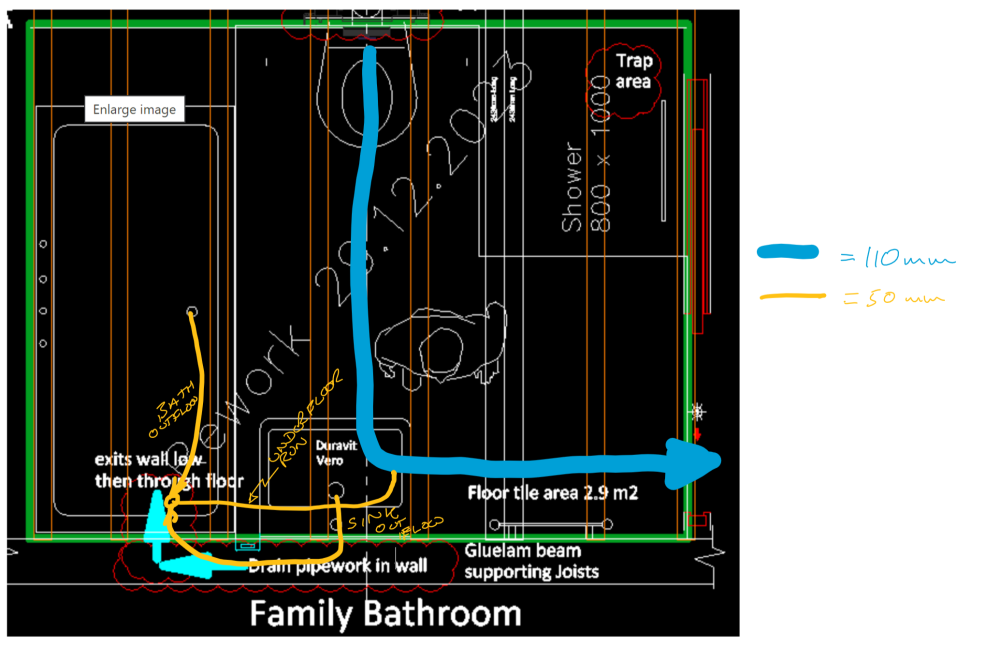
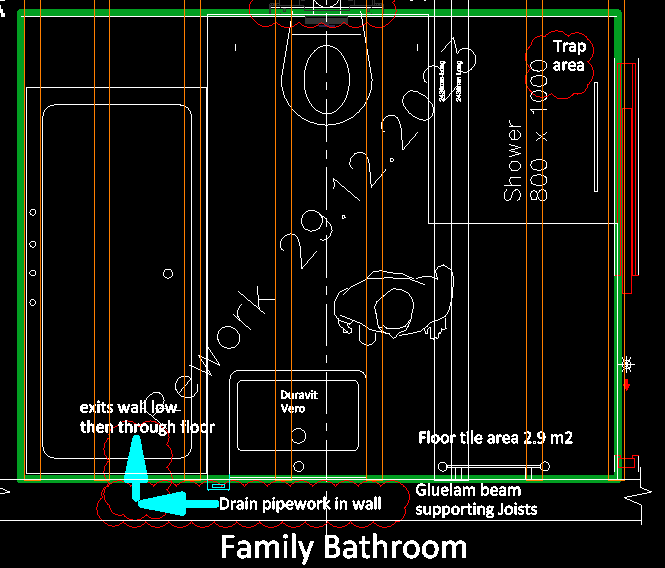
@ProDaveOk finally got time to pull the drawing: So the challenge is to get the two inflows from the from the sink and bath into the main pipe which turns to the right under sink as shown in my OP. We won't want the pipe to go into the floor under the sink so we are taking it along in the wall and bringing it out under the bath then down through the floor and along through the joists to the point I modeled in the OP. We are prevented from going through the floor below the wall as the gluelam beam is there and we cannot drill through the twin Kerto beams, in the pic, that runs under the shower and butts onto the gluelam beam because the SE, who signed off the holes we already have in it won't sign any more holes off. We cannot run in the wall all the way to the lower right corner, and drop down into the I-beam zone in a boxed in corner, from the bath as there won't be enough drop. I think I have to go through the next I-beam and then into the pipe but I will probably have to strengthen the I beams so broadly what @Conor suggests. What is the shallowest slope I can allow on the water outflows from the sink and the bath - not usual solids at least!
-
Go Back to the JPEG in 3D paint and scale the your scale bar up by 2.9 times drag the selection tightly round the scale bar. Observe the width pixels in the top right of the 2D selection. Multiply that figure by 2.9 and then stretch the box until it reads the calculated value - Only stretch in X. Then the scale bar should measure 9m near enough. They don't want scales a long way out because if they were you might be building a sky scraper or a dolls house in your back garden and they signed it off!!!!!
-
Intake and Exhaust Ducts
MikeSharp01 replied to Mr Blobby's topic in Mechanical Ventilation with Heat Recovery (MVHR)
Yep we will be using the UBBINK AERFOAM INSULATED DUCT via Epic, cos they are local and I can save the delivery costs, My only question though is what do people go up through the roof with - the UBINK cowels have a massive flow restriction . -
Yep that's how we did it.
-
All I can say is that nailing them to achieve a 90 joint is no fun. I eventually gave up and where I have 90 deg junctions, around windows, I used Simpson strong tie 90 deg brackets with a backer piece in the reverse webs to take the screws.
-
Is that what you really meant to say as it reads somewhat like the old which is heavier a kg of bricks or a kg of feathers josh🤔.
-
Thanks all - I will post a drawing later to show the whole layout. This is all due to change in the room layout which means we have very restricted height above the pipe. The soil pipe is not yet fixed, only dry fixed, so it can all come out to play. I can get the pipe up a little but because it runs about a meter further in the direction of the open end I still need a fall and I cannot cut the flanges although the webs are fair game for 50mm holes given the span and loading.
-
Vaillant 7kw % efficiency rating for BREL Part L
MikeSharp01 replied to Post and beam's topic in Air Source Heat Pumps (ASHP)
That is a very interesting read - would be good to see the research the default tables are based on and how the 'where this data is made available' is asked of the manufacturers. -
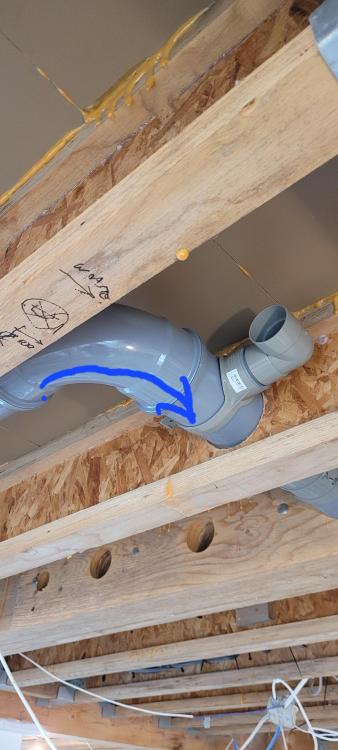
I need to connect the bath and sink outflows into the soil pipe and I am thinking something like this - ots only clipped on. I worry that its too close to and on the outside of the bend and that it will cause a 'catch point' for solids etc from the WC which is about 2m away from the bend. The blue arrow shows the flow direction. I can go through the I beam just behind and perhaps move the entry point 3-400mm downstream. I can also reduce the incoming pipe size but if I go much smaller the bath may take time to empty - not that that is a problem. Any thoughts?
-
Talking to people this seems like something of a lottery. Several here have asked for more than the 16A limit and got it while others did not. If you can get 3ph you will have 48A. We are about to ask for 7kW (32A approx) but my sources say we won't get it while another- who works for a DNO says is worth punt.
-
Only with current insulation config - by taking some steps to improve thermal performance you may well be able to get the gap closed and so get the size of unit down - I think that would be my starting point.
-
Microcontroller based power switching revisited in 2024
MikeSharp01 replied to TerryE's topic in Boffin's Corner
Don't be daft I have been seeing my dissertation students all year and the Easter break is after their hand in - its cruel out there these days! -
Microcontroller based power switching revisited in 2024
MikeSharp01 replied to TerryE's topic in Boffin's Corner
They are already kicked off on their projects, if only I had known in December we could have arranged that. -
Microcontroller based power switching revisited in 2024
MikeSharp01 replied to TerryE's topic in Boffin's Corner
Actually, last evening I managed to get Free RTOS working on a PICO board working, in C++ that is, which I had not tried and it does what it says on the tin so I think I will, once I have completed the terms teaching with Python, I will look at moving my personal system of systems over to that - I still have all the stuff I did with the esp blocks in prototype so lets see how I get on. -
Microcontroller based power switching revisited in 2024
MikeSharp01 replied to TerryE's topic in Boffin's Corner
Yes that is a pain. I have a similar stretch although a different combination and I have tried teaching coding to undergrads in perhaps 8 languages across my career, which goes back to the early 80s, and they all have their challenges (Never Ada though - respect) - started with Assembler, moved through Fortran, BASIC, C (I can see my copy of Kernighan and Ritchie from here - literally), C++, Java (Hated that), C#, PHP, Javascript and now Python mainly because of its breadth - Data Science and Embedded although not mobile and its position on the TIOBE index, with a host of spin outs along the way EG ASP, VB & SQL. I would prefer full Python on the PICO and an RTOS but I appreciate why these are not imminent possibilities although you only have to swap to the RPi Nano and you can do all the languages, not the RTOS, and run under UNIX as well! If I really wanted true, hard, real time (Sommerville's rules as I think of them!) system I would not use Micropython but I think we can get away with a somewhat softer real time system so as long as we can achieve the softer timings it should be a workable solution. Yes I have found the timing issues with Micropython, usually dealing with MQTT publish / subscribe operations, a problem. Seem to spend a lot of time dealing with them - my current strategy is just to keep the main loop handing flagged operations from callbacks rather than extending the callback to actually do the handling. -
Microcontroller based power switching revisited in 2024
MikeSharp01 replied to TerryE's topic in Boffin's Corner
Yes - I agree, I even advocated not doing this here I think, I won't be developing the hardware I will use COTS components everywhere I can, which I will double up on so I have spare of everything as I don't know how long even established brands will keep on keeping stuff available in a fast moving tech market, and document copiously both the system and the code if I need to develop any. I have wired the house traditionally and in places it will be used as such otherwise the switches just send momentary pulses, at 240V - so if needed be the momentary switches can be replaced by traditional rockers and the HA bridged out to control the lights, to the de-bounced inputs of the relevant PICO - its all node-red, local RPi install of mosquito and MYSQL for data logging - actually getting that stable has been one of the biggest challenges so far. DMX control of the lights via Whitewing will be the way forward although I have not purchased them yet as I don't actually know how many of the lights need dimming! I have struggled to keep it below 16 so I only need one unit but even then I will buy two with one as a spare! So I guess I would argue I have thought this through but I admit the risk you highlight but you must admit that any technology has a life (a carrying capacity) and so there are no guarantees anywhere here, only balances of risk. -
Microcontroller based power switching revisited in 2024
MikeSharp01 replied to TerryE's topic in Boffin's Corner
I have a slightly alternative view of the PICO / ESP issue and that is down to my feeling that I want to support RPi Ltd in developing leading products in the UK rather than buying into a stream of technology from elsewhere, I have nothing against the ESP and was teaching with it until last this year, I am not a 'little Englander' I just want to bring my approach closer to home. I appreciate that I have given up a decent RTOS that I was using on the ESP but on the PICO I can work in VS code environment point it at either C++ or MicroPython which is, I feel, OK for HA work and I can talk to ZigBee, Z-Wave and most other proprietary protocols if I need to. I also wonder, although I appreciate the work involved, how long it will be before you can flash Tasmota onto the PICO! -
Microcontroller based power switching revisited in 2024
MikeSharp01 replied to TerryE's topic in Boffin's Corner
I have a couple of these I intend to use to control 24v which will then use WAGO 24V relays to control the bigger loads. https://thepihut.com/products/industrial-8-channel-relay-module-for-raspberry-pi-pico?variant=40605655367875¤cy=GBP&utm_medium=product_sync&utm_source=google&utm_content=sag_organic&utm_campaign=sag_organic&gad_source=1&gclid=Cj0KCQiA2eKtBhDcARIsAEGTG40_R-cXtRgFbkA_bCKbAX7r1NvSWOReNEeHk8qOv5Sf7LZeswKMf6gaAiS6EALw_wcB As it takes a PICO directly, which you can of course bridge out on the Gpio pins, you have a smart relay board to boot.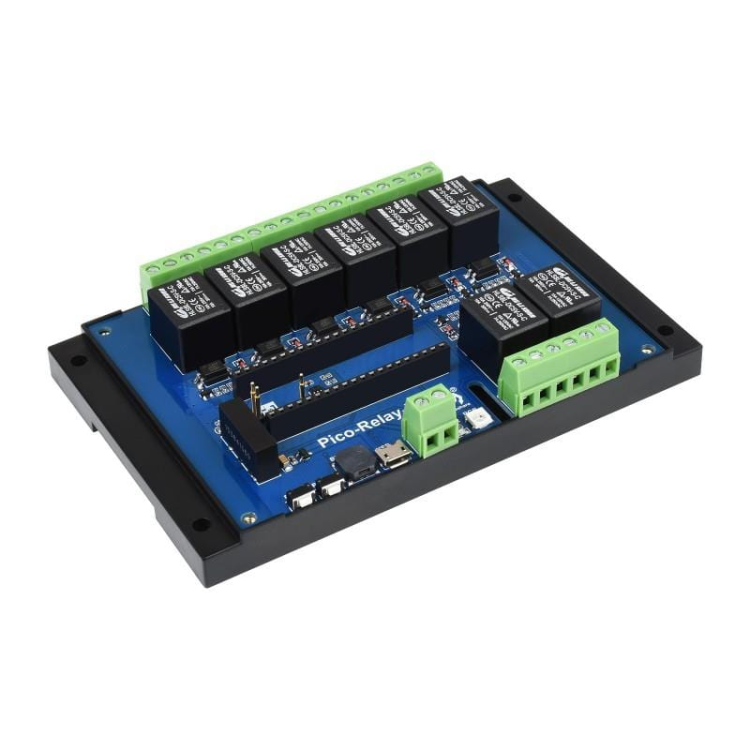
-
Hi and welcome. Not an expert in any of your questions somebody who does should be along shortly.
- 31 replies
-
- 1
-

-
- concrete slab
- lime render
- (and 1 more)



