Jeremy Harris
-
Posts
26430 -
Joined
-
Last visited
-
Days Won
360
Everything posted by Jeremy Harris
-
Yes, it is an issue, and one our roofers commented on. Our main roof was counter battened at 400 centres, then battened (both with 25 x 50 battens), and was no problem, but the garage roof was at 600 centres. However, when the roofers took a close look they realised that nail bounce wasn't going to be a problem with it as MBC had fitted 50 x 50 battens on the garage roof, and they were stiff enough to stop any bounce. Made the roofers happy bunnies!
-
That's simply unbelievable. How on earth could anyone assume that an aluminium composite panel would behave in a similar way to a ceramic tile? More to the point, how on earth could any rational being accept that a compliance demonstration based on such an obviously flawed assumption was in any way reasonable? The more information that seems to being revealed about the way product approvals have been undertaken, the more shocked I'm becoming. I started from a position where I already suspected that a lot of approvals weren't worth the paper they were written on, so I shouldn't be surprised, but the extent to which this seems to have been going on is simply incredible.
-
I suspect they are wise to not trust the paperwork, as it seems that some of these cladding materials were never, ever fire tested, but were approved using a desk top study, something I find unbelievable. How on earth we have allowed a system to develop where safety-critical materials aren't physically tested as a part of the approval process I don't know; it makes the multifoil approval fiasco look insignificant by comparison. I wonder how many other building materials have never actually been tested in order to gain approval certification?
-
While you're at it, try and get hold of an old front door that's been scrapped, and get it firmly fixed as a temporary entrance that you can make secure with a good lock. You can often find old doors that have been taken out by replacement door and window fitters - my neighbour acquired a perfectly serviceable uPVC door set for his garage like this.
-
There are already some fire risk reduction schemes used in other countries that have insulation clad buildings that could be adopted, but one major issue now is that the government have whipped up a frenzy of fear with their barking mad sample testing regime. I'm pretty sure I know why they are doing the sample testing, it's almost certainly to just identify the type of thin core inside different panels, and establish whether it has fire retardant additives. These tests aren't, strictly speaking, fire resistance tests at all, but rubbish reporting, and the lack of adequate government control, is making them sound as if they are. Other countries have far greater EWI fire risks on some of their buildings than we do, and, as this problem has been around for well over a decade, solutions have been devised to make buildings safer. The simple and easy solution is one borrowed from the oil and gas industry; the use of external, roof-mounted, deluge sprinklers, that pour water over the outside of the building. These are relatively easy to install, not massively expensive and are able to quench an external wall fire if operated during the early stages. Best of all, there is no real risk of damage from accidental operation of the sprinklers, so they can have a high-sensitivity trigger system, as false alarms don't really cause much of a problem. Fire stops are an essential requirement, but the building regs are clear about the need for these already, so all that needs to happen is an enforcement of the regulations.
-

Spot the Pipeline
Jeremy Harris commented on AliMcLeod's blog entry in A house! A house! My kingdom for a house!
I don't think it's that uncommon to find things in the wrong place, it seems to happen a lot, with everything from pipelines and HV power cables to smaller pipes and cables. We found a water pipe under the lane in front of the house that the water company had told us didn't exist. We traced it to a neighbouring house and found the stop cock in the verge had been replaced relatively recently, as it had the water companies name on it. Similarly, there was a very large project nearby to run a large diameter, high pressure, water supply pipe across several miles of fields, under a river and across two major roads. I drove past the roadworks involved with this every day for several months, and was intrigued by the large drilling rig they used to bore underneath the river (which is a popular trout fishing one). Out of curiosity, I had a look at the project website, to see if there was any information about the way they were drilling under the river. There was a scale plan of the project, and it was pretty clear that the pipe was not in the same place on the ground as it was on the plan - my guess is that they had to re-position it for some reason, but that the new position wasn't reflected in the plan. There's no indication that this pipe is there now, the crops are back growing on the fields and you need to look closely to see where the work was done. I just hope that someone had the sense to re-draw the plans to show the as-built location. -
The site security chain I used is one that I used to use to secure my boat trailer, and is similar to the description @PeterW has given. In my case I used two lengths of Kevlar dinghy rope, threaded through the chain, then covered the whole thing with a bit of heavy duty black heat shrink sleeve. The idea is that the Kevlar should act a bit like the padding in chain saw clothing, and tangle up around a grinder blade.
-
Yes, but it still needs a custom widget, rather than an off-the-shelf humidistat. I have a feeling that if going for a custom humidistat approach, then the easy way to do it would be to just look at ΔRH/Δt, as that should be all that's needed to trigger the MVHR to increase the ventilation rate. Extra occupants, a shower running, or cooking, would generate a fairly steep increase in RH over a relatively short period of time, an increase that's probably significantly faster than any natural change. Using a relatively rapid increase in RH to trigger a higher ventilation rate, and then using the slower decrease in RH to trigger a return to the background ventilation level would probably work quite well, and would only need a single RH sensor.
-
Yes, that would work OK. The only slight snag is that it would need a custom control box, as the cheap programmable humidistats, like the one I fitted, aren't able to do this. It wouldn't be hard to make a custom unit, although it would need to derive AH from RH, as all the cheap and reliable sensors only measure RH. Not a problem with a temperature sensor as well, though. It would probably be good enough to just adjust the RH switching threshold with outside air temperature.
-
AEC 5CG Air Source Heat Pump
Jeremy Harris replied to ProDave's topic in Air Source Heat Pumps (ASHP)
Sorry, you're right, it looks like B model 2. I'm pretty sure they still have the click-click SD card socket. -
AEC 5CG Air Source Heat Pump
Jeremy Harris replied to ProDave's topic in Air Source Heat Pumps (ASHP)
That's a RPi model A, which commonly had the "click-click" SD card slot, so it's possible that the card has pinged out. It's ten minutes work to burn a new bootable card, if they can send you the image file. -
Damon borrowed my monitor to make those school measurements, and I've seen the same strong correlation between RH and CO2 concentration in the main living areas. The correlation falls over in bathrooms, where humidity rapidly increases at a rate higher than the increase is CO2. All told, I'm convinced that just using RH control would be plenty good enough, and would enable ramping up the ventilation rate when the shower of bath is in use. The boost system I've installed uses RH sensing inside the extract duct plenum. This seems to work well, but does need adjusting twice a year, as the background RH changes with the seasons.
-
A colloquial term for them is pot joints............
-
AEC 5CG Air Source Heat Pump
Jeremy Harris replied to ProDave's topic in Air Source Heat Pumps (ASHP)
Which version of the RPi is it? The early ones had a "click-click" card slot, and that was a bit notorious for pinging cards out a long way if the card was pressed and let go. The later models change to "push-pull" card slot, that is a lot less likely to ping the card out. I think it may be possible to ping the card out of an early RPi just from a bit of shock or vibration, so it could be the card was in there but has been pinged out. -
Could be, although whether or not it would have made a significant difference I'm not sure. My guess is that, by the time the fire had become established on the outside, the outcome may well have been the same. The zinc composite panels that were originally specified had the same rating as the aluminium composite panels, but as the ratings were pretty meaningless with regard to the way the entire system was designed and installed, there's no way, short of a proper full scale test, to be sure. One (wholly unacceptable to the local residents. I'm sure) way to test the way this fire developed might be to deliberately start a fire low down on one of the undamaged areas of Grenfell Tower, and record carefully how it develops. If evidence that swapping the zinc composite for aluminium composite was a contributory factor, then some of the surviving cladding could be swapped for the zinc composite so a direct comparison could be made. I'm sure this won't happen, because of the trauma it would cause to the local residents seeing that block on fire again, apart from anything else, but it would be a very good way of collecting some first-rate evidence.
-
It's also still misleading, as the melting point of zinc is a lot lower than the melting point of aluminium, 419 deg C for zinc, versus 660 deg C for aluminium. Had the composite zinc cladding been used over PIR, with the PIR providing the fuel for the fire, then the cladding skins would have failed sooner, exposing the core to the fire earlier.
-
My experience was that OpenReach were happy to supply free grey Duct 56, with the hockey sticks, for me to lay, and then they'd come along later and pull the cable through. In the end they dropped a reel of cable off and we pulled that through, too, leaving it coiled up at either end for them to make the connections.
-
We paid around £22/m² for about 65m² of travertine stone tiles, laid mainly on to a pretty flat slab, but including two bathroom floors that were laid on to marine ply screwed and bonded to the OSB floor. We're right on the Wiltshire/Dorset border, roughly midway between Salisbury and Shaftesbury.
-
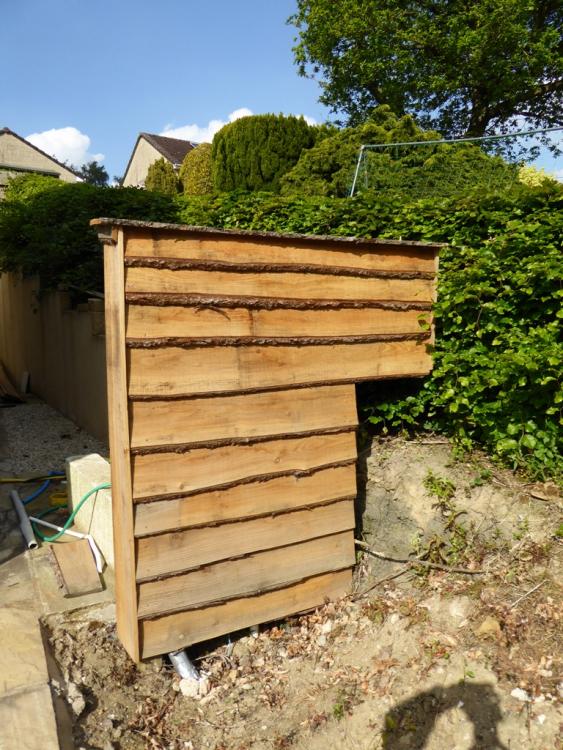
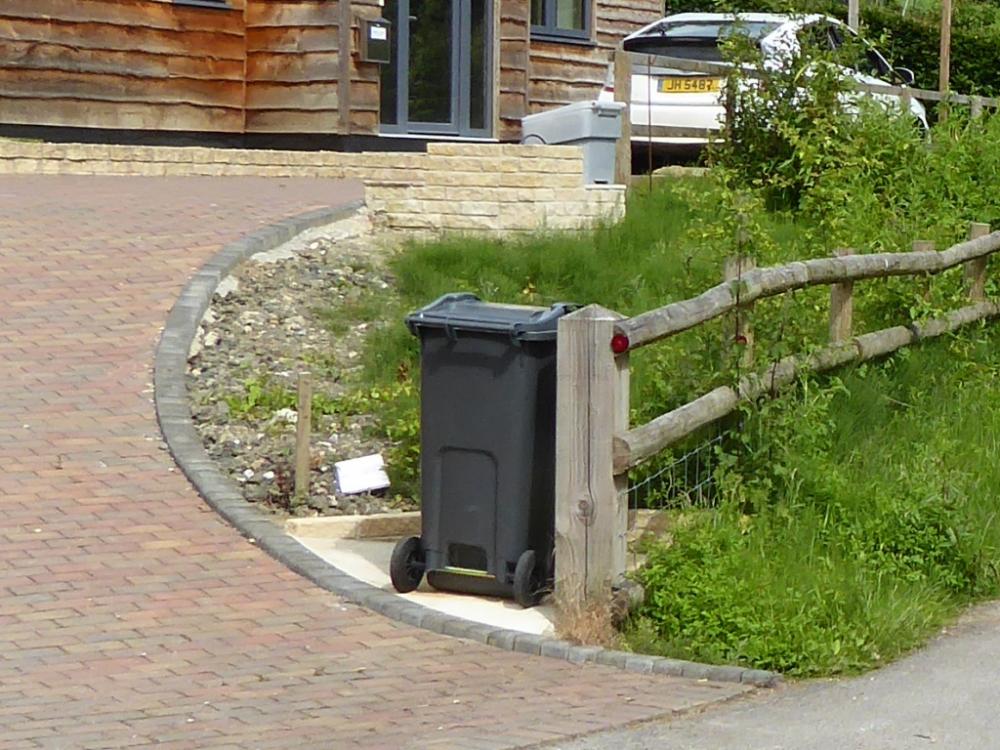
I managed to combine the requirement for an external meter box fence with a screen for the bin storage area (this is an old photo, the bins now live where the junk is and the ground in front has been landscaped): Because our lane is narrow, with no grass verges, I needed to create somewhere to leave the bins, as the refuse people have to have them near the roadside. The solution was this stone paved area just inside one of the gate posts:
-
Our situation was a bit bizarre in the end. We started off with around 14 people (neighbours) who had all very strongly objected to the previous planning applications for our site, and as a consequence it had gone to committee and been rejected (twice) before it was finally granted approval. We needed to submit a new application, and I knew that it was going to be an uphill struggle, just because of the pretty unpleasant comments that had been made about the previous applications. My concerns were made greater when we went to the Parish Council meeting, where the chairman started off consideration of our application by reading out the entire planning history of the plot, and reminding councillors of all the reasons they had given for recommending refusal in the past. We were saved by one lady on the PC, who had been looking at the scale model I'd made, and started things off by saying that the new application looked nothing like the previous ones and that they should recommend approval. She seemed to pretty much railroad the rest of them! So, we got PP with no objections from anyone, and when we started building we only had two sorts of comments. The first comments were about the speed they house went up (4 1/2 days), which seemed to amaze a lot of people. The second comments were when we were putting the cladding on, when pretty much everyone was complimentary about the way it looked, with only a couple who asked how I thought the larch would weather down. After that, our house has become a bit of a village feature, with me being asked to give a talk in the village hall about it, as lots of people seem interested in the idea of a house with no energy bills.
-
VHB tapes vs drilling porcelain
Jeremy Harris replied to Calvinmiddle's topic in General Self Build & DIY Discussion
I can vouch for the strength of this stuff. When my last car was written off, there was a massive amount of bodywork damage. None of the VHB fastened external trim came off, even on panels that were badly creased. I think the only time I've had a consistent bond failure with the stuff has been when using it to attach a dashboard camera mount to the windscreen. It seems to last about a year to eighteen months before coming off. I suspect it's a combination of heat and degradation from sunlight, as it's always the bond to the glass that seems to fail, the stuff stays extremely well bonded on to the attachment (so well bonded that it takes ages to scrape the old stuff off). -
AEC 5CG Air Source Heat Pump
Jeremy Harris replied to ProDave's topic in Air Source Heat Pumps (ASHP)
So the unit acts as an AP, rather than a client? There may well be a way to change that somewhere, as the WiFi IP cameras I've been playing with seem to work the same way. By default they start off as an AP, with their own SSID, but once you connect to the web interface via that AP there is an option to have the camera operate as a client on an existing WiFi network. You use the direct connection to set the WiFi SSID and password up for the camera to connect to the main house WiFi LAN, then reboot it to get it to connect. -
That's good news, I wonder what the difference is between the gloss and matte finishes? I did notice that the underside of the bit I tested, that has a rough gloss finish, felt slightly slimy after a few days in water, so perhaps the gloss finish tends to break down a bit when immersed.
-
Part 20 - 2nd fix Plumbing / Sanitary Ware
Jeremy Harris commented on Stones's blog entry in An Orkney Build (in ICF)
As @Nickfromwales says, the more usual thing to do in a low energy house is to avoid a stack penetrating through the fabric of the house like the plague, as it acts as a big thermal bridge. We have an AAV at the highest point inside the house, and the foul drain run is ventilated at the treatment plant. For those on mains drainage then fitting an external vent, outside the thermal envelope of the house, is the most sensible solution. The arrangement @Stones has shown is very like the way I arranged our downstairs WC, with the 110mm soil pipe continuing to behind the washbasin, and then having a 40mm waste fitted to it to take both the basin and adjacent utility room waste pipes. -
That's the situation we were in, so I opted for the slightly more capable unit, which was slightly bigger than we needed, to make sure we had a bit in reserve for the losses. The higher airflow unit was the same physical size, and not a lot more expensive, so was as easy to fit in the space. In practice, the measured flow rates from every terminal massively exceeded the requirements in Part F, so they all needed to be throttled down a lot, and we can exceed the background ventilation requirement on the lowest setting of the MVHR, which is around the highest SFP, too. I'd not be overly worried about a couple of 90 deg bends, as they will be far less restrictive then the very flexible duct that's often used. I used some semi-flexible "concertina" type aluminium duct for the vibration decoupling sections, wrapped with insulation on the external inlet/outlet side, and that seems less restrictive than the more floppy stuff.