Jeremy Harris
-
Posts
26430 -
Joined
-
Last visited
-
Days Won
360
Everything posted by Jeremy Harris
-

Balancing MVHR system
Jeremy Harris replied to Stones's topic in Mechanical Ventilation with Heat Recovery (MVHR)
@JamieM, attached is the report I drew up, but it's worth noting that it doesn't follow what's in the guidance note, as at the time that I wrote it up I hadn't found the guidance (it wasn't easy to find at that time as it is now). BC accepted it without any questions; I got the feeling that they just ticked a box that it had been done without looking at it closely.................. Mechanical Ventilation and Heat Recovery system Test Report.pdf -
Balancing MVHR system
Jeremy Harris replied to Stones's topic in Mechanical Ventilation with Heat Recovery (MVHR)
There doesn't seem to be a newer version available online, the one I linked to is still the only one on the government web site AFAICS. There is a newer, more general, guide to compliance with domestic building regs, but that seems to have very little detail in it: https://www.gov.uk/government/uploads/system/uploads/attachment_data/file/453968/domestic_building_services_compliance_guide.pdf -
Three pubs in our village closed and have been turned into homes. Each had a bit of a struggle, but the general principle for each was the same. They had to prove to the planners that firstly the pub wasn't viable as a pub, which meant advertising it as such and seeing if there was any interest, and that hinged largely on community demand. If there wasn't they then moved to the next step, which was to apply for change of use from commercial to residential, To do this they again had to advertise it for an appropriate commercial use (office space, IIRC) and provide evidence that there was no demand for that either, or not enough to make it viable. Once over that hurdle they were granted permission for a change of use to residential. I believe there are companies that specialise in this, as I noticed that it was the same company providing the evidence for viable rents, income etc for two of them. It may well pay you to ask around and see if there are any specialist planning consultants that are used to dealing with this, as it could save you a fair bit of time, I think.
-
Sometimes nightmares are real.
Jeremy Harris replied to ToughButterCup's topic in General Self Build & DIY Discussion
So it comes down to whether or not Durisol insist on either bracing unfilled walls, or filling up walls as they go up, in stages. If they do (and you will know this, having had the same training) and the contractor decided he didn't need to follow those instructions, then there has to be some liability there, I'd have thought. -
Sometimes nightmares are real.
Jeremy Harris replied to ToughButterCup's topic in General Self Build & DIY Discussion
Sorting this with the contractor depends very much on whether he was expected to have knowledge and experience of using Durisol, I suspect, plus whether or not there is anything in the MIs for Durisol that say that it should be concreted in batches, or braced to remain stable before the pour. I'm guessing here, but if the contractor was unfamiliar with the product and was relying on information from you, Durisol or your architect, then it may well be that the contractor isn't wholly at fault. It will come down to what could be reasonably expected in the circumstances. -
It would need to be beefed up, Nick. It can deliver a couple of showers, one after the other, without a recharge, but then the Sunamp PV will be out of capacity, and there would be a recharge time of around 30 minutes for the buffer, with DHW being reliant on the electric instant water heater. Youd really need two Sunamp PVs, or a Sunamp Stack, for a bigger system. The buffer tank could be increased in size, but the smaller one has the advantage of a faster recharge time from the ASHP, so it depends on how big a gap there is between large DHW demands.
-
The PHE was this one from Germany: http://shop.wiltec.info/product_info.php/language/EN/info/p3855_-changeur-de-chaleur-thermique-inox-20-plaques-max-44kW.html The flow switch was a Gentech FS-02: http://uk.farnell.com/gentech-international/fs-02/flow-switch-noryl-dc-1l-min-10bar/dp/1006767 data sheet here: http://www.farnell.com/datasheets/1702844.pdf The pump was a low power Wilo, this one: https://www.pumpsukltd.com/yonos-pico-15-1-4.html but any small circulating pump would work OK, as the flow requirement is pretty small and the is very little head to work against.
-
Balancing MVHR system
Jeremy Harris replied to Stones's topic in Mechanical Ventilation with Heat Recovery (MVHR)
Well spotted, I just copied the link from my blog, which is now out of date - I should have checked. -
Balancing MVHR system
Jeremy Harris replied to Stones's topic in Mechanical Ventilation with Heat Recovery (MVHR)
I can stick up on my website later easily enough. I didn't follow that guidance note, as I hadn't found it when I did my measurements, but building control were fine with what I produced, which was really just ticking off all the bits of Part F that applied, with some measured data. -
Balancing MVHR system
Jeremy Harris replied to Stones's topic in Mechanical Ventilation with Heat Recovery (MVHR)
I have a copy of the report I did on my other PC, that I can upload later, but there is a lot of useful info in this guidance note: https://www.gov.uk/government/uploads/system/uploads/attachment_data/file/456656/domestic_ventilation_compliance_guide_2010.pdf -
I used a 44kW PHE plus a small Wilo pump and a solid state 3/4" BSP flow switch in the pre-heated DHW pipe to turn the pump on and off. It thermosyphons well, so the PHE is always at the buffer tank temperature, which means that pre-heat is available straight away, it doesn't needs to wait for the slug of warm water from the buffer to be pumped around.
-
Our local sawmill reckoned that local larch was good for around 20 to 30 years before needing treatment, and if clear treated every five years after that would probably last for around 60 years. His view was that larch was a bit under-rated, and generally tended to be as good as, if not better than, UK grown cedar, in terms of durability.
-
Sometimes nightmares are real.
Jeremy Harris replied to ToughButterCup's topic in General Self Build & DIY Discussion
It depends on what the concrete is being required to do and whether there is rebar. It's pretty common practice to pour in batches during reinforced concrete construction, leaving rebar sticking out of the previous pour in order to ensure there is a good bond between the sections. If the concrete is required to be an airtight/watertight layer, then it's generally not a good idea to pour in batches (some may recall the poured concrete basement in Grand Designs that had really bad leaks along a junction between two pours). If possible, then I think just treating it like ICF, and adding bracing before the pour, might well be the best solution, especially as it will be a lot easier to fill all those voids up using a concrete pump that it will with a labourer and buckets................. -
Yes, preheat is via a "44kW" rated PHE, but that's pretty much the same rating as the coil in the indirect buffer tank. The rating is very highly dependent on the actual temperature differential - halve the temperature differential and you halve the heat transfer rating. What I was thinking of, as a good solution for combined ASHP buffer tank and DHW preheat system, was a direct TS of around 70 litres or so, and with a standard DHW coil in the top section. There's no point in having more than about 100 litres, as the buffer only has to provide preheat to the DHW, so the power needed is around half that needed if the buffer/TS was running at a higher temperature. The ASHP will provide constant top up to the TS when it cools a bit, too, acting as an additional "instant heat" source, in effect. I would hazard a guess that the Telford guys were thinking in terms of "normal" DHW temperature, rather than just preheating to maybe 30 deg C or so. It makes a big difference just dropping the temperature requirement a bit. This only makes sense if you're running an ASHP, want to keep the COP high and have another means of boosting the water temperature up to normal DHW temperature. With a single Sunamp PV, the effective combined capacity with a 70 litre preheat buffer plus a 6kW ASHP is close to double the capacity of the Sunamp PV on its own, plus the buffer/TS could still do it's normal job of providing a direct buffer store for the ASHP when it's running the UFH.
-
Nick, This is what I wrote: I'd not recommend using an indirect small buffer as we have, but having said that I did calculate the heat transfer rate for the lower temperature and it massively exceeded the ASHP output. Newark were happy to replace the wrong tank they'd sent, and gave me the surface area of the coil in it, so I could see whether it had any impact. As it turned out, the indirect coil was rated for around 40kW at 55 deg C, so handled 6kW at 40 deg C with no problem at all. In practice we get no measurable difference between the buffer temperature and the ASHP flow temperature at all, and the heat up rate from cold seems to match the ASHP output. As above, I'd not go down this route by choice, but I made do with what we received by accident. The reason I suggested a small direct TS instead of a buffer was just to eliminate the need for a PHE if using it for DHW preheat. It would be a lot simpler to just run the cold water into a small TS coil for preheat and then run it to the Sunamp PV, electric boost heater or whatever.
-
They were pretty well made, or at least the one we saw at a show (may have been at the Swindon centre, I can't remember now) was. The one we looked at was a GRP moulding, with an inset rubber seal, together with some fairly discreet fixings that fitted to the outside of the house. I didn't think the price was too OTT, given the quality of the unit and the design, but it may well be that someone could come up with a cheaper solution. I think the bigger problem is making other parts of the house flood resistant, things like sealing air bricks and underfloor voids, fitting one-way valves into all the waste and soil pipes, etc.
-
We had the option of lowering the floor height and fitting flood defences, or having it at least 1.5m above the once in one hundred years flood level. I did look at lowering the site by around half a metre, just to make the drive less steep, but the cost of the ground works put us off. However, what I did find was that there were some neat flood protection boards around that looked pretty easy to fit and didn't look obtrusive then not fitted. The planners were OK about this as a solution. There are some links below of the sort of things that are available. When I was thinking about this, I also looked at things like one-way valves to go in waste pipes, to prevent flood water entering that way, and considered adding a deeper sump inside each door, where the door mat would fit, with a small pump to pump out any water that might leak through the door flood barrier. http://www.floodtite.com/ http://www.floodshield.com/ http://www.floodgate.ltd.uk/
-
Sometimes nightmares are real.
Jeremy Harris replied to ToughButterCup's topic in General Self Build & DIY Discussion
Bit of a bugger, but on the bright side it could have been a hell of a lot worse, plus there will be lots of people reading this that will have learned from it. I'd guess that one key point may be that the system you're using isn't that common, and so some of the quirks may not be known or understood. Do you think that bracing might have helped? The only ICF build I went to look at had a fair bit of internal support rigged up, in the form of sheets of shuttering ply and timber braces. I believe these were put in place ready for the pour, but they may well also have been there to stiffen things up before the pour. -
You can buy the knockout rings here: http://cart.vacuumsdirect.co.uk/index.php?p=product&id=449&parent=66 I have a couple of spare ones and could stick one in the post if you want to see if you can use them. They are designed to be clamped in place in the plenum chamber fittings (these parts: http://cart.vacuumsdirect.co.uk/index.php?p=product&id=446&parent=66 ) where the threaded ring holds them in place, but you might be able to glue them in place instead. BTW, the decent flow rate semi-rigid aluminium ducting I mentioned elsewhere, the stuff that is a great deal better that the rubbish flexible stuff with the steel spring in, is this stuff: http://cart.vacuumsdirect.co.uk/index.php?p=catalog&parent=38&pg=1
-
I've found the hardest part has been accurately conveying an idea. My other half is, by nature, a "glass half empty" sort of person. This means that I'm always starting from a disadvantage whenever I suggest something. This is compounded by me being able to immediately see from a drawing or sketch what something will look like, whereas she can't. In several cases I've found that the solution is to either make an accurate model, or to go somewhere to look at something very similar.
-
builder Builder's references - what to ask?
Jeremy Harris replied to oldcoop's topic in Introduce Yourself
I'd second communications being important, as well as how well they deal with problems. Every build, no matter how good the builder, will have a few problems, it's pretty much the nature of building, together with the inevitable things that are out of the builders control, like the weather, reliability of suppliers etc. What matters is how well the builder tackles these. I would be wary of only speaking to people that the builder provides as references, as with the best will in the world they are likely to be the jobs that went well. If you can find others who haven't been given as references you may get a more balanced view. FWIW, I've taken a firm line when it comes to providing references for all the companies that have been involved in our build. They have all been told the same by me, and that is that I will provide an open an honest reference if anyone asks, without bias. That even applies where I've received a discount, in the case of two suppliers, and both were confident enough in their quality of service to agree to that. -
@SunampBlogger, Andrew was very helpful on this forum's (now closed to posts) predecessor, Ebuild, so it might be worth reviewing Andrew's posts there (they are still there, as read-only, in these threads mainly: http://www.ebuild.co.uk/topic/15853-they-are-here-place-your-order-batteries-then-moving-on-to-phase-change-material-storage-units/page__st__120 http://www.ebuild.co.uk/topic/17614-sunamp-pv-vs-thermal-store-heat-loss-comparison/ http://www.ebuild.co.uk/topic/17641-sunamp-stack/ Pretty much every member of Ebuild is now a member here, so will be familiar with the content of those threads, so the links above will most probably give you the information most of us already have about the Sunamp PV and the Sunamp Stack.
-
Newark were happy to fit the connections wherever I wanted, the price seemed to be the same for any layout I think. A 70 litre tank wasn't expensive, I have a feeling that the shipping cost was a major element of it.
-
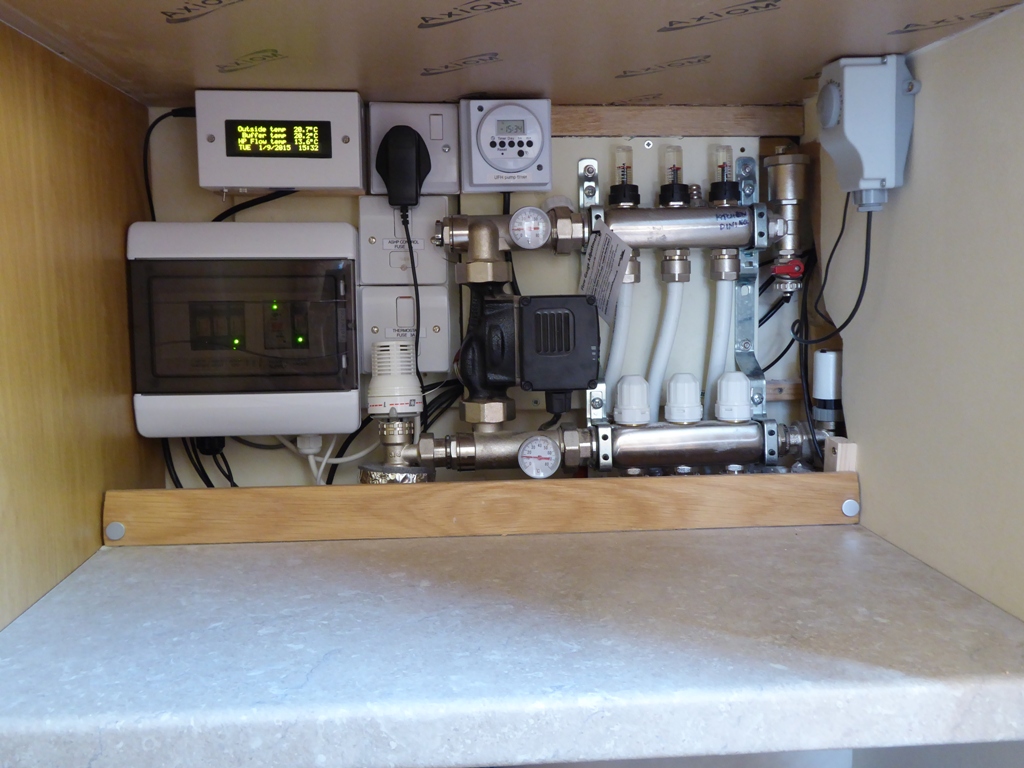
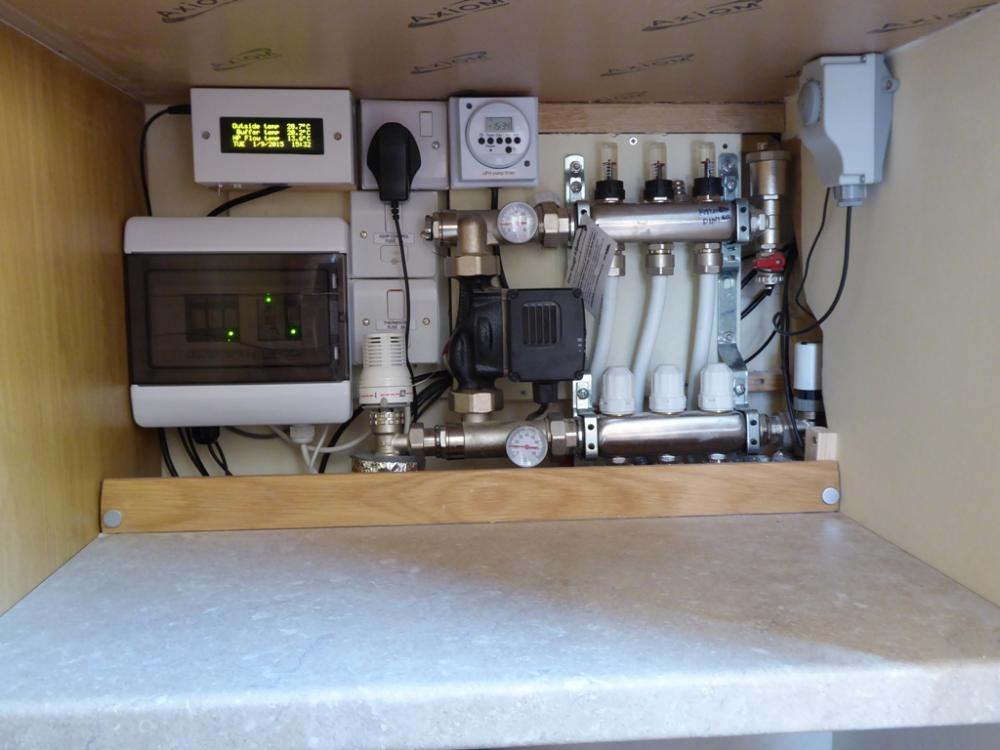
I'm pretty sure you need the UFH pump, so the TMV isn't really adding much. The UFH manifold probably isn't going to work that well without a pump station to circulate water around. Looking at our manifold system I can't easily see how there would be any significant flow around the UFH without a pump station, TBH, as the ASHP pump would just shunt water across the return side. Maybe you could try and connect the flow side of the manifold to the ASHP flow, but I'm not 100% sure that would work OK unless you could separately control the ASHP pump. Here's a photo of our manifold, with the flow from the ASHP coming in at the bottom left, the upper manifold is the flow manifold the lower is the return and the ASHP return comes off at the lower right, after the thermally actuated valve:
-
I used an indirect buffer tank by accident - I ordered a direct one but Newark made an error and sent me an indirect one. the upside of that is that the volume of (expensive) antifreeze/inhibitor is a lot lower. If doing things again I think I'd fit a small thermal store as a buffer, with a mains pressure coil for DHW preheat, and take the hit on the cost of the extra antifreeze/inhibitor. There's no legionella concern as the system is sealed and isolated from any water supplied to the house. A TMV for the UFH isn't expensive and gives the ability to regulate the UFH temperature independently of the buffer, and that's very useful if you're thinking of using the buffer to preheat DHW. I've found that a 70 litre buffer seems to be OK, it eliminates ASHP short cycling when heating and doesn't take up too much space. Ours is fitted in the bottom of an airing cupboard, without taking up too much room, as it's about worktop height.