Jeremy Harris
-
Posts
26430 -
Joined
-
Last visited
-
Days Won
360
Everything posted by Jeremy Harris
-
I agree, but it shouldn't be needed, in my view. If, for example, we followed the lead of countries like Ireland, who now pretty rigidly enforce more stringent building regs than ours, and, in some parts of the country, require new builds to meet passive house standards, then that would achieve the same goal. I have long held the view that all the additional energy efficiency standards that have sprung up (AECB Gold and Silver, PH, etc) are like sticking plasters being applied to massive trauma. Our building control and inspection regime has been demonstrably ineffective for years, and the tightening standards in the most recent issue of Part L1a was watered down under pressure from industry. I've done a few thermal imaging surveys on new builds that show a number of failings, plus Paul Buckingham from the AECB has written two papers on his findings from surveys that add much more weight to this point: http://www.aecb.net/publications/we-must-change-our-disgraceful-approach-to-build-quality-or-wave-goodbye-to-energy-savings/ http://www.aecb.net/still-taking-disgraceful-approach-build-quality-waving-goodbye-energy-savings/ If we just enforced current regulations there would be a significant improvement in new build energy performance, I'm sure. When it comes to knowing whether your self-build meets the PH standard or not then it isn't really rocket science. You start with a design that eliminates thermal bridging, has designed-in airtightness provision, has glazing that provides the right balance between solar gain and winter heat loss and ensure there is an adequate level of insulation for the volume to surface area of the house. The rest is just detail, low energy lights, low heat loss DHW system, selecting the right size and efficiency of heat recovery ventilation system, etc. If someone like me, with zero building design and construction experience, other than a bit of DIY renovation, can design a house, model it's performance, select the construction system and specify and install all the required elements and systems, and end up with a house that easily meets the PH standard, then I'm sure it really isn't that hard to do, if the will is there.
-
Yes, every bend will increase flow resistance by a small amount, so the fewer the bends and the shallower the angle of them the better. Having said that, it's often not possible to avoid 90 deg bends on the primary duct connections at all, unless there is a lot of space around the MVHR unit. I've had to fit 90 deg bends on all four MVHR primary duct connections, as there was no way I could have run straight ducts or gentle bends to it, as there just wasn't the space available. Having sharp bends in the big primary ducts has less impact than having them in the small distribution ducts that connect to the plenums. I used a block and tackle to get our MVHR up the stairwell. IIRC it weighed around 70kg.
-
Every domestic MVHR system I've ever heard of uses flow restrictors to balance the airflow to each room, in order to comply with the provisions of Part F (specifically Table 5). As such, the flow rate in the individual supply and extract ducts is set by the restrictors, either within the distribution plenums (the flow balancing system we have) or at the individual room terminals (a more common domestic balancing solution). Dampers are not normally fitted to domestic systems, and cannot be fitted to the duct system that @Stones has, and that I and a few others have used. What you seem to be describing is the sort of air handling system fitted to the last commercial project I managed, and they bear little resemblance to domestic-scale MVHR systems. Finally, the impact of a very large cross sectional area absorption silencer plenum on the physics of airflow is pretty straightforward to assess for a domestic system like this. As long as the CSA of the silencing plenum is greater than the CSA of the primary ducts to the distribution plenum chamber, and as long as the primary duct length is not significantly altered, the SFP cannot be reduced. SFP may slightly improve, because of the attenuation of any fan-induced flow pulsations within the absorption silencing plenum, as a consequence of making the primary duct flow very slightly less turbulent at the silencer outlet, but this almost certainly isn't significant.
-
I can't remember, but I think that copy may be the original demo copy that I downloaded a few years ago, when I was first trying to get to grips with PHPP. I remember unlocking it so that I could change some of the data, but I think that's all I did, so everything else should be the default data for the demo, but I can't be sure.
-
They were, not sure about now. Here's a copy of the demo PHPP 2007 spreadsheet (rename it from .txt to .xls after download) PHPP2007_English_Demo - Unprotected.txt
-
I've long thought that the best system would be to just provide past energy bills to potential buyers. There's no arguing about energy efficiency certification standards, whether short cuts were taken by any certification system, etc, if a seller can just show the actual running cost.
-
For a new build there's no real discretion, other than a bit of minor deviation allowed by assessment by the building inspector. The minimum opening widths and the access space inside the WC has to meet the dimensions in the diagrams in Part M. In our case I increased the dimension once side of the WC and ended up about 20mm short of the minimum dimension on the other side, but that was done on the advice of a wheelchair-using friend, who tried it out for us and said he'd rather have more room on the side nearest the door. I explained this to the building inspector during the completion inspection and he was happy to sign off on it. I'm pretty sure he wouldn't have accepted a narrower clear opening width, though.
-
From the tests that @Crofter has done, it seems as if the 10mm stuff is far more prone to water damage than the thicker stuff. I'd say the 14mm stuff we have would survive a short duration flood, say a washing machine malfunction that was cleared up pretty quickly. Whether it would tolerate a flood for a day or two I don't know. I suspect it might, but would possibly need sanding and refinishing just to get it dead flat again. The test I did was a bit extreme; the sample was immersed at the bottom of a bucket of water for over 4 days, and that's probably far worse than would be likely from a kitchen accident, I think. Being bonded down may well help a lot, as it should completely stop water getting underneath, at least for a few hours. Unfortunately I don't have any left over adhesive, as if I had I could bond a few bits down to something and try a more representative test.
-
I remember years ago spending ages sharpening and re-setting saw blades. Then came hard-point saws that were effectively disposable and I've never sharpened one since; its cheaper and easy to just buy another one.
-
Just to clarify, you can use PHPP (I did) without needing to incur the additional cost of PH certification. PHPP is a useful tool, it's the certification cost I'd question the value of. In our case, PHPP just confirmed what I'd already worked out by other means, and I didn't change anything as a consequence of modelling the house with it, and that leads me to believe that you can design a passive house without needing to spend a fortune on consultants. When I started I knew nothing about low energy house design, and even less about architecture, but still managed to build a house that meets our needs and exceeds the PH requirements.
-
I agree, Peter, particularly with the PH market being small, and I think that was what the valuer was basing his valuation on. Being the newest house in the village, with the majority of the other houses being a couple of hundred years old, and the one opposite over a thousand years old (well, bits of it!) doesn't help, either, as people looking in this area may well not be looking to buy a passive standard house. The valuer's point was that the value depends on demand, and that depends to some extent on how many potential buyers may be competing to buy the same type of house. His view was that not many people in this area would be looking to buy such a house, so it would attract less interest than one that was, say, a couple of hundred years old. To us, the value isn't important, as we have no intention of selling, but it did get my back up a bit when I read the valuation report!
-
 CO2 sensors that are usable for an application like this start at around £60 to £80. I bought some surplus ones for about £20, but they were a one-off, from a company that had changed the design of a commercial air monitoring unit they manufacture. The only reliable type of sensor is really the Non-Dispersive Infra Red (NDIR) ones, the hot element sensors are far too non-specific for use in environmental monitoring, and very power hungry. I have a hot element one (an MG811) that I tried at first, and it doesn't start working until the CO2 level gets to around 1000ppm, so is pretty useless for room monitoring. The Telaire NDIR ones I have (I bought a few, and have one monitoring the house 24/7) are pretty good, and give reasonably accurate readings. They are similar to these: https://www.digikey.co.uk/product-detail/en/amphenol-advanced-sensors/T6713/235-1373-ND/5027891
 -
I hate to say this, but how long have I been banging on about inadequate building inspection standards? This has been going on for decades, and the bigger construction companies have now got very adept at bending the system to save money. I've raised it here, and on ebuild before, I know, and I even went so far as to raise it with my MP just over two years ago. Despite me having evidence that a large development in his constituency was being built with major failures to comply with the building regulations, and asking him if he would look in to it, he insisted that the government did not want to add to the regulatory burden of industry and he was sure that the construction industry was able to police itself. I wish I had recorded that conversation, and could play it back to him now. I was concerned enough about the clear and obvious inspection failings that I asked a LABC building inspector what he thought. His reply was that he thought that around 60% of work failed to comply with the building regulations, and that this view was shared by many of his colleagues, but that they were powerless to do anything about it.
-
My understanding is that the design rights for 68mm bore, 75mm OD, semi-rigid duct have been sold to at least three companies, who sell the same duct. The ones I know of are HB+, Domus and Quiet Vent, but there may well be others.
-
I found that I could get away without using most of the barking mad number of "consultants" that initially seemed to be required, by spending my own time on doing the work. The cost saving was substantial, as I'm afraid that self-builders seem to be looked upon like yacht owners - ripe to be ripped off by those who claim that you "have" to use their services! The number of people with their hands out for money was staggering, and in the end the only two people we had to pay for were the hydrogeology guy, for our borehole drilling plan, and the SAP assessor to lodge the EPC. We were building adjacent to a brook, so had to have a flood risk assessment, and that was going to come in at around £4k, so I spent two days sifting through data and making requests for information from the Environment Agency and then I wrote the flood risk assessment myself, which was accepted by the planners without any questions. I did the same with the design stage SAP, and building control were happy to accept that from me as well, which saved another fee. I also designed the house, and did the planning and did the building regs applications and drawings, which saved another substantial sum. It depends how much time you have available - in my case I had the free time, and would rather learn how to do things myself than pay someone else a big fee to do for me.
-
The problem is that energy performance, in general, is way down the list of priorities to the vast majority of buyers. Talk to any estate agent, anywhere, and they will say that the two factors that dominate marketability are location and the kitchen/bathroom bling. Ours has said that the EPC rating isn't even glanced at by the majority of buyers, they simply aren't really interested in it.
-
Not so laughable when it's potentially £30k+ out of your pocket, I can assure you!
-
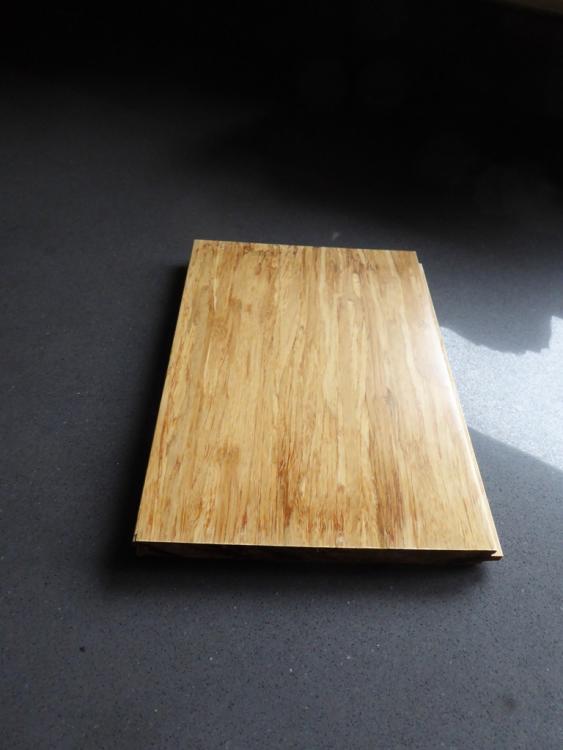
Here's a photo of that sample that I immersed all last week, and left to dry for three days: The colour seems to have returned to the same as before it was soaked, with no clear staining. It has remained very slightly cupped, about 1mm in the centre.
-
It does not add value at all, other than as a reassurance to the original builder, perhaps. Our valuer devalued our house on the basis that it was, in his words, an eco house with limited market appeal. When challenged by me, he then said that it was a good thing we weren't opting to have the house PH certified, as, in his view, that would reduce the value by a further 5%............
-
I've never really understood why anyone would want PH certification, other than bragging rights. It adds no value (in fact, our valuer told it devalued the house) and adds at least £1.5k to a house built to the same, or better, standard but without certification. Our new build exceeds the PH performance standard, but I really couldn't justify certification - I'd rather spend the money on making the house more energy efficient. It's not at all hard to self build to passive standards, and doesn't need to cost more than just self-building to a poorer standard, it's mainly about details, in my experience.
-
help needed discharging conditions
Jeremy Harris replied to Adamantium's topic in Planning Permission
You might well get away with a desk study, rather than actually doing a percolation test, as the drainage requirements (SuDS) are a building control, not planning matter. Perhaps just a statement that the drainage will comply with SuDS requirements and will be certified as such by building control would cover it? We had a similar condition and that's all I did. Frankly it's a bit daft for planners to try and impose conditions that are covered by building regulations, anyway, they are just duplicating things, not actually changing how things will be done. It's the sort of condition that might be imposed on a big development, that may well change the local hydrology, because of new access roads, etc, but is plain daft for a single self-build. -
I suspect that whether showing compliance with Schedule 1 of The Building Regulations 1991 using the wording of Approved Document Part B, or whether Schedule 1 has to be complied with regardless of the wording of Part B, may cause a bit of legal wrangling. I really have no idea how the lawyers will argue this, but my understanding is that the Approved Documents are not the legislation, they are guidance as to how the legislation (in this case The Building Regulations 1991) MAY be complied with. I think many of us know that you can show compliance with the building regs, even by not following the guidance in the ADs, provided you provide evidence to convince a building inspector. The big question here seems to be whether or not the a building inspector granted approval on the basis of evidence provided, rather than on the basis of the methods recommended in the AD. I suspect not, as building control still have this project listed as "Completed, Not Approved", which suggests they may not have approved all aspects of the work yet. Whether that includes the external insulation and cladding doesn't seem clear, but the fact that the Full Plans application was never approved, and the project seems to have switched to working under a Building Notice, makes me wonder a bit. Was that apparent switch made because the Full Plans application ran into difficulties over the way the external insulation and cladding was designed? Did the main contractor switch from using the local authority and the Full Plans submission to another building control body under a Building Notice? The information I've been able to dig out is hearsay with regard to switch to working under a Building Notice, I can't find anything definitive that states that was actually done.
-
There really is some appalling decision making and media reporting going on, with decisions seemingly being based on pretty pointless "fire tests" on 250mm square samples of rain screen cladding, for example. The government should step in and start managing this, bringing in people from the BRE to make firm and authoritative statements about the way the technical investigation is going, but presumably everyone is hamstrung by the fact that there is a criminal investigation underway. Normally, I'd agree with the principle of not releasing information that may be evidence in a later trial, but I think there needs to be an exception here, as the current display of "headless chicken" behaviour is both causing unnecessary distress and costing people and the taxpayer a great deal of money.
-
@Crofter, I'm not sure it was described as matt, but the finish is definitely not gloss, more like a sort of satin finish. When we bought the stuff I think it was only available from the Bamboo Flooring Company as 14mm thick planks, rather than 10mm, and that may make a difference. The sample I left in a bucket last week has pretty much dried out now, and I'll take a photo later to show how it looks.
-
FWIW, this is the cut and pasted relevant section of Part B that applied at the time that the application for building regs approval was made for Grenfell Tower: