Jeremy Harris
-
Posts
26430 -
Joined
-
Last visited
-
Days Won
360
Everything posted by Jeremy Harris
-
I'd second that. I acquired a very old, but massively constructed, industrial pillar drill many years ago. It had been thrown out because it didn't have a no-volt switch, just a rotary switch on the left hand side. I bought a no-volt switch contactor box and fitted it to the front of the drill and I've been grateful for the big stop button several times when things have decided to go whizz about.
-

Electric gates
Jeremy Harris replied to Tennentslager's topic in Networks, AV, Security & Automation
Yes, I had that thought, it's why I mentioned fitting a rod end as a bit of an afterthought above. I have three or four 10mm stainless rod ends, with bronze bushes (they are KA 10, from this range: http://www.dometrics.com/files/askubal/KA_Male_Standard_Data_Sheet.pdf ), and I'm wondering if they would be man enough for a 4m wide gate. Their rated static load of 25 kN suggests they would be, with a big enough margin (I'm guessing that the max load from the gate wouldn't be more than about 20% of this, if that, even without the wheel taking most of the gate load). It'd be easy to drill and tap the end of the length of 20mm stainless bar to take one of these rod ends. Fabricating a fixed pin for the top, with another rod end as a hinge bearing would be easy enough, and the 13 deg maximum tilt angle of these rod ends would be fine, as I'm sure the drive angle is less than that (I'll go out and check later). -
Whole house water pressure boost
Jeremy Harris replied to iSelfBuild's topic in General Self Build & DIY Discussion
As I suggested, you can trigger the pump from the pressure in the mains, to make sure that it never takes the mains supply down below a set pressure whilst it's charging the accumulator. This presents no risk of putting suction on the mains supply, as the power to the pump system will be cut off when the mains pressure drops below a set low level. It just needs two pump control pressure switches, one on the mains supply that's wired to enable power to the system, the other on the accumulator side, fitted in the normal way as a demand switch to turn the pump on and off. It goes without saying that the mandatory NRVs are needed in the mains side, This avoids the need for a break tank, and so also avoids the need for subsequent disinfection. I don't like the idea of break tanks if they can be avoided, as they create a whole raft of additional potential safety issues, if used for potable water. Any open tank will remove the residual water chlorination, that keeps mains water stored in sealed pipes and tanks safe from bacterial contamination. The chances are that, sooner or later, a break tank will end up getting contaminated, and that means that to be safe, downstream disinfection should be fitted. This doesn't apply to large sealed accumulators, as they retain the residual disinfection agent (usually chlorine) and so keep the stored water safe. -
Using the sort of termination I suggested is effectively a pot joint, and is deemed OK for use submerged at depth down a borehole - it's what Grundfos supply with their pumps for just this purpose.
-
Whole house water pressure boost
Jeremy Harris replied to iSelfBuild's topic in General Self Build & DIY Discussion
One fix for this is to fit a big accumulator, with a pump that's arranged to turn on whenever the incoming pressure exceeds a set lower threshold. This avoids the problem of the main being subject to excessive suction. The required non return valves on the incoming main prevent backflow, and with luck you can maintain the accumulator at a reasonably high pressure through the dips in the supply pressure during the day, when other users cause the mains pressure to drop. The big advantage with an accumulator is that it's sealed, so there is no risk of contamination as there would be with an open tank and pump, so there's no need for any additional water disinfection. -
Electric gates
Jeremy Harris replied to Tennentslager's topic in Networks, AV, Security & Automation
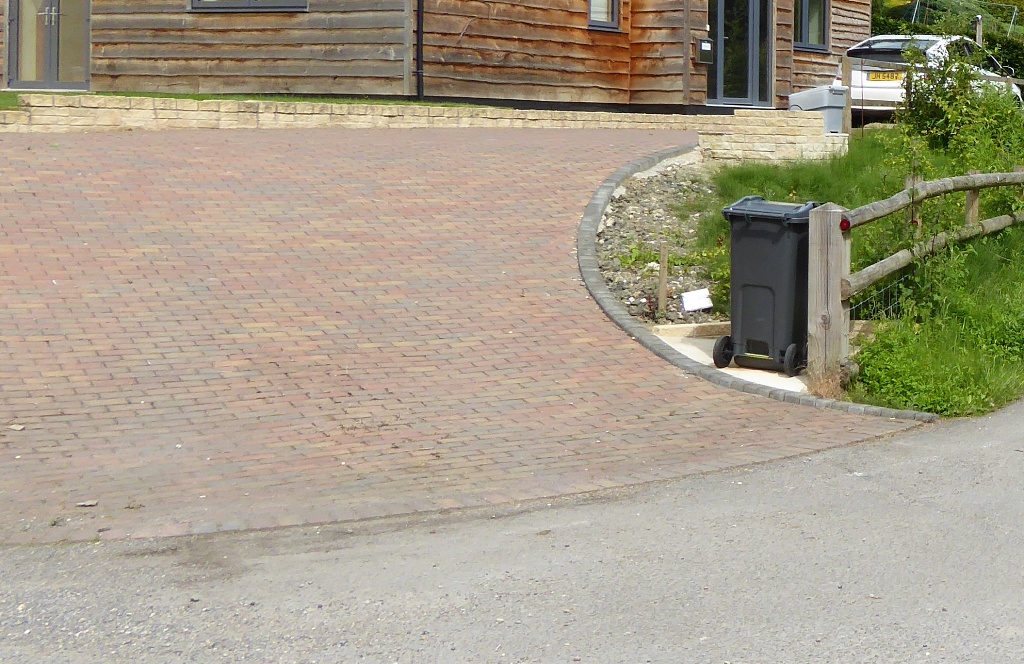
Not that easily, as it will have to hinge from the left, looking from the lane, and right where the return will be there's an area built to take the wheelie bins on collection day, as this photo shows: The bit of 2x1 banged in the ground is about where I think the extra post could go on that side.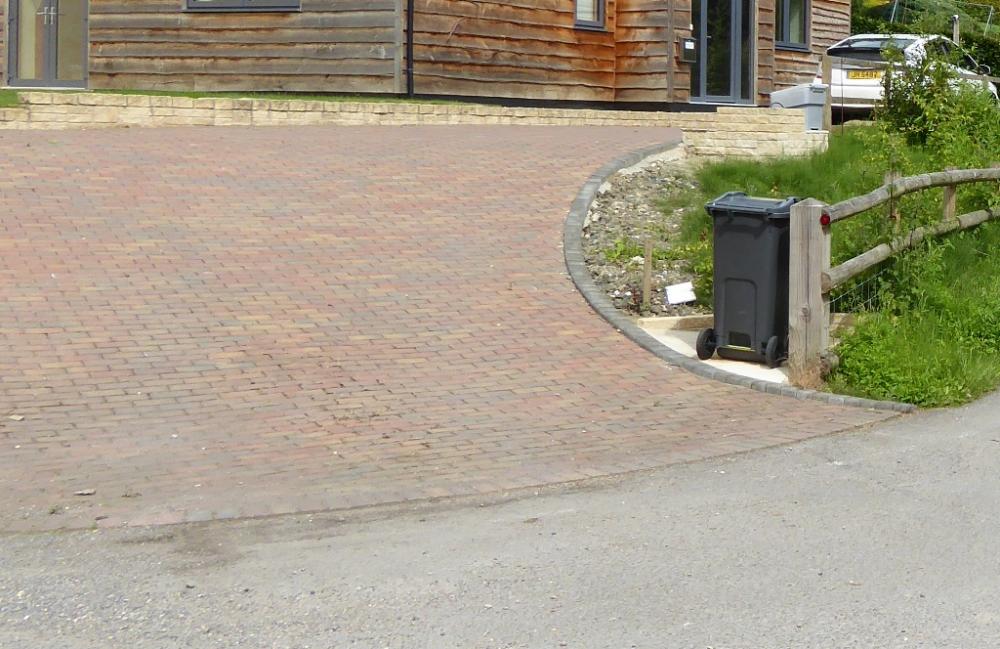
-
Electric gates
Jeremy Harris replied to Tennentslager's topic in Networks, AV, Security & Automation
I like that idea a lot, as the wheeel on the end would easily roll over the pavers. The slope is pretty steep (we had a dispensation from the planning officer for it, because we had two conflicting planning conditions) so the opener would need to be a heavy duty one but I think that being able to keep the gate vertical whilst it sings back and up would look a lot nicer. I went out and measured up this afternoon, and a 4m wide gate, perhaps with a personnel gate tacked on to the end, would fit neatly between two posts set back about 1.2m from the lane and the existing gate posts. Luckily I ran a cable duct down to the gate area, with a length of SWA in it and a draw cord, so I can get power and a control cable down there easily enough. I can get some beefy wooden gate posts from the local sawmill, and knocking up a hinge with a sliding lower bar looks easy enough. I've got some 20mm stainless bar stock, a length of 25mm x 6mm flat stock and some 63mm diameter acetal, so I reckon I could make up some acetal sliding bearings, held in place with some stainless straps to the gate, with the stainless bar threaded to fit a female gate eye, or maybe a nice stainless rod end. The gate may have to be a custom job, as the easiest configuration would be a 3m gate with an additional self-closing 1m gate fitted to the end, if that's possible to make work. If not, then I don't really ahve a problem with a button down at the gate end to open it, that can be disabled when we're away, as the gate is more for a bit of privacy than as a security measure. I'd want a timber 5 bar gate, ideally, to be in keeping with the timber post and rail fencing. -
Good point. The end of the cable I've terminated is poked back into a bit of duct that's sticking out of the a big lump of concrete foundation, so fairly well protected. There's also a bit of marker tape tied around it as a bit of a warning that it may be live (if I was accidentally throw the DP RCBO on that circuit). If it were buried without protection then the heat shrink cap may not be that good an idea.
-
I used 150mm plastic duct and elbow, with just very short lengths of flexible duct to the MVHR unit, to absorb vibration. The rigid plastic duct was relatively easy to work with, it just needs a bit of care when cutting it.
-
The electrician I used had no problem with the cable being capped off with the double insulated waterproof heat shrink end. In essence it's no different to the way the immersed cable joint on our borehole pump is made; that has adhesive heatshrink over each conductor joint, plus another layer of adhesive heat shrink over the whole joint. If you don't have adhesive lined heat shrink to hand, the non-adhesive stuff can be made into the adhesive stuff with hot melt glue reasonably easily.
-
Looks similar to one of the two I made up. Nice to hear (or rather not hear) that it works OK. I was impressed with the difference in noise that fitting the two DIY silencers made.
-
Electric gates
Jeremy Harris replied to Tennentslager's topic in Networks, AV, Security & Automation
Thanks all, I just need to work out where the best location is, and the geometry of the hinges. It's probably a longer-term project, I think, as we can manage OK without gates for now. -
Slab Insulation, UFH and Mesh
Jeremy Harris replied to MarkH's topic in Energy Efficient & Sustainable Design Concepts
Why was the steel not tied in situ? That would be the normal way to do this, as there is a high risk (as you've found) of the DPM being damaged if you try to lift the pre-tied steels into place. All I can suggest is that the steels be taken out and all the wire ties undone, a new DPM laid, and the steels then assembled and tied in situ, to reduce the risk of damaging the DPM again. AFAIK, there's no good, long term, solution to patching holes in DPM, as nothing much sticks to it. You may get away with lifting the steels partially, then fitting large areas of overlapping DPM, but it would be a bit of a bodge. -
I started to make one of these, with an old pipe cutter and a bit of hacksaw blade a while ago, but never got around to finishing it. I just machined up a bit of aluminium to fit where the cutting wheel of the pipe cutter goes, with a slot to take a short length of hacksaw blade. I'll have to dig it out and finish it off, all it needs is a couple of small grub screws to hold the hacksaw blade bit in place.
-
I still have a run that's temporarily capped off, and all I did was leave the cable well over the required length (so I could cut it back), put some adhesive-lined heat shrink over the ends of the exposed cores (after stripping back armour and sheath a short distance) and squeezing the ends of the heat shrink when still hot to form seals over the cable ends. A bit of bigger adhesive lined heat shrink over the whole lot, with a cut off bit of hot melt glue stick dropped down the end to finish it off, all melted with a hot air gun. It's like a poor man's pot joint, and probably pretty robust and long lasting. It's been poking up out of the ground for a couple of years now, and still seems OK.
-
Recommended Garden Shredders, Please
Jeremy Harris replied to Ferdinand's topic in Landscaping, Decking & Patios
After many years of battling with people lighting bonfires, and filling our valley with smoke, we've finally had them banned. This summer has been great - no more having to sit indoors with all the windows and doors shut because some thoughtless pillock has decided that a nice, calm, sunny day is just the time to light a bonfire and fill the valley with smoke for a few hours. The odd thing is that there had been a long campaign to get bonfires banned on the ground of the smoke nuisance, but the thing that swung it in the end was the increased volume of traffic on the road through the village, and complaints by drivers of severely decreased visibility. -
Electric gates
Jeremy Harris replied to Tennentslager's topic in Networks, AV, Security & Automation
I've found a few on YouTube that illustrate the principle of the offset bottom hinge. This video shows how it works quite well: -
Reducing The Potential for Error
Jeremy Harris replied to ToughButterCup's topic in Project & Site Management
In my case, MBC emailed me the AutoCad file, so I had the exact same drawings as they were using for production, and I could then just hide a few layers and highlight the window apertures, with the dimension layer visible, to hand out to window companies. IIRC, MBC handed the drawings to the company we used in the end, Munster Joinery, as they were just down the road from them in Cork (I have a feeling that Joe at MBC intervened with Munster when their service to us was a bit poor, too!). -
Air source heat pump or not?
Jeremy Harris replied to Simon Brooke's topic in Air Source Heat Pumps (ASHP)
There is a tremendous amount of profiteering going on with regard to the RHI, more than ever seemed to be the case for MCS PV installs, even when the FIT was high. The quote we had to fit a small Panasonic ASHP was something like £6k, IIRC. The price for the ASHP at that time was around £2.5k, so they were charging about £3.5k for perhaps a days work, at most, plus MCS certification so that the RHI could be claimed. Allowing a generous £500 for one man's labour, plus the bits of flexible hose, Y strainer and 5 litres of antifreeze, then it seems that they were making around £3k just for providing an MCS certificate. I installed our ASHP and had it up and running in a bit over half a day, with no previous experience of installing one at all. I did have to spend a few hours working out how to set up the command unit, but that would have been something a competent installer, with the knowledge of how it worked, could have done in half an hour or so. -
Air source heat pump or not?
Jeremy Harris replied to Simon Brooke's topic in Air Source Heat Pumps (ASHP)
Or use some of the cash saved from the £10k ASHP estimate to buy either a double Sunamp PV, or a Sunamp Stack, and get a low heat loss thermal store that takes up a great deal less space. An ASHP, PV diverter and double Sunamp PV, installed, should cost less than £8k, so around £2k change from just the ASHP estimate, for a complete system. -
Reducing The Potential for Error
Jeremy Harris replied to ToughButterCup's topic in Project & Site Management
I wholeheartedly agree, Jamie. The amount of effort that I put in to getting the window and door specification nailed down tight for our build was massive. The final contract included around 6 or 7 pages of individual window and door drawings, with dimensions by each and a clear box for me to name and sign off each and every window and door design as being correct. Despite this they turned up with one window that was 400mm too wide (along with some other more minor issues, like the French windows being offset vertically to each other in the frame, a cracked glazing unit, a poorly fitted internal trim, badly adjusted door hinges and locks, etc, etc). How any company can read a window drawing that is clearly dimensioned as being 1600mm wide by 1200mm high and manufacture a window that is 2000mm wide by 1200mm high I simply do not know. A read through both this forum and its predecessor will show that window and door dimensional problems are pretty common for self builders, so common that I think probably most of us have experienced some sort of issue with them (with a few exceptions). -
Discount Offers of the Week
Jeremy Harris replied to Ferdinand's topic in General Self Build & DIY Discussion
That's pretty much exactly what my (rather posh, used to only shop in Waitrose) MiL has said about Lidl. Every time we see her she produces stuff like Lidl smoked salmon, or Lidl champagne, and it seems she and her friends now shop there almost exclusively.................. -
Air source heat pump or not?
Jeremy Harris replied to Simon Brooke's topic in Air Source Heat Pumps (ASHP)
Also worth noting that the RHI is pretty pointless for a passive house. The additional cost of an MCS installation for an ASHP, which is required to claim the RHI, is well over £2000. For us the RHI payments would have been around £80 a year for 7 years, so a small fraction of the premium we'd have had to pay for an MCS approved installation. The couple of thousand we saved by not going for an MCS approved installation is more than enough to buy a complete spare ASHP, with enough change left over to get it installed. -
Electric gates
Jeremy Harris replied to Tennentslager's topic in Networks, AV, Security & Automation
The trouble with threads like this is two fold. Firstly it started me thinking about adding gates to our entrance, secondly I ended up spending hours researching the cunning hinge systems that are around that allow a gate to open upwards on a sloping drive. I've even "wasted" a couple of hours drawing up options in AutoCad to see what sort of geometry might work. The offset lower hinge point system looks easy to fabricate, and looks like it'll integrate with an off-the-shelf opener OK. Much as I'd love to make an opener, the safety issues are just too great, especially as the units don't seem to be that expensive to buy. It's a pity that the way the fences run either side of the current gate posts won't allow a sliding gate, as that would probably look neater. It's also a pity that the big gate posts we put in are too close to the road to take gates, I'll need to put two more in a few feet further up the drive to hang gates from. That has the advantage of leaving the area to the side of the gates, where we've made a stone hardstanding for the bins to be collected, outside the gates. I just need to work out how to fit a small personnel gate for the postman, or shift the mailbox down closer to the lane. -
Air source heat pump or not?
Jeremy Harris replied to Simon Brooke's topic in Air Source Heat Pumps (ASHP)
Welcome, I think that £10k for an ASHP for a PH is way too much. Our 130m2 passive house has a 6 kW ASHP and that's a massive overkill, it just happened to be available at the right price. It was an easy DIY install, and all told cost around £2k. A plumber could have installed it in half a day easily, say a day to be on the safe side, so maybe £200 to £250 labour for the install, plus maybe £2.5k or so for an ASHP, less if you shop around (I bought a new one, reputable manufacturer for £1700.