

Nickfromwales
-
Posts
31377 -
Joined
-
Last visited
-
Days Won
346
Everything posted by Nickfromwales
-
I'd get angry............if it wasn't for your grandson looking such a handsome little chap. Awwww!
-
Try and keep it simple for me ok ?! ??
-
Can you ping a link here ( as you update the blog ) please? I just want to make sure the technical stuff stays on track
-

Floor Tiling Timings & Step Detail
Nickfromwales replied to Barney12's topic in Floor Tiles & Tiling
At least you've chosen a sensible colour, which should negate the problems described in my last. . Pergamon tiles with jasmine grout wasn't a great idea for a full ground floor TBH, but the lady wasn't for turning. I do try to advise people, but I only say things once as anything after that often causes offence. And i'm know for my subtlety -
Floor Tiling Timings & Step Detail
Nickfromwales replied to Barney12's topic in Floor Tiles & Tiling
Phew. You said ceramic but I'd have tried to steer you away from laying that much ceramic as its not usually 'through colour' like porcelain is and any little chips or dings show horribly. Porcelain is far hardier too, so happy days. An important point is to double check with the supplier whether or not the tiles need sealing. Some also come with a protective wax coating ( thanks for that B&Q ) which is an absolute bastard to get off completely. Dont just take the smiley salespersons word for it, get them to contact the manufacturer and have them confirm what does / doesn't need doing to the tiles to complete the installation. Get a sample tile and take it home. Spill some red wine on it, drop a tea bag on it, and see if marker pen leaves its 'mark'. A previous customer of mine ordered just over 100m2 of Pergamon porcelain 600x600's from Porcelanosa and after the tea bag test the customer let out a strange noise, rang them, and said "come get your f'ng tiles". They came with a replacment load and swapped the tiles out for ones which didn't mark if someone in a different country sneezed. All tiles are not created equal, you've been warned . -
Makes no difference whatsoever because you'll be tanking it . 1 hour ago, Onoff said: I'm using these large format mosaics (SWMBO chose) so the grouting it limited: Again not much difference as the point of failure will be between the tiles at the corners, and more so against the trims, where they meet the tiles, where it's a pita to get a decent amount of grout in. Getting a foundation of CT1 in behind these points is where the money shot is . E.g. Tiles bedded into wet CT1, then grouted or colour matched silicone in the grout lines ( as is in that pic I posted with the 'corner' shower ).
-
Welcome 'back' .
-
To Terry's points first, well, what I can add anyhoo. I've always been a fan of oversizing the cold mains pipe work throughout an install. The labour is pretty much identical, and the material cost negligible to go to minimum 22mm 'backbone' when installing generic series plumbing ( starting off large at the stopcock and reducing in size accordingly as the number of outlets diminishes ). People focus on DHW flow and delivery but simply assume that the cold will be there in sufficient capacity regardless. That's not true. Most DHW is propelled by the cold mains, ( eg cold 'in'forces the hot out of the UVC ), so if there is insufficient provision for cold flow then that will directly affect the DHW performance. It's actually even worse than that as the DHW has to travel through an appliance, and ultimately its controls, to get to the outlet, so it will incur further resistance and losses along the way. That means that cold is almost always better performing at the outlet compared to hot, varying only with the resistance of the DHW device, eg a combi will be quite restrictive vs an UVC, as a combi is typically 15mm in and 15mm out, and almost always via a plate heat exchanger, therefore adding multiple further points of resistance. Add to this the fact that other occupants / white goods will be consuming cold water at the same time as, say, a shower is being drawn, then you need to seriously think about cold water delivery, and how you will provision / mitigate these losses in flow. So, more specific to Terry's question, that's dealt with by upsizing the cold mains more than may actually be needed so as to deal with any subsequent losses that would have arisen from fitting regular / smaller bore piping.
-
No wonder his bathrooms taking so long, he's bloody high off the fumes ?
-
Tanking and taping is a good fail safe, but then your discussing dealing with what happens to water that gets behind the tiles, rather than how to stop it GETTING behind the tiles. . When you tile around timber structures, such as these boxing ins, the grout cannot be relied upon as the final watertight seal. You must use a flexible sealant of some sort, even if it's just directly behind the tiles at the open edges / grout junctions, to prevent water getting behind the tiles. Capillary action will suck water in like a straw. When tanking, also consider the path that this trapped water will take. It cannot be allowed to get behind the plasterboard, it cannot get to any timber. Make sure you tank from head height all the way to the junction between the wall and floor. Then you need to make sure that any water that gets there, cannot sit there. Check out this thread about the wetroom in that pic as I go into great detail there. .
-
Armaflex do a range of self sealing tapes and lagging.
-
Rods and baskets etc give hard to clean gaps and crannies. Black crap soon starts to hide in there . I'd just have the tile so it's one wipe clean and job done.
-
Floor Tiling Timings & Step Detail
Nickfromwales replied to Barney12's topic in Floor Tiles & Tiling
Sorry, ceramic or porcelain? -
Your absolutely ideal candidates for a good combi. Instant, constant hot water on demand, and no standing losses. Also, only an annual gas safety inspection and service required, whereas you'd need a G3 annual inspection on top of that too if you go for a cylinder. The only reason I'd say go for an UVC is if you intend having solar PV, as DHW can be reinforced with 'free' energy ut only with a means to store it, such as a hot water tank etc. Vaillant are my weapon of choice, but, and it pains me to say this, Worcester Bosch are making a very good combi nowadays and aren't over charging for the privilege any more, it seems. NOTE : WB are now offering up to a 10 year GUARANTEE ( not warranty ). Basically if you use a WB accredited installer, one of their 'select' boilers, fit their Wave controls and their magnetic filter, they guarantee that you won't pay for a repair for the next 10 years, pretty much regardless of cause or circumstance. That is of course subject to you having an accredited WB service agent do each annual service without fail, and on time. Failure to so so ONCE will invalidate the cover. If I had to choose, I'd go Vaillant. One feature being a dot matrix display which tells you what's wrong with it in the event of a failure. .
-
Kitchen Payment Terms (Warning; Rant Post!)
Nickfromwales replied to Barney12's topic in Kitchen & Household Appliances
Stick to your guns. I've seen a £35k kitchen fitted by a blind ex-cobbler and they waited MONTHS to get it sorted at the kitchen companies leisure. Let them come to you. . -
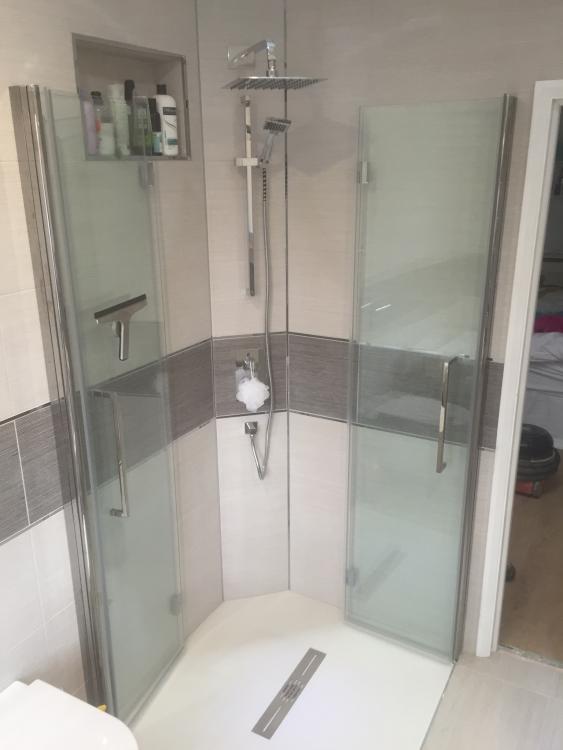
I decided to make this one a bit higher so it missed the direct flow of water. All the tiles and trims were set into clear CT1 and pushed n until it oozed out of the grout lines / gaps etc. I wiped that excess off with wipes, making sure none was left flush with the surface of the tiles / trims, and left it to cure. I then gunned a colour matched silicone onto the remaining gaps. You could lay that on its back, fill it with water and it wouldnt lose a drop. .
-
Bath Surround / Boxing In, and concealed pipework
Nickfromwales replied to Onoff's topic in Bathrooms, Ensuites & Wetrooms
I'm glad it's not just me with umpteen unfinished projects on the go -
Bath Surround / Boxing In, and concealed pipework
Nickfromwales replied to Onoff's topic in Bathrooms, Ensuites & Wetrooms
Don't bloody start him off !!!! -
Wanted: 92.5 degree double branch adaptor (110mm)
Nickfromwales replied to ProDave's topic in General Plumbing
They do help with the sound of the water going down the pipe so I'd have done it for that reason. Not having waste to get rid of is another good reason. . -
Wanted: 92.5 degree double branch adaptor (110mm)
Nickfromwales replied to ProDave's topic in General Plumbing
Looking good. Is that acoustic rock wool you've wrapped the pipework in? -
Bath Surround / Boxing In, and concealed pipework
Nickfromwales replied to Onoff's topic in Bathrooms, Ensuites & Wetrooms
I'm pretty sure you can't solvent weld onto the bent pan connector. I think it's a dissimilar plastic so beware. I recall sawing through one to reduce it in length, and it was a lot softer. I could be wrong, but why are you steering away from the 90-110mm adapter that came supplied to do the job ? -
This
-
Something like this any good? Link
-
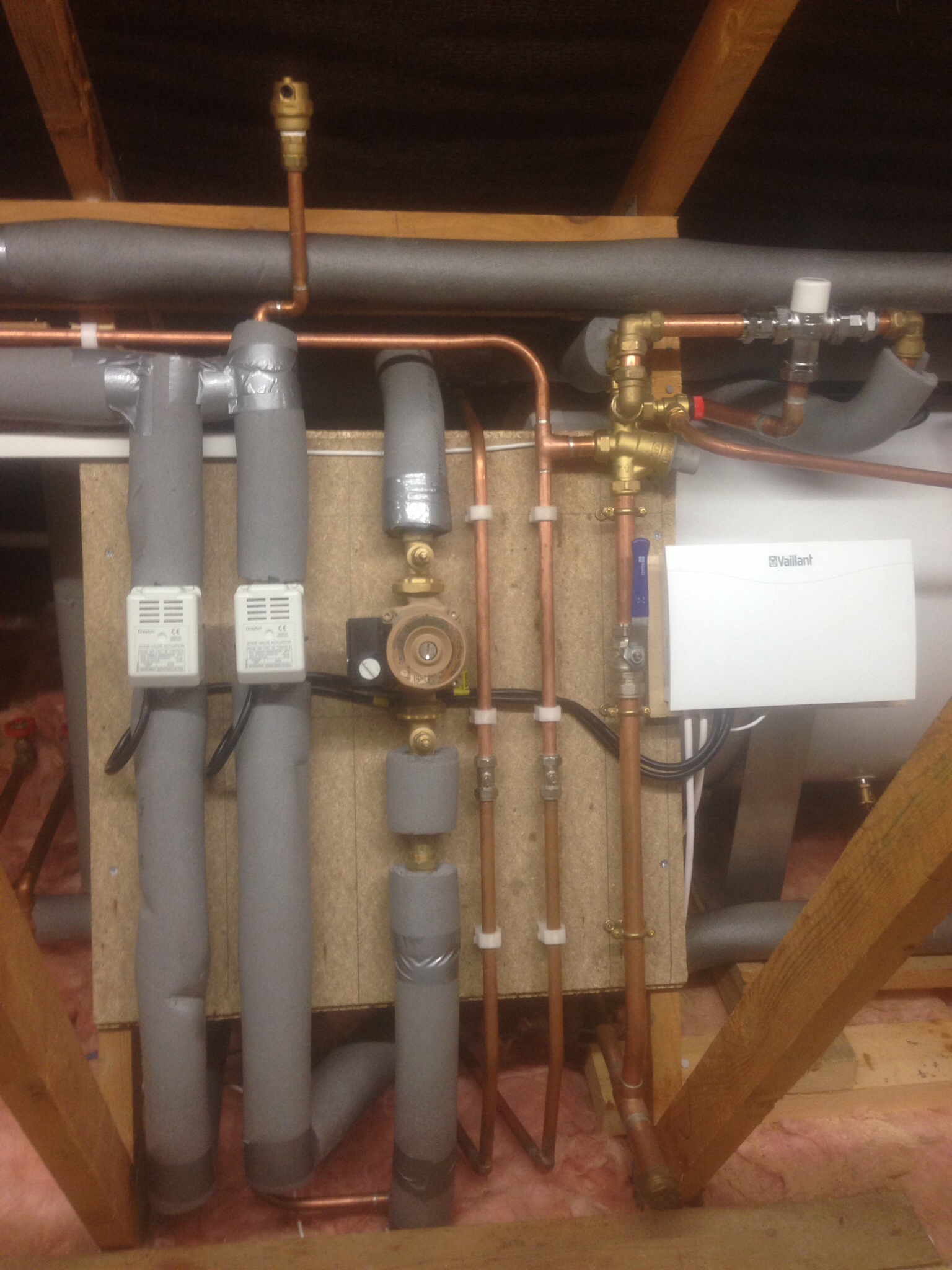
Fyi you MUST fit the multi block within around 500mm of the UVC ( in the same room adjacent will pass TBH but you can't mount that remotely ). To retrofit an UVC it's FAR easier to fit a secondary PRedV directly after the stopcock. ( yes, where you've just done all that lovely plumbing ). That gives higher pressure for the outside tap ( say set the secondary PRedV to 4 bar ( primary being the one at the UVC )) and then all of the existing cold plumbing can stay as is.
-
"This was a public service announcement"

