Jump to content

Nickfromwales

Members
  • Posts

    30306
  • Joined

  • Last visited

  • Days Won

    295

Everything posted by Nickfromwales

  1. The vent can be anywhere. That guys just plumbing it in in the knowledge that it'll work perfectly well just with the flush velocity of the the WC's alone. I've run some near perfectly flat, one for over 5 m's straight, and I'm always surprised at how well they still perform in real life. Agree with Tony, that he's not used the space very well and could have got some basic falls in there with ease. Maybe he'll be doing it again if BCO gets a butchers at it . Is this being checked by BC dave ?
  2. Heres the most recent ones. This is is the mirrored cabinet with the chrome set in ready. Ignore the black gaffa tape lol. Next I cut another piece of box section chrome plated trim to the width of the cabinet underside and stuck the led strip to it after soldering the wire on. I applied mitre bond glue and spray to fix the led strip loaded piece of chrome trim into place. This is the view looking upward at it. This is the view front on. I did the same on the top too. 5m of this 50/50 super bright strip on amazon for £13. Fill your boots. And all lit up Looks the bollocks in the dark. The sticky-outy light that came with the cabinet is a marmite fitting tbh, I don't like them. Hey-ho. And behind the free standing bath you can see in the previous images I added these, for that jer-ner-say-kwa. Bingo bango
  3. Pressure and flow are location dependant tbh. You should be 'given' 1 bar static at least, and should receive around 11-12 litres per minute of dynamic flow. You can check the latter with a weir cup
  4. Any chance to get it redirected so you can upsize the incoming cold mains to 22mm?
  5. Good point, a lot of failure is down to shite in the valve. The strange part is that the stainless gauze filter is on the incoming side normally so doesn't usually allow over pressure events, just poor flow / low pressure. You really shouldn't fit any bypass as that will allow full range pressure to get to sensitive equipment. We all know that 'temporarily fitted measures' always end up never getting changed to the way they should so I'd advise against that tbh. All relief valves will have installation practices clearly stated, as in "thoroughly purge all primary pipework prior to commissioning the valve" etc etc. That takes care of any lumps of solder, flux etc, and then the integral stainless gauze filter in the PRV takes care of any subsequent crap. Annual cleaning of the filter and checking of the set / operating / actual pressure is also paramount. On the PRV's I always fit a primary and secondary pressure gauge so I can see the incoming and secondary pressure differences. If they both match, your in need of maintenance ( or your pressure is lower than the set value of the valve ).
  6. They had 'top plumbers' fit the original UVC . Then it went pop in the upstairs airing cupboard. Oopsy.
  7. Replaced an UVC in a £1M house, and the guy said the pressure was high. I out my gauge on the outside tap and it went to 10bar and the needle bent so badly I had to bin it. Surveying the static cold mains pressure is absolutely critical and should never be overlooked.
  8. 25mm to 22mm stopcock. Brass or plastic. NOT 15mm All cold feed pipework to UVC should be 22mm, is this possible ?
  9. If this is a G3 certifiable UVC install then there's far more to it Options are.... 1) new install. 2) retro fit. 1).... Stopcock. NRV. Drain-off cock. NOTE: This is where you should now tee off for the outside tap so it is not affected by the pressure relief valve. Ensure that the outside tap has an integral non-return valve. Pipework to UVC location. Cold feed to multi-block with a local isolation immediately prior to. ( 22mm 1/4 turn lever valve ). Multi-block located within 500mm of the UVC it serves ( G3 / manufacturer requirement ). Balanced cold feeds all to be fed from the balanced output of the multi-block ( mixer taps / shower valves / thermostatic devices etc ). Therefore no requirement for non-return valves on any mixed feed outlets as all mixers will be at the same potential, regardless of static or dynamic fluctuation. 2).... Stopcock. NRV. Drain-off cock. Secondary Pressure Reducing Valve ( in addition to the manufacturer supplied one which has to be mounted at the UVC position as stated above ( so no, you can't nick it and fit it here )). Pipework to UVC location. Cold feed to multi-block with a local isolation immediately prior to. ( 22mm 1/4 turn lever valve ). All house water pressure is governed by the secondary PRV so the cold feeds can be tapped into anywhere in the house without causing pressure differential issues between hot and cold whatsoever. Hot outlet of UVC MUST have a single check non-return valve in line with flow. This is a final failsafe for instances where the secondary PRV fails and mixer taps then can back feed the UVC and over pressurise it to the point of failure. Retro fit only. Failure to adhere to these particulars is what keeps me in a job .
  10. Swings and roundabouts here Dave . Thanks anyhoo.
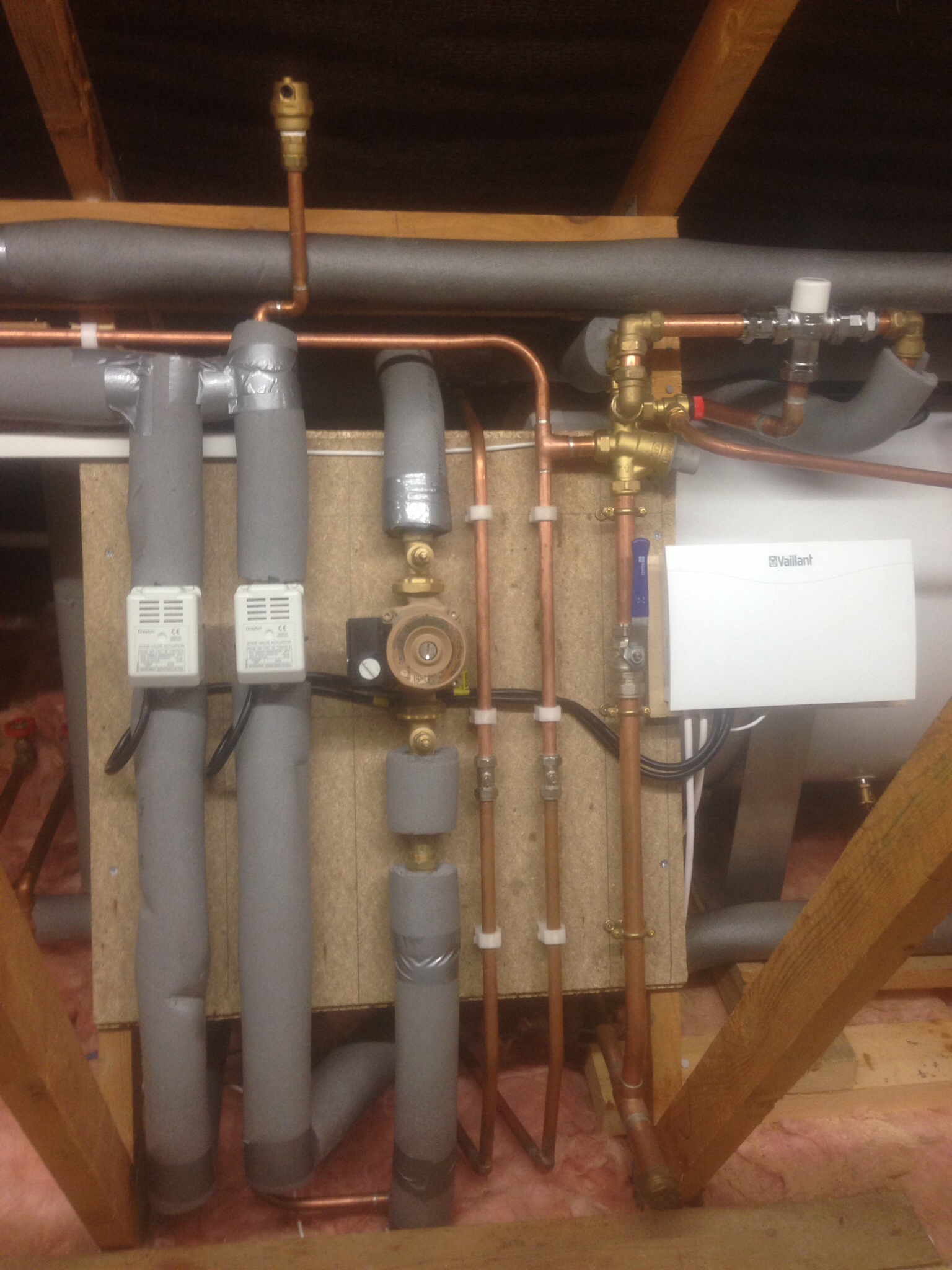
  11. Can you get extension leads for the 4 core led cable off the bay? Then you can mount that with the bath gubbings
  12. Are the hot and cold to the bath tank fed at the mo ( no gravity / cold mains conflict ) ?
  13. For the bath room I'd recommend some wall lights, that's what I have. I found a nice subtle candle type fitting from B&Q which I then changed to led lamps so they ran cooler ( the halogens supplied made the glass very hot and they were low enough to lean against innadvertantly ). They're on their own switch so the wife can lay in the bath with no glare from the spotlights. Led plinth lights at low level can do the same thing, and look super cool. I also put led strip lights under the mirrored cabinets to give extra 'mood' lighting and make such features of the room stand out. Looks the daschunds dangleies.
  14. If you look really closely you can see the king in the corner cutting the grass one blade at a time with his new multi tool
  15. I've got a 3-way diverter sunk into the wall. Pics later. For your application you just tee the hot and cold outputs from each tap together and send the unified feed to the filler .
  16. Don't forget to buy the anti-foam droplets / bottle for when you test drive the bath When I fitted my mates swimming pool and hot tub this got overlooked with interesting results. . Even if you go in the shower first before relaxing in the tub, the residual shampoo / body wash etc is enough to cause the whirlpool bath to foam up. One drop of that stuff keeps the water completely flat. Oh, and wait until the kids discover what a squirt of shampoo will do
  17. Another example of planning gone mad . I'd continue to fight the planner and go above them tbh. Complimenting brick is a no-brainer, and timber is just typical of a shed material so for a garage this is madness. The rule is 1m away from the boundary if it's made from typically combustible materials, but for brick and block with a metal clad roof profile you should be able to get away with going closer. Have you had the planners 'suggestion' in writing?
  18. I should have stated not to go crazy either side of the crack . One brush with watered down PVA should just suck straight into new plaster, deffo don't go over that with neat PVA. oops. Lol.
  19. I put a PIR ( proper name : occupancy switch ) in my cloakroom so the kids don't need to do anything, ( other than swing the door open with 500% more force than necessary ), then leave and it goes off after 3 mins or so. Stays on as long as there is a bit of movement but if your, ahem, sat in the same position for a while then you'll be sat in the dark waving your hands eventually. For a cloakroom or shower room I'd say a good idea, but for a master or ensuite I'm not so sure. Anyone care to add their experiences ?
  20. On an UVC I always put the cold mains PRV and the T&PRV into the same 15mm run. The ideal situation if you want belt n 3 braces would be to take each 15mm pipe into a 22mm tee, then to the tundish. On this job i fitted a 22mm x 28mm tundish as the run was around 11m to ground level ( so 28mm discharge pipe ( D2 )). Make absolutely sure you have a minimum of 300mm of straight and vertical drop in the D1 pipe before it gets to the tundish. Shorter runs will see a 'swirl' or vortex in the discharged water and it doesn't 'drop' through the tundish at full wallop, eg it sprays against the sides of the tundish and splashes everywhere. Same thing with the D2 pipe which needs to be straight and vertical at least 3-400mm below the tundish before the first turn to horizontal. Note the continuos fall in the pipework
×
×
  • Create New...