
Nickfromwales
-
Posts
31377 -
Joined
-
Last visited
-
Days Won
346
Everything posted by Nickfromwales
-
Ok. What's the 'headroom' under there, aka operator space?
-
I thought you'd never ask
-
Ever tried it? . It's a nightmare to cut, even with a grinder. Let me finish this, grab some Piri Piri for the thick cut pork loins, and we'll have a go. ?
-
28mm copper will be as good as it gets, for a domestic property. Can I assume you've read here and on EB about taking the outside tap off either outside as a tee off the 32mm mains incomer, or immediately after the stopcock eg before the PRedV? Fwiw, if you can pull 32mm mdpe all the way in, in one shot, then I'd 100% go for it. Cheap and quick. I do flats that way. One common riser for gas and water and mdpe all the way into each of the flats. Saves a good few £'s, less joints and less noise. .
-
Been avoiding this Ill have a crack later ?( backshift just arrived to bail me out )
-
This or one of these and reduce to 22mm from 28mm through this with one of these in the outlet instead of the 28mm olive.
-

Cutting existing 110mm stack thats tight to the corner?
Nickfromwales replied to Barney12's topic in Waste & Sewerage
Angle grinder ( 4" ) with a stone grinding disc will take care of the chamfer . The chamfer only needs to be slight, and with a bit of silicone spray the lot will slip together no problem. -
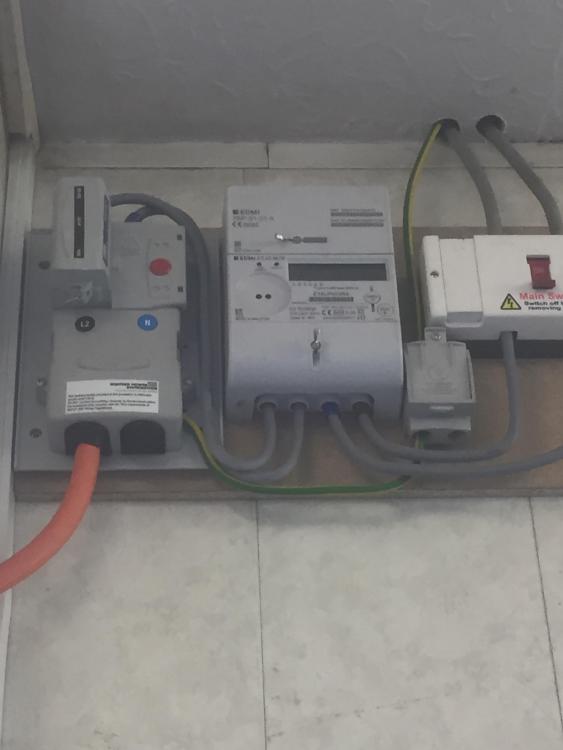
Tbh, if you ask the dno they'll change them. They should change them regardless tbph, as they'll not be to the new standard, so if you ask ( with tea and biscuits in hand ) they will usually do them free. Just had 3 separate supplies and Western Power guys were excellent.
-
@jamiehamy Didn't you have solid ceiling structure so 'had' to do walls first?
-
Bath Surround / Boxing In, and concealed pipework
Nickfromwales replied to Onoff's topic in Bathrooms, Ensuites & Wetrooms
Good lad lol. -
£200 are you nuts ?!?. Buy a level and a padsaw for change of £30 . Right. Describe properly what your dealing with. What do you mean no where near waterproof. ? Steel will eventually rust I assure you, especially where you cut the ends I think your heading in the wrong direction here, so let's discuss first ?
-
Fwiw, I'd 100% recommend ceilings first. 1) cables 2) plumbing 3) foam gap filling 4) ceilings 5) perimeter track on floor and ceiling plumb and square ( a laser is your friend ) 6) insulate if / where required and board walls putting either full osb sheets as cladding or pattresses where rads etc are going. Are you going metal as your not A1 with woodwork?
-
You can 'in-lay' the osb so it doesn't make the room smaller if that's an issue, say for hallways / landings etc, but other than that I'd heartily recommend cladding the metal stuff as I'm not a fan ( due to it being a bit flimsy compared to timber imo ). Have you fitted it before? Do you know to put struts ( sections of metal strut between stud and existing solid wall ) in at 1/3rd up and 2/3rds up to remove the 'twang' ? .
-
A sparky will swap those out in a wink of an eye. . Just have them to hand when fitting the CU.
-
Perfect boiler temperature re ufh?
Nickfromwales replied to DH202020's topic in Boilers & Hot Water Tanks
Not going to be that easy sorry. As the UFH will never ask for more than 35oC, the return temp will never get high enough for long enough as the boiler will undoubtedly short cycle or stay in full modulation. This will be particularly problematic when the UFH is up to temp and requiring very little heat input. Fitting a buffer tank in between the boiler and the UFH would solve this, where the boiler would fire infrequently at higher temp to maintain the buffer stat set temp, whilst the UFH was able to draw as much or as little heat as it required. As your install stands, it's likely your boiler will just sit at a low modulating temp for the rest of its days, away from the range required for condensing. . Can you retrofit a buffer tank, say in an airing cupboard, where the heat loss would be useful? ( The E setting iirc is the sweet spot for condensing to occur ). Hope that helps -
Bath Surround / Boxing In, and concealed pipework
Nickfromwales replied to Onoff's topic in Bathrooms, Ensuites & Wetrooms
Not in onoffs bath, I'm pretty sure of that. ? I'm sad now, happy thoughts please people. ? -
From the wider audience POV, this is a very informative exchange . Certainly separates what the difference is between simple 'good practice' and the actual regulatory requirements, with the latter, essential criteria, now well highlighted. I think that statement gives total clarity to the thread, thanks.
-
Bath Surround / Boxing In, and concealed pipework
Nickfromwales replied to Onoff's topic in Bathrooms, Ensuites & Wetrooms
For the uninitiated. . 1:38 secs in lol. Damn I'm old. ? -
Bath Surround / Boxing In, and concealed pipework
Nickfromwales replied to Onoff's topic in Bathrooms, Ensuites & Wetrooms
"I just KNEW that something good was gonna happen". Back in the day, eh?....... -
Bath Surround / Boxing In, and concealed pipework
Nickfromwales replied to Onoff's topic in Bathrooms, Ensuites & Wetrooms
I used to DJ, so can provide some hands-in-the-air music to throw some shapes to. ?????? -
Hi, and welcome ?
-
How to find a slow leak?
Nickfromwales replied to Fallingditch's topic in Central Heating (Radiators)
Yes. It's common for the PRV to fail and 'let by'. Water comes out of the copper overflow pipe at the rear of the boiler ( outside wall ), but can be tricky to catch as it often will do it when the system is hot and it evaporates away. Zip tying a clear bag over the end and making sure rain doesn't get in is the best way to see if it's been discharging. This could be the problem. An average system is around 10 radiators. It may be that the system doesn't have sufficient expansion and is causing the PRV to open. The boiler gets topped up to say 1bar, then the system heats up. The high volume of system water expands beyond the capacity of the boilers expansion vessel ( EV ) and the PRV opens to relive the excess pressure. The system then cools down again, when the heating turns off, and the water contacts. As there is water missing, the system pressure drops below the low pressure threshold and the boiler goes into lockout with low pressure fault on the display. How often are you having to top up, and how long has this been a problem ? Do you know if there is an additional EV? -
Looks the dogs bollocks mate ? Time to celebrate ? ??
-
@TerryE Dont you have a hideehole where you could remotely mount the cylinder ? Or is it out of sight where it is?
-
All for £40. ? Cheaper than shoplifting!