Jump to content

Nickfromwales

Members
  • Posts

    30995
  • Joined

  • Last visited

  • Days Won

    329

Everything posted by Nickfromwales

  1. Agreed. @readiescards, do you have pics of the floor you can upload ? One option here, as a retrofit fix, could be dropping the ceiling underneath and inserting some engineered, full depth noggins at say the 1/3, 1/2, and 2/3rds points along the length of the span. These can be made like a horse shoe to allow existing services to remain in place, so basically a pair of U-shape 25mm plywood baffles, one inserted with the mouth down, and the other overlaid with the mouth up. These then get glued and screwed together, then a pair of 50x75mm noggins get affixed to those and then to the top and bottom chords, again glued and screwed as well as practicable. Sash-clamping these so the glue is able to form a void free bond will be key to success, but a foaming PU GLUE will help a lot. Another belt and braces ( again retro solution ) measure will be to affix 18mm plywood to the underside of the joists before fitting the new plasterboard. That'll stop any remaining bottom chord movement, and hopefully that would stop the issues your having in the room above.
  2. Checking to see if there is already a static, negative deflection may be somewhere to start ?
  3. 600 and 400 are chalk and cheese. I did a job for a customer where the TF company specified 600mm centres. 1 runs of strong-back, 22mm p5 deck, glued and gas nailed, and still the dynamic deflection was horrendous. Fitted wardrobe doors seen moving etc. The deflection for static loading and dynamic loading are what you need to translate, as obviously it's the walking around / other activity aka dynamic that's causing issue. Can the company that specified them answer your questions ?
  4. I went to one leaking copper cylinder when young and keen ? and grabbed the cold feed pipe to show how bad the corrosion was, and that it was there that it was leaking from. As I put my hand on the pipe it pushes into the cylinder and the entire contents ( 115l or so ) emptied into the room in the wink of an eye. It presently disappeared into the floor void and all I could hear is the kid downstairs saying "mummy, the tellys gone off". Every drop went down the back of the telly, dvd, sky box etc. Another top day at work. They went through their own insurance after I took a photo of the knackered Union as I pointed to the hole in the living room ceiling where it was evident it had been leaking for years before I got there. Still got the old pulse racing though. ?
  5. So many 'plumbers' don't bother with doing that, but most sinks have a terrible cast where the tap sits, and cheap taps have a terrible nasty rubber o-ring and nowt else. That usually covers less than 2/3 of the hole. It's fatal with a shower over a bath but also not helped along by the fact most people inadvertently buy a standard bath instead of a dedicated shower bath, the latter has flatter sides and slowed decks to guide the splashing water to the drain. They have a much better finish and mate the taps far better.
  6. The fibre washer will suffice on its own, and do not use PTFE . The number one thing is getting a bit of emery cloth and cleaning the boss immaculately before fitting the new one. Remnants of the old washer is the number one cause of leaks. Whilst full and in use, connect a hose and open the drain off, as that'll be your biggest nemesis. Once you open it and prove it, that's one thing less to piss on your chips. With the immersion, get hold of the obligatory box spanner, but do all you can to get hold of a 3' stillys as that'll make cracking the immersion just so much more controlled. A bit of patience and effort there will pay dividends. There's no real advice other than to make sure your turning it, rather than pulling it off centre. It's quite hard to keep an eye on that as your perspective changes as you stand up. It'll either turn or it won't. If your tank is in any half decent shape then I'd go for @ProDave's method of keeping the cylinder full so it's counter weighted ( with the cold header tank empty first of course which will happen just by turning off the mains and opening a hot tap ). If you fear it'll fail then empty it slightly so the water level is below the boss. Iirc you have a shower pump. Remember to isolate the pump as this process will disturb all the sediment. Open them 24 hrs later when it's all settled Enjoy.
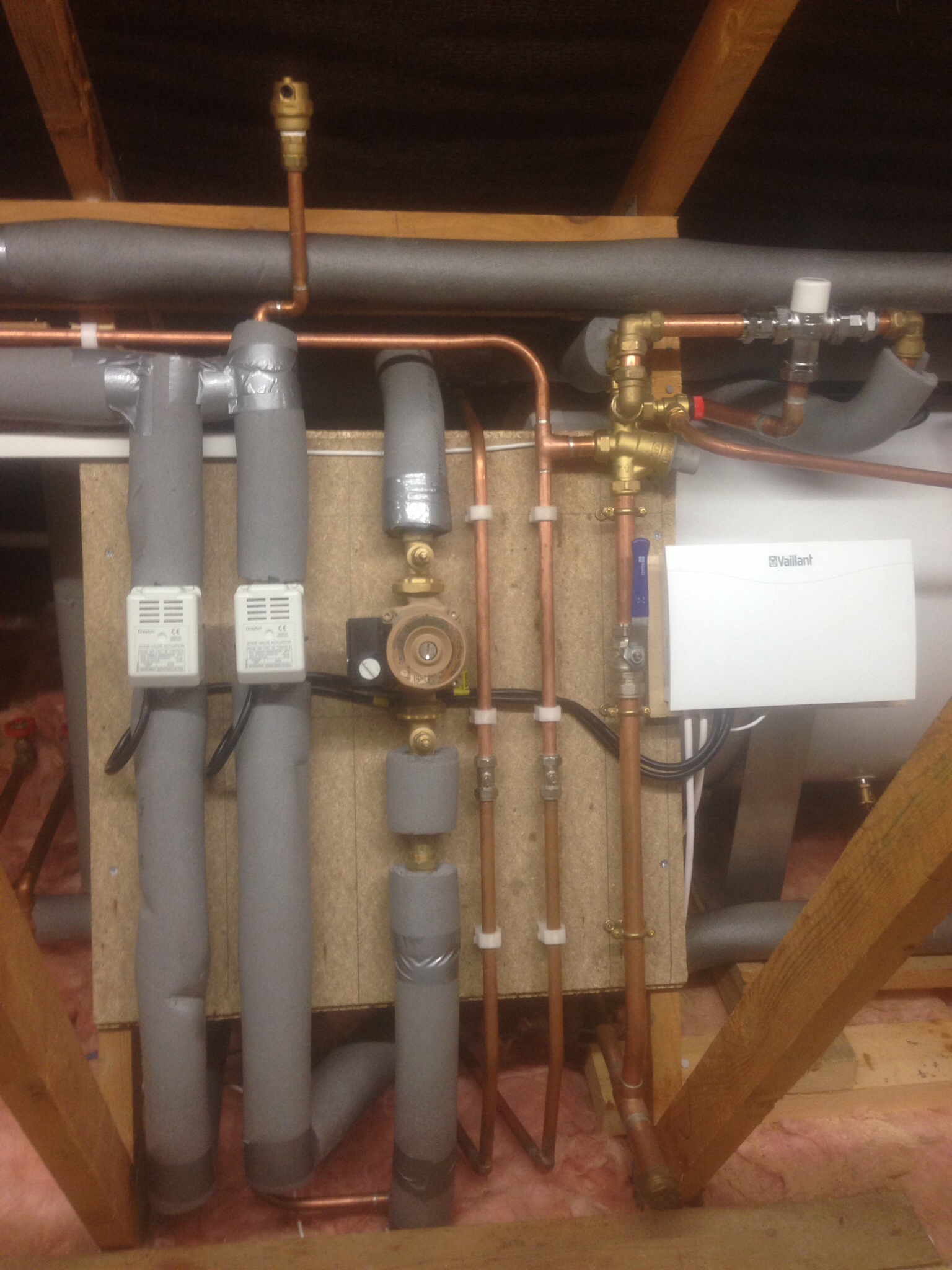
  7. Basically that's what I would do. I've stuck a lot of stuff in attics over the years, then I spoke to a very helpful chap iirc from Pumpsukltd and he mentioned making a large glass fibre drip tray with up stands for all the equipment to sit on / in. From there a Hepworth trap and an overflow run in 32mm waste pipe, so basically a big shower tray.
  8. Just squinted at that revision after coffee #2, and I think the pockets should go up one course. Apart from that, pure perfection. Slightly wider mosaic strips to get the cut tile out of the way? How many other vertical strips are there, and would them being widened to match cause issue?
  9. That looks the dogs danglies. Where did you get such a splenderific idea ??
  10. I'd purposely not mount the pressure switches on the vessels or the vessel pipework for the reasons I mentioned with isolation for service / maintenance / failure etc. There's no reason not to mount it on the peripheral pipework downstream of the pump TBH so don't know why anyone would do that in the first place, other than pure convenience / laziness.
  11. @JSHarris How much was the sq1 ? Just for another job that's chewing through the cheap IBO pump I imported from Poland
  12. What pressure does the pump typically throw out?
  13. I was thinking the same thing last night tbh. Firstly, the list sounds ok, but only you will know the actual qty and components list in fairness. The elbow issue is one of plumbing skill . The PTFE tape needs to be wound on as tight as you can without snapping it, and you need to get a good 20 turns on. Then squeeze it in your hand between the thumb and knuckle of your index finger, like a strangle hold, and twist the fitting ( clockwise only so the tape doesn't turn back off ) so it's compacted into the valleys of the thread. Then, get some liquid PTFE ( iirc @JSHarris got his from Screwfix ) and coat both the PTFE tape on the male valleys of the valve, and the bare valleys of the female thread of the elbow. Then carefully start turning one into the other. An old cloth between the spanners / grips and the valve will stop you scratching them back to the brass. Then the tricky bit. You need to work out when you have less than one full revolution left in the elbow before it bottoms out on the valve. When you approach that point you need to work out where the elbow needs to be pointing and then stop when you get there. Back turning isn't great so avoid it if possible. When made up, these ideally need 24hrs for the liquid stuff to take hold before pressurising. Stelrad are a nice looking radiator, but if there's one ( that's not the Kudox made PO? from B&Q / Screwfix ) that got higher output then go for it. Avoid Moretti for the vertical radiator as they're worse than bad. 90mm off the floor shouldn't really be a problem, as long as furniture isn't up tight against it. It's just about air resistance, eg what comes out of the top of the convector fins needs to be able to get into the bottom.
  14. Ok. First off turn the pumps to position 2 / medium. Next, do you have temp gauges on the flow and return ? When you say 45oC where is that reading taken from, the blending valve or the temp gauge? With that setup I'd have thought you could reduce that to 40oC first and try it. With regards to balancing, I'd just put everything open fully and wait to see how it performs, adjusting later only if required.
  15. Ok. If your having solar pv then you need to decide now. If your not, then I'd say a combi. If you are then I'd say system boiler and an UVC, as the hot tank will give you somewhere to store excess pv as hot water. Your DHW consumption is likely to better suit a combi however, and there are some very good ones out there these days ? I think I'd put UFH on both floors TBH, with room stats in each space for the ground / sleeping quarters, and a single room stat for overall control upstairs. I'd also fit two manifolds, one up and one down, so you can choose the flow temps accordingly to get the maximum comfort levels. It's a little complex compared to just radiators but not exactly OTT ( if your staying until your wings flap you out of there. ). Only downfall with UFH off a gas boiler is it won't like running uber low temp / flow, eg when the house is nigh on up to temp and idling there, so a buffer tank may be needed so you can guarantee the boiler stays in the realm of ideal condensing flow temperatures ( for maximised efficiency). Fyi, both manifolds can go upstairs in a single location and pipes can drop down, but can't go downstairs and run up realistically, unless you vent each upstairs UFH loop with air vents which need to be inspected / maintained. As @ProDave says, forget electric showers. Yuk. ?
  16. Prepare yourself to own one of these motherofallblowlampsandthensome. This thing is an absolute BEAST, and I use it when pipes won't solder because of water being trapped inside. It chews through the yellow Mapp gas bottles when at full wallop, but the flame tip is much narrower, focussed and gets hotter than the Devils flip flops. Dont turn it against the inside of your arm though, that gets the skin off quite quickly......probably
  17. Wow +1. You normally don't consider MVHR to have a super higher function, just recovering some otherwise lost heat, bringing some fresher air in, and maybe drying your Y-fronts a bit quicker on the clothes rack, but to hear this POV may be music to the ears of others who suffer similarly to your wife. Enjoy the house, and please pass the collective well wishes of everyone here to your better half. Best regards, Nick.
  18. If it shows no movement in 3 weeks then I'd check the float isn't stuck. ? I can only assume your showers are mixers rather than thermostatic mixers? If the stored DHW is at or above 38-40oC then the cartridge should compensate for any further fluctuations. Seeing such big changes in your DHW tells me your cylinder stat may not be set correctly too, eg getting too hot. The water temp in your tank should ideally be at around 60-65oC, and should never be any lower than 50oC in normal service. Do you know what the cylinder stat is set at ? Remember if the boiler flow is lower than the cylinder stat the system will continuously circulate with the boiler cycling unnecessarily as the cylinder stat will never get satisfied.
  19. Tres bien Rodney. And a good price to boot . It was doing my head it too as a few rads off at least a 5m head pump on a sealed system it should have been screaming around. Happy days ? Some music to play this out. Sweet. ?
  20. NB you ALWAYS fit an isolation valve at each vessel, and also you need a drain off between the isolator and the vessel so for the inspection you just shut the isolation, open the drain off, check the back pressure, top up if required, and then just reopen the isolation. All told 15-20 mins work max .
  21. If there is already a 100l vessel at the station now and your fitting another larger one nearer the house, I'd definitely keep the second vessel inline as a buffer for service / failure of either / or. If you need to do routine ( annual at least but bi-annual is recommended) inspection and or maintenance, then having a second vessel will allow you to isolate the other and retain a regulated flow. Plus it'll give extra volume too. If it's there, and free, why not retain it?
  22. Yup. 'Twas a narrow room so the idea was a completely fold away shower so they could cut a straight line to the peepee machine and have a bit of room when using the sink. I desgned it from scratch and it worked out great, other than when Novellini gave me the wrong sized shower glasses and tried to blame me. I nearly knocked the Rep out when he came to site 3 weeks later with an unusable shower. What a condescending prick he was. I actually said that I'd like him to get out of the bathroom so when he hit something on the way down it wouldn't be expensive. Tossa. ?
  23. Just run off an RCD plug / socket and you'll be fine. I've used 230v for the last two and a half decades and I'm still here. 110v may be necessary if your life / health insurance would refuse to pay out if you decided to commit electro-hiri-kiri ?
  24. If your at it 'hard n fast' then the biggest killer will be one charger. Id say 4 batteries. 2 chargers. Two in tools two charging / ready to switch out. Or, 3 batteries two out one on charge. Typical scenario is....one battery lives in the impact driver, one goes in the drill driver, occasionally used, swapping that one between other tools as you need them, and one ready to rock. For work / floodlights run an extension lead. Use LED so it's low load so you don't need a beast of a lead and you can plug your charger into it too.
×
×
  • Create New...