

Nickfromwales
-
Posts
30353 -
Joined
-
Last visited
-
Days Won
297
Everything posted by Nickfromwales
-
Must be a real problem holding cutlery lol
-

UFH Design Layout & Low temperature Underfloor heating
Nickfromwales replied to revelation's topic in Underfloor Heating
No, as room 2 looks like it will overheat if serviced by the loops feeding from / responding to the kitchen thermostat. Room 3 the same? What are rooms 4, 5, & 6? You should have that space serviced separately, and all the flow and returns to the kitchen should be lagged ( insulated ) to prevent unwanted heat loss into room 2, same elsewhere eg where the pipe runs are condensed and especially where they serve a different room. With 50mm screed i would want room stats and deicated zones throughout and to use a stat with a very good hysteresis, say 0.5oC or less. Is this a 'passive' build? eg tested as air-tight and super insulated? I would go for 120mm centres with 50mm of liquid as that's the worst type of UFH emitter you can get imho. Increased CSA and increased water volume / wider spread of pipes will lend itself to the lowest flow temp possible, but that will be dictated by the W/m2 that the dwelling requires to maintain a comfortable ambient internal temp vs outside temp. Serpentine layout as per your drawing is carp, go reverse / inverted and then you only have U-turns at the centre of each loop -
About 11mm, so all good.
-
Plastic pipe leak at compression joint on isolating vavle
Nickfromwales replied to Gooman's topic in General Plumbing
+1. I've been saying this to people for years. Still get stubborn assholes who say "it's OK".......it's not. Copper into compression and a hep fitting onto the copper each and every time = bombproof. -
Jesus. There's a special place in hell for you lot Just over hand tight, and don't go mad. It's the rubber seal that stops water leaking, the threads just keep the rubber seal where it needs to be. And, deep breath, a bit of lube will stop the rubber getting FUBAR'd.
-
UFH pipes protection/testing/fluid in slab.
Nickfromwales replied to SuperJohnG's topic in Underfloor Heating
Iirc, the UFH pipes from Wunda come Pre-pressurised with air / gas and the ends plugged sealed and factory tight judging by one I cut ( without knowing they’d started doing this, so subsequently nearly ? myself ), it’s at quite high pressure too. You’d 100% know you’d damaged it, but would the person who’s damaged it tell you? Also, a tiny puncture may not be notable so maybe not the immaculate solution. A pressure gauge is the only true way of knowing that the integrity has not been compromised. Water is not necessary, but it’s 500 times quicker to find a leak with water squirting out vs using leak detecting fluid with air. -
Are the pump isolation valves all 100% open? Close them fully, then open them fully to be completely sure.
-
Best way to set system pump speed
Nickfromwales replied to Kilt's topic in Boilers & Hot Water Tanks
Typically the pump should be pulling on the outlet of the mixing valve, not pumping into one of the inlets. Not how I'd have set this up, and I'd be surprised if that's working as intended ( however that is supposed / intended to work !?! ). My guess is that the mixing valve is installed incorrectly ( upside down ) as the direction of flow through it appears to be wrong vs the drawing at the outset of this thread. -
The inspection branch would be internal access as you’ll be T’ing in there, but you could get away with 2x inspection bends outside if the branch is going to be inaccessible after completion.
-
Yes. Been done a hundred times or more. Make the bend on the turn at the rear of the WC an inspection bend for belt n braces. Likewise with the branch indoors, eg buy an inspection branch.
-
Question about chimney breast removal and B.regs
Nickfromwales replied to Urchin's topic in Building Regulations
You can take risks for yourself, but a 3rd party cannot do that to you, so regs need following. If that comes down, you wouldn’t want to be in the room underneath it when it does. -
thermostatic mixer for shower at 100mm centres?
Nickfromwales replied to Tom's topic in General Plumbing
Just chuck some chrome compression pipes onto a standard concentric valve ? Set the valve a bit higher to allow the plumbing to do its thing and seal up where necessary. Or, can you fit a TMV on the pipework to the bathroom? Does it go underneath and you can just chop one in there? You want to intercept the plumbing before the basin and shower, but not the kitchen sink, ideally. -
thermostatic mixer for shower at 100mm centres?
Nickfromwales replied to Tom's topic in General Plumbing
Caravan things are out there a plenty. https://www.ebay.co.uk/itm/164643835176 One with 45mm centres. I’m sure a bit more googling will turn something up. -
SVP out and back into building envelope - is this possible?
Nickfromwales replied to Moonshine's topic in Waste & Sewerage
If there is free-draining material behind the retaining wall then I see no issues whatsoever. The penetrations will need ‘grouting’ to make them watertight but as long as that is executed meticulously you should have no problems with that proposed run IMO. -
https://forum.buildhub.org.uk/topic/3020-combimate-water-softener—opinions/
-
You can use a timer + AA pump Each instance is individual to occupancy / usage. No right or wrong here. A loop in 10mm for the HRC ( hot return circuit ) is what I was referring to above, and deffo not suitable for feeding 2 or 3 basins, unless you do away with an NRV and allow DHW to flow down each direction to the outlets ( a bit like an electrical ring main ) but that’s quite unorthodox and wouldn’t be something I did by design, more of a “work-with-what-you-got” solution. The advice and disciplines change for folk who are doing / have radial plumbing vs those who have series plumbing. With the latter, you may as well just do a series loop in 10mm and T off for each HRC serviced outlet accordingly. Advice also changes again for new installs by design vs retro fitting something to cure problematic dead legs. No one ‘standard’ solution.
-
Drop the nut and plastic washer, big bead of CT1, and wind it back up. Put loads on, and clean the excess off with wipes. Don’t let it go up as far as the slots for the overflow runoff.
-
Rethinking the layout of my unvented hot water cylinder
Nickfromwales replied to Adsibob's topic in Boilers & Hot Water Tanks
+1 -
The point is moot, as a 10mm pipe will clear a 40m dead leg in less than a minute. If you use the Grundfos Comfort pump then maybe a bit longer, as it's a super low energy / flow pump which crawls the water around ( based on strategic use / utilisation ). I've several projects where there are basins and sinks run in 10mm supply pipework ( no hot return circuit ) and the flow rate is adequate for filling a sink etc. 10mm is more than 'man enough' for this application, plus lower CSA and lower losses too.
-
Big issue is how much DHW is drawn off and when though? Would suggest the TS is serviced on demand if the extra independent heating zone is added plus DHW is required 'on tap'.
-
? Don't you mean that it does not control the boiler directly? With a TS which is servicing DHW too ( assumed ) then the cylinder stat controls the boiler and primary pump and he timeclock decides when. Therefore you would need a separate zone valve tee'd off the heating output from the TS which can command the boiler ( override the timeclock ) independently. That wouldn't be so problematic if you only want to use the annex in parallel with the current 'heating on' times? An idea of how you time heating and hot water ( DHW ) would help
-
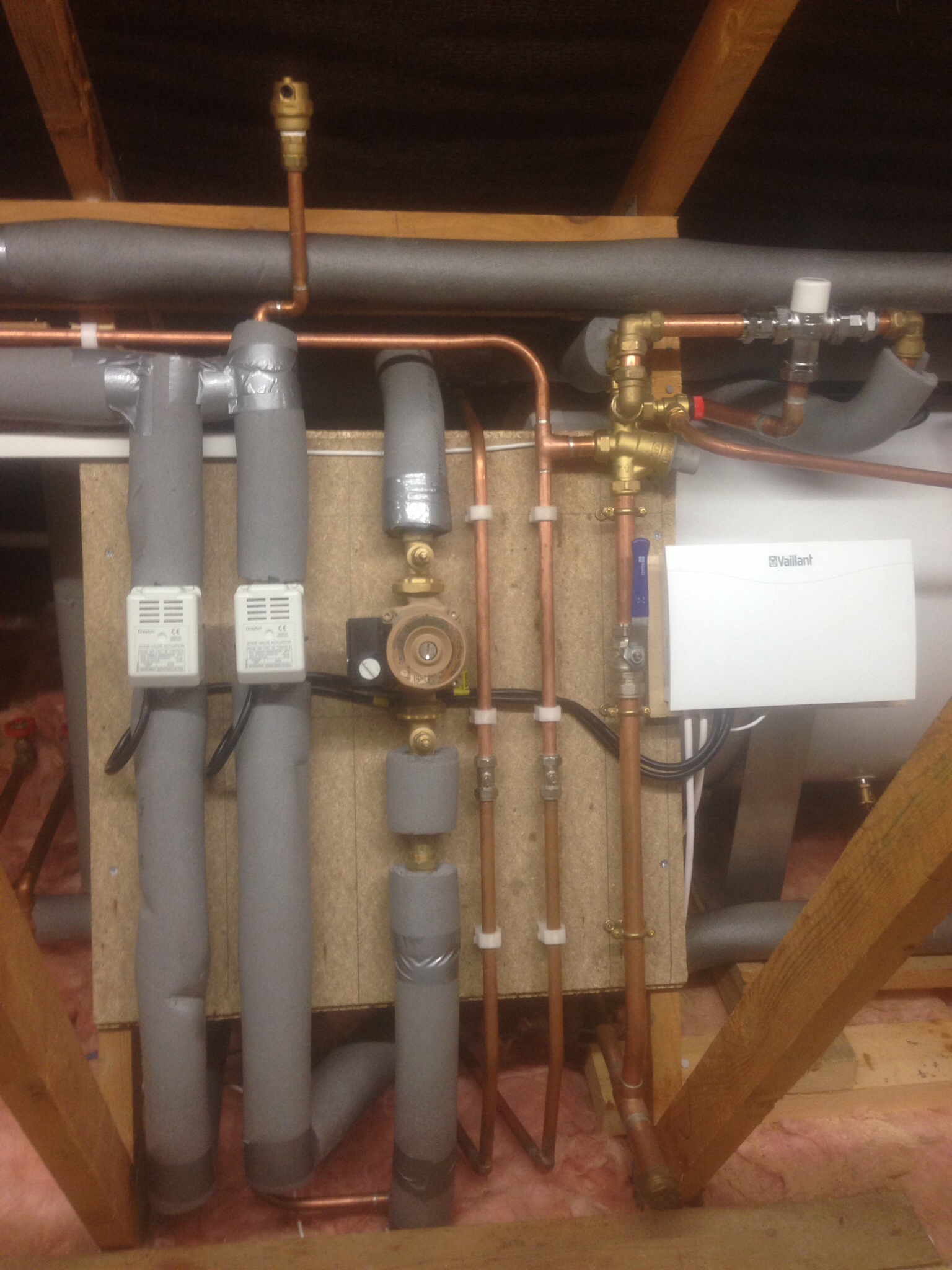
When the Zone valve brown is energised the motor creeps to the open position ( 8-10 seconds will elapse ). When the valve head reaches the 100% open position, it presses against a micro-switch inside the zone valve which is over the orange and grey pair of cables ( 5-wire ) eg to switch on the boiler and pump ONLY when the valve has fully opened. You do not need the switching pair, and you could have just fitted the 3-wire version. Not an issue, but just to help you understand what they do
-
OK. Green / Yellow = Earth Blue = Neutral Brown = Live to motor ( which opens the valve ) Orange = Common of call for heat switch Grey = Switched live out of call for heat switch Connect the blue and G/Y to the same terminals shared by the heating system supply. Split the 230v feed to actuator / zone 3 output from the Heatmiser and connect that to the brown. That will get the motorised valve to open and close with the actuator. That should be all you need?
-
Hi Keith, and welcome. Isotex in the title so have you made your mind up on ICF? Also, one bed....does that mean single story or 2 storey? Type of roof etc? Info, and more info
-
Manifold system versus hot return system
Nickfromwales replied to Russell griffiths's topic in General Plumbing
Beware the regs / good practices on the lower temp ‘dead legs’. Ideally you should be putting lower temp TMV’s at the point of discharge rather than point of origin. With 50oC set point at source, is there really any reason to lower the second group? At that temp you have little to zero risk of scalding and I assume your outlets will all be mixers anyway? Seems a bit OTT tbh.


