


Temp
-
Posts
10690 -
Joined
-
Last visited
-
Days Won
43
Everything posted by Temp
-
Fire barriers required behind cladding.
Temp replied to Big Jimbo's topic in General Construction Issues
Google found.. https://www.labcwarranty.co.uk/technical-blog/cavity-barriers-behind-decorative-cladding I have a small area of vertical hung tiles on battens so my house built in 2007 would no longer comply. -
The DPM under the floor slab should really go up the wall and lap over onto the DPC. I can't guarantee it will be OK but I suspect as long as it's lapped up the wall to a point a few inches above the DPC it will be OK.
-
Is There A Self Build Case To Meet An Identified Housing Need Policy?
Temp replied to EViS's topic in Planning Permission
The full act is here. Their obligations are listed in chapter 2. 10. https://www.legislation.gov.uk/ukpga/2016/22/contents/enacted Eg.. I would ask something like.. With reference to the Housing and Planning Act 2016 Chapter 2 "Self-build and custom housebuilding".. 1. In each base year since 2016 to date, how many people have been added to part 1 of the "Self-build and custom housebuilding register" ? 2. In each base year since 2016 to date, how many people have been added to part 2 of the "Self-build and custom housebuilding register" ? 3. In each base year since 2016 to date, how many "serviced plots of land", that meet the obligations under the Act, have been granted planning perpermission. 4. The information the Council uses to determine that a planning application is for a selfbuild or custom build home as defined by the Act. Unfortunately I think councils are only required to meet local demand (Part 1 of the register). But it might still carry weight if they are way behind. -
Is There A Self Build Case To Meet An Identified Housing Need Policy?
Temp replied to EViS's topic in Planning Permission
In my limited experience planners allow houses that are in keeping with their surroundings in scale and appearance. If you propose something that doesn't fit in or would set a president they don't want (eg outside village boundary) then they will find every possible policy excuse to reject it. ⁰ -
Is There A Self Build Case To Meet An Identified Housing Need Policy?
Temp replied to EViS's topic in Planning Permission
Councils are meant to maintain a "Self-build and custom housebuilding register" .. https://www.legislation.gov.uk/uksi/2016/950/contents/made ... and make land available to meet the demand identified by the register, however the rules are complex and not all councils do anything more than maintain a list and charge you to be on it ! People get fed up paying for nothing and drop off the list. It might be worth finding out if the council have met their obligations under this legislation and reference it in a planning application. Perhaps get a friend to submit an FOI request if you can't find info online. -
Looks really good. Very satisfying when a project like that comes together.
-
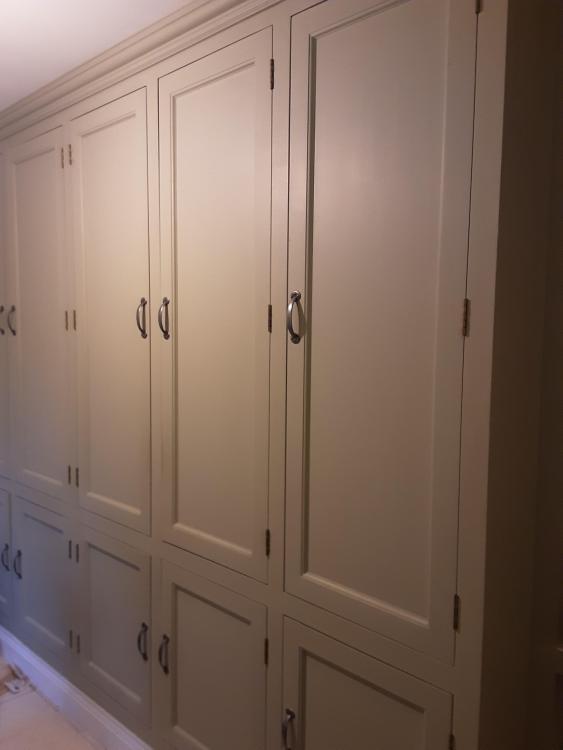
There are people that will make anything for a price. When we built our house in 2007 we decided to get some built in cupboards for a utility room made in a style that matched the kitchen. They were made from Tulip wood and cost us about £3k fitted but unpainted. Photo below. I could probably have made them myself but had a house to finish. We asked three local companies to quote to fill a space with floor to ceiling units in a similar style to those in the kitchen. Left them to work out the details. Actually what I did was go visit a few first, I said I might be looking for some work done and they showed me a book of what they had done for other people. Also got to see their workshop and what they were currently working on. Called them back later to ask them to come and quote. Fitting floor to ceiling units is tricky because you can't get them in through a door upright, and if you take them in laid flat you can't stand them up because the diagonal is taller than the ceiling if you get what I mean. They may have to be made in two parts, a top and bottom.
-
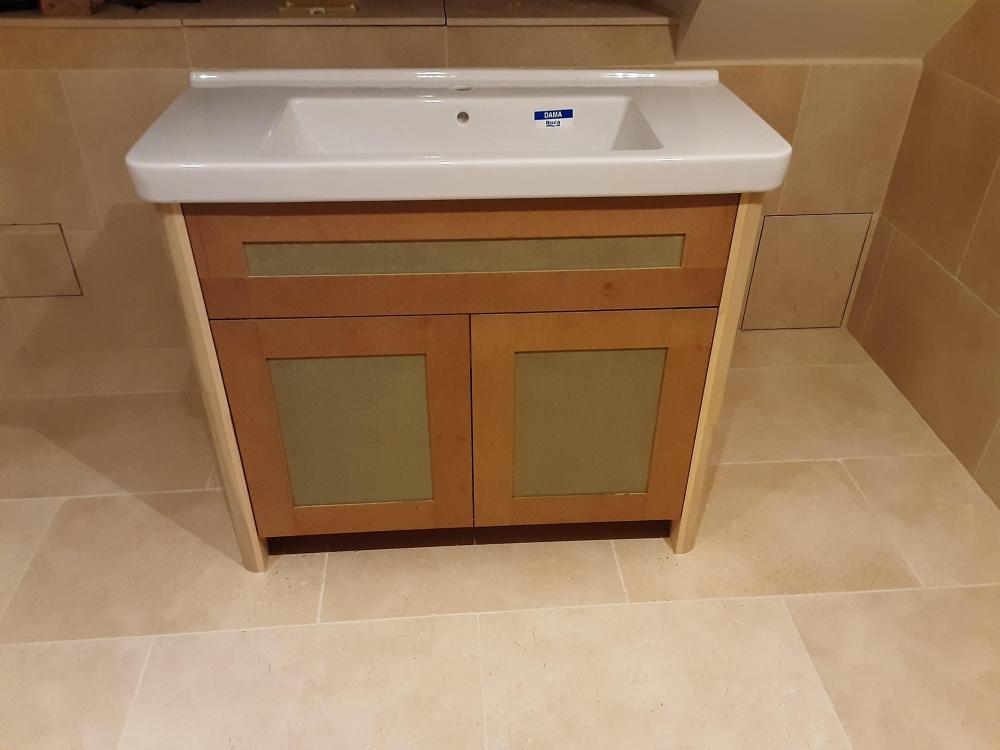
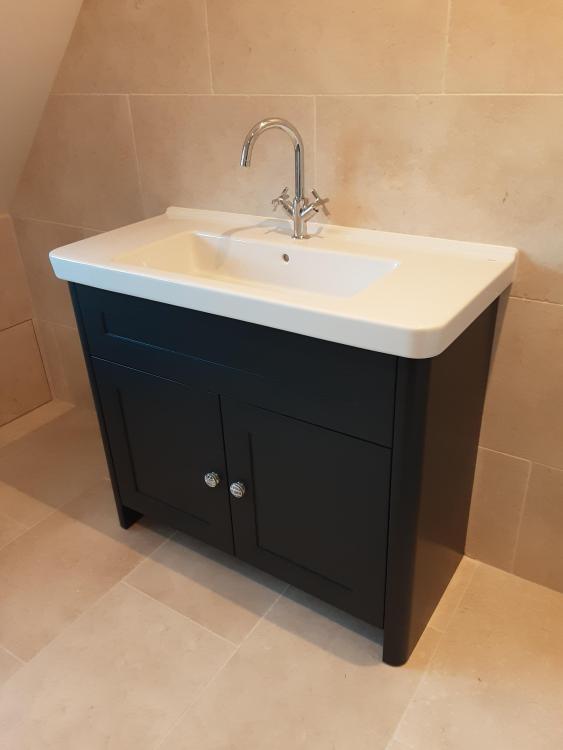
As I knew it was going to be painted I used 18mm thick water resistant mdf. The curved corners were Tulip wood dowels/cylinders from ebay cut into quadrants (I don't have a lathe). The doors are a frame of 18mm mdf with a 9mm mdf centre panel. The frame is jointed with pieces of 9mm mdf in slots. A technique I saw on YouTube. I made it myself in a small shed using a table saw, hand saw and drill for dowels and hinges. Dry assembled on living room carpet, glued up and painted in the bathroom. If I wasn't going to paint it (or wanted a stained finish) I'd would have had to use a different design and materials. For book shelves 18mm MDF isnt great unless carefully designed/braced. It tends to sag/curve over time.
-
You probably don't need to do a CAD drawing. Just give them photos of the style you like and dimensions. If they are going to be fully fitted let them come and measure up. Perhaps ask them to give you a sketch to confirm they have understood what you want. I've used the free license version of Fusion 360 to design and build a bathroom cabinet. Like all CAD packages there is a learning curve but there are lots of youtube vids.
-
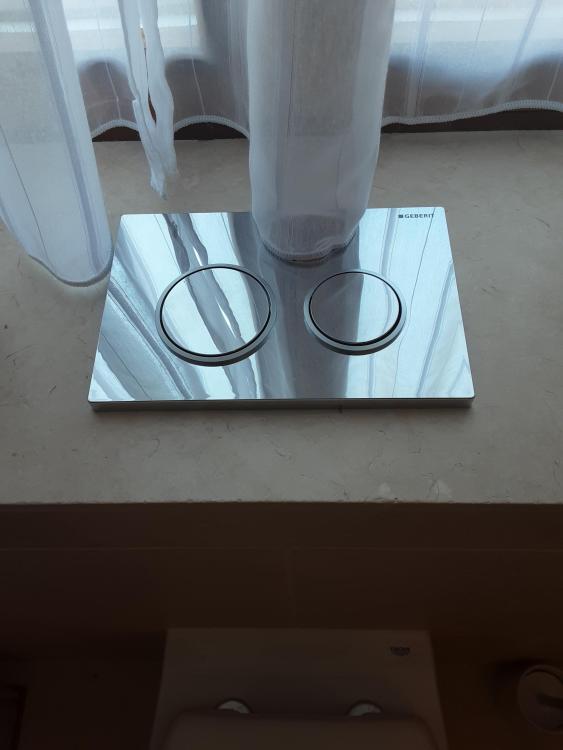
You show me yours and... Works fine for us. Main problem is fingerprints.
-
Pretty sure it will, and a possibly a water trap. Edit Actually there are dry tundish that don't need a water trap.
-
I believe tails buried less than 50mm would need to be RCD protected in the meter cabinet. Many houses (mine included) have them run in the cavity but I don't think that's really allowed if you go by the book. Might be possible to use SWA tails not buried over 50mm but I'm not an electrician.
-
Basic Heating Control Understanding Help
Temp replied to Shaun McD's topic in Air Source Heat Pumps (ASHP)
Yes that's why others have suggested one or two large zones rather than every room being one zone. We have an oil boiler and they can't modulate down like gas and we wanted lots of small zone - so we fitted a Thermal Store as a buffer. That's not suitable for an ASHP though. -
Basic Heating Control Understanding Help
Temp replied to Shaun McD's topic in Air Source Heat Pumps (ASHP)
2. Generally with ufh and multiple stats there is a "wiring centre" at each manifold. This has inputs for each stat and outputs to control the valves on the manifold. It also provides a BE (Boiler Enable) which is the logic OR of all the stats. Eg if stat A or stat B or stat C... calls for heat then BE is active. The BE signal can be used to control an ASHP or if there is a Thermal Store it controls the output of the Store. On systems with just one or two stats you don't really need a wiring centre but something else (wire and possibly a relay) performs a similar function. The BE signal also controls the loop pump on the manifold and any two port valves between heat source and manifold. Sometimes the wiring centre provides separate outputs for these. -
Screed thickness with UFH, over PIR. How thick?
Temp replied to saveasteading's topic in General Flooring
When choosing screed type, if you plan to tile make sure you understand the Laitance issue. -
Water connection for newbuild on a farm with existing water supply
Temp replied to Furnace's topic in General Plumbing
A lot of duct is sold with a draw string pre installed. This should be used to pull a 3/8 inch polypropylene draw rope (or two) through. -
Never buy a leasehold property. It has taken us a year to get the lease on a flat extended due to the land Lord p1ssing about. Had to pay for both the Tribunal AND then court action. In both cases the landlord did the bare minimum to avoid an official ruling and has delayed at every turn. Lost our very patient buyer at Christmas. Had to reduce the asking price 10% and still not getting viewings. Now we have just received this from our solicitor.. TWO YEARS JUST TO REGISTER A LEASE !
-
I was quoted £100/m for a small water main diversion back in 2005/7 so this sounds reasonable to me.
-
I raised my out building on two courses of bricks but ran the cladding battens and cladding down over them to about 25mm above the gravel that surrounds the slab.
-
I found this.. https://www.beama.org.uk/static/9f03d5e3-dd77-4424-96c138133b9b0cd5/BEAMA-guidance-on-Part-F-of-the-Building-Regulations-for-Dwellings-in-England.pdf See Page 8.
-
When the war in Ukraine ends there will be massive rebuilding there. I reckon there will be a big shortage of trades in Europe.
-
What diameter pilot hole for 5mm diameter SS screw?
Temp replied to markharro's topic in General Joinery
https://www.diydata.com/carpentry/screw-holes/wood-screw-holes.php Says.. Pilot 2.0 or 2.4 (softwood) 2.8mm (hardwood). As they are SS I would go on the larger side. Perhaps even 3mm. -
Travis Perkins have 7.3N.. https://www.travisperkins.co.uk/100mm-blocks/solid-dense-7-3n-concrete-block-grey-100mm/p/700064
-
I suspect 7N will be fine as I doubt architects design things to be that marginal. We used mostly 7N blocks and we have B&B first floor. Just had to use 14N under some steel beams.
-
My understanding is the Building Regs require either scheme membership or a Building Control Application. However since you already have an ongoing Building Control Application for the house they might allow it. On the other hand you might get a jobs worth that wants to see plans for the electrics. This is very old.. https://electrical.theiet.org/bs-7671/building-regulations/part-p-england-and-wales/certification-schemes/#:~:text=What are competent person self,carry out 'notifiable' work. Ask your electrician if he's still a scheme member. If not try for a chat with your Building Control Officer. Tell him you got a good electrician but he's retired and ask what he woukd need. If he says yes verbally send him an email to confirm what was agreed.




