


Temp
-
Posts
10684 -
Joined
-
Last visited
-
Days Won
43
Everything posted by Temp
-
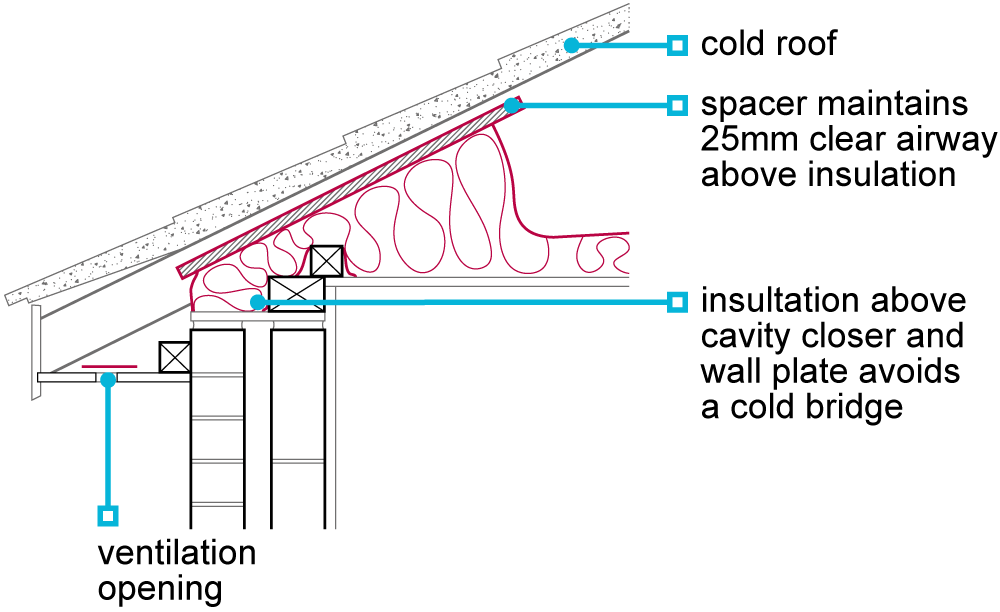
Have you checked you have sufficient ventilation at the eaves. You typically need the equivalent of a 10 - 25 mm wide slot the full length. That's a lot of 80mm round vents, perhaps 4 - 5 per rafter bay. Sometimes you have to have two staggered rows to meet recommendations a one line won't fit. https://nhbc-standards.co.uk/7-roofs/7-2-pitched-roofs/7-2-15-ventilation-vapour-control-and-insulation/
-
Block and Block with 180mm cavity instead of Isotex ICF
Temp replied to Chanmenie's topic in Brick & Block
For Thermaclass Cavity Wall 21 the board size installed is 1190 x 450mm (installed). That's an area of 1.19 x 0.45 = 0.53 sqm. So work out the area of your walls and divide by 0.53 to get the number of boards needed. In the 140mm thickness there are 64 boards per pallet so divide the number of boards by 64 to get the number of pallets. Perhaps add 5% for cutting/wastage? Shop around/haggle. -
Online Quote for triple glazed sealed units. Lots of options. Not used myself though. Looks like delivery by 26th. https://www.glasstops.co.uk/order-online/triple-glazed-unit-rectangle.html
-
Catapulted into Construction Phase. What have I missed ?
Temp replied to Canski's topic in Brick & Block
Existing services disconnected/turned off in the road? Any planning conditions that say "Before work starts..? -
I you plan to sell in a few years I'd be careful about costs. It's not hard to build a house that is worth less than it costs to build.
-
We just have some low level wall lights around the house mostly where there are steps and the patio. Quite like them as the give a certain "atmospheric feel".
-
I remember how they would fill up alarmingly when you flushed, then just before overflowing there would be a gurgling woosh and it would all disappear.
-
New member, new extension and renovation project
Temp replied to AdaminCymru's topic in Introduce Yourself
Welcome to the forum. -
Most (all?) pans have a round outlet pipe but on many it transitions to something not perfectly round when you look down the pan. In my many years of cleaning pans (I'm over 60) it's best to avoid the ones with are very "square" as you get err build up in the corners. Most toilet brushes are round and don't always reach into the corners of the square if you get what I mean.
-
Depends if you think you might want to use the water. I think most crate systems are just storm attenuators so it will all empty out before you can use it. Most tanks are the opposite in that they don't provide any storm attenuation when full. I believe it might be possible to get tanks that do half and half. Eg they automatically drain until half empty so you have half the capacity acting as a storage tank and half providing storm attenuation. I havent really investigated these.
-
How to hide manhole covers in garden
Temp replied to puntloos's topic in Landscaping, Decking & Patios
Old whiskey barrel with flowers in? -
We had same problem. Our plot was/is on clay and a percolation test showed soakaway wouldn't work. Also have a piped ditch along the edge of the road. When we applied for PP one consultee said "They wouldn't want us to make flooding down the hill worse" so we got hit with a planning condition to get the drainage approved. I proposed an underground rainwater storage tank with overflow to the piped ditch under the road. We wanted one anyway. The planners approved it even though it doesn't provide storm surge attenuation if its already full. Its been very useful when there is a drought as we can use it to water the lawn or the veg plot. We have even pumped the water 200 yards across the village green to an allotment. Its not used for anything in the house. Too much leaf mould gets into the tank for that. As far as I know the EA or County Council wernt involved, unless the planners consulted them a second time but I doubt it as approvalto discharge the planning condition came back too quick. If you don't get hit with a Planning Condition I would just propose discharge direct to the ditch to the BCO and see what he says. Perhaps write on the drawing that you have Riparian Rights. If it becomes an issue then perhaps propose a crate system for storm water attenuation or rain recycling tank. I wouldn't involve the County Council unless someone tells you that you have to.
-
In winter its obviously cold outside and warm inside. The 25mm insulation effectively "moves" part of the rafter from the warm side towards the cold side reducing its temperature. This increases the risk that water vapour may condense on the rafters. Ideally you would get a condensation risk analysis done. However my understanding is that normally upto 1/3rd of the insulation between and 2/3rds above the rafters is ok. You have 25/125 or 1/5th between and 4/5ths above so I agree with the BCO, it should be fine. To reduce risk perhaps seal the gaps between the 25mm insulation and rafters to reduce the amount of water vapour,pour that can get through to the cold side and add a vapour barrier before plasterboarding. Avoid down lights that need big holes cut in the vapour barrier.
-
Welcome, I think there are one or two threads on retaining walls/garden landscaping at the moment
-
Uneven slanted floor, big problem with kitchen plinth
Temp replied to john_the_clueless's topic in Kitchen Units & Worktops
Any chance the suppliers make a taller plinth or a tall cupboard door you could cut down? -
Can you fit smaller jets in the existing boiler? I had this done on an oil boiler. Reduced the output by about 7% as I recall.
-
Uneven slanted floor, big problem with kitchen plinth
Temp replied to john_the_clueless's topic in Kitchen Units & Worktops
Could you find something to cover the whole plinth? -
How to hide manhole covers in garden
Temp replied to puntloos's topic in Landscaping, Decking & Patios
Paving slab and a statue of some half naked Greek godess? -
Block and Block with 180mm cavity instead of Isotex ICF
Temp replied to Chanmenie's topic in Brick & Block
If the outside is rendered perhaps a fully filled cavity might be an option? There is a 140mm Celotex Thermaclass Cavity Wall 21 that has T&G edges so should be easier to install without gaps? Possibly expensive though. -
Whats an outbuilding conversion deemed as
Temp replied to livingthedream's topic in Building Regulations
I believe it's the latter unless planning permission allows the annex to be sold off as a separate dwelling. -
Extension near oak tree. Piling? Soil investigation survey needed?
Temp replied to Mattg4321's topic in Foundations
Sometimes called a Ground Condition report. Usually involves digging one or two pits and pushing an instrument into the ground, also sending samples off to a lab. -
How would I move this scaffolding?
Temp replied to CalvinHobbes's topic in General Self Build & DIY Discussion
I think unloading it the other end is the issue? -
Hi @jsjsjs Welcome to the forum. If it turns out to out helpful perhaps consider donating, we have some key fobs to give away to donors at the moment. https://forum.buildhub.org.uk/topic/33304-free-build-hub-key-fob-for-donors/#comment-490153 In our experience dealing with people from the planners to trades is the hard part. We originally planned to have our Architect manage our project but our builder was pretty good and the Architect hardly ever came to the site so I felt we wasted some money on him. Some people use an Architect to manage their builder, some manage the builder themselves and others hire trades themselves. The former is the most expensive but least risk, the latter can be the cheapest but higher risk and a lot of work. There are good, bad and positively ugly builders out there. There are other ways to go.. An option is to hire a Project Manager who might be a retired builder or other profession. With a project manager you pay them a fixed fee and they should be helping you minimise overall costs. They would probably be on site much more than an Architect. Hiring individual trades with help from a project manager might be an option. Another option is to use a builder but hire a Quantity Surveyor to control payments to the Builder. The QS would visit and assess how much work has been done to date and give you the OK to pay the builder that stage payment. If you decide to make changes the QS can help assess if the builder is charging the right amount - especially if its the builder proposing the changes. Have you tried to find a builder yourself? While looking for plots we did a lot of driving around and any time I saw a nice house being built I asked if the boss was on site. I explained I might be looking for a builder and asked to look around. You can get a good idea what sort of quality they are capable of. Look for odd gaps, neat or untidy plumbing etc. Ask questions and see how they answer you. If they answered with "Oh don't worry about that" I didn't bother to keep their business cards. If they carefully explained their approach to that issue I was more likely to keep it. We found our builder that way. He was working on a fabulous barn conversion. We gave his details to the Architect and he was included in the bidding process and he turned in the lowest offer of three we had. Two other bidders took me to see houses they had built for other people, sure they were nice but I couldn't be sure they wernt taking me to see one they built for their mother 🙂 Are you living in the house? If the house has been unoccupied for more than two years and is still unoccupied you should be able to get renovation work at the reduced VAT rate of 5% instead of 20%. The rules allow you to move in after work starts but not before.
-
Now you mention it we have noticed that as well. It's because cold air in winter can hold less moisture so humidity is lower in winter than in summer. I don't think it's anything to do with the UFH itself. Its what the gap around the edge under the skirting is for.

