


Temp
-
Posts
10690 -
Joined
-
Last visited
-
Days Won
43
Everything posted by Temp
-
Whats an outbuilding conversion deemed as
Temp replied to livingthedream's topic in Building Regulations
I believe it's the latter unless planning permission allows the annex to be sold off as a separate dwelling. -
Extension near oak tree. Piling? Soil investigation survey needed?
Temp replied to Mattg4321's topic in Foundations
Sometimes called a Ground Condition report. Usually involves digging one or two pits and pushing an instrument into the ground, also sending samples off to a lab. -
How would I move this scaffolding?
Temp replied to CalvinHobbes's topic in General Self Build & DIY Discussion
I think unloading it the other end is the issue? -
Hi @jsjsjs Welcome to the forum. If it turns out to out helpful perhaps consider donating, we have some key fobs to give away to donors at the moment. https://forum.buildhub.org.uk/topic/33304-free-build-hub-key-fob-for-donors/#comment-490153 In our experience dealing with people from the planners to trades is the hard part. We originally planned to have our Architect manage our project but our builder was pretty good and the Architect hardly ever came to the site so I felt we wasted some money on him. Some people use an Architect to manage their builder, some manage the builder themselves and others hire trades themselves. The former is the most expensive but least risk, the latter can be the cheapest but higher risk and a lot of work. There are good, bad and positively ugly builders out there. There are other ways to go.. An option is to hire a Project Manager who might be a retired builder or other profession. With a project manager you pay them a fixed fee and they should be helping you minimise overall costs. They would probably be on site much more than an Architect. Hiring individual trades with help from a project manager might be an option. Another option is to use a builder but hire a Quantity Surveyor to control payments to the Builder. The QS would visit and assess how much work has been done to date and give you the OK to pay the builder that stage payment. If you decide to make changes the QS can help assess if the builder is charging the right amount - especially if its the builder proposing the changes. Have you tried to find a builder yourself? While looking for plots we did a lot of driving around and any time I saw a nice house being built I asked if the boss was on site. I explained I might be looking for a builder and asked to look around. You can get a good idea what sort of quality they are capable of. Look for odd gaps, neat or untidy plumbing etc. Ask questions and see how they answer you. If they answered with "Oh don't worry about that" I didn't bother to keep their business cards. If they carefully explained their approach to that issue I was more likely to keep it. We found our builder that way. He was working on a fabulous barn conversion. We gave his details to the Architect and he was included in the bidding process and he turned in the lowest offer of three we had. Two other bidders took me to see houses they had built for other people, sure they were nice but I couldn't be sure they wernt taking me to see one they built for their mother 🙂 Are you living in the house? If the house has been unoccupied for more than two years and is still unoccupied you should be able to get renovation work at the reduced VAT rate of 5% instead of 20%. The rules allow you to move in after work starts but not before.
-
Now you mention it we have noticed that as well. It's because cold air in winter can hold less moisture so humidity is lower in winter than in summer. I don't think it's anything to do with the UFH itself. Its what the gap around the edge under the skirting is for.
-
https://www.plasticpiling.co.uk/plastic-sheet-piling/
-
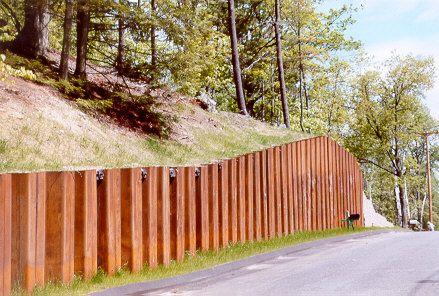
Yes the sheet steel piling serves as a structural retaining wall. If you don't like the look you can add non structural timber cladding or planting to hide it. While googling for a picture I found there is also PVC sheet piling but not sure if available in the UK. https://www.escpvcsheetpiling.com/retaining-wall
.jpeg.cb488dbcc635227bfc0170d98cabb6a7.jpeg)
-
Extension near oak tree. Piling? Soil investigation survey needed?
Temp replied to Mattg4321's topic in Foundations
We have clay soil and got a soil condition report. That showed the clay wasn't really a bad type and strip foundations with expansion boards were allowed for our new house. Not even terribly deep. And we have trees nearby. One just 3m away in neighbours garden. Several houses down the road they just assumed they would need piles and they had to go so deep they joke about a man in Australia using the other end as fence posts. I would ask around and see if anyone in the area has built recently. -
If you don't know if you have soakaway try asking neighbours. Someone in the cul-de-sac might know if they have them.
-
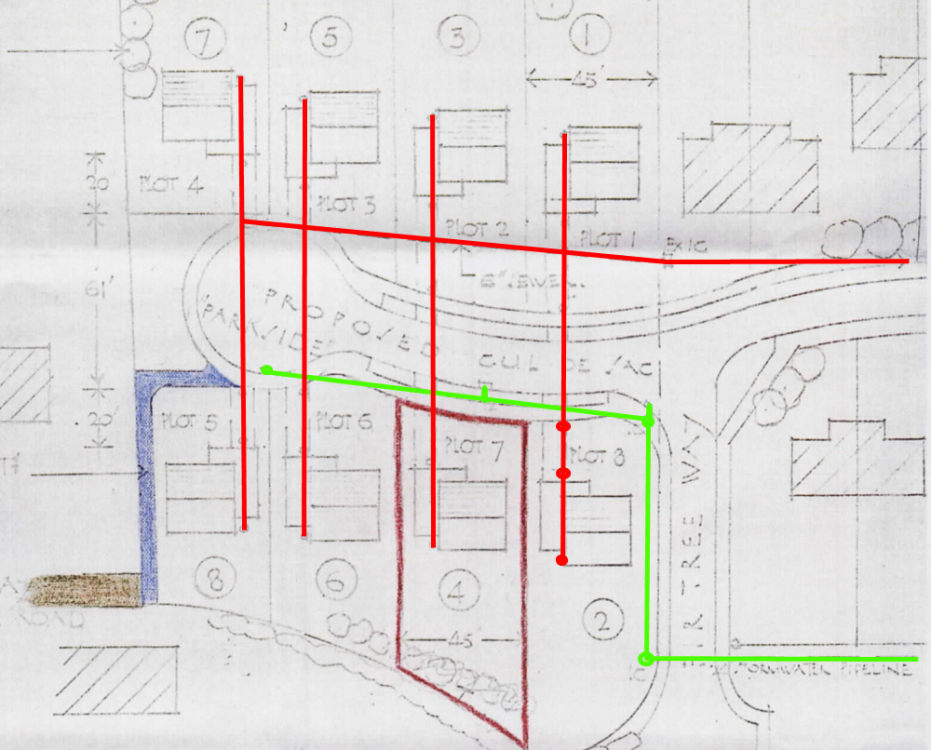
Its not very clear but this was my interpretation of the drawing. Green being the storm pipeline and red being the foul sewer - but the slope of the land might mean I'm wrong. What are the circles that I have marked in red? Are they where you have gutter down pipes or soil stacks? If you don't have any soakaways I suspect you might have a combined sewer. Perhaps see if dye appears at the manhole in red near the cul-de-sac? What I would do is figure out where existing rainwater goes then propose the same to the BCO when you make your Building Control Application. Normally they want a drainage diagram so I would get one drawn up and write on it something like.. "Surface water drainage connects into existing surface water drainage system at this point". Then see what the BCO says. He might just accept it. PersonaIly I would avoid asking the BCO a specific question about it. In my experience you don't ask a policeman "Are you going to give me a ticket for going 79", you just say good evening and let them decide if they are going to give you words of advice or a ticket.
-
Hi Judith, welcome to the Forum. If you find it useful perhaps consider a donation to the running costs. We have a key fob offer running at the moment..
-
Indicative cost of this extension
Temp replied to EmmaSp's topic in House Extensions & Conservatories
Link to other thread.. -
Link to other thread..
-
I also suspect the garage would need to be demolished and rebuilt as unlikely to carry the load of the extension? Sorry to sound a bit pessimistic.
-
Unfortunately yes. 1m between the wall of your extension and the boundary. Doesn't give you much of an extension. Yes. Normally they also cite a reason or reference to a policy that contains reasons. You could try appealing the condition using the justification tthat your proposal makes the situation no worse than it is currently. You only have 6 months from planning grant to appeal. If your planning application included dinension you might be able to appeal on the grounds that the decision isn't clear. For example how can they approve drawings that can't be built? Would a passage way with rooms over be considered a side space. If you decide to appeal I would suggest asking a Planning Consultant what the best approach is. Would a rear extension be a better option? Possibly even moving? Would a small side extension add enough value? Even if the condition is removed you might not be able to build right to the boundary. For example nothing must overhang the boundary without permission including eaves/verge. The Party Wall Act might also add to costs if the neighbours want to be awkward.
-
I might be out of date but that Bosch has an 8mm collet. I think 1/4" and 1/2" are still the most common sizes but burhaps someone can comment on the availability of 8mm shank bits now? Not a problem? If available 8mm would be better than 1/4".
-
Engineered wood is better than solid over UFH. Much less likely to warp and cup so you can risk wider boards. Ours are 210mm wide and you can't tell they aren't solid wood. We don't have it but many others have Carpet over OSB and ufh in dry mix on first floor. We have a mixture, just about everything somewhere in the house. From best to worst I rank them... Tiles over ufh in screed. Stone over ufh in screed. Wood over ufh (foiled insulation/heat spreader plates) Carpet over ufh in screed (but it does depend on the underlay and carpet). As I said above we do need to run high flow temps but see reason above. We have an oil boiler so that's no issue. Note that to meet building regs wood floors spanning joists are meant to be 18mm thick. So be careful when shopping for engineered wood as some is 14mm and may require chipboard under it. You don't want 18+14 = 32mm of wood.
-
The main advantage is you might get away without having to take down fences and dig out your neighbours garden temporarily while you build the retaining wall. That's one advantage of the sheet steel piling that @Radian mentioned. These can be hammered into the ground close to the boundary and then you dig out your side afterwards. Curved walls are inherently stronger than straight and look better in my opinion. If you want to go back so far that the wall is over 1m high you should get a professional involved and they should be able to propose different design ideas and solutions.
-
Not sure how accurate these costs are but they suggest £250 to £450 per square meter. https://www.checkatrade.com/blog/cost-guides/retaining-wall-installation-cost/
-
Sounds OK to me. The soaker should be at least 100mm wide under the slate so you have an extra 50mm to cope with any unevenness of the wall that the tile cutting cant cope with.
-
Phenolic boards such Kingspan K103 have a better thermal conductivity than PIR but not by much 0.018 vs 0.022 W/mk I think. That's about 18% better. When you screed the floor form expansion joints at doorways. Screed can shrink very slightly and form a crack at doorways. This crack is never straight and can propagate through tiles or stone. The expansion joint forms a deliberate crack that you can cover with a grout line or door sill.
-
+1 We have 21mm Engineered Oak over UFH and B&B without screed. We actually fitted battens the same thickness as the insulation and secret nailed the Engineered oak to that. We did find we needed high flow temperatures to push enough heat through the floor when it's very cold but that's possibly because we built to 2005 Building Regs and have a full height window and no curtains. Put as much insulation under the UFH as you can. We only have 80mm and if building again might double that. I know better now.
-
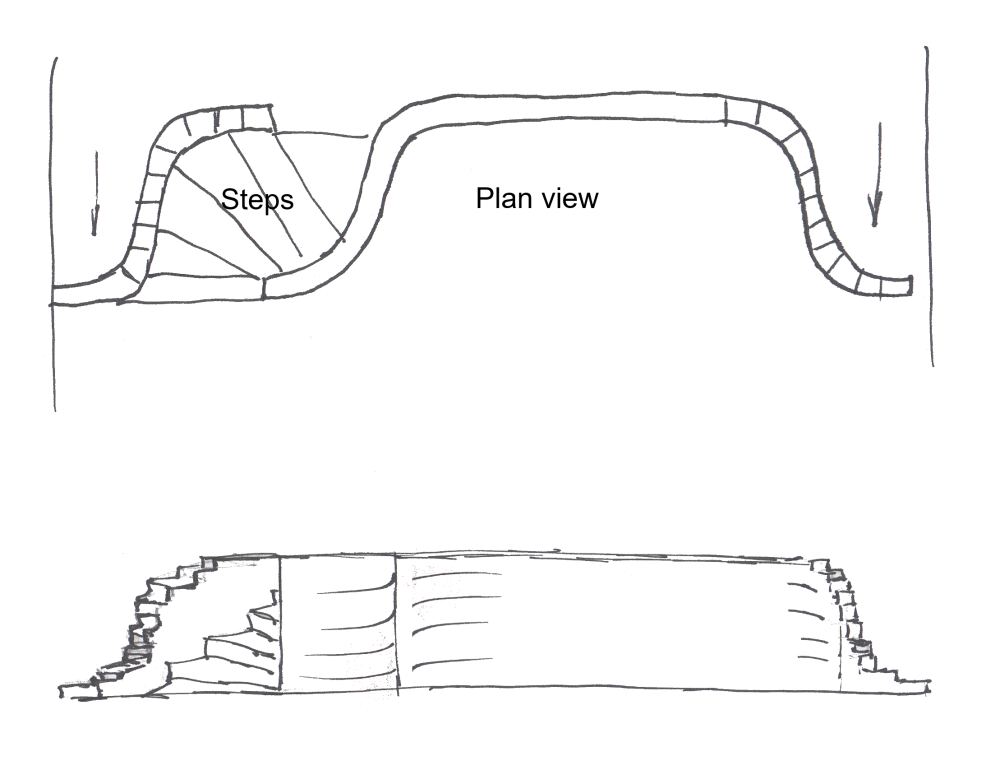
If you dig out the full width you would most likely have to take out the fences both sides and build side retaining wall and reinstate the fences. How about leaving a meter of so either side sloping down and taper the retaining walls something like this. Gives you a recessed area near the "P" of "Plan" for a small BBQ or seating area. Not a great sketch sorry..
-
I think using insulation is much better idea than plywood. Less chance of damaging the pipe fitting when removing it.

.jpeg.cb488dbcc635227bfc0170d98cabb6a7.jpeg)

