


Temp
-
Posts
10690 -
Joined
-
Last visited
-
Days Won
43
Everything posted by Temp
-
Looks like I misunderstood. I thought one of the photos in the OP was a house to which you were adding a porch!
-
If you need a hot water store for the bath I would also use it for the shower.
-
I'm not sure an oak framed porch is right for the house. I think something modern in glass might be better. Flat glass roof, glass wall on the left. Open at the front or a glass door so you can still see the existing front door. Probably not what you want but that was my first instinct.
-
It's not illegal to add a 20% markup but it would be to add 20% and say it's VAT when it isn't.
-
This bit also went missing... https://www.gov.uk/hmrc-internal-manuals/capital-gains-manual/cg65243
-
Sorry once again the formatting has gone wrong and the editor won't let me fix it. Grrr. How do I make quote tags visible so I can edit them? One missplaced / and the formatting is spammed up and I can't fix it, presumably because quotes aren't meant to be edited?
-
Try... https://www.gov.uk/government/publications/private-residence-relief-hs283-self-assessment-helpsheet/hs283-private-residence-relief-2019
-
I'm also confused... So they are intended to be used like normal actuators but (with auto balancing via loop temperature sensors) but @JSHarris has an extra one configured to replace the mixer so it controls the flow temperature to the floor? Any chance of a diagram?
-
Are there any nice roof beams/posts you would want to retain if converted? Would they limit how much insulation you can fit between them without covering them up? With a new building you can set them lower, below whatever thickness of insulation you like. Calculate CO2 reduction over life of the building :-)
-
We have a beam and block first floor that has two quite deep steel UBs to reduce the span of the concrete beams. The B&B floor rests on the lower flange just like your hollow core. The tops of the UB project above the top of the blocks. These were hidden in the insulation layer before adding UFH in screed on top.
-
We quite like having the master bathroom on its own zone. That way we can have it toasty first thing without heating the bedrooms to the same extent. We're using a Heatmiser stat with remote sensor for the bathroom. We have several computers in one bedroom and that would probably get too hot if it was on same zone/stat as other bedrooms.
-
Not sure if this link will work but it's to the data sheet for another valve that needs the flow 10C higher than the output. Note 1 suggests this is some sort of safety feature when the valve is used to control the water temperature of a tap or bath. They say its to ensure the valve shuts off if the cold supply fails. https://www.arrowvalves.co.uk/media/wysiwyg/pdfs/tmv5213datasheet.pdf
-
That sounds like the valve might have a limited range. Eg it can't mix 100% flow and 0% return but limits at say 90% flow and 10% return?
-
I expect you have already tried this or can't but... I would turn on the cold supply and run cold out of the shower, tap and to the WC to get the pipes cold. Then turn off the cold supply and run the kitchen taps. Then feel the temperature of the cold pipes at the shower and the bathroom tap. If one of those is now warm the problem will be with that device.
-
Shower Screen Support Bar at 45 degrees
Temp replied to Ferdinand's topic in Bathrooms, Ensuites & Wetrooms
This one appears to have grub screw at the wall end allowing the end to be rotated. Glass end can also be rotated. https://www.kerolhardware.co.uk/shower-stabiliser-bar/multi-angle-wall-to-glass-support-bar.html Looks like it will do just about anything. -
Shower Screen Support Bar at 45 degrees
Temp replied to Ferdinand's topic in Bathrooms, Ensuites & Wetrooms
300-480mm https://www.kerolhardware.co.uk/shower-stabiliser-bar/wall-to-glass-support-bar-with-45-degree-sleeve.html 290mm https://www.kerolhardware.co.uk/shower-stabiliser-bar/multi-angle-wall-to-glass-support-bar.html -
Shower Screen Support Bar at 45 degrees
Temp replied to Ferdinand's topic in Bathrooms, Ensuites & Wetrooms
In case it helps... With many you can cut the bar to length and reattach the end fittings. -
No need for that. The crap that can build up is corrosion products. Put corrosion inhibitor in it. Follow makers instructions on the concentration required - more than one bottle maybe needed.
-
Google found a bit about its history here.. https://www.getsurrey.co.uk/news/local-news/concrete-elephants-50th-birthday-trumpeted-6347851
-
-
Designing gas central heating for DIY maintenance.
Temp replied to epsilonGreedy's topic in General Plumbing
There might be an easier way but here is my idea for a filling port for pressurised systems. To add inhibitor you would switch off the system and close valves A and B. Then open C and D to drain the 1L tank. Then close D and pour inhibitor into the tank via the funnel. Then close C and reopen A and B. Switch system back on.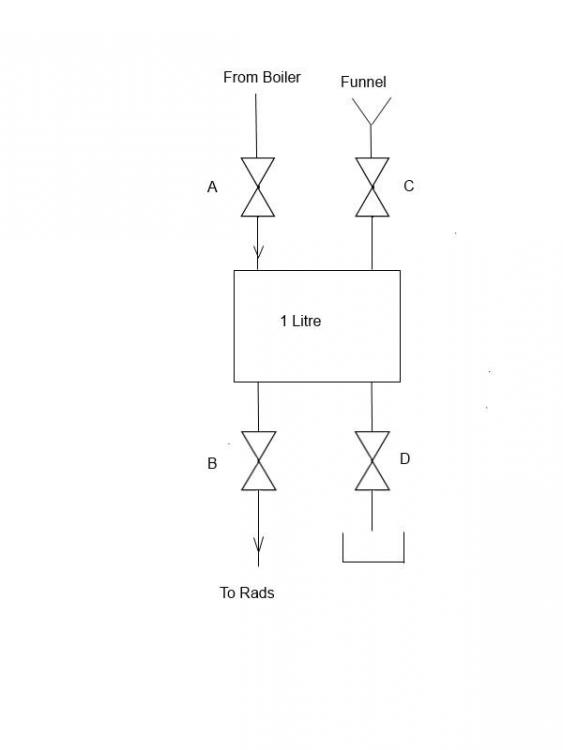
-
Designing gas central heating for DIY maintenance.
Temp replied to epsilonGreedy's topic in General Plumbing
7. Make it easy to put corrosion inhibitor in the system ! I seem to be banging on about corrosion inhibitor at the moment. Must be the time of year. I'm sceptical of annual maintenance contracts. They cover servicing but most do NOT include checking or topping up the corrosion inhibitor. Yet this is the most important thing you can do to keep your system reliable. Without it over time sludge builds up and can block pipes and pumps and cause leaks in the boiler and rads. The first you know about it is the system fails to work when you switch on the heating in September/October. The sludge has settled out over summer and blocked a pipe. When the service man rocks up he tells you the contract doesn't cover the first power flush. You are faced with a bill of £300-£800. Sometimes they tell you its mandatory to have one or they won't cover you any more. You can shop around and get a power flush done by another company but there are quite a few sharks out there. Adding corrosion inhibitor like Fernox F1 can help prevent the problem... If your system is vented you can just tip a bottle or three into the header tank but this can mean a climb into the loft. If your system is pressurised you have to lower the pressure and use a kit to inject the stuff into a radiator bleed valve or similar. Then repressurise the system. This would be a lot easier if there was a "filling port". See my next post in a moment. -
They don't usually have holes. Most have a texture/pattern both sides that helps the adhesive bond it to the floor and tiles. Some are waterproof and can provide a form of tanking. BAL have a tech guide... https://www.bal-adhesives.com/a-technical-guide-to-uncoupling-systems/ There are also several vids on youtube. Search "Decoupling mat" or "uncoupling mat".
-
Flashing: some sympathetic advice please
Temp replied to ToughButterCup's topic in General Self Build & DIY Discussion
Think I would turn turn the rolls around, hammer them in well, CT1 bead over the lot eg fill groove including over lead rolls. -
I had a rented house once with rads full of sludge. Just connected a hose to the drain and ran it outside to a man hole. I emptied, refilled and ran the heating a few times to clean it out. Mine was vented but yours is probably pressurised. So after connecting the hose and opening the drain valve you may need to open the filling loop valve to force fresh water in and old out. After its all working remember to put corrosion inhibitor like Fernox F1 in the system. May need more than a few bottles to get the right concentration.


