


Temp
-
Posts
10690 -
Joined
-
Last visited
-
Days Won
43
Everything posted by Temp
-
Perhaps the only lender that give him commission?
-
Drains should be at least 300mm deep unless they will be driven over so perhaps start that deep. Then 25m at 1:40 would go down 0.625m so the depth below surface is now now about 300+625 = 925mm. Then you say the garden slopes down 2m over 60m.. 60m at 1:40 would be another 1500mm fall but the ground slopes down 2000mm. So the depth below ground at the treatment plant would be 925 + 1500 - 2000 = 425mm How deep does it need to be at the treatment plant?
-
WD40 is quite a thin oil. I think something a bit heavier or possibly even a grease might last longer?
-
+1 Our house has two floors each on three levels. One manifold per floor on the highest level works fine. What you need is enough ports per manifold/floor. Some large rooms may need two loops, smaller rooms one loop or possibly even sharing a loop if that makes sense. By making sense I mean I wouldn't share a loop between two bedrooms as some people like very different temperatures at night. In addition there is a risk to sharing loops - it only works if the heat loss/gain is similar. Don't share a loop between a cold north facing room and a south facing room with large windows.
-
Distance between kitchen units and under floor heating
Temp replied to Loz's topic in General Plumbing
I'd think of the future.. https://underfloorheating1.co.uk/blog/article/Underfloor_Heating_with_a_Ground_or_Air_Source_Heat_Pump -
+1 Leave all loop valves open for the pressure test so a leak in any floor loop will show up on the pressure gauge. You might see some variation in pressure due to temperature changes over next few days/nights.
-
Land Registry Question - how to access a "copy filed"
Temp replied to Ferdinand's topic in Party Wall & Property Legal Issues
Google found.. How to request/purchase 'Copy Filed' documents? https://help.landregistry.gov.uk/app/social/questions/detail/qid/109/~/how-to-request%2Fpurchase-copy-filed-documents%3F See follow up questions and replies at the bottom. Suggests your solicitor could get it online. -
Land Registry Question - how to access a "copy filed"
Temp replied to Ferdinand's topic in Party Wall & Property Legal Issues
I might be wrong but I think there is another database called the "charges register" so if its not at the Land Registry perhaps try there? I think these records are/used to be maintained by local councils but the government is trying to provide central access. Not every area has joined the central scheme which is here.. https://search-local-land-charges.service.gov.uk https://search-local-land-charges.service.gov.uk/check-if-an-authority-is-migrated -
Distance between kitchen units and under floor heating
Temp replied to Loz's topic in General Plumbing
PS There are limits on the minimum bend radius if that's what you are asking but floor layout means there shouldn't be too many bends. Especially if you do it like this.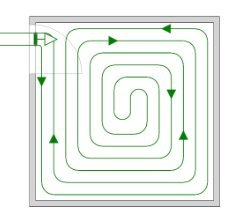
-
Distance between kitchen units and under floor heating
Temp replied to Loz's topic in General Plumbing
No, it's more to do with having sufficient pipe in the floor to get enough heat into the room. Rooms like kitchens and bathrooms that have a lot of areas where you can't run pipe can benefit with having a closer spacing to make up. -
Distance between kitchen units and under floor heating
Temp replied to Loz's topic in General Plumbing
I would probably reduce the spacing to 150mm and have 7 pipes in the 1200mm gap and 150mm separation from the units. -
Can the firepower of a gas nailer be adjusted?
Temp replied to epsilonGreedy's topic in Tools & Equipment
I hired one to nail feather edge board to make a fence. As others have said, it's adjustable, but the one I hired worked out fine as delivered. Made short work of my fence. Can be used one handed so was dead easy to hold board in place with one hand and fire the gun with the other. Could also reach through neighbours prickly plants which would be impossible with hand nailing. -
Counter battens might be needed for several different reasons but... The roof should be designed so that water cannot pool on the top of the roof battens. This can happen when something stops the membrane from draping between the rafters. For example when insulation or sarking boards press it against the underside of the battens. In this case counter battens raise the tile battens allowing any water blown under the tiles to run down.
-
Is the balcony metal framed with wood deck or is the whole thing wood? If the latter I think it would be wise to assume that at some point it might be necessary to replace all the balconies.. https://collier-stevens.co.uk/advice-hub/residential/do-balconies-present-a-fire-risk/ https://assets.publishing.service.gov.uk/government/uploads/system/uploads/attachment_data/file/869532/Building_safety_advice_for_building_owners_including_fire_doors_January_2020.pdf
-
Marley say.. https://www.marley.co.uk/blog/what-are-the-fixing-requirements-of-bs-5534
-
Zehnder q600 password
Temp replied to osmononame's topic in Mechanical Ventilation with Heat Recovery (MVHR)
The "Binary 101" course was surprisingly difficult. -
Do we need a Party Wall Agreement
Temp replied to Becks1974's topic in Party Wall & Property Legal Issues
Even then you only need a Party Wall Agreement if you will be digging deeper than the neighbours foundations. If your extension will use foundations the same depth as your house then chances are they won't be deeper than the neighbours so no PWA needed. See para 28 on page 21.. https://assets.publishing.service.gov.uk/government/uploads/system/uploads/attachment_data/file/523010/Party_Wall_etc__Act_1996_-_Explanatory_Booklet.pdf Remember that nothing can overhang the boundary so the wall might have to be slightly on your side to allow for the gutters or verge overhang later. Many builders seem to forget this point. -
No insulation in the floor? Normally the combined depth of screed and insulation is sufficient.
-
Zero rating vat
Temp replied to nod's topic in Self Build VAT, Community Infrastructure Levy (CIL), S106 & Tax
That's as it should be. Materials hould be standard rated to you unless part of a supply and fit type deal. -
Have a look at the title deeds for all the properties involved and discuss with your solicitor. There should be something in there already about the soakaway. Their right to use it and and maintenance. It will be difficult or impossible to add something that binds the neighbours unless the other houses haven't been sold yet, then the seller could add something when they are. If the neighbouring houses have already been sold the deeds should be available from land registry for just a £few. They are sent by email seconds after you pay. This is the real land registry Web site. Beware of fakes that charge more. https://eservices.landregistry.gov.uk/eservices/FindAProperty/view/QuickEnquiryInit.do?_ga=2.256197643.1208010228.1630642415-877028900.1600035571 You might also ask the seller for evidence the soakaway has been sized correctly for three houses.
- 1 reply
-
- 1
-

-
I suppose there is a slight risk of problems with your vat reclaim if they were to investigate because they require the work to be legal. Unlikely though. Make sure you have claimed the CIL exemption and got the paperwork done for that.
-
What products do you think will be banned/worth avoiding using?
Temp replied to CalvinHobbes's topic in Ireland
Some weed killers have come close to being banned. -
You can hire a theodolite for £20-£60 a week but modern ones are pretty complicated. https://www.zenithsurvey.co.uk/product/datum-theodolite-hire/
-
We have this. It's OK. Issues... A few times we have accidentally kicked a sharp outside corner in bare feet (ouch). Our sink is recessed and I do feel it in the back if there is a load of washing up. Think you will be OK with the Belfast sink if it's not too deep/low. The top edges of the skirting attract dirt.
-
Normally these are done by different people (Surveyor and Architect) so my guess is the Surveyor didn't want to do the street scene drawing. Our Architect was a bit of an artist and used pen, ink and watercolour to do the street scene.

