


Temp
-
Posts
10690 -
Joined
-
Last visited
-
Days Won
43
Everything posted by Temp
-
It's common for the planners to send a letter stating they intend to issue enforcement proceedings. The key is to find out what they want you to do about it. Sometimes they think you need Planning Permission and are likely to grant it. Sometimes they really want the building work reversed. Sometimes they want changes. Ask them. If they say you need planning permission but they are unlikely to grant it and want them removed I would find yourself a local Planning Consultant.
-
As I recall there is a rule of thumb that to avoid condensation you should have at least 2/3rds of the insulation above the rafters and no more than 1/3rd between. That's 2/3rds of the Thermal resistance not thickness. I believe that can be done easily with something like 150mm PIR above and 100mm Rickwool between but I rushed the sums. Have any thicknesses already been specified ? .
-
Air gap?
-
Freeholder withholding consent for alteration
Temp replied to bupieker's topic in Surveyors & Architects
If you had input from an SE and Building Control (and your mortgage Co?) then I think any refusal would be deemed unreasonable. https://www.penningtonslaw.com/expertise/business/real-estate/property-entrepreneurs/property-entrepreneurs-faqs/faqs-dealing-with-tenant-requests-for-alterations-and-assignment -
I would suggest no perimeter insulation on the one that needs the Constructional Hearth. Should be ok on the other one. We have regular wood skirting around the inside of our recess. Think I would put perimeter insulation around before screeding, trim it back flush and cover with the stone.
-
The Approved Document describes two types of stove, those that are/aren't certified that they won't raise the hearth over 100c. This determines the total thickness of the hearth needed. From memory it's 12mm or 225mm. So check that first.
-
Freeholder withholding consent for alteration
Temp replied to bupieker's topic in Surveyors & Architects
If Building Control say its OK they should allow it. -
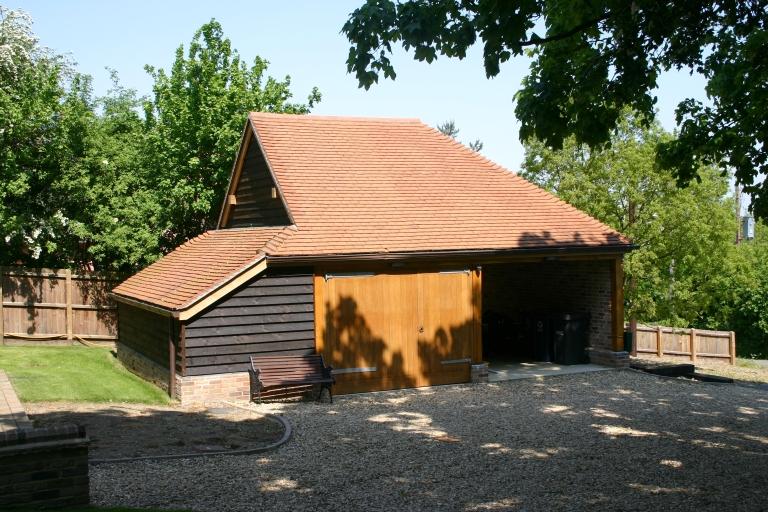
You only need provide drawings and possibly details such as the materials and finishes. You don't need to tell them what it will be used for and I wouldn't. Our mistake was to build a double garage as a single and lean to. It's effectively a double garage with wall down the middle and that wall takes up space I'd rather have for other things.
-
I doubt procedural errors carry much if any weight*. Errors to do with the GPDO, the NPPF and local policy do but many can be subjective. Harm outweighing benefits and all that stuff. * I know they might be required to correct them but they don't usually change an outcome.
- 7 replies
-
- 1
-

-
- planning permission
- lawful development certificate
- (and 1 more)
-
Soil pipe across neighbour land broken by them
Temp replied to ashthekid's topic in Waste & Sewerage
@ashthekid They are wrong. It is NOT a private drain following the changes in 2011. On this page it details the position on ownership before and after 2011.. https://www.lyonsdavidson.co.uk/whose-drain-anyway-changes-private-sewer-ownership-pipeline/ Your situation is detailed at position "3" on the "before" diagram, and "4" on the "after" diagram. I don't think this can be any clearer. -
Welcome to the forum. I know some local authorities share planning staff but never heard of them doing this over such a distance. The acts refer to decisions being made by the "Local Authority" so I would have expected their name on the decision letter even if some work was done by staff at another but perhaps I'm wrong. If its dated 2002 then technically it's too late to appeal as you only get 6 months to file one. Google found this which suggests errors such as the issue date may have to be corrected by the Inspectorate not the LA. https://www.localgovernmentlawyer.co.uk/planning/318-planning-features/22731-the-finality-of-decisions https://www.legislation.gov.uk/ukpga/2004/5/section/56 https://www.legislation.gov.uk/ukpga/2004/5/section/59
- 7 replies
-
- 1
-
-
- planning permission
- lawful development certificate
- (and 1 more)
-
Depends on the tree and the soil type. Worse case would be something like a willow on a clay that shrinks and expands.
-
Measured our Bosch and its 596 or 7 wide. https://www.theguardian.com/money/2017/aug/13/washer-dryer-too-deep-replacement-ao "...the majority of standard UK front-loading washing machines are roughly 850mm high and 595mm to 600mm wide. They are designed to fit into a standard kitchen width space of 600mm, with width (not depth) the one dimension that is strongly adhered to by most manufacturers."
-
https://wslaw.co.uk/insight/commencement-development-practical-tips-pitfalls/#:~:text=What is commencement%3F,period expressed on the permission.&text=In practice%2C very minor works,to commence a planning permission. Make sure you have done the CIL exemption paperwork before doing anything on the site.
-
Soil pipe across neighbour land broken by them
Temp replied to ashthekid's topic in Waste & Sewerage
Get photos of the existing layout and the new one. If the new pipe is no longer shared then it might become your responsibility rather than the water co. If you have photos you can prove it was theirs and the neighbours changed it. -
Soil pipe across neighbour land broken by them
Temp replied to ashthekid's topic in Waste & Sewerage
Normally the BCO won't look at existing drains unless alterations or new connections are being made. I'm wondering if the BCO knows they should have got approval from the water co and that's the real reason for his concern. I think its unlikely given there haven't been any problems with it and nobody is making any changes to it. If the neighbours are building over the sewer then they should be getting approval from the water co. The water co might insist the sewer is diverted around their foundations or allow them to build over. In some cases it is not possible to do what water co insist on. In such circumstances it might not be possible to build what/where they want. -
Soil pipe across neighbour land broken by them
Temp replied to ashthekid's topic in Waste & Sewerage
I think worth notifying them of "problematic work on a shared drain that you believe the water company own". I think it will be easier to get the right thing done while there is still work going on site. Once its all covered up they will see it as your problem and since you own your drains it will be down to you to fix. -
Soil pipe across neighbour land broken by them
Temp replied to ashthekid's topic in Waste & Sewerage
So I think this is your situation..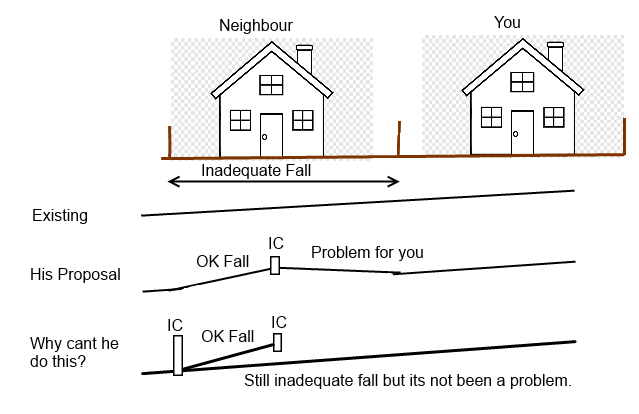
-
Soil pipe across neighbour land broken by them
Temp replied to ashthekid's topic in Waste & Sewerage
The builder must get the water company involved. It's not his pipe to mess with. You could consider contacting them yourself. I don't think he can just steal all the fall causing your drains to stop working. Check both title deeds for any explicit rights. You may have other rights if none in the deeds. Why can't he leave the existing drain in place and connect his new pipe into a new nanhole near his downhill boundary? That would get him all the fall without affecting you. -
On the radio yesterday a recruitment company owner was claiming wages were up 4-8% due to major shortage of workers. He thought it might continue to be a "employees market" for 10 years!
-
This is a new one to me.. https://www.bristol247.com/news-and-features/news/planning-hell-over-for-family-as-self-build-houseboat-granted-permission/
-
If this was an application for a wind farm you would take the photo from a position where your development would be hidden by a tree ? Seriously though.. imagine the planning officer drawing your development on the photo. You want them taken from a position where the result won't make it look like its towering over the neighbours house. So I'd take photo from the fence line with the neighbour looking towards your house rather than from the other side of the garden where your development would hide the neighbours. You can include photos of any similar development in the road but make sure you mark them to avoid confusion and take them from angles that make them look similarly favourable.
-
I think they have used several different connection methods over the years. Our 13 year old Britania Rangemaster dual fuel (lpg hob, electric oven) has a "rigid" copper gas pipe coming out of the floor into the gas hob. Makes it difficult to pull out for repairs. Has to be moved a bit then spanners used down the back to disconnect the gas pipe and allow further movement. @fiaraziqbal Looks like the previous owner just cut the solid pipe. I would buy a new flexible pipe to bayonet to make servicing easier. The installation manual for some Rangemasters are online.
-
You can still get syphon flush valves from screwfix. Some are dual flush.
-
First you need info from the tub supplier on the support required. Do the tubs have a frame that must be supported or must it be supported everywhere? Ask them about use on decking as they may have a recommended joist layout or other advice. This may feed into option 3 nicely. I'd be a little concerned about putting 2 ton right close to the retaining wall (option 1)unless I was sure that retaining wall was up to the job. For same reason I think I'd want the posts supporting the deck either very deep or on the house side of the retaining wall. I would sleeve all wooden posts with post saver or even galvanised steet metal at ground level to protect the thin pressure treated skin from accidentally wear by strimmer. Better still use metal below ground and keep all wood off the ground. This sort of thing but shop around as they look expensive.. https://www.ebay.co.uk/itm/Stainless-Steel-Timber-Fence-Post-Shoe-Post-Support-100-x-100mm-Square-Posts-/193679535664?var=0&mkcid=1&mkrid=710-53481-19255-0&campid=5338268676&toolid=10044&customid=CjwKCAjwmeiIBhA6EiwA-uaeFTsUfcqgJi-7rzjHx3YQfElN1zW8P7Cw3NElOP_hhgbkS4J48pkioRoC0JIQAvD_BwE&redirect=mobile

