
ragg987
-
Posts
873 -
Joined
-
Last visited
-
Days Won
1
Everything posted by ragg987
-
I am not clear what you are trying to achieve. Are you trying to just circulate the water in the UFH round? This is not going to add cooling, but it will redistribute and even out a bit e.g. if you have a sunny window that floor would normally be warmer and this method of water circulation will shift it a bit. I doubt it will have a massive effect, depends on other factors like UFH area and if you have cool aspects (e.g. North facing). or Are you wanting to actively cool the slab in whch case your GSHP needs to have a cooling mode - effectively reversing the compressor to dump heat into the ground and taking it out of the house. I would expect there to be a heat exchanger between the GSHP loop and the UFH loop, so don't see how this is possible?
-
First I have heard of that - we just brought the duct up through the slab and Openreach happily pulled the cable through when we were ready. I recall telling them this in the original application / plan and no questions were asked at either point. We put in a spare duct at the same time, just in case fibre ever makes it to our village.
-
We have UFH downstairs and basement with whole-house MVHR. House to PH standards. In winter, upstairs remains approx 3-4 C cooler than downstairs. In summer the difference remains - I suspect this is because we generate more heat downstairs from cooking, TV etc and also have large west-facing glazing areas in the kitchen and lounge. MVHR does not re-distribute the heat (e.g. in winter our incoming air is 17-18C vs outgoing air of 20C - these are after the heat-exchanger has done its bit). I have added a 1kW in-line electric heater to upstairs MVHR which we used briefly last winter to for the coldest period.
-
Hi and welcome. That is the hardest part and set to frustrate - definitely rigged in favour of the builder who seems to have a long-term relationship with sellers with cash in hand. After 2 years of this we extended our search to include old and low-cost houses. Purchased a 1950s 3-bed bungalow on 0.25 acres that was ripe for demolition and took it from there. We saw it as an investment, if planning got refused we would sell it off and lose little money (but a lot of time), in the end our plans got approved wish and moved in end of 2016 with the bungalow a dim and distant memory. In our case we were able to purchase the bungalow mortgage free so no issues with demolition.
-
Can't answer that specific one, but if your house is not water tight how will you protect the screed from future downpours?
-
GSHP for cooling - Hot climate area
ragg987 replied to Shah's topic in Ground Source Heat Pumps (GSHP)
My approach would be: Priority 1: mitigate the issues ("fabric-first") Shutters are a tried-and-tested solution to reducing solar gain, so if you have East / West glazing consider these. Insulation to a high standard - roof, walls, floor Double or triple glazing Attention to air-tightness in all fabric elements, including well sealing external doors and windows. I suspect light-coloured external walls will reduce the heat gain as well. Once the mitigation is in place, then consider how to reduce heat and humidity. You should be able to model the heat gain using some of the spreadsheets available - e.g. @JSHarris has one, I believe (have not tried it myself, we did a PHPP calculation). This will give you an indication of the power you need - say 10kW with external temperature of 50C and internal of 25C. Don't forget to add heat generated internally to the equation - people, cooking, showers etc. In Northern hemisphere these are a good thing, in your case the heat added needs to be removed. You now need to provide a cooling power to match that - 10kW (plus some extra for safety). Say 15kW. This becomes the size of your heat pump(s). I would be inclined to go with A2A split air conditioners - these are readily available and cheap in most hot countries, spares and repairs will be easy vs importing a GSHP that no one can support and spares have to be imported. E.g. a large heat pump (or 2) outside and internally have small fan units in all the rooms. These cool and remove humidity - both are essential for comfort. Use of the aircon for extended periods (e.g. 12 hrs per day) will cool the room as well as the fabric inside of the insulation - so it should cool the floors and internal wall, plus furniture and so on. These store the coolth and release it into the building when you switch off the aircon. Then comes the question of powering the aircon - Solar PV is the obvious option, drive the aircon during the day and switch off at night. You will need to factor in DHW - perhaps Solar PV as well? insulate your DHW tank and pipework well else you are increasing the heat load in the house. And finally, think about air-changes. Your aircon will remove humidity but will not provide fresh air, so potentially a MVHR. I suggest you speak to the MVHR suppliers about this - most on this forum use it to warm the outside cold air before it comes into the house, you want to do the reverse, not sure what this means to e.g. condensation at the heat exchanger. -
GSHP for cooling - Hot climate area
ragg987 replied to Shah's topic in Ground Source Heat Pumps (GSHP)
I suspect humidity will be a key factor here - cooling via a slab will drop the temperature but not remove moisture in the air. I am guessing that you would have condensation issues in that case as relative humidity will increase as room temperature drops. An air-to-air heat pump (i.e. the ubiquitous aircon) will remove moisture and drop humidity, contributing to the comfort. I lived in Singapore for a period and it amazed me how poorly the buildings were constructed. Single glazing and non-existent air tightness, so aircon was always on and switching it off resulted in a warm room relatively quickly, though the solid concrete floors that are the norm would retain some coolth for a while. I also preferred the split units as they were much quieter - the noisy HP can be hidden away outside. I see no reason why a PH standard would not work well, provided you can get your architect and builder to embrace and follow through with it with diligence. And then maybe use a cooling strategy that takes advantage of solar PV - cooling on while the sun shines then switch off after and let the PH do it's bit and retain the cool through the night. -
Air source heat pump or not?
ragg987 replied to Simon Brooke's topic in Air Source Heat Pumps (ASHP)
From a "sweat-the-asset" perspective, I think your idea has merit. Suggest you do the calculations - in our case the capital cost difference between ASHP vs electric immersion would have been about £1,100, and running costs using Economy 7 for electric immersion would be £250 lower with ASHP - so break-even would have been 4-5 years. I went with ASHP as it also has the bonus of cooling and takes up less storage space than 1,000l of water. In your case running costs should be lower as you have a lot of PV. I believe a 12kWp system would be metered for export (vs assumed 50% is export) so you would lose out on the export payments if you use it. If you need to install solar thermal from scratch then your capital will increase for limited benefit. -
We have 4kWp array, on a really good day we can generate 24kWh. Our DHW consumption is relatively high, we have 6 people to cater for. In reality, my heating / cooling strategy (still in infancy, will fine tune) is a bit more subtle. DHW on a timer starts at 10:30 set point 42C. By then we should have had about 5kWh PV to immersion. If sufficient DHW then it will not come on at all. Cooling on a timer starts 10:40. So if no DHW load will come on straight away, else is delayed until DHW is satisfied. Any excess PV goes to topping up the DHW - we do not seem to export unless we are away and not using DHW and power. We also try and run washing / dishwashing from early afternoon to even out the load as best as we can. Cooling load can be relatively high - the unit reports current of 4A (single phase so about 1kW). Cooling capacity is approx 7kW, 10% lower than heating capacity.
-
I will report back on energy generated by the ASHP for cooling. I am unable to monitor consumption, I am expecting no overall extra power consumption and that the PV generates what we need. Prior to switching on cooling, I relied only on PV to heat DHW. Now that cooling competes for that generated power, I have put the ASHP to heat DHW as well as cooling of slab. Should consume no more energy in total, but does mean ASHP is back in duty.
-
These few days we have been hitting above 26C by late afternoon - we have quite a lot of west-facing glass. I have just switched on our cool slab so hopefully that will help. Timed to run during the day so we use generated PV to drive the cooling. At present we are trying to keep windows shut in daytime and open through the night.
-
I bought 6 triple-glazed skylights and some accessories from a supplier in Europe. Worked out just a bit over half UK price with shipping. Factory made them to order and they arrived well packaged and intact. Shall pm you the supplier in case you want to try them. GBP is much weaker now so the balance may have shifted a bit.
-
Another cheap 12kW Kingspan Aeromax ASHP
ragg987 replied to Stones's topic in Air Source Heat Pumps (ASHP)
In our case (330m2 house to PH standards for insulation and air leakage) flow needed to go to about 30C last winter on the colder days. We only commissioned in October so perhaps house is still drying out and not in steady-state, I intend using the next winter to fine-tune and validate our setup. How are you measuring COP? The Hitachi unit I have does not have a readout for this, though it can estimate output energy over a period of time. I think the gap is it does not know input energy. If there is a simple way would love to try it. -
Another cheap 12kW Kingspan Aeromax ASHP
ragg987 replied to Stones's topic in Air Source Heat Pumps (ASHP)
I disagree about the relevance of compensation in a low energy house, the principle is the same as with a normal house just that the range of flow temperature is lower as you lose less heat. The point is that low energy houses still lose heat. ASHP is much more efficient when running at a low flow temperature. If you set static flow temp for a cold winters day at (e.g.) 28C then as the external temp goes up your flow is still 28C, but could be much lower to achieve a balance between heat input and heat loss. You end up cycling the heat pump. If you adjust flow temp to balance the input to the loss (which is what weather compensation does), you can run the system on all the time with minimal cycling and lowest flow temp to achieve highest COP. Now the saving is not likely to be massive in a low energy house, but as weather compensation seems to be built into these units in any case then why not use it? Costs no more. -
Where do you keep the vegetables
ragg987 replied to Triassic's topic in General Self Build & DIY Discussion
We use the fridge for most of our veggies. Onions being the primary exception which we store in tray inside a kitchen cupboard. Works fine for a couple of weeks or so, by which time we aim to use them up. -
Snag: shower trays not flat
ragg987 replied to Fallingditch's topic in Bathrooms, Ensuites & Wetrooms
Steel trays would be my choice - e.g. Bette or Kaldewei via megabad.com for keen prices (but still more expensive than your BM acrylic trays). We have Bette flush-to-floor trays which are excellent, heavy and will not flex if mounted correctly. Yours look like they are slightly above the floor, I believe both types are available from both suppliers. -
Don't know, this was one of the few materials I asked my builder to supply and I did not ask for a breakdown. I suspect it might be.
-
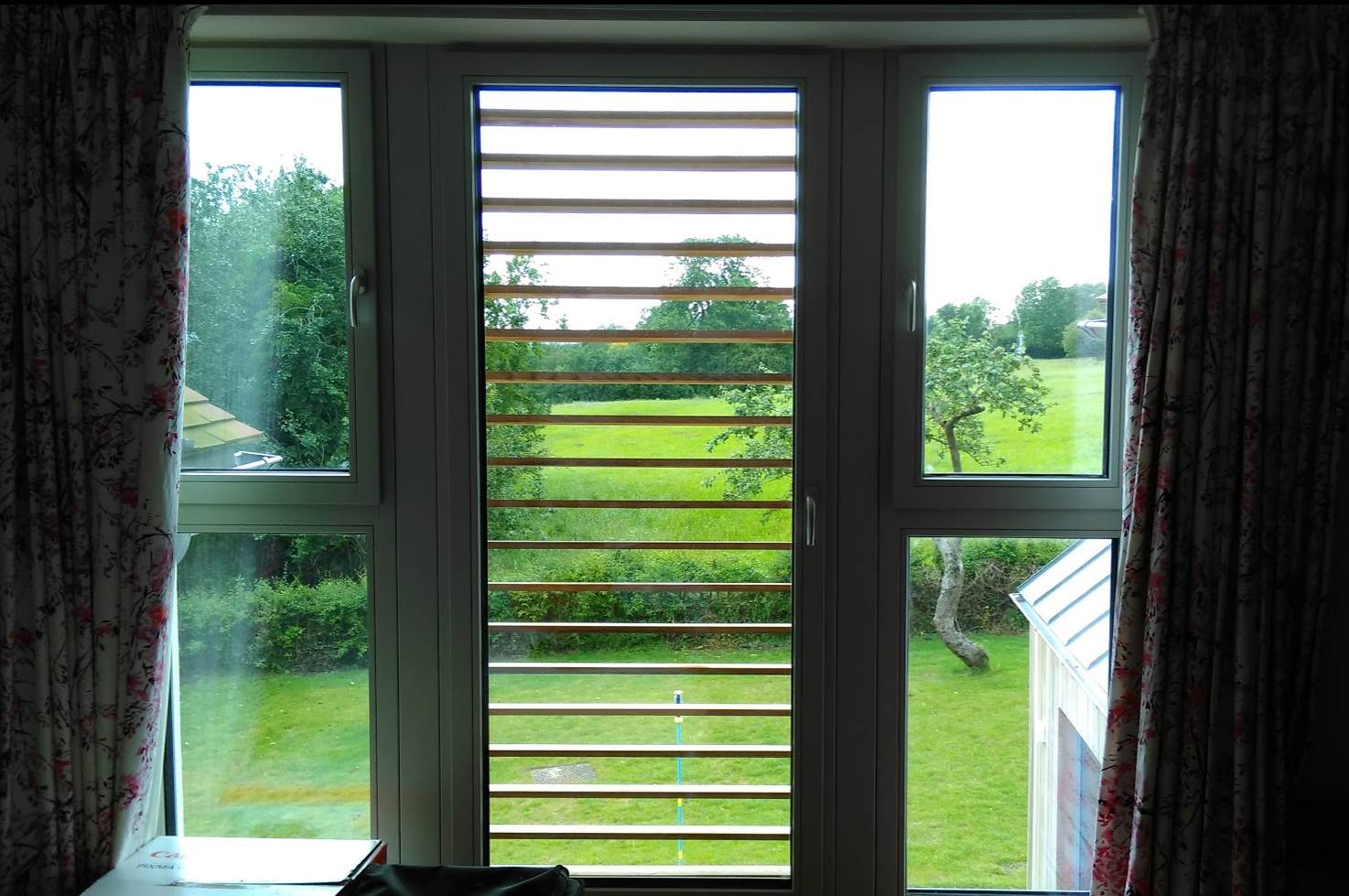
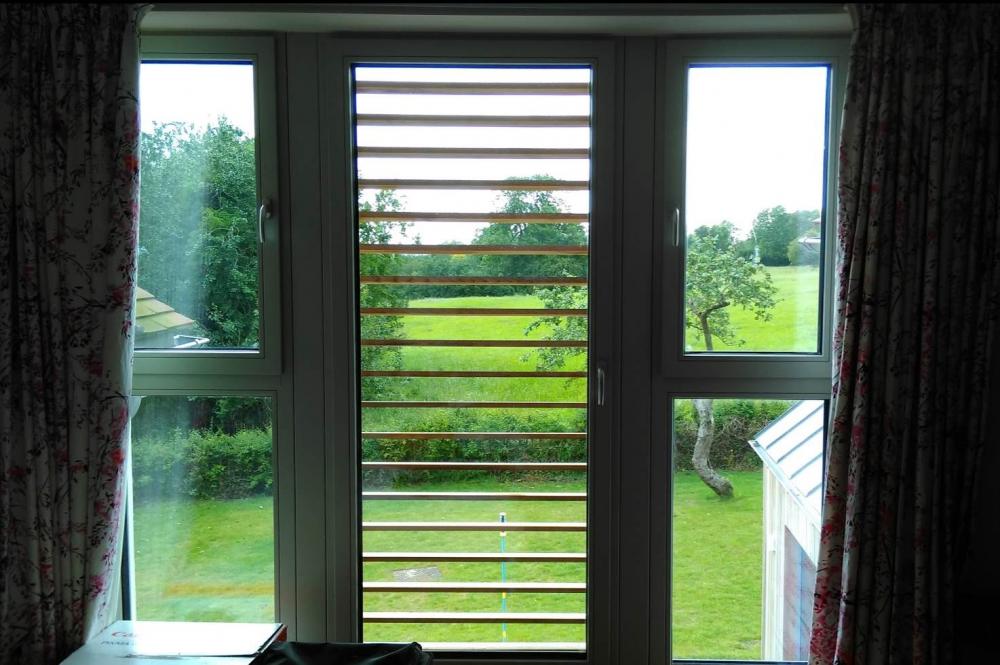
Oh and I should mention that slat spacing had to comply with build regs for baby head gap - that middle window is actually a door the swings open completely. But that spacing with a 95mm extension works well for reducing solar gain.
- 32 replies
-
- 1
-

-
- privacy
- brise soleil
- (and 3 more)
-
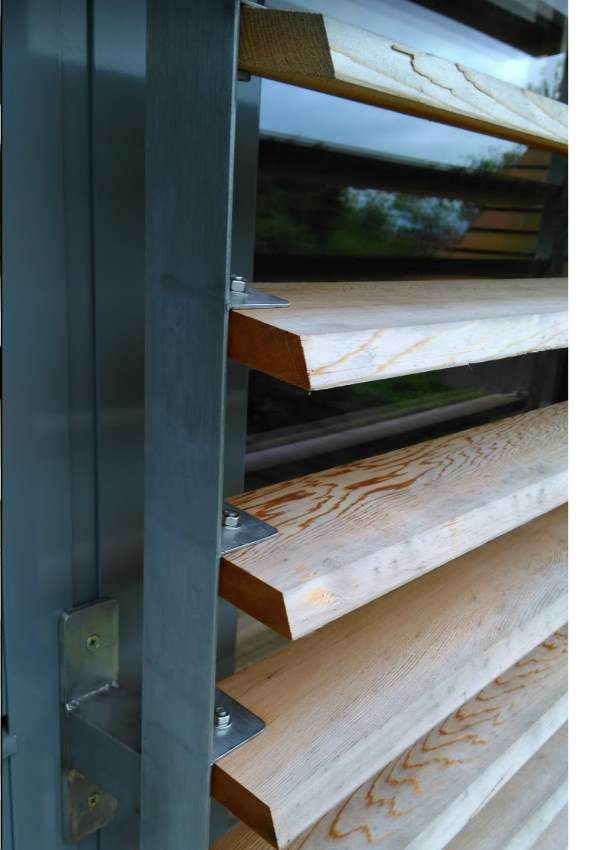
These are the slats, 95mm x 20mm: https://www.vastern.co.uk/cladding/splayed-cladding/ Photo inside to out attached - this is my study and doubles as a spare bedroom (working from home today). A caution, this assembly is not light and you need to make sure you can anchor it well. We had 150mm x 150mm timbers behind the aluminium clad windows anchored top and bottom and the screws go about 120mm deep into that.
- 32 replies
-
- 1
-
-
- privacy
- brise soleil
- (and 3 more)
-
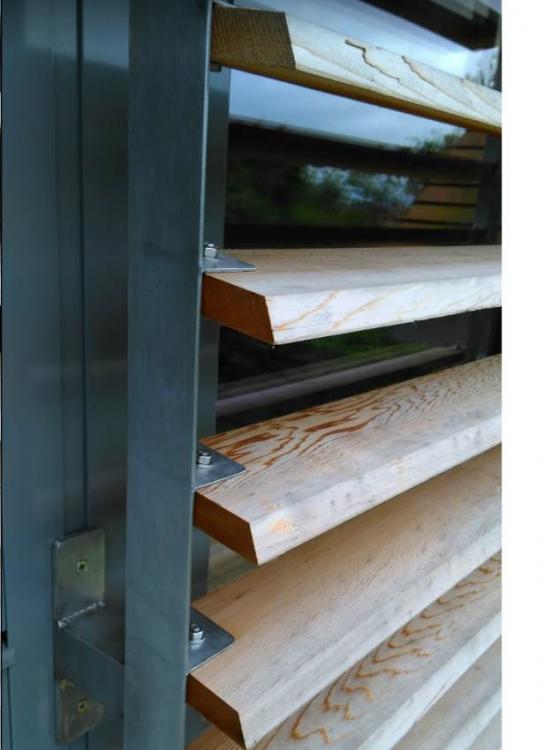
We have this. Stainless L-channel and plate knocked up by a local fabricator and off-the-shelf Canadian Western Red Cedar slats cut to size. I kept the downward angle of the slats small - about 10 deg - to permit water run-off without blocking the view and light. In our case it has a practical purpose but is also an architectural feature.
- 32 replies
-
- 2
-
-
- privacy
- brise soleil
- (and 3 more)
-
It will probably be cheaper, and definitely much quicker, to have a specialist (e.g. liquid screed company) lay the perimeter insulation, membrane and UFH pipes to the manifold rather than your builder who has not done it that often. Ours took less than a day (210m2) including screed pour. ASHP runs most efficiently if you can reduce flow temperature. Pipe spacing is an important factor. This link suggests a 5C increase in flow temperature at 200mm vs 100mm spacing: http://johncantorheatpumps.blogspot.co.uk/2014/03/getting-best-from-underfloor-heating.html
-
From my screed supplier: "Force drying of a Liquid Screed can begin as early as 7 days following installation of the screed by various methods. Commissioning (heating & cooling procedure) of under floor heating systems. Set flow temperature to 20-25ºC, maintain for a minimum of 3 days and then gradually increase the temperature in Max 5ºC increments to maximum operating temperature. This should be maintained for a further 7 days (water temperature should not exceed 55ºC for screeds), prior to returning to ambient temperature again in Max 5oC increments" Though I would check with your supplier first. And it would make for an uncomfortably hot build site!
-
My understanding is that laitance inhibits the process. Might be worth comparing readings between an area with high traffic (hence laitance would have worn off earlier) vs. an area with no traffic. I would expect 80 days to be sufficient, especially over the relatively dry spring we have had. I came across an interesting internet article that said air flow was a key factor, in our case I ran the MVHR to do this. I will see if I can find the link. Ufh flow of 21C is not much higher than ambient. Have you asked your screed supplier what temperature they recommend?
-
Would appreciate some thoughts on plans please :)
ragg987 replied to Kuro507's topic in New House & Self Build Design
I agree that designing a house without land makes little sense, however if you view it as an exercise in tuning your requirements then it has value. However, do not under-estimate the impact of emotional investment you (and your family) will make through this exercise. You will need to guard against matching a plot to your scheme else you are likely to reject plots that would be perfectly good, but somehow do not match your ideal. Finding any plot is difficult, finding a plot that matches the design is likely to be futile. Be prepared to rip it all up and start again. -
The prices I had include plasic sheeting and the full service - so no, pump is not extra. They turned up with a trailer that had the a hopper, pump and pipes, a cement lorry turned up and then poured the screed into the hopper. Each pour lasted <1hr, they had to wait longer than that between lorries.