
ragg987
-
Posts
873 -
Joined
-
Last visited
-
Days Won
1
Everything posted by ragg987
-
To add, the liquid screed was flat within a few mm across the floors and we were able to lay finishing floors direct without the need for additional levelling compounds. I understand this is not easy to achieve with sand and cement, so another saving to be had?
-
I had 202m2 at 50mm deep. £15 for screed and £1.50 for perimeter strip. All done within 1 day. Do allow cost for laitance removal. In our case manual scraping approx 1 day
-
Building Regs requesting ramp approach
ragg987 replied to hmpmarketing's topic in Building Regulations
And I suspect we will all get to the point of needing one in the future... -
Building Regs requesting ramp approach
ragg987 replied to hmpmarketing's topic in Building Regulations
Maybe do both steps and (permanent) ramp? e.g. a ramp to the side of the top step? A ramp is not just for wheelchair users, it also aids infirm walkers. -
Have no experience of the others, but Bette are similar to Kaldewei and cheaper. megabad.com Had an acrylic in previous houses - probably a bias but I avoid as feel flimsy and tendency to flex and move.
-
We faced the same question. Our garage is near the front of our property, hence closer to the incoming supply. Approx 30m of cable run between them. We decided to go house to garage as we could use the DNO's cable, they can get away with a relatively small cable prior to the incoming breaker and meter, but once past that we would have to get a massive cable to carry the 100A to the house. Garage is 32A so smaller cable is fine.
-
Utter newbie questions about financing a self-build
ragg987 replied to dakid's topic in Self Build Mortgages
Hi Martin, welcome and best of luck with this - we started where you are some 5 or 6 years ago and moved into our new build in Oct 2016. On purchasing land, we gave up after a while and bought an old / derelict house and demolished. Given this, we decided we had to fund the purchase without a mortgage else it would quickly become a complicated discussion with the mortgage company - "you want to do what? demolish our collateral?" - not something i wanted to do. We were lucky enough to be able to cover the purchase price by increasing mortgage on another property. If you end up here, you could consider selling your house and using the released equity to fund the land purchase. Not ideal as when you get a self-build mortgage, chances are you will still need a lot of money up front, and the lenders tend to pay in arrears of a build stage, though you may be able to use the land + planning permission as collateral and ask the mortgage company to front-load the lending. Then of course is the question of where do you live in the meantime? Be under no illusions on timescales - it took us just under 3 years from land purchase to moving in. Our build was fairly complex (split levels and basement), but our planning went through quickly. So living on site in a caravan takes a lot of committment from you and your family. -
VAT invoices
ragg987 replied to Vijay's topic in Self Build VAT, Community Infrastructure Levy (CIL), S106 & Tax
Shipping / carriage is eligible for VAT reclaim provided it is on the same invoice as the materials. On name and address, I recall seeing somewhere that low value items do not need all the details. I cannot recall where I came across this, I did have a few receipts (<£10 each) which were anonymous till receipts. Claim is in but awaiting feedback for the revenue. -
BuildLoan, Chorley and mortgage fund releases
ragg987 replied to oldcoop's topic in Introduce Yourself
My experience of the mortgage company inspections, we had 3 of them: Groundworks and basement complete stage payment. Inspector stood on the road and took some photos, did not want to get muddy shoes. Total time on road 5 mins. Timber frame and windows complete stage payment, inspector stood outside the building and took some photos. Total time on site 5 mins. We still had not installed some doors at this point. Build complete (actually we had not, but this inspection was tied to BC who were happy to sign-off once we had some basics completed - working bathroom, kitchen, electrics, smoke alarms, drains were the main aspects, though we did need to supply a bunch of documentary evidence). Inspector wandered around house for 5 mins, took some photos... (you get the picture!) Our BS contracted the inspection to a third party. As this was the only independant basis, I would say the process was not at all rigorous. On the question of steaming in, my BS was getting very picky in the early days leading to delays and I complained - amongst the points I made was that their delay was adding increasing to them as I would have been forced to abandon the build mid-way without timely funding. This helped unblock it very quickly. -
Help please balancing specification with budget
ragg987 replied to JohnW's topic in General Construction Issues
Count me in to that. Made a few mistakes along the way too - all part of the learning. Agree, and would also add that they are not going to make the best material purchasing decisions for you as (in my experience) they do not plan further ahead than a few days, and just rely on the local builders merchant to supply whatever they normally supply. After all, they can simply pass the cost on to you. This was one key area I took control of and I found I could easily better the builder for prices or specification, sometimes by as much as 50%. But I drew the line at nuts and bolts etc where I let the builder get on with it. As @Bitpipe, you will need to understand the detail if you decide to do this. -
Echo (sound) dampening options - special paints?
ragg987 replied to readiescards's topic in Sound Insulation
Pardon - can you speak up, can't hear a word... -
Echo (sound) dampening options - special paints?
ragg987 replied to readiescards's topic in Sound Insulation
That seems geared towards reducing noise transmission to the adjacent room, so would not tacklr reduce echo. There are 2 approaches to reducing echo - absorb the sound before it reflects off a hard surface (curtains, sofas, carpets, soft wall hangings) or diffuse the sound so reflection is not so directional (hard furniture, books in shelves, wall panels). In a domestic environment and assuming you wish to day-to-day echo, furnishing the room will take care of it. If looking at audio-listening rooms then you have a bigger job on your hands. -
Help please balancing specification with budget
ragg987 replied to JohnW's topic in General Construction Issues
Might be worth reviewing the method as well. foundations - trenched foundation or piling vs floating slab (as PeterW, I think) external walls - timber frame screed - apart from PeterW's suggestion, how about liquid screed - you can get away with 40mm depth, less materials and less drying time One factor to bear in mind is price variations - e.g. the moment you need to dig into the ground out you will risk issues and hence price escalation. If your methods mean you are more "assembling" on site rather than making on site you can reduce the variability. Our house has u-values of approx 0.11 for wall, roof and floor. We still needed heat on first floor and are unable to rely on the heat from ground floor rising up (UFH), we use a direct electrical heater through the MVHR to top it up on really cold days. -
Welcome Mark and best of luck with the project. That round building looks nice and package seems sensible. I guess the other obvious question would be how would you get support in the UK?
-
I would check the unoccupied cover policy. The normal policies I looked at (for occupied building) only covered minimal build works - £5 to 10k range. The key difference wih build insurance is that in addition to cover for the unoccupied buildings, it also provides cover for mishaps during the build, including accidents to 3rd parties and I think for certain issues with building works. Do not treat that last part as definitive - I read and re-read the policies at the time and also when I needed to make a damage claim, and they would win no awards for clarity.
-
Content cover was low - something like £5k (don't quote me). We decided to move in with it as-is, though we could have bought contents separately (did not investigate if the extra content cover would be valid - for domestic building and content cover we had to get a completion certificate). The conversion from build insurance to building insurance for any remaining period was a feature of the original policy, so just notified them when we moved in. This is a very expensive way to get cover, mind, our annual house+contents was cheaper than 3 month extension on build insurance.
-
We were told by our flooring supplier that expansion of engineered floor is not likely, if it does expand it is likely to be small and along the length rather than the width. We butted ours (tiny gap) at the head of the stairs. Floor is glued not floating.
-
We did and our build insurance covered this scenario. BC told us is was quite common for people to move in prior to completion certificate.
-
Double-edged sword. We moved in early (but not as early as you - only finishing jobs in the main house and Annexe remained). On the plus side it meant I could define priority day-to-day rather than weekly and the builders would change it without consulting me, however living around the mess was not a great experience. Also, having a drop-dead date prior to moving in was helpful - it helped everyone focus.
-
The warranty tends to provide limited cover for building / roofing / structural elements. If you are putting those up yourself then it seems they might chase you to pay back on your claim, however if you are employing contractors to do these then it would make sense - foundations, timberframe, cladding and roofing, for instance. I guess the grey area is if you employ casual labour only to (e.g.) build a brick wall and they work directly under your management, then who would they chase? I went with the warranty in the end as we had a mortgage. One thing I did notice is that the warranty provider started insisting (after inspections) that we had to have 3rd party 10 year warranties that covered labour and materials on some of the build. I argued that this was not made clear in their policy and they were material changes to the way we did our procurement "after the fact". They backed off. But it does leave me to question what would happen if I needed to call on the warranty.
-
Sorry ignore the above - I just spotted you needed to match an existing panel so other options are not of any use.
-
Sorry to hear that - plenty to worry about without a supplier letting you down. If of any use, I used Cembrit Cembonit for our soffits and fascias. This was after getting samples for three products: Cembonit - lovely finish and colours. Self-coloured all the way through, so cut edges do not need treatment Marley Pictura - wide colour range and but very expensive. Cut edges need to be treated. Hardie Panel - not a nice finish, looked quite cheap compared to others. I think was cheapest, memory fading... Marley and Cembrit have limited suppliers, through fabricators (prices were for cut to size) rather than whole sheets. I manged to find a Cembrit fabricator at a sensible price for the smallish quantity I needed - pm if you want to go this route.
-
Controlling underfloor heating in passive house
ragg987 replied to dogman's topic in Underfloor Heating
I used a separate timer (Neostat) for the passive circulation and a UFH wiring centre (heatmiser UH4) to control the overall logic - very simple and no automation systems required. Schematic attached. The Hitachi 3-way valve is used to open or close the supply of heated water from ASHP to UFH. When off, the circuit is closed, ASHP is off and the timer controls if pump needs to be on for passive circulation.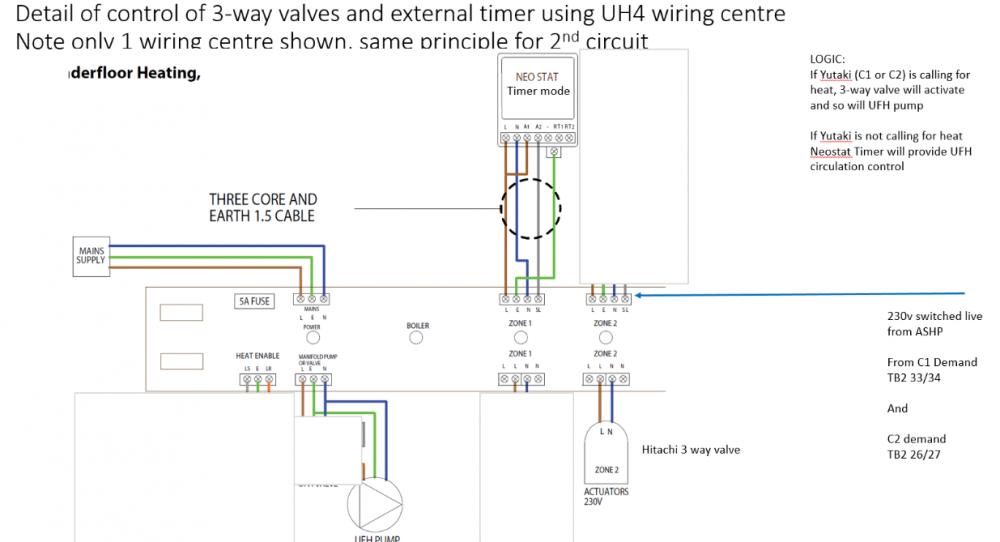
-
On bats, I was getting quoted quite high numbers by ecology companies including observations during variuos months of the year etc. I rang the council on the off-chance and spoke to the ecology team, they offered a site visit for a nominal fee (about £50), and the chap poked around in the loft and said that there was evidence of bats but it was very old and nothing recent, so he issued a report giving us the all clear. PHEW!
-
We were in a similar position - though without PP, just an old bungalow. I held off demolition until we had all our ducks in a row. My logic was that if something changed (e.g. PP was going to be a major compromise against our requirement) then we still had the option to not proceed and could sell the existing house off and not have lost too much. Compared to spending money on demolition and then selling the land. Once PP is granted, you will probably need a few weeks or months to get quotes in, select and book your groundworkers. This period can be used to demolish - there is a notice period we had to give our council (I think 6 weeks), however my demolition contractor forgot to give notice then called them and they granted it straight away, of course on payment of the fees. Our 3-bedroom bungalow was down on day 1, footings dug out on day 2 and site cleared on day 3. This was all with a single man in a big digger-thingy. Other things to watch out for: Bats - can need surveys etc which could take forever - tied to seasons. Asbestos - survey and specialist removal and disposal Services disconnection - gas, electric, water, telephone. We had Thames Water and it took forever to sort that out.