


jfb
-
Posts
668 -
Joined
-
Last visited
Everything posted by jfb
-
I had a similar issue and ended up with an extra step (sizable, not just like a stairway step) up to the door as I think a 200mm step would be a bit much. Maybe set up a the step with whatever is to hand to get a feel for what is and isn't acceptable.
-
Spray foam or bonding.
-
I got mine from my local Buildbase - cheaper than any internet price remarkably! I have an account so maybe that helps.
-
I'm looking to minimize a timber frame wall between bedroom and bathroom/landing. It is about 5m long with door in middle and two walls at right angles either side of the door. No need for sockets in the wall, except a light switch. If I was to try and use 50 x 75mm timber on its side so the depth was 50mm, 15mm soundbloc plasterboard each side and 50mm acoustic R45 slab, would that: 1. be sufficient structurally? 2. be sufficient acoustically? (if not what if I added 2mm acoustic rubber matting?)
-
Fire alarm test certificate HMO
jfb replied to jfb's topic in Regulations, Training & Qualifications
Apparently so! I've been asked for one by Oxford City Council on a 2 year HMO license. I have a certificate book for fire alarms but much of that has stuff regarding larger more complex systems. Anyway I have booked in someone to do it for £50 so will see what he does.. -
Does anyone know what exactly is included in a fire alarm test certificate for a small HMO (4 bed , 2 story, grade D rated)? The obvious things to me are: battery check fire alarm unit checked/cleaned/tested - including testing that smoke and heat engage relevant alarm suitability of existing fire alarms and locations record of any false alarms from tenants clear signs for what to do/who to call in case of emergency and maintenance issues ensure building structure still suitable for escape route Am i missing anything?
-
Advice on attic ceiling junction with wall
jfb replied to Drew1000's topic in Plastering & Rendering
I know plasterboard is cheap Dave but wouldn't that lead to quite a bit of wastage. Not sure I could justify that for something that should never show. -
Advice on attic ceiling junction with wall
jfb replied to Drew1000's topic in Plastering & Rendering
I would - don't see a problem with it so long as you have good fixing. -
I see Dave, thanks. The CU placement ideally goes in the space above the shower - its a vaulted barn roof with access from a mezzanine/bed level so will have room to get cables in.
-
1 - is it ok to have a Consumer Unit located directly above a shower ceiling? 2 - is it ok to have ring mains cables/ 24 volt transformers in ceiling void above shower? 3 - cant seem to upload a picture so i will try and explain this one - ring main has sockets on two side walls and the cable runs at socket level along the middle wall: is it ok for there to be no socket on the middle wall and for the cable run to considered a safe zone?
-
Years ago, how did they .... ?
jfb replied to ToughButterCup's topic in General Self Build & DIY Discussion
Bits of wood embedded in the wall make fixing a bit easier. -
Sorry not very clear - by radial I just meant similar to a single radial electric cable run where one cable to the first socket, then a cable from that socket on to the next, etc rather individual cable runs to the main input (which I understand is radial as well !) Thanks for info Jeremy I will think on!
-
If I am wanting two or three ethernet sockets in a small office/studio does one take a different cable back to a patch bay for each socket or can they be run in a radial fashion?
-
That is most helpful Dave - the three core being additional to the main feed makes sense. And using 1mm everywhere is good to hear as I have seen some pretty busy back boxes!
-
I am ready for first fix electrics in a very small barn/office with mezzanine bunk bed and shower room and would welcome any advice on the lighting plan. I have an electrician on board but he is currently out of action/contact with covid symptoms. S1 – switch for 24v LED strip lighting under the mezzanine bed S2 – main switch for lighting S3 – positioned at mezzanine/bed level it is a 2 gang switch – one switch as 2 way with S2 and other switch for bed reading lights S4 – switch for lighting in shower/toilet room positioned outside the room Avoiding any ceiling roses with circuit wires being brought into the switch. All wiring 1.5mm 2 core except wire from S2 to S3 in 1.5mm 3 core. Questions: Anything wrong with the layout? (especially the 2 way switch S2/S3 and then going on to S4) Could I use 1mm 2 core for all wires from switches to lamps? (most lighting would be from S2 – 4 small lamps on the purlins with overall length under 10m) Would 35mm back boxes be sufficient? 25mm? Minimum distance of wiring from EPS insulation? (only couple of sections where this is relevant)
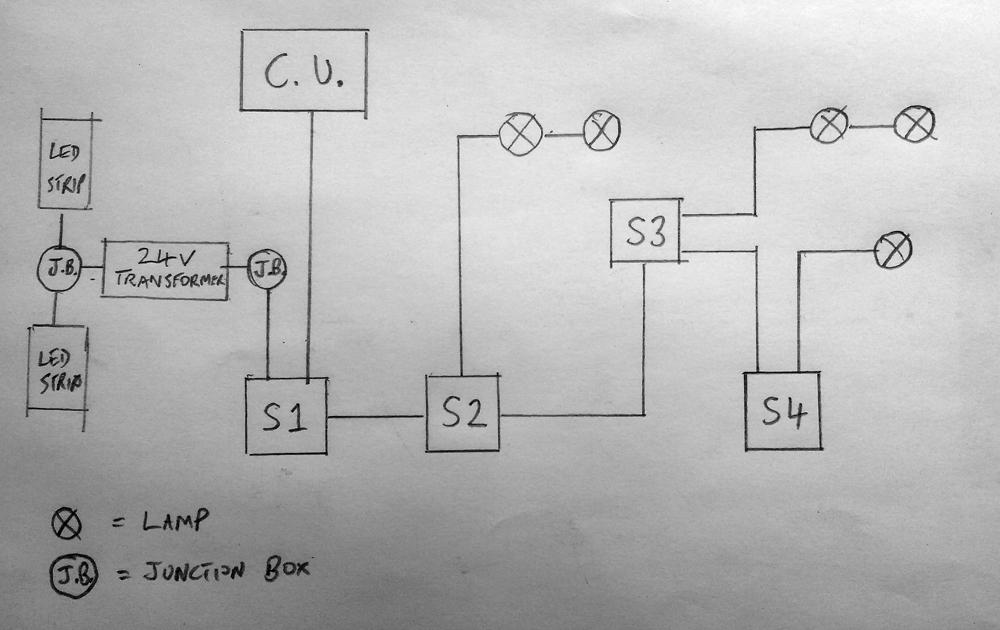
-
socket in back wall of stud containing toilet cistern
jfb replied to jfb's topic in Regulations, Training & Qualifications
Excellent - thanks all -
I am planning on a wide stud wall (150mm?) for a concealed cistern. Is there anything in the regs to stop me having a double socket on the back of this wall in the living space? (it would be lower than the cistern and slightly to the side)
-
you can always shave a bigger peg down but not the other way round!
-
will be scraping the existing back so not simply going on top
-
By 20mm base coat do you mean a base coat with 20mm aggregate? Which then needs sealing (with what?) if no wear course going on. So in theory you could have just an 80mm layer so long as it is sealed. I have measured the track on google and it comes to 215 metres - width looking at 3.5m. When you say 'done properly' in your estimate peter do you include materials/work for compacted sub base, tarmac and edging (kerbs or are there other options?)?
-
Anyone with knowledge on tarmac? I have a 300m single track I share with neighbours and there is movement to tarmac the lot as it is a pothole nightmare despite multiple filling ins. Tractors/lorries all drive down it fairly regularly. I know there is a trade off between quality/depth of sub base and longevity but there are significant cost issues. 1. What is the minimum overall depth of tarmac anyone would suggest? 2. What size aggregate would be best? 2. How important is it to have a wearing course? Or can one get away with one layer? Presumably a wearing course has finer aggregate - 10mm? 6mm? Cheers
-
I believe the first course has to be layed very precisely to make the rest go smoothly. Something to think about when hiring workers and assessing their work.
-
What does it say on the tin?
-
I've used hydraulic lime bags that are well out of date and they have been fine. Never had much success with out of date bags of multi finish! Goes off much too quick.
-
Securing PV panels to shipping container
jfb replied to NWGEAR's topic in General Self Build & DIY Discussion
why can't you weld them to the container?

