
ProDave
-
Posts
30678 -
Joined
-
Last visited
-
Days Won
424
Everything posted by ProDave
-
 Personally I won't do anything. When selling our old house, that was still listed on the paper registry not on line so as soon as I informed our solicitor that we were going to sell it, he put in place the transfer to the electronic registry so it was all ready and would not cause delays. Should we ever decide to sell this one, we will do the same, make any changes at the time we are selling.
 -
Mvhr funny noises and dripping
ProDave replied to Pocster's topic in Mechanical Ventilation with Heat Recovery (MVHR)
Well it should not be there. Empty it out then see if there is a drain channel between the 2 sides that is blocked. -
That is a recent (post Brexit) install so are we to assume a new house or is it a retrofit to an old house? Are bedrooms carpeted? If so lift a carpet if you can ans I bet it is cosy warm underneath and the heat is just not getting through the carpet fast enough, hence the floor is heated up to flow temperature giving the low Dt but the heat is not getting into the rooms quick enough. If so higher flow temperature, or thinner carpets is the answer. As a sanity check, turn the upstairs heating off. Let it all cool down, say over night, then when you first turn it on, I bet you will see a Dt between flow and return while it heats up the spreader plates and the floor. Our previous house had UFH and carpets upstairs and we ran that at 40 degrees flow on the upstairs UFH and lower on the downstairs with solid floors.
-
Mvhr funny noises and dripping
ProDave replied to Pocster's topic in Mechanical Ventilation with Heat Recovery (MVHR)
Can you see if there is anything coming out of the condensate drain? If there is not, see @Roundtuit post above. Go on, turn it off and lift the lid off. You know you want to. -
Mvhr funny noises and dripping
ProDave replied to Pocster's topic in Mechanical Ventilation with Heat Recovery (MVHR)
In cold weather the inlet pipe (inlet from outside to mvhr) will be carrying cold air, if not well insulated you will get condensation on the outside of that. -
Does @Pocster care to post a screen grab of how his shows. @Kelvin Ours shows just by searching for the postcode. It is listed as "land only" the Scottish Register says "Registers of Scotland records six property types: residential, commercial, land, agriculture, forestry and other. The property type information is provided by the agent on the application for registration." I see no pressing need to change it from land to residential.
-
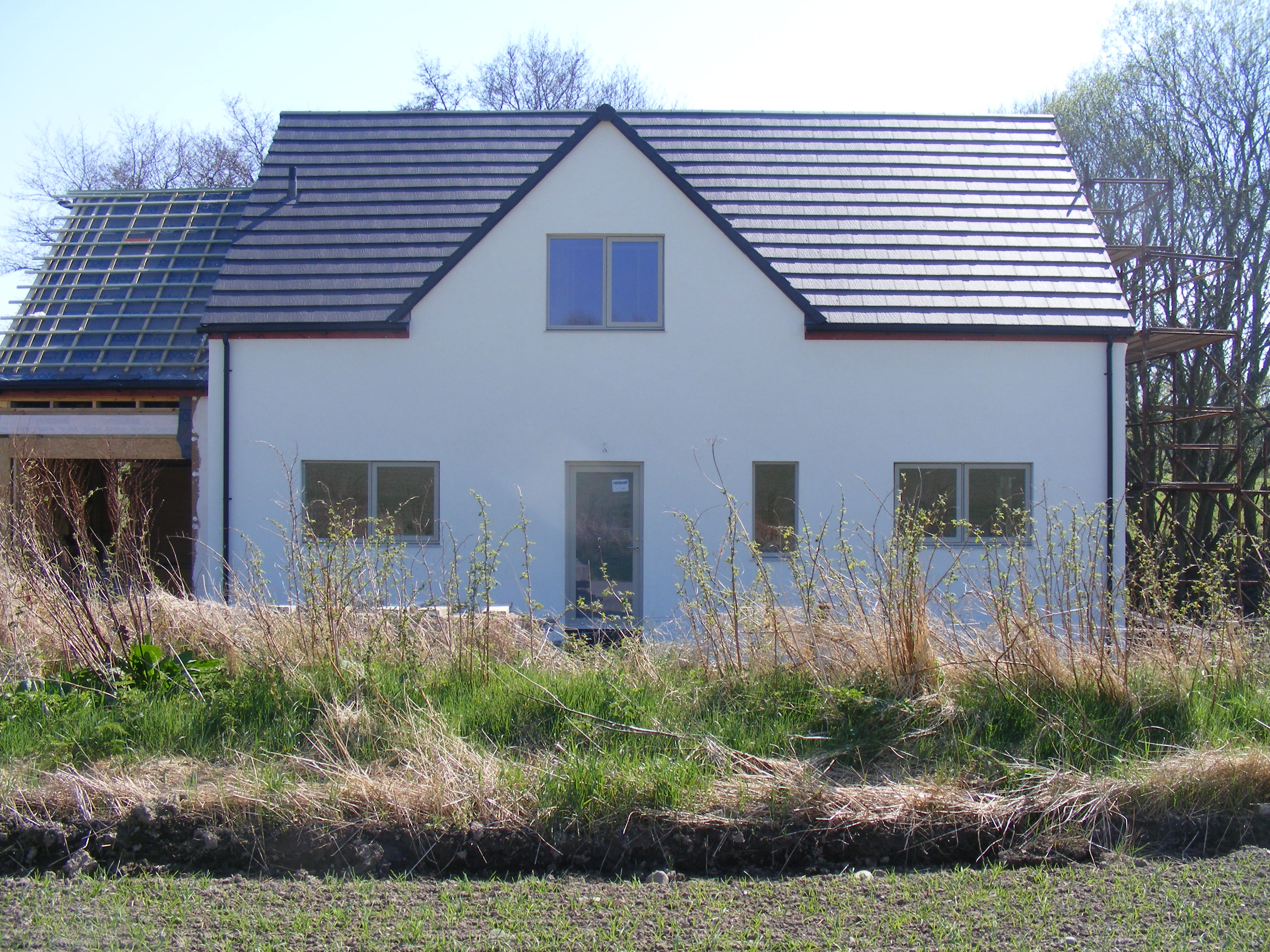
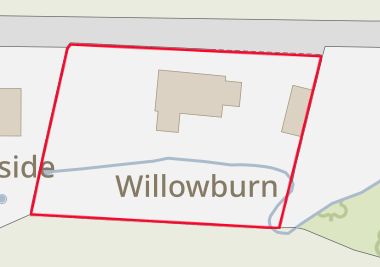
This is how ours shows on the LR maps We registered it as a bit of empty land. The building outlines and house name just appeared on the map as if by magic.
-
The land registry maps are OS derived. I think the OS do a good job of mapping new buildings that appear on land. I never told them anything but like you the LR OS map now shows a pretty good outline of the buildings on the site, including our static caravan. I did once see a man with a packpack with an aerial on it, walking around the perimeter of a new build house clearly recording the position of each corner of the building. Someone must have done that here, but nobody asked my permission to do so.
-
Your build requirements were much the same as mine, and I would say that is pretty normal for self builders. But most self builders are quite different to mass market house buyers. I self built (twice) because mass market builders at the price I could afford only offer row after row of identikit boxes crammed in tight together with small gardens and little regard to views or which way faces south.
-
Pallet forks for excavator, that's a thing?
ProDave replied to Alan Ambrose's topic in Tools & Equipment
Also tricky to control, the forks don't just remain level like on a telehandler. -
Whoever owns the land owns the buildings on it, unless they are leased to someone by leasehold
-
Land registry etc would have been dealt with when you bought it, whatever it was then, even an empty piece of ground (as ours was). Not something you usually have to worry about at completion. Do you find it listed here? https://www.findmyaddress.co.uk/search
-
What type of pump do plumbers use to pump out water from a pipe?
ProDave replied to Adsibob's topic in General Plumbing
If the outside tap is fitted correctly, the pipe feeding it will go DOWN hill to connect to it. Just open the tap and the little drain screw at the bottom of most outside taps, and it will be fine. We have always done the same and never came to any harm in -10 -
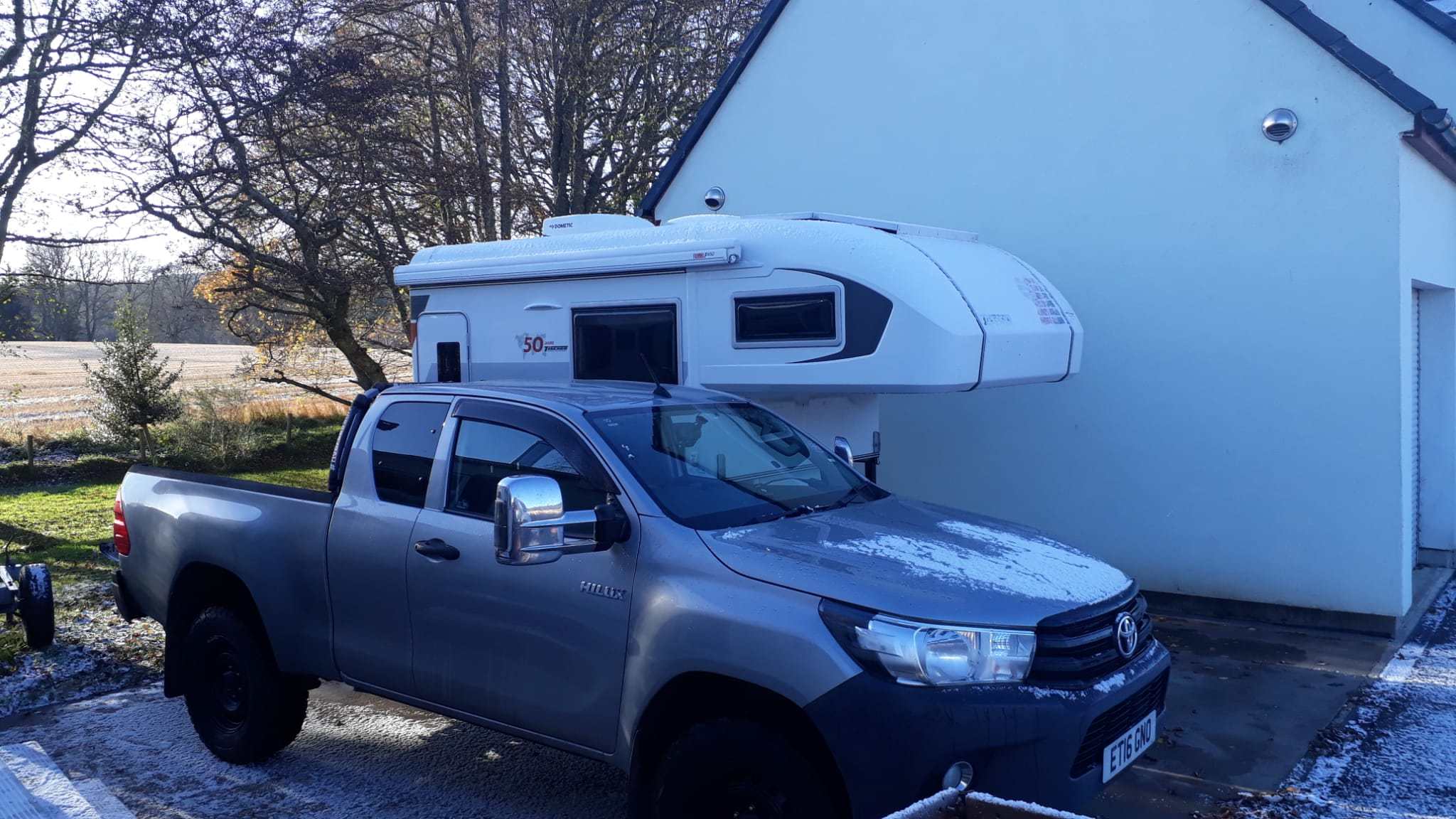
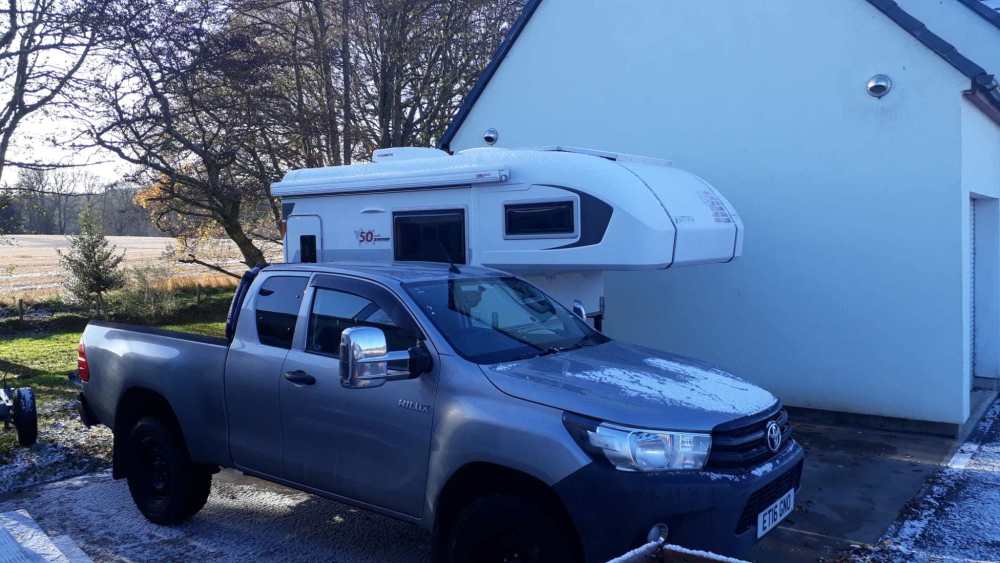
We demounted the camper from the truck this morning. This is why we chose this type of camper, when not off camping, it becomes a perfectly normal truck for other uses. It has been lowered on it's legs just now, but the car port still needs to have enough clearance for it to go under it when on the truck.
-
I once thought that wouldn't it be good if every device could be controlled from one central point. So for example: When the sun is shining and not otherwise being used, turn the freezer to a lower temperature, and then overnight when no sun turn it back to a less cold (but still freezing) temperature Make some devices that are not time critical "pause" when something more important is using the power, like the heating element on a washing machine, if there is not enough power immediately, it will just take a bit longer to do the wash as it waits for something else to stop. All this of course would be great in a boffins house, but imagine the complexity trying to market some kind of consumer product oriented communication system and build that into appliances. It would be so complicated and unreliable. Battery storage should largely solve all this, if working properly it charges to soak up any PV generation not being used, and discharges as much as it can to feed loads when not enough generation. That really really needs to be widely available with a reliable wireless connected current probe with a decent range. I don't know if that is the case? As regards reliability. I have repaired a couple, and was generally disappointed with the build quality and lack of basic understanding. The things that stood out were PCB tracks burning out because they could not handle the current. Jump leads to power devices doing the same. And power devices failing due to over heating either by not having a decent heat sink or even worse just no heat sink compound used. Some shockingly bad and so simple to avoid design mistakes.
-
I have a cheap plug in dehumidifier BUT if fails to work when very cold as moisture freezes on the condenser and it has no defrost function, so it just stops. Does your new build have a chimney? If so get a temporary WBS in there.
-
Yes the crux is definitely the long beams, how many and what size. I guess I need to phone a timber merchant and get some prices and work out the best bang for the buck from what is readily available. I will still ask my neighbour (who works for a steel company) about steel plates to make a filch beam. For a laugh I asked him to estimate for doing a steel frame for the whole lot and his answer was "do it in timber"
-
Interesting ideas @Iceverge So you are suggesting a 225 by 75 would span 6M if it was not carrying too much load? and suggesting 5 of them. My design already has 4 of them so not that different. I would rather not go as many as 5 posts each end perhaps compromise on 4. I will have to mark it out on the ground to see how it would look in reality and where they would land. Yes I thought the box profile could get away with fewer cross beams. I don't want to stack the cross beams on top of the long beams, that adds to the height which is also very high, I want to drop them between the long beams on joist hangers.
-
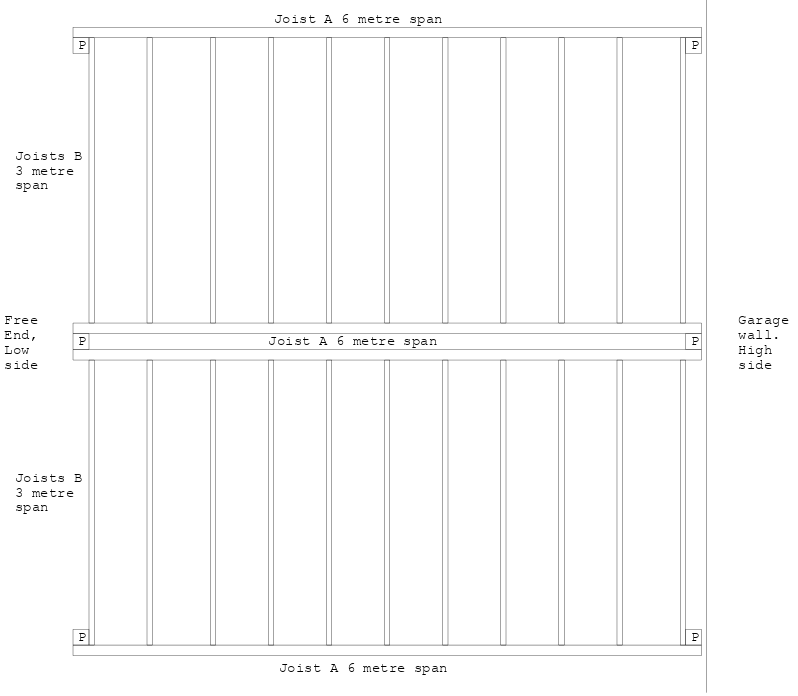
First stab at joist plan for the car port roof There will be 6 posts "P" 3 each side, probably 150mm square all supported on post feet. The 3 at the garage ends will also be bracketed to the wall, to locate them, not to take any weight on the garage wall. The 3 at the left hand free standing end will require some diagonal bracing. Box profile roofing from the garage high end to the free low end. Probably with a small gap at the garage end to avoid having to flash it to the wall. Total size 6M by 6M. Box profile roof needs supporting on joists running across it, so in this case front to back joists. Assumed at the moment 600mm centre to centre spacing they are Joists B in this plan and each need to span 3 metres. I don't think these are going to be difficult. The problem ones I think will be the 4 "Joists A" that have to span 6 metres and support the smaller joists. This is the one I need some design input to see if this proposal is viable. I would rather they were not too deep, say no more than 8" / 200mm. But I do expect to double or even tripple these, and there is the possibility of a steel plate between them to make it a flitch beam? Ideas please?
-
The Plans, version 2.
ProDave commented on TheMitchells's blog entry in Renovation of Ellesmere Bungalow.
Those were popular in their day, and only a few years ago, you could still buy them new, it was about 10 years ago I last installed one. These days they market them for heating industrial spaces. BEWARE if your install is anything like many I have seen, the walls of that cupboard could be lined with asbestos as is often the inside of the cupboard door. They were meant for whole house heating, so 8.5kW is just like having 3 big storage heaters all in the same box. On a 7 hour off peak they could store almost 60kWh of heat. I once replaced a fan motor in one of those. Never again, miserable job with a huge amount to strip out to get at it. Even if the house has suspended floors (which it probably does for the under floor ducting) there is likely a cast in place concrete slab under there for it to sit on. -
New install? Boiler swapped for ASHP? If so was it noisy with a boiler?
-
Those are impressive figures, the usage is commendably low. One of the reasons for my DIY solar PV diverter was the unusual meter position and PV generation remote again from the meter. I hard wired my current clamps using twisted pair armoured telephone cable between the meter box and the house, about 25 meters, then 2 pairs of a CAT5 cable from the entry to the house to the plant room where the diverter is, probably another 10 metres. All seems to work well. I have exported just over 400kW in about 5 years. Definitely very much colder from today for at least the next week.
-
Boils my blood... Gullible people and cowboys!
ProDave replied to Andeh's topic in General Self Build & DIY Discussion
I would love to know just what was wrong with such a new build that was such an easy fix to make a noticable improvement. -
Boils my blood... Gullible people and cowboys!
ProDave replied to Andeh's topic in General Self Build & DIY Discussion
So after the work that cost her £6, is the property actually warmer? Was there really visible black mould before they came? -
There will likely be a gap but it can't / won't be that much, the supporting poles will be attached to the garage wall for stability. The whole point of buying this particular type of truck is you can wind he legs down and demount the camper unit from the truck, and use the truck on it's own as a normal vehicle. So parking the other way would mean driving out onto the grass to demount which would not end well in winter when it is wet and soggy.