
ProDave
-
Posts
30861 -
Joined
-
Last visited
-
Days Won
427
Everything posted by ProDave
-
Not that simple, depending what valves you have it may need a "hot water off" signal. No doubt it could be re jigged but just buy the one mentioned above is the simplest answer.
-
I think the concern with a non insulated cavity is you might be heading for the plasterboard tent principle with a cold cavity, likely vented to the loft negating much of the benefit of EWI. Surely if you are adding EWI to an unfilled cavity you should at a very minimum ensure the entire top of the cavity is closed off so cold air from the loft cannot enter, and any warmth created in the cavity from the house cannot escape.
-
 I am assuming those 2 pipes, one is hot water, one is cold water? So you probably won't use the hot water and you will first need a bit of pipe out of the cold isolating valve to a tee then to two washing machine valves. And some brackets to clamp the pipes to the wall.
 -
That is indeed the simplest thing to try, just one tip when looking for a replacement programmer, avoid any that make mention of a "Service Interval" timer, often with SI in the part number. Sometimes depending how it is wired, it can be very difficult getting a test probe onto what you want to measure to determine which bit is working or not.
-
I don't think a remote diagnosis can go much further. do you have any electrical test gear like a multimeter? Are you confident taking live readings? If not you probably need an electrician. But if you don't want to do that, one thing to try is a new programmer, but that is not guaranteed to work. they are easy to swap and in 95% of cases the new one will just fit onto the old back plate without alterations.
-
When it has stopped working and you try turning heating and hot water on and off with the slide switches, do you hear the relays in the programmer go click?
-
What stops working? CH, DHW or both? Are the Hot Water and Heating lights on the programmer still on when it stops? Can you get it working again by turning the heating or hot water off and back on again?
-
Nobody can diagnose that remotely. What trips? MCB? RCD? RCBO? or post a picture of what trips if you don't know. Next time it trips, switch the two slide switched to OFF before resetting it. then try with just heating on for a few hours, then try just DHW for a few hours and see if you can narrow it down a bit. The clunk from the controller is a relay energising and quite normal.
-
LED strip causing MCB tripping! Reason?
ProDave replied to markharro's topic in Consumer Units, RCDs, MCBOs
Do NOT build it into an accessible space. It has to be accessible somehow e.g in a kitchen, on top of a wall unit etc. Or even build it in behind the light switch and run dc to the light strip? -
The membrane forms the water tight barrier ?
ProDave replied to Post and beam's topic in Roofing, Tiling & Slating
I have always understood tiles and appropriate flashings collect all the water and send it to gutters etc. The membrane is only there underneath to catch a leak if it occurs and catch any condensation that may form under the tile and trip off. But it is good to test how watertight the membrane is before the tiles go on so you know it is a good backup. -
Zanussi combi oven/microwave tripping fuse
ProDave replied to Adsibob's topic in Electrics - Kitchen & Bathroom
Yes the fault is with the oven. Persevere searching for the meaning of those fault codes. Is it still under any form of guarantee? -
Zanussi combi oven/microwave tripping fuse
ProDave replied to Adsibob's topic in Electrics - Kitchen & Bathroom
That's an rcbo so there is no way to find out if it is tripping due to over current or earth leakage. It's 16A it would have to be a very big oven for that not to be enough, -
I would not. I would take the door frame out. Build shuttering either side and pour the concrete IN PLACE. When dry, put door frame back.
-
Zanussi combi oven/microwave tripping fuse
ProDave replied to Adsibob's topic in Electrics - Kitchen & Bathroom
Have you looked up what those error codes mean? Is it an MCB or RCD that trips? and does it only trip when the oven actually turns on? Have you tried other oven modes, e.g fan oven, conventional oven, grill? -
Or if you create shuttering and pour concrete, is is not really a "beam" as it will be fully supported on what is there already and will just fill the gap you want exactly.
-
Vaulted rooms - benefits and issues?
ProDave replied to Benpointer's topic in New House & Self Build Design
I can see a vaulted ceiling could cost more if for instance you decided to have the vaulted ceiling downstairs instead of putting a room upstairs, it would make the whole house bigger, so real cost. but in our case the roof design was to get an unincumbered room in roof space. So vaulted ceiling or not vaulted ceiling was literally where do I put the plasterboard, insignificant and almost impossible to quantify between low and high ceiling. -
Thermia Diplomat DHP-L Outside Sensor
ProDave replied to Andyh747's topic in Ground Source Heat Pumps (GSHP)
do you have lots of fixed resistors available? If so I would connect different values one at a time, say 1K, 10K 100K to start with. And note the readings you get on the heat pump for each. From that you can plot the graph of resistance vs temperature and thus determine the slope of the thermistor required and then buy one. -
LED strip causing MCB tripping! Reason?
ProDave replied to markharro's topic in Consumer Units, RCDs, MCBOs
An MCB only has the "switch" not the little test button as well. A consumer unit with just those, should have one or 2 big RCD's at the end of the row with the test button on. -
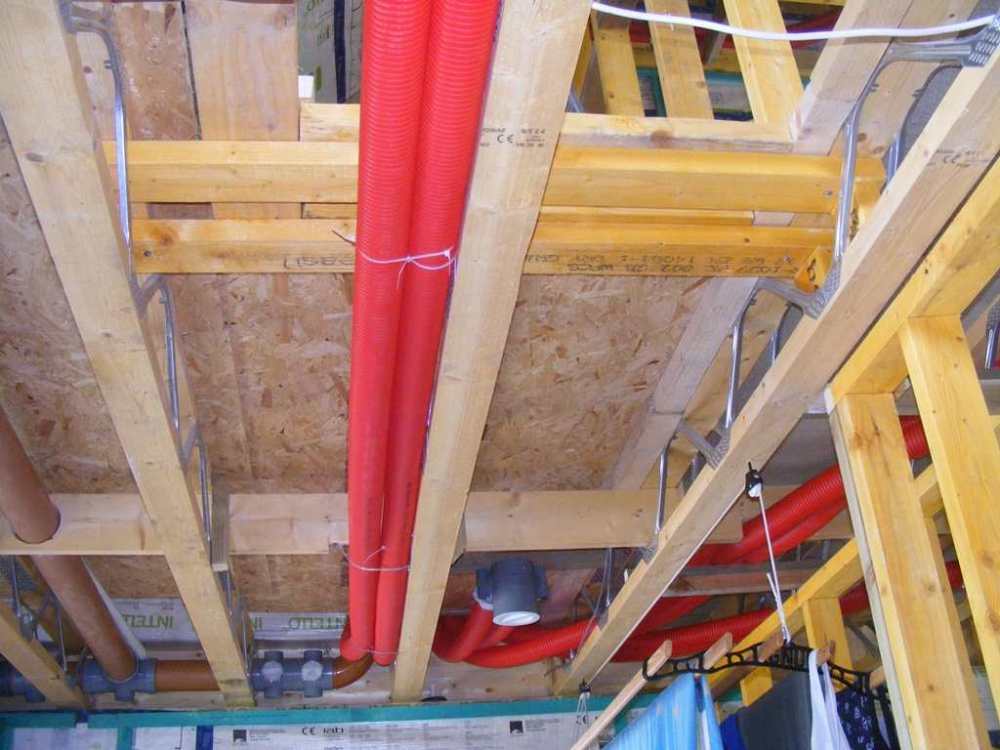
Mine, from BPC, I forget the make. Fixed from below ducts just push in, cut to length after plasterboard fitted and the outlet just pushes on.
-
Thermia Diplomat DHP-L Outside Sensor
ProDave replied to Andyh747's topic in Ground Source Heat Pumps (GSHP)
See second part of my reply, if it is really open circuit, how come you get a temperature reading with it connected but an error code when you disconnect it? Anyway a thermistor is marked using coloured stripes using the resistor colour code that looks to be therefore green black black gold. So 500 plus the gold, not sure what the gold means in the context of a thermistor? -
Thermia Diplomat DHP-L Outside Sensor
ProDave replied to Andyh747's topic in Ground Source Heat Pumps (GSHP)
Don't trust an MFT for that, it might only have a limited resistance range, try an old fashioned simple multi meter on ohms range. Or at least try your MFT with say a 100Kohm ordinary resistor to check it will read that high. If it was really open circuit, your HP would display the error message that it displays when you disconnect it. -
Thermia Diplomat DHP-L Outside Sensor
ProDave replied to Andyh747's topic in Ground Source Heat Pumps (GSHP)
So do you have a multimeter to test it? -
Thermia Diplomat DHP-L Outside Sensor
ProDave replied to Andyh747's topic in Ground Source Heat Pumps (GSHP)
I would take a hair dryer on an extension lead and warm it up and see if the reading changes. It is just a thermistor so it's resistance will change with temperature. If you have a plain ordinary multi meter disconnect it at the heat pump end and measure the resistance. Then warm it up and see if that resistance changes. If it does then it is not the sensor that is faulty. -
LED strip causing MCB tripping! Reason?
ProDave replied to markharro's topic in Consumer Units, RCDs, MCBOs
It's an rcbo that is tripping, so you don't know if it's tripping on over current or earth leakage. Do you have another socket anywhere, even in a different property, that has rcd and mcb separate, plug it in there and see which one trips. You mention cutting a longer LED strip short. Did you cut it where shown and are you sure it was a clean cut with no whiskas that could short out? I would expect some form of cap to go over the cut once done. -
Thermia Diplomat DHP-L Outside Sensor
ProDave replied to Andyh747's topic in Ground Source Heat Pumps (GSHP)
How do you know it is the sensor that is the issue not with wiring connecting it? If you carefully turn that little square black thing over see if there is any writing on the other side to identify it? Do you have a multimeter?