


Alan Ambrose
-
Posts
3392 -
Joined
-
Last visited
-
Days Won
15
Everything posted by Alan Ambrose
-
Can you give us an idea of the spec you're looking at for the investigation? I just got a quote for £5K + VAT for 6 boreholes to 6m including all the detailed testing and analysis. I didn't think that was crazy cheap considering it would probably be a team of 2 or 3 onsite for max 2 days.
-
>>> btw, quoting people the way you do doesn't notify them that they've been quoted! 😉 @Thorfun - ah yes I do that when I want to actively avoid bothering someone - but then if they come back to the thread they can answer if they want. Thanks for the thread reminder - I had seen it but will read it through again and make sure I understand everything this time
-
A big bit of steel pipe over the burn otherwise?
-
I can't quite visualise your set-up - a drawing and/or photo would help. Like JohnMo, I insulated around the twinwall in the roof with mineral wool - making sure that I was observing the distance to combustibles limits (e.g. for the roof membrane). BC signed off on it. I don't know exactly how much of a thermal bridge I have left. I guess I could figure it out, but it strikes me that if you have a wood burner and a flue, you're prepared to take the hit on the thermal bridge.
-
88 new houses near Cambridge to be demolished.
Alan Ambrose replied to Temp's topic in General Self Build & DIY Discussion
Goodness another BS result like Greenwich. There must be way to nip this stuff in the bud - presumably BC signed off the foundations in the first place. More brinkmanship do you think? -
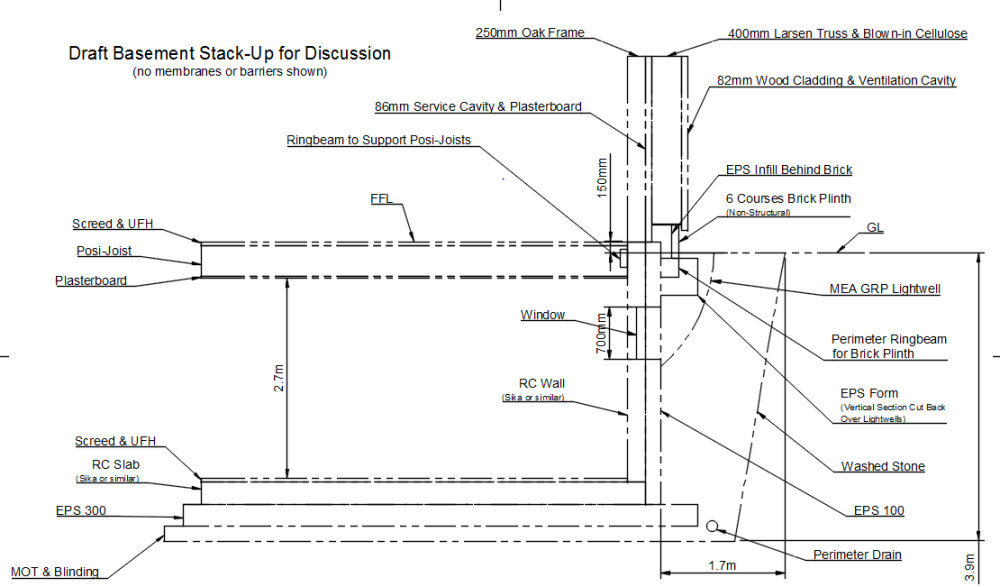
>>> as you have the Larson truss sitting on the non structural plinth wall This is structural oak frame with the cladding hanging off it, like your neighbour's. You'll see that the oak frame bears directly on the basement wall. My understanding is that's what all new oak frame houses are like now. You're right also - there should be a bigger gap between the truss and the plinth just to make it clear that the plinth is not load bearing. >>> I assumed this was more a specification/ guidance than showing real life detailing. This is a design sketch with the objective of making sure the main design blocks hang together and that the design decisions re plinth and lightwells can be firmed up. I have detailed stack-ups for the wall etc and, as it says, there are no membranes shown there. At this point, the detail is not that relevant though - I'm keen to see whether I can have the plinth and the lightwells. Obviously, I could omit both and make the structure simpler - but I would really like them if there's a way
-
Where's @Bitpipe when you need him? Gus, I think you might be right, I could do with some proper advice on the bits that fall between. That option hadn't actually occurred to me, duh. I'm not mainly trying to save money (as soon as you say 'oak' you mostly lose that battle) but to get the best job done I can. I think oak frame with a basement is a bit of a niche - not exactly rocket surgery, but not mainstream either. Let me PM you if I may.
-
Jeez... https://www.theguardian.com/politics/2023/dec/13/michael-gove-to-ease-housebuilding-targets-for-councils-in-england
-
>>> ground water depth & flow It's also struck me that if you have reasonable insulation outside the basement RC and a membrane external to that - then the ground water effect should be minimal.
-
>>> In the old days we called it 'Curve Fitting', now it is called machine learning. You don't you think it's important to recognise cats and the MIL?
-
>>> It does seem that EPC's are not worth the paper they are written on. The methodology is a bit flawed but basically it's a cheap service where someone just punches a bunch of options into some software and out spews the rating. Garbage in etc. If you ensure they have accurate information so they don't have to 'assume' anything then you will get as good a result as the methodology allows.
-
Actually, I'm going to disagree with eandg - I'm sure you know how to give the impression to subcontractors and suppliers that there's potentially a nice future stream of work coming from you if they do a good job on your own build. And I think that you've got a fighting chance of a fast time-to-watertight speed with the right off-site factory. So, I'm prepared to be impressed
-
Westminster planning permission consultant
Alan Ambrose replied to hrxv1's topic in Planning Permission
+1 You can even select the ones that get the 'yes' answers. Your planning portal is here: https://www.westminster.gov.uk/planning-building-control-and-environmental-regulations/planning-applications -
>>> special SS screws with black heads Goodness I thought I was ocd...
-
Plywood for lining internal walls in timber frame
Alan Ambrose replied to Hannah82w's topic in Timber Frame
I think the 18mm in the bathroom is in case someone decides to hang wall mounted loos etc at a later date. Personally, I would use 'class III' everywhere if the price difference isn't much and definitely in the bathrooms to avoid a small leak doing a bunch of damage. It might be worth actually seeing/testing the product before you buy - plywood quality has gone way down over the years and has a great variation in quality whatever what the sellers call it in their listings. I used some 'class III' in the spring for a temporary outside job and gave it a couple of coats of varnish to help it along - it is already bowing and delaminating. -
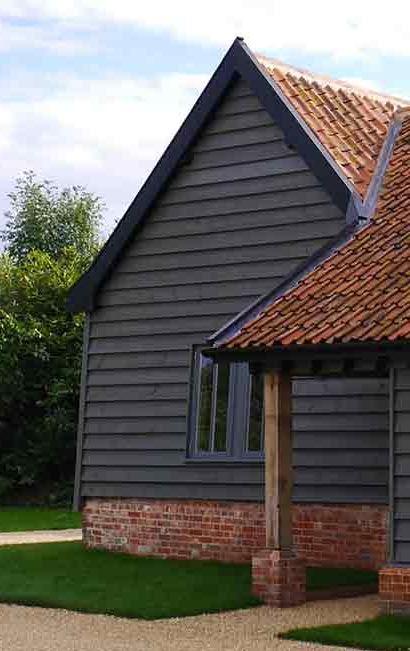
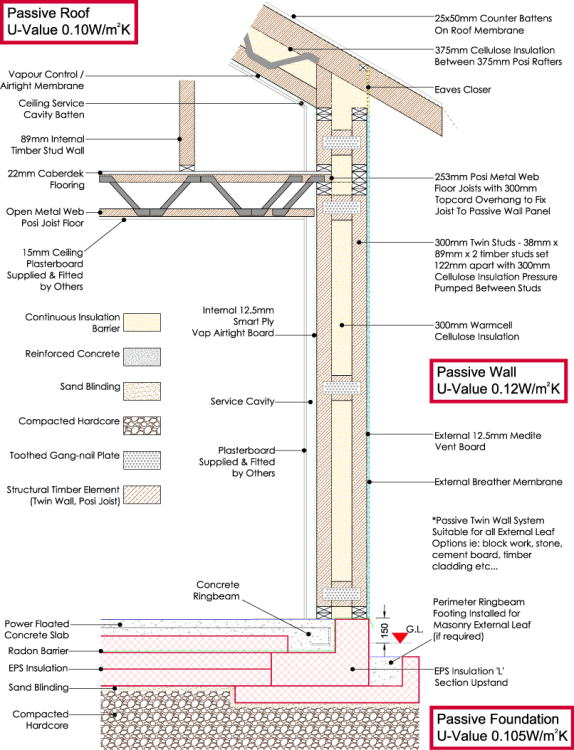
Hi, I'm looking at my basement detail - particularly the part where the basement wall joins the house walls. I'd like to have both a traditional brick plinth (e.g. 1st image) and some lightwells into the basement - although the detailing to accomplish both looks a little troubling (3rd image below). I can see that if I lost one or the other (so that the support for the plinth didn't obscure the lightwells) life would be easy . I've based my current thinking (3rd image) re the support for the brick plinth largely on this MBC detailing (2nd image) - where they cast a fairly non-structural ringbeam to support the brick plinth into some EPS channel which is itself laid on MOT. I will have an SE design the RC basement and an oak frame co design/make/erect the frame - but I may need to do my own thing on the insulation and cladding and also the interface between the topsides and the basement. Anyone have any thoughts? Ta, Alan
-
>>> Have zero faith in the SE It may be that the architect overlooked the engineering requirements or didn't think them though. Go back to the SE and ask if there's any other solution. Again, the SE may not have twigged your requirements accurately re look or function and/or assumed that you want the lowest cost solution. There may be other solutions (there often are) which will accomplish both the look, the functional requirements that you have, and the the engineering. A good SE will usually be happy to try and meet all three if they can. Of course, there are sometimes cost and engineering requirements which can't be overcome or only at extreme cost. There was a Grand Design last night where the roof was a bunch of different angles and facets. Fine, it wasn't so crazy that it couldn't be made by actual contractors (although a bit of a bodge in places - the SIPs people were using a sledgehammer and a sabre saw to 'adjust' their work) but it was substantially more expensive. p.s. alternatively define what you want exactly in terms of function and look and feel and point the SE & architect at each other and ask them to come up with a solution. Sometimes they will be able to sort everything a a 5 minute call (or have a 3-way call). That avoids you being the Chinese whispers guy.
-
>>> I did have the other thought that we would like a shower niche, recessed shelf. We have that (my suggestion ) - looks great, maybe larger rather than smaller. Ours (a metre or so square) has SELV lights at the top which makes it look v. good.
-
Yeah, my other half likes the bedroom super-cool and breezy. Most of the year we accomplish that by simply not heating the bedroom and leaving the window open. It's stuck me that she is a better CO2 detector than I am, but we'll only find that out when we finally have our build done. @Norbert - will you have separate control of the heating in your bedrooms?
-
@Andehh - from your report, it looks like the MVHR is dipping the air temperature very fast downwards by a few degrees? Is that right and is it really the problem or is, say, the vent right over the stat?
-
Committee decision - attend or not?
Alan Ambrose replied to Drellingore's topic in Planning Permission
Wow, love the design -
>>> I found them very unstable and each one was calibrated differently. Funny you should say that. I have two set-ups running (in 2 properties) with no real problems for 3 years - one with 14 sensors and one with 10 - including wet and electric UFH, immersions, towel rails and outside sensors. All work fine. There are two small things - (a) the outside sensors are battery and have a shortish range and (2) if I switch off the power to the property completely, the stats end up with the wrong time. I think this may be something to do with my router taking longer to start up than the heatmiser hub - but that's only a guess. Easily fixed once I remember. Also Heatmiser doesn't have a decent user forum and their product guys could be smarter - I've told them a couple of times how I've bodged their system so I can use higher temps on the immersions (their app is limited to 35 degrees) - but they don't listen. The API could be better, although I've not used it in anger. They update the app about once a year instead of every damn week like some apps, which is good. Sure, the temperature reading is from airflow through the stat itself. In one room, stupidly, I put the stat directly above the heating and so it reads high - so for that room we use a separate battery sensor near SWMBO's desk. Are you having a problem with comms to the hub? Have foil back plasterboard or somesuch on internal walls? The stats are supposed to mesh, but I have not actually seen how they do that. Re: 'calibration' - if you want to, you can use the stats' own menus to calibrate. I did, just because I have a Tektronix temperature meter hanging around here. Not sure it's really necessary though.
-
Congrats
-
Builders Temporary Electric Supply
Alan Ambrose replied to BadgerBadger's topic in Electrics - Other
@ProDave - just to finish that subject off - would you revert to PME when the building is done or leave as TT? -
Builders Temporary Electric Supply
Alan Ambrose replied to BadgerBadger's topic in Electrics - Other
@ProDave >>> And remember to give the site sockets their own TT earth NOT a PME earth. Possible to remind us why that is again?



