


Alan Ambrose
-
Posts
3392 -
Joined
-
Last visited
-
Days Won
15
Everything posted by Alan Ambrose
-
PV plan and in-frame mounting options - am I going crazy?
Alan Ambrose replied to SuperPav's topic in Photovoltaics (PV)
>>> run back to the garage CU. I was pondering something similar on my shed. I have a similar set-up with a small garage CU which runs via ~20m of SWA back to the house CU. I see that it's on an MCB, itself on one of the two RCDs in the CU. I suspect it shouldn't be on that main CU RCD as it has its own RCDs anyway. Question is (I think you may have the same question) - can you direct attach the inverter to the garage CU, or do I (you) need to run a separate SWA back to the main CU? Re: having a lower inverter capacity than the peak output of the panels you have. I don't think this is as much of a problem/waste as it might seem - losing a bit of the peak output isn't that big a deal as (a) by definition the peak doesn't occur very often and (b) when it does, it's almost certain to be electricity you can't use and/or have to sell off cheap to the DNO anyway. -
What's more important for comfort U value or 'thermal mass'
Alan Ambrose replied to Gone West's topic in Boffin's Corner
>>> not that it addresses the original question here Banish the thought. Anyone? Is it related to this question below or are they totally different? Does ‘comfort’ (in the original question) imply lack of temperature variation? “What's the target for phase shift / decrement delay? I can't decide whether the optimum is 12h based on the idea of 'cancelling out' some of the dailytemperature swing or 'very large' on the basis that the interior temperature swing will be super low?” -
Well congrats. If you can get the roof edges to drain properly so that any ground splash won’t soak the lower 6 inches of walls, that’ll give it a long life. I was not convinced about the pva stuff, did they supply contact adhesive for the edges? Probably not a big deal anyway as it’ll lie flat (ish). There are some good stainless nails with rubber collars to hold down the edges of the epdm - you probably don’t need many. I also used ss staples in the non-critical parts.
-
>>> Use resin and screwed rod +1 something like this: https://www.screwfix.com/c/screws-nails-fixings/resin-fixings/cat840022 Sometimes called chemical anchors. Read and follow all the instructions exactly, including the bit about sweeping the hole carefully with a bottle brush. Discard the 1st bit of resin from the tube if it’s not mixed thoroughly. You might want to plan for the rod being not exactly centred in the hole, but you can jiggle it into centre when you first put it in to help. Forget the screws and rawlplugs unless you want to do the job again later.
-
Think you forgot your attachment. I have a vague memory that these quotes were meant to use a standard price list? Wouldn’t surprise me if the DNOs tried it on though - monopoly pricing and all that.
-
I've used a dremel with a cutting disk to cut new slotted heads before to get purchase on various screw-like thiings. Takes just a few mins, wear glasses.
-
Using muck away to level a paddock
Alan Ambrose replied to WannabeBob's topic in Landscaping, Decking & Patios
Of course, if you calc the quantity of soil removed and bulk it up by a fluff factor (say 15%) you can figure the increased depth on your paddock. I used a density of ~1.3T/m^3 and 11 £/T muckaway for comparison purposes. This was for clay. -
Yeah there's some special rope and cement - check out any stove supplier. Check out the brand Vitcas. https://www.modernstoves.co.uk/?s=cement&search_id=1&post_type=product Also, the instructions for the stove model / flue will detail how to seal it.
-
Jeez, legal nimbyism given a boost...
Alan Ambrose replied to Alan Ambrose's topic in Planning Permission
A bit in the Times yesterday: the article wasps on about adding new storeys, up to two storeys in rural locations, seven in cities! No other 'use case' examples. A kind of 'street planning application' which still gets voted on by the council. Plus a bunch of detailed rules about sizes, angles etc. Weirdiama - and it kind of assumes most property has man enough structure and foundations to handle the extra weight or can be upgraded. I can't figure out whether this is (a) government's idea to allow 'more community involvement' in something (that'll never get used); (b) the thin edge of the wedge giving us the UK equivalent of the US 'Home Owner Associations' (much derided), or (c) simply a bad bit of legislation with no obvious purpose. Here's a summary of the current permitted development re extra storeys: https://www.planningportal.co.uk/permission/common-projects/additional-storeys-extending-upwards/planning-permission ‘Street votes’ to allow seven-storey extensions on homes Plans laid out by Michael Gove’s levelling up department aim to boost ‘gentle’ development through local referendums Neighbours will be able to add up to seven storeys to their homes by holding local referendums to avoid the need for full planning permission. Under government plans to encourage “gentle densification”, ministers will allow residents to band together to vote on allowing extensions, basements and loft conversions along entire streets at once. https://www.thetimes.co.uk/article/street-votes-to-allow-seven-storey-extensions-on-homes-rj2qxvth5 -
A stainless sheet might also reflect heat back into the room
-
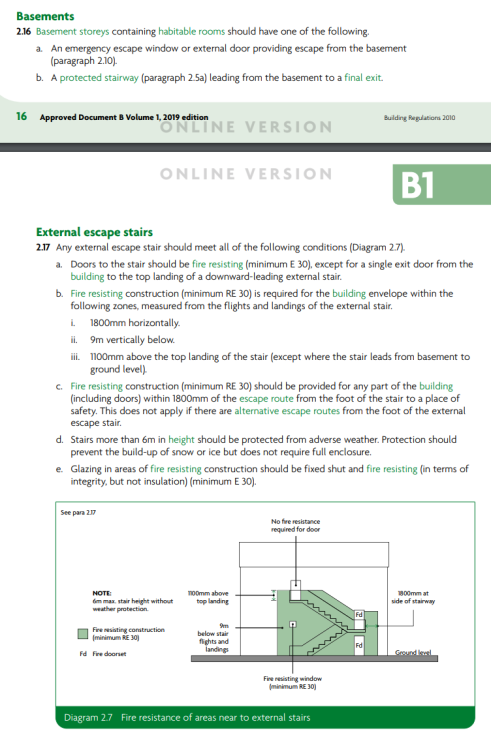
OK here: https://assets.publishing.service.gov.uk/media/639ae7e98fa8f5069839c7d7/Approved_Document_B__fire_safety__volume_1_-_Dwellings__2019_edition_incorporating_2020_and_2022_amendments.pdf Page 16:
-
>>> you need an exterior stair also Or some other form of escape e.g. a window or the right sort and dimensions.
-
Jeez, legal nimbyism given a boost...
Alan Ambrose replied to Alan Ambrose's topic in Planning Permission
Yeah, not totally clear what problem this is trying to solve, this is the only example I came across: ”A group of residents which meets certain requirements will be able to come together with a proposal for permission to be granted for development on their street, for example the addition of an extra storey to properties. The proposal can be put forward by the group of residents directly or with the assistance of an individual such as an architect.” I thought that an extra storey was PD already, so the example is a bit odd. I guess you could all vote that you were allowed dormers on the front of houses or something. Maybe of use more in cities? I know that some of my neighbours will vote ‘no’ to anything though. -
Consultation on street votes begins https://www.planningportal.co.uk/services/weekly-planning-news/planning-news-11-december-2024 Suggest we all respond.
-
My understanding is that if you have habitable rooms down there you need an exterior stair also.
-
Another recent thread on here recommended getting an asbestos testing kit.
-
The vermiculite I've seen is grey-ish/white-ish granules, and the old stuff did tend to have some asbestos fibres in it. Looks like cork from here?
-
Internet switch - recommendations
Alan Ambrose replied to Moonshine's topic in Networks, AV, Security & Automation
Yeah +1 for PoE for cameras, doorbells, wifi access points etc. A switch has traffic management, vlans etc so if you don't already know you need them, you probably don't and a hub will do. I like the Ubiquiti stuff as I feel it is 'semi-pro' rather than consumer. -
What's more important for comfort U value or 'thermal mass'
Alan Ambrose replied to Gone West's topic in Boffin's Corner
Is it possible to chuck in a somewhat relevant question here? Re: What's the target for phase shift / decrement delay? I can't decide whether the optimum is 12h based on the idea of 'cancelling out' some of the daily temperature swing or 'very large' on the basis that the interior temperature swing will be super low?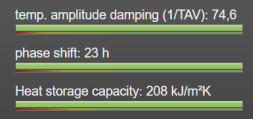
-
And free : https://www.passivhaustrust.org.uk/event_detail.php?eId=1048
-
>>> Or would we be better putting in the new supply first, and setting up some kind of temporary connection to it? FYI some people here have power run into a cabinet ('kiosk') by the DNO right at the beginning and then run their own cabling from that point on at a later date without further DNO involvement. You will eventually need to get official power to your house anyway (which often takes a while) so that may be a consideration. Also there's some discussion here on BH regarding the earthing arrangements needed for a building site 'TT' being different to those needed for the final house 'TN-C-S'. I'm sure a proper sparky will be along soon
-
FYI more CIL appeals than I expected: https://www.gov.uk/government/collections/community-infrastructure-levy-appeal-decisions At least they're all listed in one place. Annoying that they're redacted - it makes them significantly harder to read. Standard planning appeal decisions are not redacted. As a (not very encouraging) example, this one, for instance, finds a technicality in favour of the LPA to invalidate a self-build exemption. Total BS if you ask me and against the intent of the self-build exemption - but consistent with CIL as a revenue raising activity and a fragile tax law laying in wait to trap the unwary: https://assets.publishing.service.gov.uk/media/64d5ec095cac650014c2ddaf/CIL_Appeal_1801243_26_Sep_22.pdf BTW CIL appeals seem to follow a totally different system to standard planning appeals. Nope, spoke to soon ... another list from the standard appeals portal: CIL Appeals.pdf I have not tried to reconcile the two lists... Also this: https://www.irwinmitchell.com/news-and-insights/expert-comment/post/102fdgq/the-famous-five-a-quickish-recap-of-case-law-on-the-operation-of-the-community Presumably there's an extended bunch of court decisions too for those taken beyond the appeal stage. @Haylingbilly - possible to share your CIL lawyer's details - I can't imagine there are many of them around.
-
>>> the description is changing, I’ve been advised that a new full application would be required. You can write pretty much put whatever you like for the description of a planning application. I suggest asking your architect whether you really need to submit a full application or whether it could be a variation of the old - possibly even accepting constraints on the basement design to make it a variation only. This could be important and may be the difference between paying CIL or not. I'm assuming you are looking at a non-trivial CIL amount. Mine is £40-60K atm depending which design I'm looking at - and that's excluding the basement floor area which will another 1/3rd to the CIL amount. I don't know whether we will definitely have a basement until I see the soil investigation results. Note that the reasoning for you to do a variation rather than a full application is solely because of the CIL impact - otherwise you might not care. I think we are in the exact same position except that I have asked ahead of time: + this is, there is existing planning on my plot and I would like to use that to get the services in while I'm waiting for the approval to come through for my new design. My CIL people are saying 'if you do that, you will invalidate your self-build exception and have to pay the CIL'. + you have already started on your build and want to substantially modify the design such that you might need to submit a new full application. Presumably you have sent in the CIL liability and self-build exemption forms. So, if my local CIL people are right, you would also invalidate your self-build exemption . I'll see if I can find the reasoning for their logic in the CIL 2010 Regulations when I get a few hours and determine (a) whether they're right and (b) if there's a workaround. You might check with your local CIL people, if you have not done so already, as they have some discretion. Yours may be more sensible than mine.
-
@eski009 - btw as a newbie to the forum, just so you know - the forum etiquette is that if you ask a question and people take time and energy responding, then you implicitly agree to consider the replies, and reply yourself etc. I'm not singling you out, just saying that there are some people who alight on Buildhub for the first time, ask a question, people reply - sometimes at length ... and we never hear from the original questioner again. OK I think you might have a snag - I've come across this myself. Like other UK tax laws, the CIL law ( https://www.legislation.gov.uk/uksi/2010/948/contents ) is very fragile, which means if you put a foot out of step, even accidentally, you get nailed. Fair? No. I also think that the CIL law is 'interpreted' by your local LPA - so not all LPAs read or implement CIL the same way. Also, I don't think there are many experts on CIL - I had a commercial property lawyer (read 'grown up') for my plot and she sad 'we cannot advise on CIL'. I don't think she realised that it was even part of the planning legislation. I have not read the legislation (yet) but I had this interaction with my local LPA's CIL department last summer. As the plot had planning already, I asked whether I could put in my services, driveway etc based on the old permission while I was waiting on them to decide on my new permission: "We would like to start getting the services and access arrangements started on this plot. The applications listed above are for the same single dwelling plot, a ‘greenfield plot’ located at xxx yyy. Planning was granted for a single storey dwelling under zzz back in November 2021. We have since proposed two variations in design for LPA consideration and these are still waiting for decisions - which we are told will be forthcoming over the next week or so. We have been told that the single storey design will be granted and the 1.5 storey design refused. We intend to take the latter to appeal. This is a self-build. The access arrangements, cart lodge etc are the same in both of the outstanding designs – it’s just the dwelling itself that varies. As we already have planning granted for a single storey dwelling, we would like to make a start on the installation of services and for the driveway for access. I imagine that we can simply signal a formal start under the original application and then ‘move the CIL arrangements’ as the new planning and/or appeal comes through. Would that be correct? If so, what is the correct procedure for ‘moving the CIL arrangements’?" They answered: "If your new applications were variations of the original consent, it would be possible to transfer a self build exemption across, however, as you have made new full applications this becomes somewhat more complicated. You cannot transfer a self build exemption from one full application to another. If you make a start and carry out a material operation to commence development, you could invalidate any possibility of claiming exemption on an alternative permission. Given the access arrangements are the same, you would effectively have already implemented a new permission on the day permission was granted and the CIL for it would be payable in full, immediately. I would recommend you wait to implement any permission until you have received the permission you intend to build out to avoid any potential issues down the line." This agrees with the response you got, although I imagine your local LPA CIL guys do have some flexibility. That said, they are a revenue raising team, so guess what - they probably love the fragility of their interpretation of the CIL law. So I suggest, a possible way around is to try to vary your original application (there are various mechanisms for that) so it's not a new application, just a variation of the old. That might mean some compromises in you design - maybe so it looks the same as the old to the casual observer, even though you have a basement now. If your variation gets turned down, you still have the original application intact. This assumes you have a bit of time to wait for the LPA's response. They may still refuse to vary based on the fact that it's an increase in floor area. But they may not. I found my local CIL guys a lot more approachable that the planning guys, so maybe you could get a face-to-face to see what they might allow or whether they might give you an exemption so you just pay the uplift for the extra floor space. They might decide it's a question for the planning guys and send you there or might take the question to the planning guys themselves. If you are a risk taker and have a good lawyer and the CIL law supports your position then you might also ignore their response, and be prepared to fight in the courts later. Do let us know what happens - I for one am still interested in this question. Also it builds the level of Buildhub knowledge.
-
Yeah I see - particularly the back view will need 5 downpipes.



