


Alan Ambrose
-
Posts
3392 -
Joined
-
Last visited
-
Days Won
15
Everything posted by Alan Ambrose
-
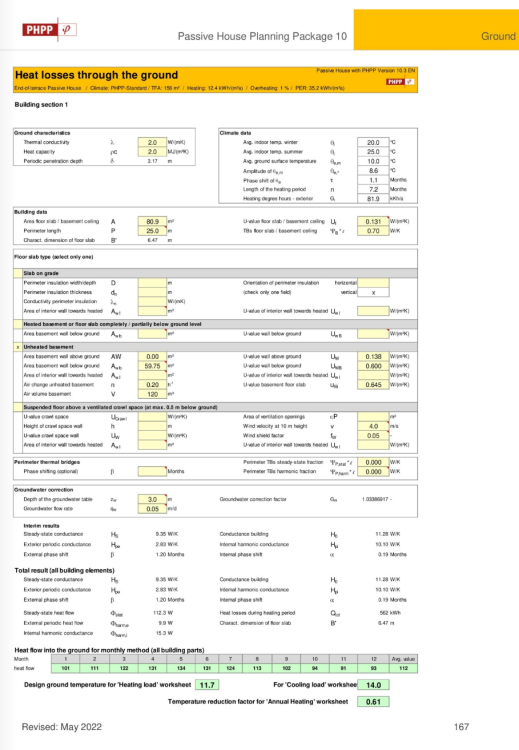
OK I've found the answer (not really). But PHPP does have a bunch of calcs for: + standard slab + unheated basement (i.e. basement outside thermal envelope) + heated basement (i.e. basement inside thermal envelope with interior temperature assumed to be the same as the rest of the building) + US-style suspended floor above crawl space + some way of coping with combinations of these. They include ... adjustment for soil type / perimeter losses / ground water depth & flow / seasonal ground temperature and delay! I'm not sure how anyone measures ground water flow rate in the typical soil investigation? Exactly what methods PHPP uses I have not determined yet. But if you accept it as a black box, then it would seem to do most of the necessary calcs. I'm not sure yet if there's a workaround for 'partly heated basement'.
-
>>> Not sure where the original input for the "need" of a new regulation like Part O came from in the first place though. Yes, it would be interesting to know. To pick an example, here's the spiel from Future Homes Hub: In September 2020, the Future Homes Task Force was set up to develop a long-term delivery plan for the sector in line with the Government’s legally binding net zero and wider environmental targets. The Delivery Plan is divided into four areas with a goal and roadmap for each area. The Delivery plan also set out the specification for the Hub. The Future Homes Hub has now been set up as a non-profit making company limited by guarantee. We are an independent organisation bringing together the homebuilding sector with the wider circle of supply chain, infrastructure, finance and government organisations that need to collaborate. Over 40 of the largest homebuilders committed and many other related organisations committed to working together through the Hub to achieve the goals on publication of the plan. Here are the steering group members - now how did these guys get selected? Adam Graveley, Element Four Professor Kevin Lomas, Building Energy Research Group, Loughborough University Simon McClelland, Story Homes Danielle Michalska, Barratt Developments Clare Murray, Levitt Bernstein Neil Murphy, TOWN Anastasia Mylona, CIBSE Oliver Novakovic, Barratt Developments Richard Partington, Studio Partington Martina Pacifici, AHMM Dale Saunders, Taylor Wimpey Michael Swainson, BRE Victoria Tink, DLUHC
-
Combined Sewer on Private Property
Alan Ambrose replied to iMCaan's topic in General Construction Issues
>>> I don't think I'm being misled. I hired him because he does a lot of groundworks for council and schools. OK then, that implies that he decided not to notify or maybe he did without wanting to bother you? Ask him maybe? -
Combined Sewer on Private Property
Alan Ambrose replied to iMCaan's topic in General Construction Issues
>>> My builder re-routed it in our garden to avoid the foundations (back wall). Is there a chance you're being misled by your builder? Did you see the work? -
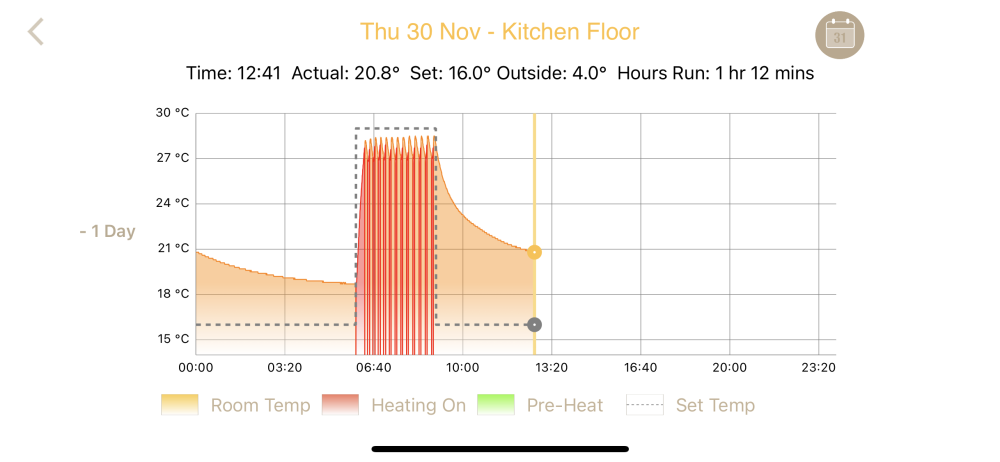
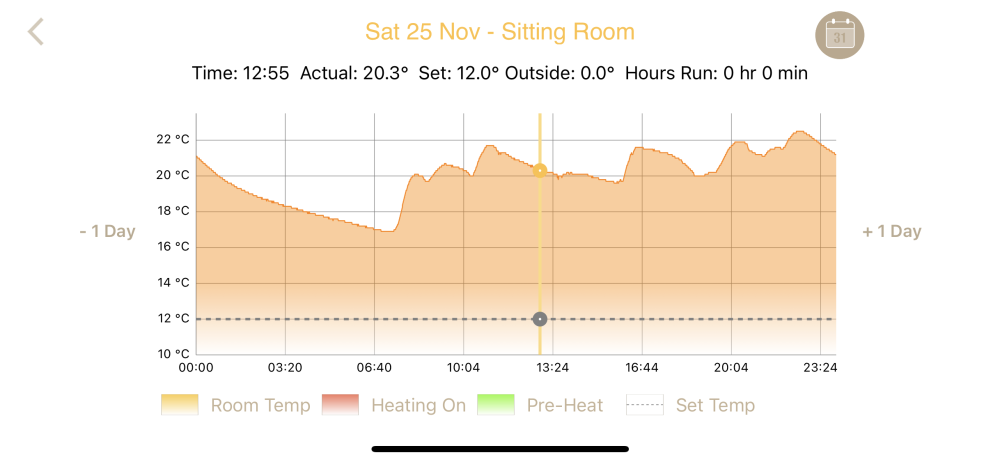
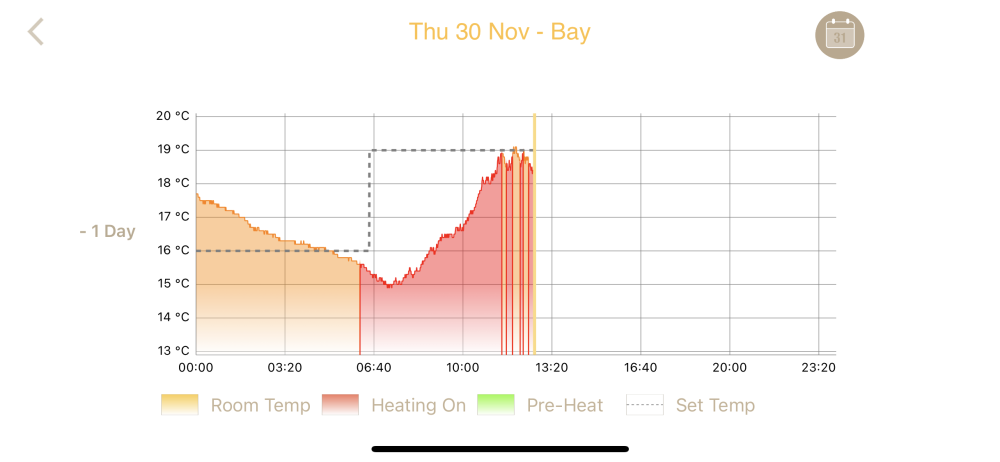
Some examples: (1) Electrically heated kitchen floor with floor sensor following programmed morning cycle. Yeah, it's bang-bang (i.e. on/off) control with a 0.5 degrees dwell and 10 minute 'output delay'. (2) Wet UFH on frost standby (will heat if temperature drops below 12 degrees). Log fire keeping the place warm - each bump is someone adding a new log or two. (3) Electrically heated area following program. (Outside temperature is quite cold and therefore takes ages to warm up.)
-
>>> why is it even calling for heat? The dashed line is your programmed heating schedule - it says 'heat up from 16 to 20 degrees please from 3-7am, then don't heat after 7am unless it drops below 16'. If you check the profile for those rooms you should find that that's what is set. This is the basic operation of any typical timed programming device and is described in the manual. >>> Are those room temperatures? Depending on which thermostats and sensor set-ups you have - most likely room temperatures. You can add floor sensors and/or remote wired or wireless room sensors to the standard room temperature display - so it depends on your set-up. Ask you installer maybe? >>> I can't believe the room temperature goes up and down so rapidly, so I would be looking at some other local heat source confusing the thermostat It does look a bit rapid, but I've found it is surprisingly sensitive. Yes, you're seeing desired temperature (dashed line) and actual temperature (reddish graph) together with an indication of whether Heatmiser thinks it has called for heat (hence the red colour). If the call for heat somehow doesn't switch the heat source on, say, due to a fault or you light the log fire (which Heatmiser doesn't know about) then the actual temperature won't necessarily reflect the expected behaviour of the programmed temperature - i.e. slowly catching up with the programmed temperature.
-
OK will look for it, thanks. >>> But it was so long ago I can’t remember the formula! If I could remember even half of what I used to know, I would really be quite smart
-
Early days in starting our barn conversion journey
Alan Ambrose replied to fluffnstuff's topic in Introduce Yourself
Is there not a ditch nearby that you can drain the outfall from packaged treatment plant? By the time it's left the plant it's meant to be guaranteed to be clean enough for this. -
Draining external taps prior to the BIG FREEZE
Alan Ambrose replied to Adsibob's topic in General Plumbing
Obviously there some insulation thingys which go over the tap. Screwfix etc. I put mine on a couple of weeks ago. My water company suggested one of the insulated green boxes that @Kelvin mentioned for a site tap. -
OK suggest this is either your HP cycling or the UFH blending valve closing off as the water is too hot. You can see from the graph that Heatmiser is 'calling for heat' but something else is shutting off the heat supply for a bit - presumably until whatever it is has cooled down enough and then it starts up again. Suggest close observation of the manifold, actuators, mixing valves etc and the HP itself. Also checking what temperature the blending is set to. Looks like the cycle is about an hour? A temperature probe / thermal camera and a voltmeter might help.
-
Adding panels myself? (Inverter & cables already installed!)
Alan Ambrose replied to glock339's topic in Photovoltaics (PV)
>>> There's a procedure to formally request it It'll probably take a week or two for me to get to this. In the meantime, if you search 'wayleaves' and 'dno' or similar here on here, you'll get most of the info. -
OK thanks all, much appreciated and thanks for the pointers, links and considerations. Like a lot of subjects, the answer appears to be 'it's complicated' BTW Jeremy's spreadsheet just has floor area x U-value and assumes steady state ground and inside temperature. There's no allowance for perimeter losses and it comes up with a constant heat loss rate over time. So, in an ideal world, I should model the ground conditions, ground water presence & flow, temperature fluctuations at various depths and seasons and the full thermal properties of the basement construction I'm just delving into PHPP modelling and I see they have some resources and calculation methods here: https://passipedia.org/basics/building_physics_-_basics/thermal_bridges/tbcalculation/examples/heatedb https://passipedia.org/basics/building_physics_-_basics/thermal_bridges/tbcalculation/examples/unheatedb But I was hoping for an easy answer.... I'll post back here with any progress I make.
-
British Gas computer says no - why??
Alan Ambrose replied to Tom's topic in General Self Build & DIY Discussion
Sadly even some dno staff don’t get 3 phase - at least the ones that deal with consumers. I once had a company send 4 bods on 4 visits over as many months trying to swap out my 3P meter. Eventually they sent the boss and he arrived with a mostly suitable meter. -
Early days in starting our barn conversion journey
Alan Ambrose replied to fluffnstuff's topic in Introduce Yourself
For a quick read on type of soil, drainage etc you can ask any or all of building control, local builders, the seller, neighbours, septic tank emptying companies, british geological society bore hole records etc etc. All quick and free. Won’t give you a 100% read, but if two or three agree, you’re probably home and dry. A good solicitor will also check utilities and drainage records / easements etc for you. -
>>> Some PV guru's could probably enlighten me. Hardly a guru, but each PV panel string usually sits on one central inverter input (or MPPT) and will be limited to the output current of the lowest panel - the panels are literally strung together in series. A string is usually limited up to, say, a dozen panels and is limited to the max inverter input voltage. Total voltage is approx. # panels x 40V. So shading one panel will reduce the output of all the panels to the same extent. With local inverters, there's usually one inverter for each panel (they sit on the roof too) and there's no such limitation. Of course, this option is usually more expensive.
-
Also, what's the best treatment for unheated spaces like lobbies?
-
Blinds that are compatible with Loxone
Alan Ambrose replied to Dunny1234's topic in Networks, AV, Security & Automation
>>> I now specify 3+E and cat6 Run in different conduits? -
PHPP form factor apparently is total outside surface area (floor, roof, walls etc) / treated floor area (i.e. sum of internal area of rooms, not including internal walls etc)
-
As per title - I'm initially looking at Mr Harris' spreadsheet, but also curious about SAP / PHPP treatment? I can see that PHPP talks about unheated vs. heated basements. In practice, I'll probably lay UFH pipes but only use them if we feel the need. For unheated, am I right in thinking that there's an assumption of a constant heat loss through the ground floor just like the non-basement case? Maybe, total basement wall and floor area x constant heat flow per m^2 assuming inside & ground temperatures are fixed? What does that all do to 'form factor' - does it all fall apart in the case of house + basement? I think 'form factor' sort of implicitly assumes that floor, walls & roof have the same temperature gradient?
-
Mineral wool in the service void as it's more practical to install there than cellulose? Any utility in using posi joists rather than standard rafters so you could run MVHR ducting there? Can I ask how you chose 1.4 as a target u-value? Is that a typical optimum value in practice?
-
Blinds that are compatible with Loxone
Alan Ambrose replied to Dunny1234's topic in Networks, AV, Security & Automation
@joth I think the difference of opinion between various sparkys demonstrates that there is no accepted standard / little experience in the field / and not covered in detail by the regs. -
Any experience with ErfurtMav Professional Insulation Panels?
Alan Ambrose replied to rkrv's topic in Heat Insulation
Is there no possibility of adding more than 7mm of insulation? -
@Iceverge Thanks for the very clear 'heat loss in a nutshell explanation'. Very useful for everyone, I think. Love the colourful fold-up cardboard cutout version of the house design - was that used somewhere, or just to illustrate the surface area? I just bought PHPP yesterday, so @Nic thanks for bringing this subject up at this time
-
>>> I can't recall the brand It would be fantastic if you could remember which one.
-
>>> contact the seller/supplier and ask for a VAT invoice. Yeah VAT registered businesses must issue invoices with the VAT clearly shown. You might have an order confirm or whatever instead of an actual invoice. You may have to hassle their accounts department to get it, of course.




