


IanR
-
Posts
1857 -
Joined
-
Days Won
6
Everything posted by IanR
-
Are you bring the cable up in a trench, or over-head? Ours was in 125mm ducting, in a trench, dug by us, so I got them to create a non-serviceable, underground joint to the domestic supply cable. The joint is underground with nothing that marks its position. I couldn't convince them to bring the "public" supply cable all the way to my kiosk.
-
The DNO would only bring their cable to a point 25m from the meter position on the property, joining to a domestic supply cable at a position that was in a field, so we made that connection underground and brought that to a self-built kiosk on the edge of the curtilage. The kiosk serves multiple roles, with the mains water stop-cock and splitter to house and out-buildings there and also a relay point to get the PoE and data cabling to the Entrance within 100m.
-
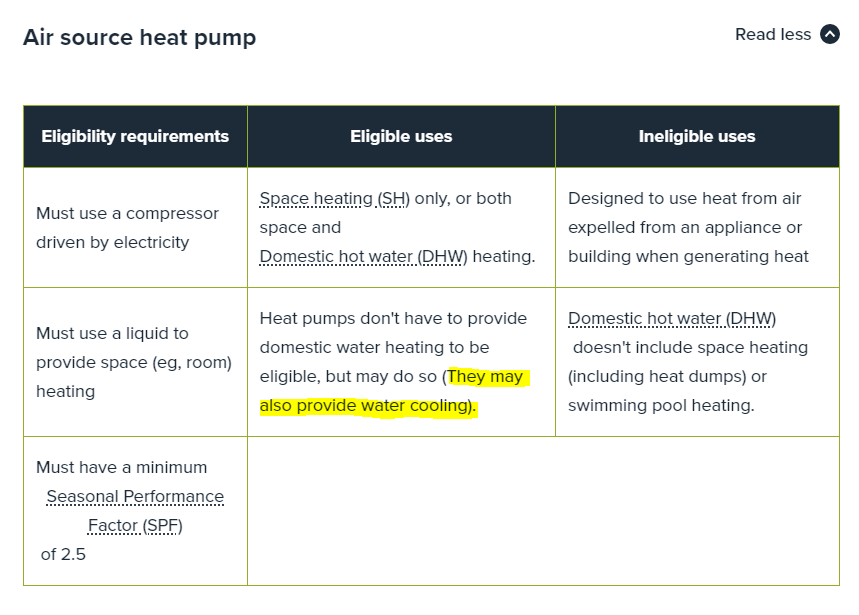
The cooling has no effect on the efficiency of the ASHP. Cooling wasn't initially allowed with RHI, but is now. It changed in 2017 I believe. Ref. https://www.ofgem.gov.uk/environmental-and-social-schemes/domestic-renewable-heat-incentive-domestic-rhi/applicants/eligible-heating-systems Yes, cooling is effective, but since mine is via the slab, is slow to react, ie. it will take 2-3 hours to lower the slab temp before the cooling effect is felt. I also have cooling available via MVHR, from the same buffer that supplies the UFH, but as I don't cool the buffer below 12°C, it's not that effective via MVHR. No effect on RHI - COP on ASHP and low flow temp is unchanged, so max RHI allowed on the Nibe I have (F2040-12)
-
Looks expensive to me. I paid £11K excl. in 2017 for a 12kW Nibe + Cooling module, with a 500l Nibe UVC, 200l buffer, Modbus module and controller, installed. Nibe seemed more expensive than most, but offered the cooling module, which few others did at the time.
-
In planning terms, Amenity land is an area of land that has a residential use, ie. can be used for the enjoyment of the attached dwelling, but can't be considered Residential Curtilage, so you can't have permanent domestic structures on it such as sheds, bike store, bin store, washing line etc. and doesn't count towards PD for outbuildings where you can cover 50% of the original curtilage. To the best of my knowledge it requires no boundary separating it from the residential curtilage , so does not require fencing off. I certainly know of a few that are just extensions to the garden. I see it often used in rural areas where the planners have allowed a change of use, but wish to keep the residential paraphernalia close to the building and not spread out into what was previously agricultural land. Start off small, and see if anyone complains.
-
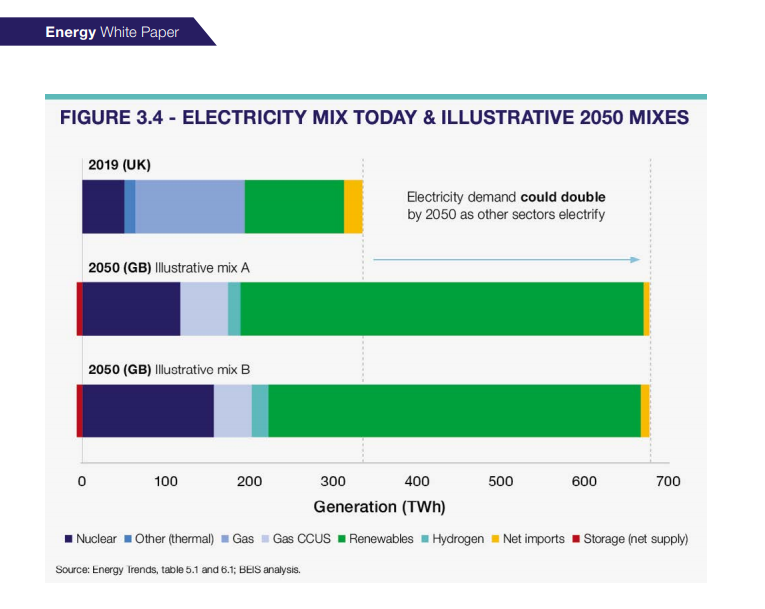
Today we don't, but there are the green shoots of a plan. Carbon capture still requires development to scale up, but is in the plan to allow continued use of Gas for flexibility in electricity generation. There's also a plan for long term electricity storage, to help with peaks and reduce the amount of Gas power stations required. Ref. https://assets.publishing.service.gov.uk/government/uploads/system/uploads/attachment_data/file/945899/201216_BEIS_EWP_Command_Paper_Accessible.pdf The above linked document is a long read, but a good overview of the Governments thinking with future predictions.
-
I don't believe that is the argument, one size clearly does not fit all, so there will continue to be a mix of technologies that provide heat to our homes and in a wider context to industrial and commercial buildings and powering transport etc. But, that mix is going to change. The only technology available today that could be up-scaled to provide the majority of net-zero-carbon heat for homes at anything like a similar price to that currently paid is electricity. The plans currently in place are therefore to generate more renewable electricity as a proportion of the total electricity produced, generate more electricity in total to allow a shift away from fossil fuels, and prepare the housing stock to be heated by non-fossil fuel sources. There will be a proportion of homes and buildings that for one reason or another can not viably be heated by electricity, and the other options you mention will fulfil that need. Since this is a long term shift, new technologies may be developed that can be up-scaled sufficiently to be included in the mix. Green hydrogen is an obvious example, and has the benefit of being able to be supplied within most of the the existing domestic natural gas infrastructure (although not the gas grid side, which would require upgrading) - it's just that currently it's a very inefficient user of electricity and a step change is required in the electrolysis process to make it scalable for heating homes. It doesn't take a heat pump evangelist to then appreciate that they offer a relatively efficient method for using electricity to provide the heat in our homes, so cannot be dismissed as a "niche", "failed" or "snake oil" technology.
-
The 2025 date is for new builds, and requires them to have a zero carbon heating system. For the existing housing stock the only plan currently announced is 2028: EPC C or above for all rental, social and houses sold; 2035: EPC C or above for all housing. There's been no suggestion yet on how the transition to non-fossil fuel heating systems will be encouraged, or forced for existing housing, but it is the stated aim.
-
No.
-
Welcome Martin. Garden rooms seem to be a hot topic currently, no doubt spurred on by lots of people needing work-from-home space. I also work in automotive engineering, what part of the country are you from?
-
Yes, if you don't plan a significant renovation, then your situation is different to the OP, so you would need to include replacement heat emitters and additional plumbing into the ASHP costs, which probably means Gas is the more cost effective solution today. Although I'd still run the figures through RHI, just in case it closed the gap. As an average COP, across the whole year, that would not be a a good assumption. If you were renovating, and designing for a low temp heating system, exceeding 4 would be achievable.
-
The OP isn't building flats...
-
RHI paid out considerably more for me, but even at £3,290 would cover the difference on a new build. Cost of Electricity v. Gas is in parity today, but Gas will soon be loaded with the green tax that will be coming off of Electricity, and then I expect additional carbon taxes to be added to Gas to make it less competitive. There is no compelling reason to install a Gas boiler in a new build, let alone Oil or LPG
-
Apart from future proofing your home at no additional cost (with the help of RHI), rather than using a technology with a shelf-life.
-
We need a "disagree" emoji to save time replying to such rubbish. Which would be less than a third of the kWh of Gas/Oil required to heat the same property. Same price as Gas, cheaper than Oil or LPG.
-
I'd personally do everything possible to avoid an oil boiler. The heating system is a long term investment and the pressure to move away from all fossil fuel heating systems will be ratcheted up over the next few years, starting with building regs changes next year. Since you are embarking on a substantial renovation you have the ideal opportunity to convert the property to a low-temp heating system, just as the 2022 building regs will be forcing on all new builds. You already plan UFH, so you just need to include a suitably sized water cylinder and you've future proofed your house. With those items in place, an ASHP install will be a similar cost to an Oil boiler install. If you go the RHI / Clean Heat Grant route then yes, the MSC Install will cost more for the ASHP which will be offset by the grant, but a non-MSC ASHP install would be similar priced to the Oil Boiler install. If the Clean Heat Grant is anything like RHI, I'd go this route and go with the best COP you can afford. I was brought up in a farmhouse with an Oil Boiler and can attest to them being significantly more noisy than an ASHP. Ours always smelt as well, and it still does today. Which ever heating method, insulate as well as you can afford, especially underneath UFH, and improve air tightness where ever possible. These are simple things to do now, while you are renovating, but very disruptive in 10 years time when you need to replace a fossil fuel boiler and the Government has outlawed anything other than zero carbon heating systems.
-
While PIR performs well with a masonry skin, it's not going be as good in a light weight timber frame structure due to its short decrement delay. For a light weight structure you need to pick an insulation with a longer decrement delay. Insulating material with low thermal conductivity, high density and high specific heat capacity give a long decrement delay. Cellulose fibre and wood fibre are better matched to a timber frame structure. Edited to ask: How much glazing does your garden office have? can sunlight come directly in to the room? If it can how are you shading the room? Solar gain will heat the room up very quickly.
-
What's the purpose of the gates? If it's just for security of cars on the drive, how about rising bollards instead of gates? But get them with lights on, I hear delivery drivers tend not to notice them. If it's to enclose dogs, then you do need a gate with a bottom edge that is parallel to the lateral slope. Any gate hung from the higher side, that has a sloping lower edge (so is taller as you move away from the gate post), is going to exaggerate how much rise is needed in order for it to clear the fore-aft slope as it opens. The rise is created by leaning the hinge axis away from vertical, so that the lower hinge is further up the slope. In effect you set the hinge axis to be perpendicular to the slope rather than vertical. But with the gate vertical when closed, you have to offset the lower hinge away from the bottom of the gate. That offset, pushes the bottom of the gate away from the gatepost as it opens. The more rise you need the greater the offset and more peculiar they look when open. If you have to have a sloping lower edge to your gate, then I'd try to split the gates in such away that both gates need the same rise. It will mean a longer gate on the lower gate post, but to work out the ideal ratio you'll need to draw it out and know the slope angles. At least with the same rise either side the lower hinge offset will be the same and they will look more similar when open. If you are not powering the gates, I believe you will find that they are self-closing - if the rise is sufficient to overcome the friction. They'll need to be opened over 90 degrees, or have a latch to secure them, to stop them from closing on you. I guess a latch is safest as it stops the wind from just pushing it over-centre so they start to close.
-
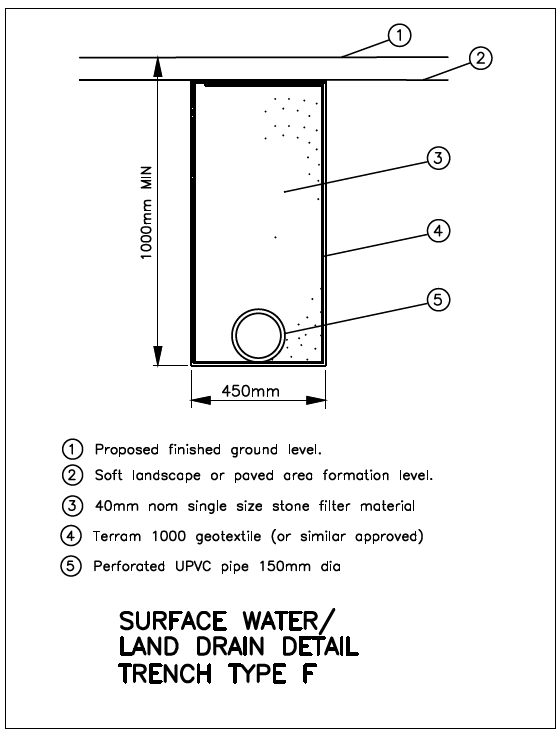
My trenches were fully lined with a geotextile membrane, and I'm on clay.
-
Mines only got an air pump, what makes the noise on yours? Is it one of those fancy Klargesters with all the moving parts to justify the premium price?
-
My 10 person treatment plant (Ensign 10 from Marsh) was under £2K. Not noisy at all, I have to bend down towards the man hole to hear the pump and check it's still running.
-
Or discharge directly to a water course (ditch, river etc.) and do away with the drainage field altogether.
-
Have you met the General Binding Rules? https://www.gov.uk/guidance/general-binding-rules-small-sewage-discharge-to-the-ground It's more difficult with a Septic Tank. It comes down to whether the system and leach field is designed to British Standard BS 6297:2007. What's made you go with a septic tank rather than a small treatment plant? Edited to add: Do you know that water table will never rise up to the surface in the area of the leach field, even temporarily after heavy rain? You could have raw sewage coming up to the surface if it does.
-
M3.5 is readily available https://www.accu.co.uk/en/countersunk-socket-head-screws/5608-SSK-M3-5-8-A4
-
A little smaller than I thought. It may be an M3 x 8mm Counter sunk Socket (Internal Hex) (but it could be an M3.5 or M4) https://www.westfieldfasteners.co.uk/Bolts-Screws-Metric/Socket-Head-Countersunk-Screw-M3x8-A2-Stainless.html You have to buy 60 from the link above, you'll likely find smaller amounts on eBay. Can you measure the thread diameter, is it 3mm, 3.5mm or 4mm?



