


IanR
-
Posts
1857 -
Joined
-
Days Won
6
Everything posted by IanR
-
With a 500l tank that would be a flow rate well above mine to deplete all the hot water in 20 mins. However, that's neither here nor there. Leaving the hot tap on full for 20 minutes is not a use case I've ever done, so even though my system could do it, it's not something its designed to do. Needing multiple 15 minute showers at 38°C is a use case used regularly, so the system is designed to cover that. And for times we have guests and there's a higher DHW demand the Hot Water is switched over to "Lux", so the tank is lifted to 55°C. I'm glad we've moved the needle, even if it is only a little. You were previously stating ASHP are for "niche" builds, and a dead technology.
-
Not sure what "20 mins full bore" would prove or dis-prove. What matters is if the heating and DHW system is designed for the worst case use in the house it's installed in. Unless our winter temps drop to -20°C for long periods, winter has no effect on the ability to produce hot water, just the efficiency it can do it at.
-
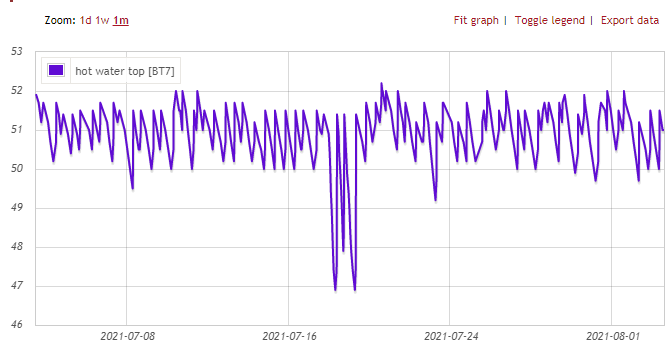
Really? you'll have to explain how you worked that out. Your bias is making you jump to incorrect conclusions. What you are seeing is an ASHP reacting to DHW usage.
-
I know you don't want to hear it, but an ASHP works perfectly for a family of 5, and as the tank temp seldom drops below 47°C, I'm turning mine down a bit to push the COP up further. Please offer some data/figures to show how it doesn't work, rather than conjecture.
-
The Government are backing Heat Pumps, and are changing the landscape to enable their mass use, so I have to disagree. Why not? works fine for my family of 5.
-
Dave, you need to look in to how Hydrogen is going to be produced in sufficient volume to heat homes. That's after it has satisfied the need for long distance HGVs, Ships and planes for which there is not an electric alternative. In short, it's not going to happen. Hydrogen will be the niche when it comes to heating homes, where using electricity is just not possible. And for those houses that have to rely on Hydrogen the costs will unfortunately be higher than electricity. No need to come around, just work it out for yourself. In my case there's 500l of water at 50°C. Nobody needs endless/limitless hot water, they just require enough to suit their needs.
-
The issue I have with Dave's statements is that we don't actually know what his issue is as he won't provide any detail of his experience. If he'd provide some detail for a discussion we might be able to help drag his head out of the sand.
-
Not sure what you are expecting the passage of time to do. He's provably incorrect now.
-
Not really, just makes a lot of ignorant statements about a subject he appears to know nothing about.
-
Welcome to the forum. Are you after Planning pitfalls with Class Q or design & engineering pitfalls for the conversion? What are you trying to achieve? Long-term home for yourself? Do you have aspirations for a Passiv Haus type build? Is there a mezzanine or are you trying to introduce one? Have you got any pictures? Is it a portal frame, with shallow pitch roof?
-
The DV1100 I mentioned is PH Certified and designed to the same standards as their domestic units, so noise levels are comparable. When the house is occupied I run it at 20% with no discernible noise and switch it down to the minimum 12% when unoccupied. I have the boost set at 55%, which is about the limit for hearing "wind" noise from the outlets, and still no noticeable noise from the unit which is in a 1st floor storage area - all my habitable space is on the ground floor. Boosting at this level clears the bathrooms relatively quickly after a shower, and stops kitchen odours travelling anywhere else in the house while cooking. I also have a purge setting that I use to help purge heat at the end of a warm day, if I can't open up the roof vents due to rain. That runs at 80%. Sound from the outlets are noticeable if you are within 2m of them and there is a light hum from the unit. I wouldn't describe it as intrusive, but I don't tend to run it for too long on this setting. Since mine is a converted cow-shed, with a 6.5m ridge height, my volume is particularly large in relation to the floor area. From memory it's about 1650m³ within the thermal envelope.
-
You could consider a small commercial unit. I have an Airflow DV1100. I understand balancing is more difficult with 2 units. I got Airflow to design my system and they were against two smaller units, plus it was cheaper to go with one slightly larger unit.
-
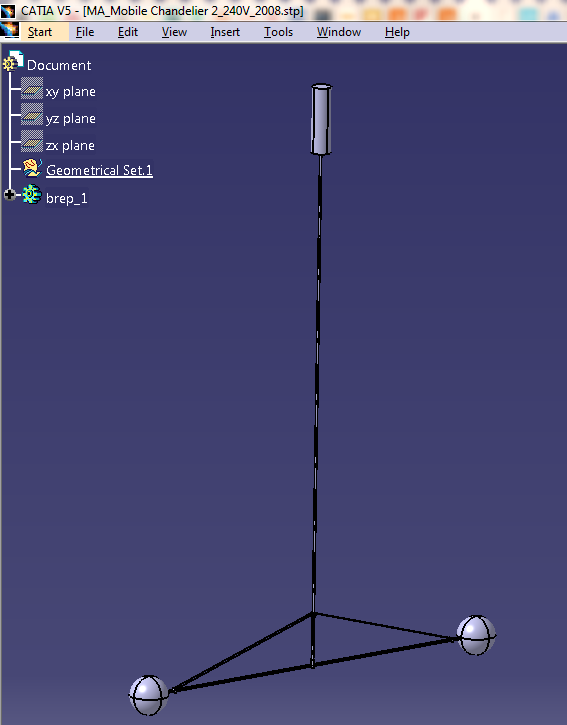
I may back away from that statement a little... The installation instructions show the horizontal tube having to be assembled to the vertical, but no wiring connections being made, so they have a trick coupling for making that joint, which includes the electrical connection, and on theirs it rotates. Really quite clever. Unless those couplings can be found as an "off-the-shelf" item, then it's likely the joint would need to be up-sized a little so that the wiring can be carried through it and into a slot in the horizontal tube.
-
They kindly supply some "basic" 3D CAD, which is helpful The drop is 2300mm. If you can find similar glass spheres on another product or available as a shade then the rest of it is easy. You do need the supporting wires, if you want it in the thin tube they are using.
-
No it won't. Heating Oil is 42p per litre and 10kWh per litre so at 90% efficiency of an Oil Boiler = 4.67p per kWh A heat pump has only got to get to an average COP 3 to be cheaper - that's pretty easy. The OP is actually using LPG, which is more expensive than Oil. That's rubbish. I've never run short of hot water with a family of 5 and a 12kW ASHP. DWH efficiency is unrelated to insulation and air-tightness, so the same for everyone.
-

Hi new member need advise on oil fired central heating system.
IanR replied to mike2020's topic in Introduce Yourself
It's not really as simple as that. At current pricing electricity is around 3.5 or 4 times the kWh cost of Gas. Gas boilers are up to 90% efficient, so if you are going to use (renewable) electricity to heat your home, you need an electric heater that is 350% to 450% efficient (averaged throughout the year), for it to have the same day-to-day running costs. With a heat pump, it is possible to achieve and exceed this. If you don't have access to gas, then the comparison to electricity is much more favourable, as you have to spend much more on every kWh of energy you purchase in the form of oil or LPG A heat pump is more efficient with a low flow temp, so larger heat emitters (UFH and large rads) and a large water cylinder, allow flow temperatures to be reduced. The lower SAP score suggests a higher energy loss due lower levels of insulation and/or poorer air-tightness. This means that proportionally larger heat emitters would be required to achieve the same low flow temperature. For UFH that would mean closer spacing of the loops, or for radiators, even larger ones. Undoubtedly a heating system can be more easily designed for low flow temperatures with a house that has a better EPC score, but that doesn't mean they can't work in a house that doesn't. The capital cost is a different matter. If you are not already planning a renovation then the cost of changing heat emitters to UFH and/or large radiators to accommodate a heat pump has to be considered. And if you are planning a renovation, insulation and air-tightness should be high on your list, so however you are heating your home you need to buy less kWh of the energy required. -
Yes, if you put an "@" in front of their name they'll get a notification that they've been mentioned. ie @Selfbuildsarah Assuming the the TF/SIPs Supplier worked in 3D CAD, ask them for the Exterior/outline models.
-
Hi and Welcome, Sketchup is the obvious option, as there is a free version. https://www.sketchup.com/plans-and-pricing#for-personal OnShape also has a free online version, but it's not quite so aligned to an Architectural work-flow (at least it wasn't the last time I used it 3 or 4 years ago), but good for Mechanical Design. https://www.onshape.com/en/products/free It will take 10's of hours (perhaps a 100) to get it modelled from scratch if you've no experience of any 3D modelling system. You could also contract someone to do it relatively cheaply at somewhere like People per hour: https://www.peopleperhour.com/services/architectural+rendering?ref=search How has your "Final Design" been created? is there a 3D (CAD) model available? It could save a lot of time if you have access to it.
-
ASHP Contractor - Hertfordshire
IanR replied to HertsSelfBuilder's topic in Air Source Heat Pumps (ASHP)
If you are going the RHI route then I'm happy to recommend who I used, who are Eco East Anglia https://ecoeastanglia.co.uk/ If you are not going RHI route there may be cheaper options, but still worth checking with them on price. -
RHI definitely puts a premium on the prices. Some of it is justified due to the MSC process requiring additional steps from the installers, some of it not. I can only see the grant going one way, so assume what replaces RHI will not be as "generous". The government will tackle new builds first and can do that mostly with stick (legislation) rather than carrot. For the existing housing stock - rentals and social housing will be first and again they can do this mostly with legislation. It's only when they get to owner-occupied that the encouragement of grants will be required and by then perhaps prices will have dropped a little for heat pumps and increased a little for fossil fuels, so the gap is much reduced that the grant needs to cover.
-
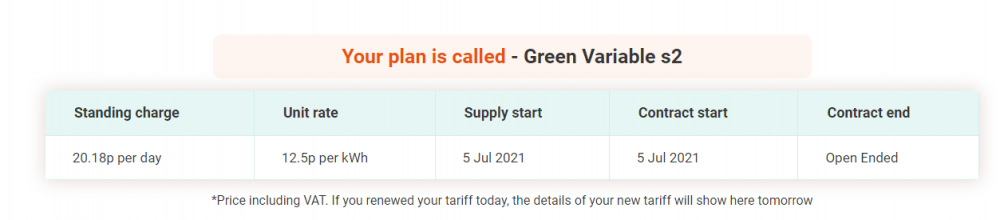
They must offer different prices across the county. Here's my current deal with PFP, it is variable, and they're offering a 12 month fixed for a few tenths more. I'm thinking it's probably wise to take the fixed deal.
-
There is the start of a plan, with the high level investment identified https://assets.publishing.service.gov.uk/government/uploads/system/uploads/attachment_data/file/945899/201216_BEIS_EWP_Command_Paper_Accessible.pdf And give them their dues, they're already delivering on the actions stated as required for 2021.
-
You'd be better off going by how much LPG the previous owner purchased per year, or paying for someone to do some detailed heat loss calcs. My experience of the EPC's created for house sales are they are a tick box exercise with lots of assumptions, so *could* be wildly out. You should be able to get far cheaper. That gets you to a level where the losses won't be too high on the UFH, and if you've already "booked" this cost, I feel the pendulum has swung in favour of going with an ASHP. The job now is to reduce heat losses to permit a smaller ASHP and reduce the install cost further, and that looks like it is already in your plans. Edited to add: You need your new ASHP heating system commissioned by 31.03.2022 as RHI is finishing. It does sound like there will be something to replace it, but no details yet.
-
I've just moved from Symbio to PFP Energy, both are charging 12.5p / kWh. Symbio are terrible though, hence my move. Have you got a link? the devil's in the detail. Currently announced was that new builds would be net-zero-carbon from 2025. There hadn't been an announcement (to my knowledge) on how they were going to encourage existing housing stock to more away from fossil fuels, only that EPC requirements were going to be ramped-up from 2028 - 2035.
-
EPC's aren't necessarily all that accurate, is that 34,500 kWh space heating demand confirmed by how much LPG you purchase in a year? LPG boilers are up to 90% efficient, so that would be around 38,500 kWh worth of LPG annually, plus what ever your DHW demand is. Unless you also have alternative heat sources, such as log burners, and then it will be difficult to calculate. Where did you get this figure from? and what does it include? Unvented cylinder, buffer, larger radiators and/or wet UFH? Hopefully that figure includes everything you need. Is that the cap now? Even with low flow temp (35°C) heating emitters? What ever heating system you go with, insulate as well as possible and make the property as airtight as possible. Ideally you'd plan for a low flow temp heating system, so if you don't go for an ASHP now, you won't be ripping it all out if you need to in 10 - 15 years. Low flow temp heating systems require ideally UFH with "good" insulation underneath and/or larger radiators plus a hot water cylinder. This I don't necessarily agree with this. I've never had LPG, but it looks like it's around 6.5p per kWh (45p/litre and 7kWh per litre). At 90% efficiency, that costing 7.2p/kWh With electricity at 12.5p/kWh, you've only got to get a COP of 2 and an ASHP is cheaper to run. You'll be far better than a COP of 2, you could probably get to a COP of between 3.5 to 4 for an average throughout the year. The lower you can get the flow temp, the more efficient the ASHP will be. Large heat emitters and large hot water cylinder means lower flow temp. How much insulation can you get under your floor? Are you considering wet UFH? Are you planning any significant renovation, or are you trying to improve insulation with minimum disruption?



