IanR
-
Posts
1857 -
Joined
-
Days Won
6
Everything posted by IanR
-
I would expect the two to be able to run in parallel, and can be on the same application, but I wouldn't count on being able to achieve it. My experience is that you need a very strong argument to redirect a PRoW. ie. examples of theft or arson and no alternative means of securing the buildings that are exposed to the PRoW. To be successful you'd also need to own the land that would contain the diverted route for the PRoW.
-
No that's unfortunately not true. An Agricultural Unit gets one allowance to convert, with no renewal. They can now convert up to 5 properties, although not more than three large (greater than 100m² floor area) and the max cumulative area converted to large properties allowable is 465m². Small properties are those with less than 100m² floor area. But, the Agricultural Unit can not benefit from Class Q PD if it has used Agricultural PD (Class A(a) or Class B(a)) since 20.03.2013, until 10 years after that PD was used.
-
Yes, Full PP is the only option. Here's an example of a successful Change of Use Application at Maldon. A bit of trading off was done, removing a couple of structures to allow another to be converted. https://cdp.maldon.gov.uk/planning/planning-documents?SDescription=20/00994/FUL Maldon do seem to make you work for an Approval. I have a feeling they'll want Stage I surveys for most things as part of the Application. Your Planning consultant needs to try and push them to pre-commencement conditions, but might not get away with it. For the Application linked to, the surveys required were: Bat and Owl (Protected species), Preliminary Ecological Appraisal and Heritage, but no contamination The recommendation was to Refuse, but it appears to have been pulled in to committee and been Approved against recommendation. I'm locallish to Maldon, and I hear they are a little difficult...
-
The first one was refused because... Q.1 Development is not permitted by Class Q if— (f)development under Class A(a) or Class B(a) of Part 6 of this Schedule (agricultural buildings and operations) has been carried out on the established agricultural unit— (i)since 20th March 2013; or (ii)where development under Class Q begins after 20th March 2023, during the period which is 10 years before the date development under Class Q begins; The second one was refused because the Council were not convinced that the subsequent splitting off of the Barn from the original Agricultural Unit that had done the Class A(a) or Class B(a) development after 20.03.2013, into a separate Agricultural Unit, had actually happened. So, in short, no barns/sheds that are part of Lower Barn Farm Agricultural unit will qualify for Change of Use to Resi, under Class Q PD, until 10 years after the date that Class A(a) or Class B(a) development was completed. Doh! Your Consultant was correct. Class Q is off the table. Edited to add: Lower Barn Farm appear to have built a Hay and Straw barn and an Implement shed, untillising Class A(a) or Class B(a) Agricultural PD between 2014 and 2016. Since this is after 20.03.2013, it starts the 10 year clock running before Class Q can be used on the Agricultural Unit.
-
I'm not sure I've understood, wouldn't you need a handy hot spring in the garden to heat a pool with a COP of 6 using a water source heat pump. Where are you moving energy from and to with this WSHP?
-
This is the only one that relates to a Class Q. Have you got the full Officer's Report to see the reasons for Refusal?
-
Have you had an outdoor pool before? Never, ever again for me. Although, mine was a '90's built Penguin pool, with an uninsulated concrete tub. So, on top of the time it took keeping it looking OK, the cost to heat was ridiculous.
-
Yes...but... I have low heat loss/gain, so for heating only require a low flow temp. For a 21°C target temp, I have around a 31°C flow temp and keep the slab at around 21.5°C. ie. the slab temp only needs to be slightly above the desired room temp. For cooling, similar offsets are required. ie. I take the slab down to around 19°C with a flow temp of around 14°C (avoiding dropping below the dew point and causing condensation problems) and it keeps the indoor temp stable. The caveat is, that with a low flow temp heating system it is slow to react, so you can't wait until it is 27°C degrees in side before taking action on cooling. And for me, because I chose to have a fair amount of glazing on south-east and south-west aspects, I need to mitigate the solar gain risk, which I've done with external shading. AC does have a quicker effect on cooling, as it works directly on the air temp, but as soon as you switch it off the temps will rise again as you are unlikely to have significantly lowered the temp of the building fabric. If I was doing mine now, with the knowledge gained from this forum, I'd be considering adding some fan chillers cooled by the ASHP to get the same quick benefit as AC, while still getting the stabilising effect of the UFH cooling. When I was asking timber frame specs, it was in relation to being an "eco build". ie. what level and type of insulation and what air tightness target. I have an I-Joist structure with 300mm walls and 350mm roof, filled with cellulose fibre insulation and sitting on an insulated raft foundation with no cold bridging, and a sub 0.1 ACH air tightness. Nothing high tech at all, nor particularly expensive, but good value for the energy losses it delivers. If you drop below 3m³/m²h @50Pa buiding regs will require you to have mechanical ventilation.
-
There's lots of knowledge on the forum regarding ASHP cooling via the UFH, and there's a few that additionally use fan chillers, cooled by the ASHP, for additional cooling in specific rooms. I have ASHP cooling via UFH and it is effective. GSHP can be more efficient than ASHP with cooling since their medium is already at a lower temperature (8°C - 10°C), so can offer cooling without the compressor running. Finding installers confident with ASHP/GSHP Cooling can be difficult. What's the spec of your timber frame? Are you going with traditional founds? have you taken any steps to mitigate cold bridging, beyond standard building regs?
-
There's more energy to be saved with the spec of the timber-frame (and foundation) than with the renewables you choose to heat it. What stage are you at? is the detail design done? Have you a view on an energy loss target for the building fabric? What spec of frame and foundation are you considering. +1 for cooling via ASHP (or GSHP if your loads justify it). AC can be avoided.
-
Hello @ukjamie and welcome "Eco" build" conjures up all sorts of options. Are you sticking with the practical "low energy" options, or venturing towards earth homes or straw bale walls and composting toilets.
-

MVHR Location Dilemma
IanR replied to Ryan Bazeley's topic in Mechanical Ventilation with Heat Recovery (MVHR)
Location 2 sounds the better location for the installation, but there are risks. Would there be insulated stud work between the back of the built-in and the MVHR? My DV1100 is within a storage area in the loft. There's 100mm of Rockwool above the ceilings and the unit is barely audible when running at a boost of 75% and you are right below it. My unit is a little over-sized so in general it doesn't boost above 65% Any ideas what sort of boost speed you will need to run at? Will you have any automation that would allow the boost to be turned down over night, just in case. I've used some flexi-ducts on the inlet and exhaust, and to the plenums. Most of the air noise comes from these. I'd stick to rigid and semi-rigid on your location 2 scenario. I'd also have a back up plan to isolate the mountings for the floor (or wall) it's mounted to if it turns out there is a resonance issue.. Bolting through some rubber blocks should be enough. -
The devil's in the detail with Class Q. From what you've put above the rejection of "other barns" is a little vague. Have you looked on the Planning Portal yourself and read the reasons for Rejection, and would that also apply to these barns? Or, has the Planning consultant given you a full explanation of why it would not work for these barns. Just make sure you are satisfied that that option is really off the table. Feel free to upload the (anonymised) Officer Report for the previous Class Q applications, to get comment on them. There has been no easing of the Class Q rules, since they were first introduced as Class MB, however it is now possible to convert a greater area of barn(s) to residential if you juggle your large (over 100m²) and small (under 100m²) houses effectively. Guidance has been added though to help LPAs be more consistent with their decisions. The alternate route your planning consultant is suggesting is certainly an option. National Planning Policy Framework rules are strongly against development in the open countryside, but there are caveats, such as "unless the development enhances the openness". Trading off existing structures in order to convert another is one of the arguments that LPAs will accept. It's quite possible that as well as the archaeological survey, the LPA will also want a contamination survey and a protected species survey. Better though that these are pre-commencement conditions rather than all having to be done up front with the application, to avoid your costs spiralling.
-
I have the same unit, although with the SMO40. I have cooling enabled on mine and when I purchased in 2017 it required an additional cooling module to be able to cool. I was also told I needed the SMO40 controller.
-
ASHP with least gubbins inside the house?
IanR replied to DenkiJidousha's topic in Air Source Heat Pumps (ASHP)
I'm guessing its space for the Sunamp/HWC and buffer that you are short of. How about the loft? Can you make space up there, even if you have to cut a larger hole to get what you need into the area. There are hot water cylinders that can be mounted horizontally. -
It's got to be more subtle than just that you're using electricity for space heating. On my EPC it lists the same ASHP and UFH (above insulation), but gives 5 stars. On the as built SAP it records the "boiler" efficiency (SEDBUK), it's got mine as 384%. I thought it might be Design Flow Temp, but on my SAP that's recorded as "unknown", so that can't be effecting it.
-
It takes about 8TB to store a months worth of recording at mine (11 Cameras). That would start to become a high monthly cost to have that storage on a cloud server, depending on how long you want recordings kept for.
-
In the cloud? That's some serious upload bandwidth you'd need. Not practical for me.
-
I've found HikVision to be reliable, and very easy to set up. I have the DS-7716NI-K4 NVR, which is 4 years old now so may well have been replaced, and a range of 4Mb to 8Mb cameras. The 7700 Series NVR has space for 4 internal HDD. I think the 7600 is similar functionality, but only space for 2 HDD. It has an integral PoE Switch that makes the camera setup very plug-n-play. If you have any cameras over 100m from the NVR then you need a PoE Switch local to the camera. There's lots of options for viewing the cameras live and recorded, either directly off the NVR with an attached screen, from PC/laptop via a web browser or phone/tablet via a few different Apps. There's probably too much choice in HikVision cameras, until you start to tune in on their model numbers and what it means. Definitely worth doing a plan view drawing of the property and work out where to best place the cameras, and what focal length lens is best for each position. Get the right camera for each location, even if that means waiting because something is not in stock. I feel the IR distance is a bit optimistic, I suggest always going for the next up for what you think you need, ie go for the 80m if you want 50m of illumination and 50m if you want 30m. Don't expect too much out of movement detection from the outside cameras, shadows from clouds and leaves will constantly give false positives. Much better to put PIRs nearby and use the alarm function on the NVR to then send you images from certain cameras when the PIR gets pinged. I use the same PIRs for cameras an outside flood lights.
-
Class Q maybe the only option, depending on how relaxed the LPA are with the re-use of redundant agricultural buildings. The ones local to me like to see some good reasons for re-using farm buildings as residential, ie. that they can't be found another use like light industrial or craft, and they want a reason proved for keeping them such as maintaining the typical scene around a farmhouse (especially if the farmhouse is listed), or the historic value. So, PP is an option, if the LPA are open to the change of use conversion, and it may open up better opportunities for a simpler conversion. The LPA's are generally more open to PP if they know you have the Class Q option. If you can go Class Q then they have little input, so are then more open to PP so that have some control over how the conversion is done and what it will look like. Class Q requires the existing owner of the Agricultural Unit to "be onside". You can't define the buildings as part of an Agricultural Unit without them agreeing to this, and as I said before they have to accept the loss of Class B Agricultural PD for 10 years and the fact the conversion of these barns uses up the Sqr meterage allowable under Class Q, so other barns still owned by the Ag unit may not be able to be converted using Class Q. It needs to be profitable and able to sustain a full time worker to be an Ag Unit (or to have previously done).
-
That's no distance in the bigger scheme of things, so sewage isn't a real problem that needs too much consideration at this stage. Do you know all the rules? have you spoken to a "professional"? It's the "Agricultural Unit" that has the PD for conversion, so not necessarily the Barns if they've already been sold away from a Farm that is still in business. Or, is the whole "Agricultural Unit" for sale, even if it's no longer functioning as a working Farm? The definitions matter with Class Q. If the barns are still part of a working farm and are yet to be parted from the Farm and sold off, the current owner needs to be part of the Class Q Submission, as it has an impact on the working Farm, ie. any further Agricultural PD (Class B) is removed from the Farm for a period of 10 years. Assuming you can meet all the rules of Class Q, you can then convert to Residential within the envelope of the existing structures. (The open front to the barn you have shown would cause an issue with some LPAs, but not with others). Most LPAs are quite strict on not extending beyond the existing envelope, so the corrugated sheeting defines your outer skin (but can obviously be replaced). This makes it difficult to then get the primary structure of the barn inside the thermal envelope, so you need to keep it outside, and build you walls inside of this structure, and dovetail the old and new to maximise internal floor area, while keeping the existing structure outside the thermal envelope. The barn shown is a very lightweight structure so will likely only have pad foundations. Your going to need some foundation structure to sit under the external walls you need to introduce, so again you'll need a new floor structure that can dovetail around the existing pad foundations and provide the support for the new external walls. All doable, but complicates and adds a little cost. A full planning application for a change of use conversion, may open up better value options where you can extend beyond the existing envelope a little and wrap the existing structure inside the thermal envelope. Edited to add: I can see from your reply, added while I was typing mine, that it appears to be the Agricultural Unit that is for sale, so the next thing to check is that these Barns were last used for Agriculture and haven't had a recent use for fixing cars or storing non-agricultural paraphernalia. Edited again to add: You mention "a few acres". Is the existing owner a farmer, farming the land and possibly renting other land, or a contract Farm worker. Oddly, barns used for contract farming aren't included within Class Q, as agricultural contracting falls outside the Agricultural Unit definition.
-
Hi @Robw85, and welcome. Is there planning in place? If not, what's the route to planning? Class Q PD? or Planning permission for a Change of Use conversion. I assume there's no chance of a knock down a rebuild, it looks very much in a rural setting. Off mains sewage is no issue with a treatment plant, especially if there's a ditch within the site that's downhill from the house. Depending on route to planning could effect the costs. While Class Q maybe the easier to achieve in planning terms, the requirements for not exceeding the existing building envelope can drive to a more expensive solution to insulate and make airtight. Either way costs are north of £2K/m² to do a reasonable job, unless you are doing much of it yourself. Tell us more about the planning route and what your aspirations are for the site. ie. long term house for yourself, low energy losses etc. etc.
-
My poured resin is straight on to the reinforced concrete slab, although my slab was power-floated. The process for the poured resin is to grind the surface to key it and expose any cracks. Clear out any loose in the cracks and fill with epoxy to stabilise. Roller on an epoxy base coat, and then pour on and trowel out the PU resin and finish with a rolled on lacquer coat. It's 3-4mm thick overall. Even our UV stable resin will show slight differences in colour where rugs are, although that difference fades when uncovered. I feel you need to get rid of the ridges for comfort and the finish will wear quickly on the high spots.
-
I used Nick Gill at Pebble Energy. https://pebble-energy.com/index.html Get a price commitment for also updating and submitting your as-built SAP, once you're finished. Some seemed to want to treat this as a "start again", but Nick was very reasonable.
-
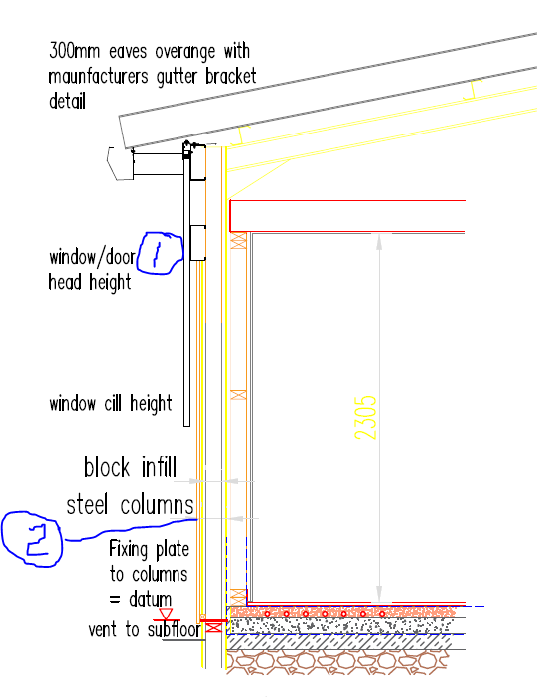
Is (1) the vertical timber cladding and (2) the proposed "New box section double-skin insulated vertical cladding"? In the upper area, behind (1), is there any insulation planned between the "C" profile beams.