


IanR
-
Posts
1857 -
Joined
-
Days Won
6
Everything posted by IanR
-

Internal solid brick wall insulation. Insulated plasterboard or what?
IanR replied to howplum's topic in Heat Insulation
There is a bit of a mix up in the units. Typical units for U Value are W/m².K . the 1.9 figure you have looks "about right" for a 9" solid wall with some plasterboard on it, so that's probably 1.9W/m².K The value you have for the Gyproc Thermaline Super looks more like a λ (lambda) value ie. Thermal Conductivity of the phenolic foam part of the composite board. The typical units for an λ value are W/m.K. But the boards are made up of gyproc wall board (λ 0.19W/mK) + the phenolic foam (λ 0.020W/mK). If you wanted to workout the thermal resistance (R value) of the whole board thickness, you need to divide each material's thickness in meters, by its λ value to get its R value, and add the R values together. Typical units for R are m².K/W For the 50mm thick Gyproc Thermaline then, that's (0.012 / 0.19) + (0.038 / 0.020 ) = 1.96 m².K/W (I've assumed 12mm gyproc and therefore 38mm phenolic foam) To get to the U value, you need to 1 / (sum of the R values). For the Thermaline on it's own that means the U vlaue is 1/1.96 = 0.51 W/m².K But to see how this effects your wall if added on, then you need to revert the wall's U value to it's R value ie. 1/1.9 = 0.53 W/m².K And then to get the total U Value of the new wall build up: 1 / ( R of original wall + R of the Thermaline), so 1/ (0.51 + 0.53) = 0.96W/m².K Edited to add: There are online calculators to make this easier https://www.ubakus.com/ -
For someone looking for low energy losses, but not wishing to go as far as PassivHaus type measures then 3m³/m².H @50 Pa is the sweet spot. (I've changed units from ACH as "m³/m².H @50 Pa" this is what Building Regs uses) In England at least, if you drop below this level then Building Regs require you to provide mechanical ventilation, which you're not going to benefit from unless you go significantly below this threshold.
-
There was lots of chat on this 10 years ago or so. iirc the consensus then was to use silver-lined pipes to avoid health issues related to mould growth. Not sure what the current thinking is, but do your research, it could be a breeding ground for mould.
-
Installation Deadline for ASHP for RHI
IanR replied to Andeh's topic in Air Source Heat Pumps (ASHP)
ASHP cooling is allowed on RHI. Rules changed at the end of 2017. Although many installers seem to be unaware. -
Installation Deadline for ASHP for RHI
IanR replied to Andeh's topic in Air Source Heat Pumps (ASHP)
You have to submit your paperwork by midnight 31.03.2022. To get all the paperwork together the system will need to have been commissioned and the invoice paid. -
Heading to auction. Perhaps someone is in a rush to sell. https://auctioneertemplates.eigroup.co.uk/auctioneers/ded/lot-details.html?lid=149337&ClientID=33&lad=Stebbing-Road-CM6-3LG
-
U-value for Ashlar Bath Stone & brick Walls
IanR replied to Geoff-Belgraver's topic in Heat Insulation
You've put 20mm for plaster, so perhaps there is a plaster board? If it's foil backed it resolves the condensation 100%. If not foil-backed it helps a little and pushes the surface condensation to only when it is below 0°C outside, and with an 8.5 hour decrement delay it's got to stay below 0 for 8.5 hours before the inner surface drops below the dew point. You may also have the inside temp lower than the 20°C I've shown and generally have a lower RHI than shown, which will all help avoid surface condensation. Plasterboard also brings the U Value down to just under 2 W/m²K -
U-value for Ashlar Bath Stone & brick Walls
IanR replied to Geoff-Belgraver's topic in Heat Insulation
You've not mentioned a plasterboard, so I have assumed a rough coat straight on the brick then a finish coat on top. U= 2.222 W/m²K - It's not looking great for condensation (surface & interstitial ) at low outside temperatures. It's surprising how much improvement on the U Value a relatively thin insulated plasterboard achieves, and removes any condensation risk. U = 0.672 W/m²K Calcs from https://www.ubakus.com/en/r-value-calculator/?

-
Planning refused: entrance deemed too grand!
IanR replied to albion2021's topic in Planning Permission
I feel the Planning officer has a romantic notion of the "open countryside" and does not appreciate that in private ownership it needs to metaphorically earn its crust. It is unreasonable to expect a paddock to be open to an access track - there are 101 reasons why that wouldn't be acceptable, and it is unreasonable to categorise the open countryside as absent of fences and suggest that they are contrary to the intrinsic character and beauty of the countryside. It is also unreasonable to label post and rail fencing as "ranch type" suggesting it is alien to the UK countryside, being of a type only used on large North American horse and cattle ranches. I'd include the agriculturally typical post and rail in your Reserved Matters application and set your argument out. I can't imagine they'll refuse on that basis as I don't feel their position is defensible on appeal. Maybe an approach on the garden is to split what you currently have proposed into a smaller garden, close to the house and then the rest as an area of amenity land. It still allows you a residential use, but restricts the area that is considered as residential curtiledge, so from the LPA perspective it keeps the residential paraphernalia (sheds, rubbish bins, clothes lines, hard landscaping etc.) closer to the dwellinghouse. -
Planning refused: entrance deemed too grand!
IanR replied to albion2021's topic in Planning Permission
Congratulations! There's a sniff of over-reach there. They will have given a justification for this in the Officer's report. This may be able to be challenged if they do not have a good justification. Yes, the conditions only cover the planning unit defined by the red boundary on your application. If the red boundary defined the track, then that does suggest there is nothing stopping you fencing the neighbouring field, from the track. -
@Robw85 Thought this may be of interest, if you've not seen it already. A little North of Lower Barn Farm, and under the Uttlesford LPA, which by all accounts are a lot more relaxed on Change of Use PD/Applications. https://www.rightmove.co.uk/properties/113649239#/?channel=RES_BUY https://publicaccess.uttlesford.gov.uk/online-applications/applicationDetails.do?activeTab=summary&keyVal=QUPD1TQN01O00
-
I'll add a mention for an Insulated Raft foundation. Most "manufacturer's" of these will claim they are cost effective compared to traditional foundations due to the shallower dig, less concrete used and no need for a separate screed. I can't vouch for those claims as I never costed a traditional foundation, but went this route for my build due to the higher thermal performance. They are suitable for most ground conditions, down to quite low bearing capacity. An insulated raft for a timber structure is the simplest (cheapest) of the options, and gives the best opportunity for removing all floor to ground cold bridges. Having a masonry outer skin, or ICF build adds a little complication and cost to an insulated raft due to the likely need for a second, separated ring beam around the periphery of the raft to take the extra weight.
-
I like the wide door option, but what angle can you open them too? Ie. Is the frame set flush with the outer face of the wall so you can almost get them to 180. With the side lights you should be able to open them right up even if recessed into the reveal.
-
3G shouldn't be double the price of 2G, if all else is equal. I'd recommend 3G, if aspiring to PH levels of energy loss, ideally with triple air seals to assist in air tightness. Alu-clad will help the durability of the frames (giving a 60 - 80 year life), and certainly shouldn't be failing after 10 years.
-
Yes, definitely chase to get an indication of what issues, if any, they have with you application. Might give you an opportunity to make minor changes and avoid a rejection.
-
Couldn't agree more. There's no need for the additional complication, standing charge, service costs. I personally wouldn't consider keeping the Gas Boiler, based on what you have said. Your Gas boiler didn't require a backup system in case of failure, so neither would an ASHP. That brings RHI back in to play, if you can get the property to an EPC C. Victorian or not, as long as not listed, there has to be options. ASHP generally range from 2.5 to 5.0 SCOP. To get towards the upper level you'll need a space heating flow temp of 35 degrees. I think having a huge thermal store works against the ASHP. Trying to fill it up in 9 hours at 15kW, rather than heat the house directly at 5.4kWh makes for an inefficient (higher temps and large standing losses) and an unnecessarily large system.
-
What's the issue making you retain the Gas Boiler? What SCOP do you have estimated for the ASHP, that gives rise to issues with the anticipated electricity costs? 6m³ hot water tank, 6000l, really? Is this just for a domestic property or is there more to this install? Loose the Gas Boiler?
-
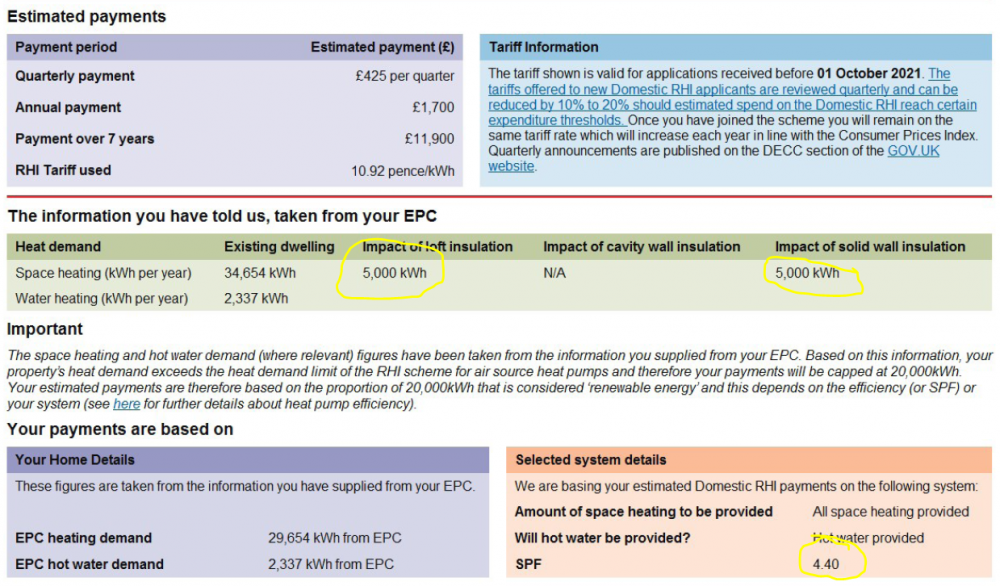
With 16kW, you'll have no issue with heat-up time on the cylinder, so go larger if you can fit it in. The larger it is the lower you can drop the temperature and the more efficient the ASHP will run. You can work out your own RHI payments: https://renewable-heat-calculator.service.gov.uk/StartCalculation.aspx I've plugged your figures in below and have guessed the improvement expected from loft and wall insulation. When you do it, remember to change the SCOP from the default 2.6. It makes a big difference. I think the F2040-16 has a SCOP of 4.48 Edited to add: 4.4 SCOP relies on an emitter size that allows a 35°C Flow temp.
-
Nibe are a very good heat pump manufacturer, and their prices tend to be a little higher than the direct competition. I have the 12kW F2040, so not sure how much more the 16kW is. (I remember it was an extra £400 ish from the 8kW -> 12kW). To my 2017 pricing (which shouldn't have gone up much for ASHPs) I'd say you're quote is around £2K - £2.5K more than I was charged. Edited to add: That's a small UVC for ASHP size. Is your space heating requirement driving the size rather than DHW requirement?
-
You seem to have posted this question twice. I answered over here:
-
You could get the MVHR system designed and supplied, and install yourself or by your builder, or Project Manager. They're not difficult to install if they've been designed along with your house. Airflow will do your design free of charge and give you the bill of materials to then take to all their distributors to achieve the best price. There are single units that will easily deal with your size of property, although volume is more important that floor area. I have an Airflow DV1100 for my 421m², 1650m³ property and it's oversized by quite a factor. Airflow class it as a small commercial unit, but it's made to the same standards as their domestic units, is PH Certified with pollen filters etc. I remember Paul also do MVHRs that were more than large enough for my place and I'm sure there are others. If you do want to hand it over to someone else to design and install, then I'd try Mango Projects Ltd. https://mango-projects.co.uk/ I haven't used this company (it's a recent venture), but the people involved were all involved with my build. I see little point in MVHR unless you are targeting better than 3m³/m².h @50Pa air tightness. But if you are, then for building regs you have to have a centralised mechanical ventilation, so it might as well be heat recovering.
-
I used Dr. Rod Williams at Williams Energy Design https://passivehouse-international.org/memberSearchDetails.php?member_id=2349 It was a great experience for me and helped make a number of design decisions. Really highlights where the money is best spent for maximum effect.
-
As it is very Important to you don't leave it to guesswork, get your house design thermally modelled. PHPP would really help with this aspect, even if not considering achieving PassivHaus levels of energy loss. External venetians and roller blinds have large head boxes. They are best "designed in" to the building fabric, they're not such a good look as a retrofit.
-
By full Change of Use Planning Application.
-
It's unlikely the LPA would allow PP for something larger than what is already there. Most Barns are within countryside, so LPA's have to follow the NPPF to not allow development in the countryside unless it improves the openness of the countryside. The Class Q permits the Change of Use, so it's then down to convincing the LPA that a knock-down and rebuild would lead to a better house (performance, layout, sustainability) and an improved setting (higher quality materials, less visually intrusive). I can't see a larger volume, or one that is not in keeping (non-agricultural in form and materials) improving the setting, so I'd think they are not options.





