IanR
-
Posts
1857 -
Joined
-
Days Won
6
Everything posted by IanR
-
I have a concern for the supply side. The BUS scheme hasn't been a sufficient incentive to accelerate the ASHP uptake, so the UK is not yet on the right path to meet 200K ASHP installs a year by 2025. With the sheds starting to offer ASHP packages that your local plumber can buy over the counter is an encouraging change, but there still needs to be someone in the process that's preparing a basic heat loss calculation and ensuring the ASHP is sized correctly. Perhaps that will come with Building Regs changes for the FHS. Then we need to see a ramp up of the supply chain, prior to rules change, otherwise there's going to be shortages, and houses that can't be finished as there's no heating system installed.
-
I see No.10 has tidied up their press release relating to Rishi's Net Zero "re-commitment". There is no mention of any delay or watering down of the Future Homes Standard: Ref. https://www.gov.uk/government/news/pm-recommits-uk-to-net-zero-by-2050-and-pledges-a-fairer-path-to-achieving-target-to-ease-the-financial-burden-on-british-families It looks to me that the plan to deny new builds a connection to the gas grid and require a non fossil fuel boiler, from 2025, remains in place for now.
-
Hmm. Actually, I'm blaming the gas industry. The heating industry (boiler manufacturers) are the fools for trying to jump on the bandwagon and sell something that is of no use to their customers. The 80/20 proposal was attempted to be sold to the government as a stepping stone to a 100% green hydrogen gas grid, for heating domestic buildings. The 80/20 stepping stone only delivers a 6% reduction in CO2, at the boiler, however, since there is no green hydrogen available, even in the medium term, for domestic heating. It would be, at best, grey hydrogen (made from gas) or worse, black/brown hydrogen, made from coal, which are the current cost effective ways of producing hydrogen. Due to the processing inefficiencies, the manufacture of such hydrogen gives off far more CO2 than the 6% gas that's being saved by the 80/20 mix. The 80/20 proposal therefore increases CO2. Since the argument is now lost for the 100% green hydrogen, gas grid, just on the basis of the cost of green hydrogen, the 80/20 stepping stone is a pretty pointless adventure.
-
Because there's no ban yet, and those new connections today may continue to buy gas until their boilers are irreparable post-2035. Then the heating industry are fools. 80/20 gas/hydrogen mix was an attempt to bluff the government. Thankfully it has now as good as failed. Yes, the point is often missed that changes now are only in preparation for Net Zero. And while they will immediately deliver a CO2 reduction, which is positive for the 2030 and 2035 targets, it won't actually be Net Zero until some point in the 2040's.
-
Then they need to get their heads out of the sand, it was announced and widely reported on in 2019.
-
I'd read that piece last week, and I don't feel it's saying that. It's a lot of Tory bashing, predicting further back-tracking, but the statement from the Minister for Energy Efficiency:
-
I don't that that is true, nor has it every been. Blimey, considering we're a pretty well informed community on this subject, even this collective are confused about what's happening. (me included) So, the Future Homes Standard, due to come into Buildings Regs 2025 mandates an 80% reduction in CO2 from our new housing, and a non-Fossil Fuel heating system in order to do so. I've not heard that the FHS has been delayed or watered down. Could anyone please post a link if there is a suggestion it has. In Rishi's speech, I was only aware of the plan for EPC improvements for private rentals being delayed and the ban on replacement Fossil Fuel boilers, for off-gas-grid properties, being delayed from 2026 to 2035 (aligning it with the rest of the housing stock). If that's the case, the requirement for non-FF heating systems for new builds from 2025 remains. - If I've missed an announcement to the contrary, please post a link. Heat pumps won't be compulsory, but Fossil Fuel heating systems may be outlawed, for new builds, from 2025. If you are rural, you may be able to use bio-mass (it's not clear on what the rules will be that will allow this, "in some cases") and there's an ongoing argument regarding bio-fuels. However, for most new homes, a heat pump would be the most cost effective option.
-
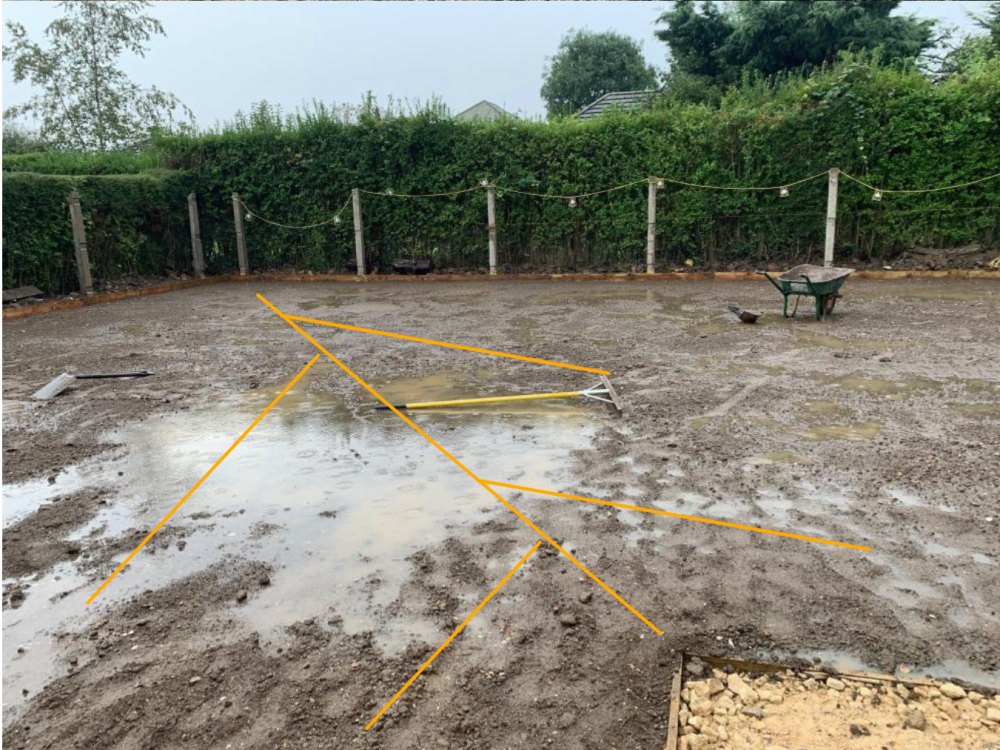
How about another silver birch in the middle of your yellow circle, that should reduce the issue for most of the year. Otherwise you need to put in some small scale land drains. Assuming the soakaways aren't full and the water pooling is due to the slow movement of water through the sub-soil to the soakaway. From your explanation, if the soakaway is in the corner then a 150mm wide trench to the corner, with some branches off to capture the whole area should do a good job. You could get away with Ø50 perforated land drain pipe set in shingle. The trenches around 350mm - 400mm deep. Put 75mm of shingle in, then lay the pipe in and add more shingle on top, stopping it around 75mm from the surface. Ideally you'd line the trench with a geotextile material, and fold it over on top of the shingle, then the drains won't clog up over time with silt. At the very least cover the top of the shingle with a strip of geo textile and then back fill with top soil.
-
And if you are coming to that conclusion without costing both on the same job, then that's quite possibly confirmation bias. For you, maybe traditional founds would be more cost effective, maybe you have a network in place that helps deliver that cost effectively. Without a network in place, I costed both options for bringing in the required trades and materials. If you think about it though, like for like, an insulated raft is going to be cost effective, unless someone's adding on a big margin. There's less dig, less concrete (and or no block and beam), maybe more steel, but nothing exotic, cheaper insulation (EPS in lieu of PIR/PUR) and no screed. But, you do need to pay an SE to Engineer the foundation system. Yep, all the manufacturers do of course say their product is better performing, but I'm talking about calculating the thermal performance for PHPP. There's a lot to do to a traditional foundation to get it close to being thermal bridge free, but for an insulated raft it's inherent in the design. ie. the exterior walls are sitting on the raft, which is insulated from the ground. While insulated rafts remain niche in the UK, they are more-or-less standard in Sweden. It's a well proven technology.
-
Is the trench with 50mm stone not capturing the ground water and taking it away to the nearby ditch? If it was only taking away the surface water then a surface drain would haven been sufficient. If ground water doesn't move through clay then French drains would not work in clay (apart from removing surface water). The biggest yield improvement we saw on our arable farm, which is/was on Essex clay, was when we started mole draining in the late eighties. That wouldn't work either, if ground water didn't move through clay.
-
I appreciate you do not understand this system. It's disappointing that your lack of experience with it would have you challenging the knowledge of the Structural Engineers designing the system, rather than considering your knowledge is incomplete. It does. Seen it with my own eyes. Had I not been sure I would have caveated my response. No, that would put the DPM at risk. FFL would typically be 150mm above GL, so 350mm - 450mm The water table at my old house was 100mm below the garden level, unless it had recently rained. You are coming across as if you are. "Ultra-cautious" would be opting for a 250mm reinforced raft with loads of steel, and spending a client's money on unrequired concrete & steel and extra dig depth. If you take some time to look into insulated rafts you'll actually find that they are, in most cases, Engineered for the actual loads they take and the ground they are sitting on. The one system that does follow more of a "one-size fits all" approach is the Isoquick system that is the subject of this thread, but it still out performs traditional foundations and is comparable in price (when apples are compared with apples).
-
If there's either water moving through seams in the clay, (after rain) or a high water table, which brings the water up to the EPS level, then water would move between the sub-base and the EPS and in between the EPS layers (below the DPM). The EPS under the ring beams will likely be around 500mm - 600mm below FFL, and for the majority of the floor area around 400mm below FFL. There are quite a few companies now Engineering these insulated rafts, and (at least when I looked) they were all using a similar build-up.
-
The "no fines" pea shingle or granite chippings are there to be free draining and the French drain is to lower the water table so the bed the EPS is sitting on is kept dry. If the EPS is sitting in water (up to the DPM) then its been thermally bypassed. ie. if you have 3 layers of 100mm thick EPS and the DPM is between the bottom two, with the water table above the lower layer, then you've effectively only got 200mm EPS.
-
There's no harm in zoning. Houses are a thermally dynamic environment, effected in different areas by solar gain, occupancy levels, open windows etc. Zoning reduces the effects across the house from a change in one area and provides better control to have different areas at different temperatures, ie. bedrooms v. living spaces. Be aware though, if you use zoning to significantly drop the temperature of, say, an unused area, then this may cause your heating system to be less efficient due to it running at a higher flow temp, and end up costing more to run.
-

Airflow Airflex or Zehnder Comfotube?
IanR replied to Jambutty's topic in Mechanical Ventilation with Heat Recovery (MVHR)
I've used Airflow Airflex, with Airflow manifolds, terminals, joints etc and all went together very well. Best price I could find was via Travis Perkins. They're a distributor for Airflow, but don't seem to know anything about what they're selling, so you need to give them all the part numbers for what you want. -
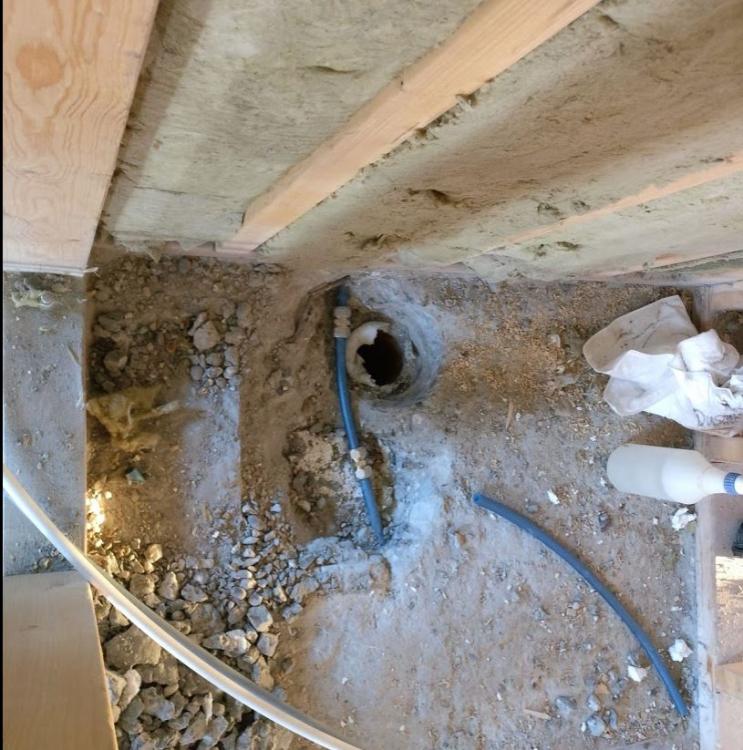
Can't say it's best practice, but what worked for me was cutting out the damaged pipe and inserting a new piece with some couplers. I was sure the UFH pipes were nowhere near the shower wastes, so was confident cutting around them to make space for the trap. I guess you can't keep your eye on a couple of km of UFH pipes....
-
ITVX has just started Live channels. More 4 streams the C4 channels Live also. Due for launch next year is Freely, which will be Freeview/FreeSat channels streamed without an aerial. You're not tied to Loxone's own products. Although, if planning to go with some/all 24v lighting it may be less painful to stick with their lighting and power supplies. I had all sorts of trouble matching 3rd party power supplies to 3rd part 24v lighting. Loxone is competitive on price, but can get expensive if you get carried away. For me I avoided separate controllers for UFH (heat & cool), Roof vents, MVHR, external blinds and use Loxone for my alarm (can't be used for police/fire connection) which went some way to offsetting the initial outlay for the Loxone kit. But, then you start adding motion sensors (with light sensors) in all rooms and touch switches with temp sensors and costs do start to mount up. You may want more than 2 CAT6 to some TV's. ie. for games consoles, active speakers, android boxes etc. I'd also stick PoE to at least one position for a landline (VOIP) phone base station. Although having said that I've just switched to a Wi-Fi VOIP handset and that's very good, but would be more expensive if you want multiple handsets.
-
Yep, you are right. Edited to add: The Planning App records it as "Core 10" roof panels. There or there abouts. Venetian polished?
-
It's an isolated plot, there's no pavement on the main road it connects to, public transport is unlikely to be used, IMHO not sustainable for additional smaller houses. The LPA have allowed a significant size increase of an old cottage, to a similar size as its neighbour, but in an agricultural vernacular aligned to its setting. Good job done by Architect and LPA.
-
Love it, although the Corten is not for me.
-
If you are selling, then I'd stick with a 7kW charger, as a 22kW charger is not "yet" likely to be valued by a purchaser. Battery sizes are increasing and will settle in the 100kWh - 150kWh range for passenger cars. For typical small vans (Vito/Transit Custom/Transporter), as the BEV versions come out they will be in this range already and needing to increase to the 200kWh level to achieve similar performance to the current ICE variants. Families will also have multiple EVs on the driveway. Then there's the wish to monetise the battery in the EV with V2H technologies.
-
There isn't one answer. It depends on what you are including in you economic comparison. Just day-to-day costs? Including installation? Including maintenance? Lifetime costs? As a broad fuel cost comparison per kWh: Fuel Energy price per kWh (p) Efficiency % Heat price per kWH (p) Natural Gas 8.0 85 9.4 Oil 9.0 85 10.6 LPG 8.7 85 10.2 Wood Pellet 13.8 85 16.2 Coal 8.9 80 11.1 Direct Electricity 30.0 100 30.0 Low efficiency ASHP 30.0 250 12.0 High efficiency ASHP 30.0 400 7.5 I took the energy prices off Energy Savings Trust national average on 1st July 2023 - https://energysavingtrust.org.uk/about-us/our-data/ There's not much to separate Gas, Oil, LPG and ASHP (I'm ignoring coal) With the benefit of a £7.5K BUS grant for the ASHP, I'd expect installation costs to be similar (assuming same heat emitters), with ASHP possibly being the cheapest. If it's a forever home, maybe you should consider the ease of a replacement boiler after 2035, when FF boilers will not be available. ie. whatever you go with now should be ready for a low temperature system and at least space for a UVC, positioned close to where you would site the ASHP. When it comes to the other side of the economic calculation, the amount of energy used, there you can make a much bigger difference. Building to current building regs you'd likely be in the order of 50-60kWh/m² per year energy use for your space heating. It's quite easy with some care and attention and not too much additional expense to halve that.
-
That's how I'm reading it. Hopefully some updated policy documents will be published soon.
-
Off (gas) grid is the term the government use for those properties that can't connect to the gas network. Oil, coal and LPG replacements were to be outlawed from 2026, biomass would still be aloud in certain circumstances. Replacement on grid gas was to be outlawed (and still is) from 2035 From 2025 new builds are not to be connected to the gas network.
-
What's the actual change on "boilers"? From the BBC: It was only the replacement of off-grid fossil fuel boilers that was to be outlawed from 2026. Looks like these have just come in line with on-grid gas boilers. ...and a 50% increase in the BUS grant for ASHP.