


IanR
-
Posts
1857 -
Joined
-
Days Won
6
Everything posted by IanR
-

Cyclo electric boiler?
IanR replied to Adsibob's topic in Energy Efficient & Sustainable Design Concepts
-
Hi & welcome. Could you paste the Planning conditions that restrict the barn to Agricultural Use, and the related reason for refusal, from the Officer's Report. "Isolated" doesn't get defined in the NPPF, so there's been a few arguments over its definition. It now seems to be accepted though that the "Braintree" decision at the Appeals Court has settled it for now. https://www.bailii.org/ew/cases/EWCA/Civ/2018/610.html Lindblom J said: “Simply differentiates between the development of housing within a settlement - or village - and new dwellings that would be ‘isolated’ in the sense of being separate or remote from a settlement”. Ie. a site is either within a built settlement (town, village, parish, hamlet) or it's isolated.
-
From the info you've provided, it's difficult to tell. Even if working correctly, the buffer temp at its centre will be cycling between flow and return temp, and there may be some lag in the Temp the sensor is reading as it's likely to be placed in a pocket on the buffer and not within the water itself. What's your distance between ASHP and Buffer? Is much of that distance outside? and how well insulated are the pipes? I'm trying to gauge what your losses may be. Since the HP is set to switch off at an LWT of 40°C, a well designed 4P Buffer would be almost fully charged at the point the LWT temp hits 40°, so the centre of the tank should show close to 40°C (ie. 40°C - losses in flow pipe), once the pocket and sensor have stabilised and as long as the heating circuit isn't circulating at that point. If the heating circuit is circulating the buffer will discharge and the temp will drop. At what point were you measuring the 31°C temp? and was it stable at that temp for say 10 mins? Your DHW is controlled differently, ie, by a temp sensor in the tank, or perhaps the return temp, so the HP LWT will exceed the UVC set point until it's temp requirement is met (potentially masking any losses in the flow/return pipes). The temp of the water in the UVC is also likely to be less transient than the buffer temp, so the gauge is more likely giving stable/accurate readings.
-
That's exactly my situation. A 6kW ASHP would easily cover my heating requirement, but I have a 12kW HP for faster DHW reheat times (500l UVC). I therefore have a 200l 4 port Buffer in my install.
-
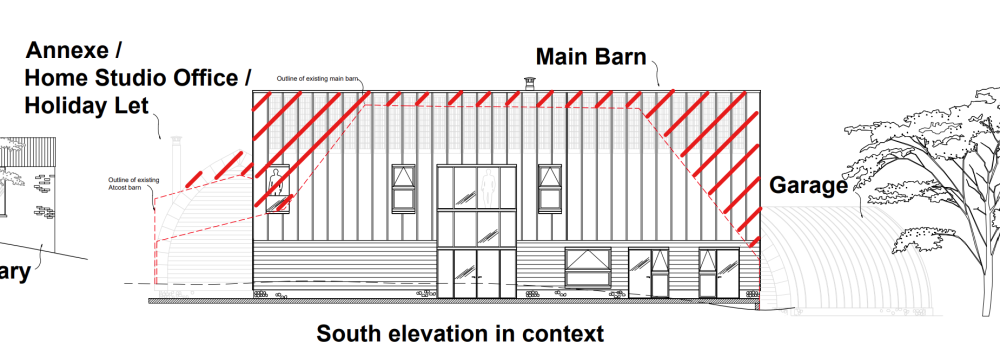
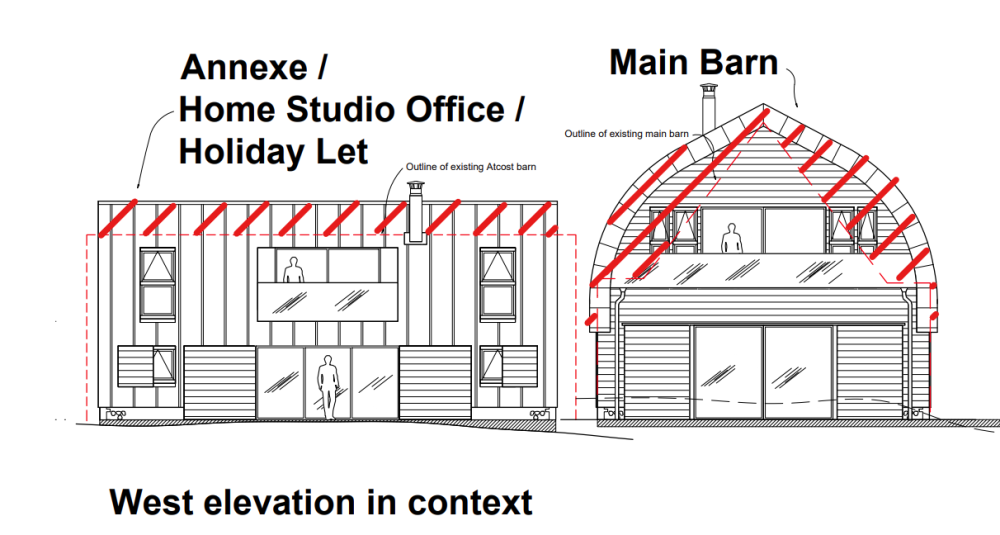
Sorry to hear the outcome, it's a long wait to hear a rejection and then feel you are starting again. I didn't want to post previously and bring negative comments about your scheme just as you were going to committee. I did feel however it is over-developed for the plot, and I know my LPA would have rejected it out of hand against their interpretation of the NPPF rules. My feeling was that you had overdone the massing and scale with your proposal, and not traded off anything else within the site to mitigate it. The extra width on front and side elevations, to achieve a full height second floor, does lead to a tangible increase in massing that I feel would be considered as harmful to the openness of the countryside by most LPAs. I've not watched the linked videos or read the Officer's report, so perhaps they've not rejected it on that basis, but it stood out to me. To get around those rules you are in Para 80 (e) territory, where you need to demonstrate: Which is a high bar to pass.
-
Hi and welcome, Assuming you are not considering fossil fuels or Biomass(?), then your energy usage does suggest ASHP is the best option. Say your SCOP is around 4, then a direct electric solution is going to require 12,000kWh a year, so your heating and DHW will be around £3,600/yr on a standard tariff. Can you move the ASHP a little further away from your back door?
-
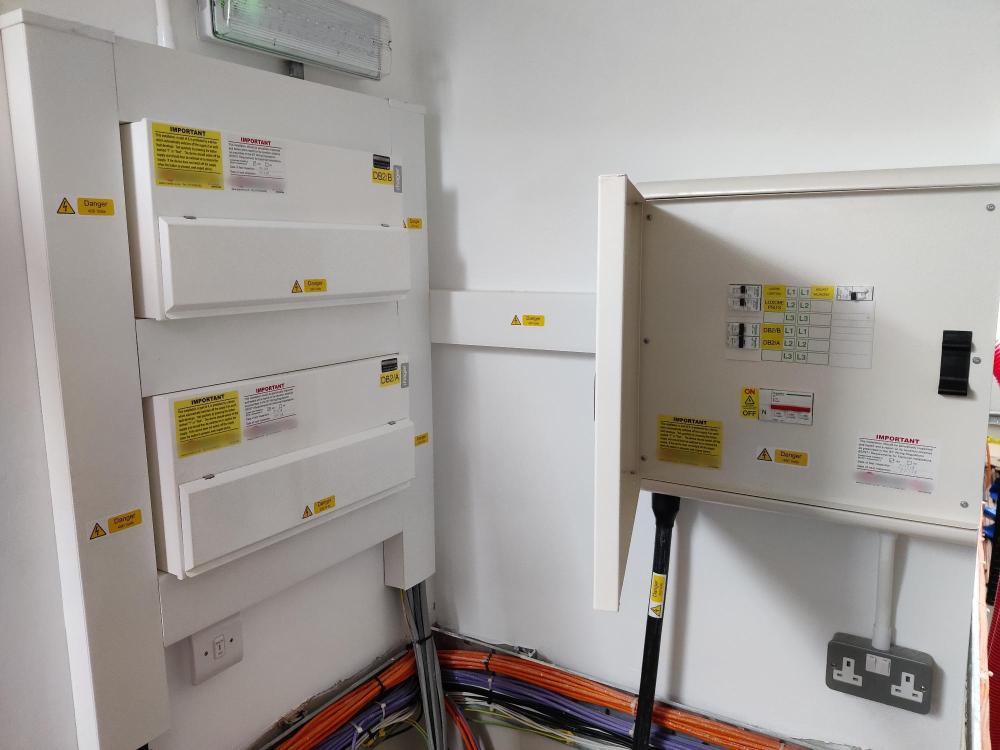
Mines a 100A Supply, but similar to the above unit, and feeding 2 phases within the house. Picture to visualise:
-
I'm using Yay.com They do a free 14 day trial. iirc it was around £25 to port a number. I'm impressed with the service, even for their lowest cost option. Loads of storage for voicemail and call recording. The voice-to-text transcripts are pretty good too that gets emailed and stored on the account, when voicemails are left.
-
It's just a smaller OD, so 20mm less insulation all round. The equivalent Rehau product to that is the Rauthermex 32mm+32mm/111m
-
That's good to know. Advanced Foundation Technology Ltd. did gain European Certification (ETA / EOTA) for their foundation system a few years back, which Building Control accept, so reduces the paperwork needed for sign off.
-
What size ASHP? You'll be safe if you go with Ø32 pipe, but maybe you could go smaller. If you plan to run these in through a duct later though then how are you going to insulate them? You should get in something like Rauvitherm pre-insulated twin duct from Rehau. The 32/150 duo is pretty well insulated, but needs a deep trench due to the minimum bend radii. Most SE specify that the pipes/ducting must come up vertically through the raft. iirc the 32/150 Duo needs a 750mm deep trench (below insulation) in order to get it coming vertical through the raft.
-
Loxone iPad Wall Mount Back Box
IanR replied to Thorfun's topic in Networks, AV, Security & Automation
For us there's an ideal location between kitchen and family room area that wouldn't be used for anything else, and it does get used for other things it's just the Loxone use is less than I expected. It's handy to have several Apps running on it constantly so it's quick to switch between CCTV, Loxone, YouTube Music, VoIP phone account for checking voicemails, a household Google Calendar (with everyone's individual schedules in one place), shopping list, Google Keep etc. etc. I did think I'd end up running it on Android, but Windows has proved to be flexible enough to cover everything we want. -
Loxone iPad Wall Mount Back Box
IanR replied to Thorfun's topic in Networks, AV, Security & Automation
Slightly different approach for me. I hung a touchscreen on its Vesa mount, in a recess and powered it with a Windows NUC behind the flush door below the Touch tree "switches" I use it a lot less than expected, as Loxone runs itself, so the screen is usually showing CCTV or being used to cast music etc.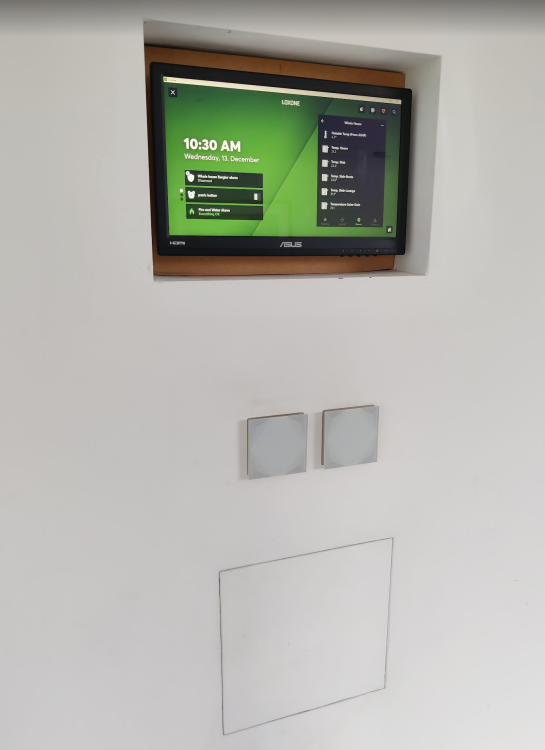
-
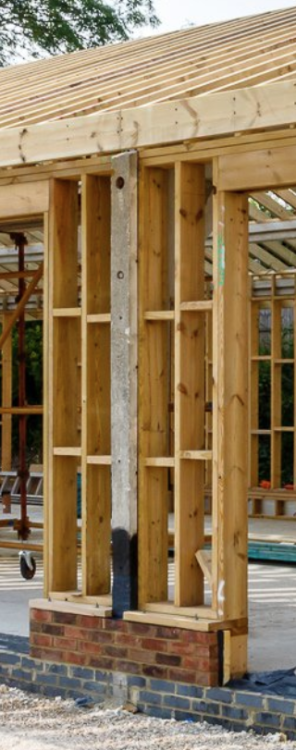
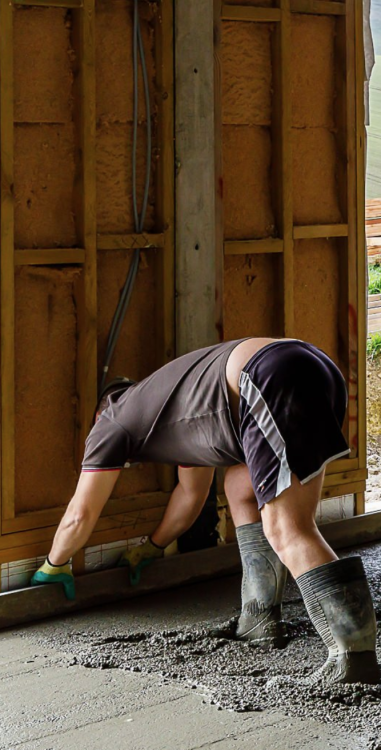
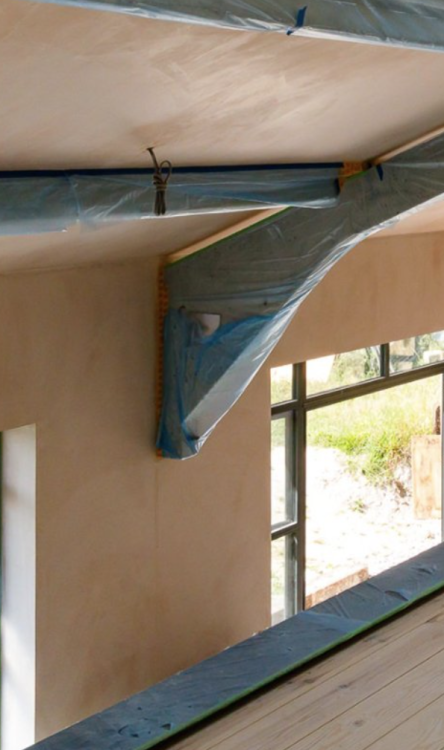
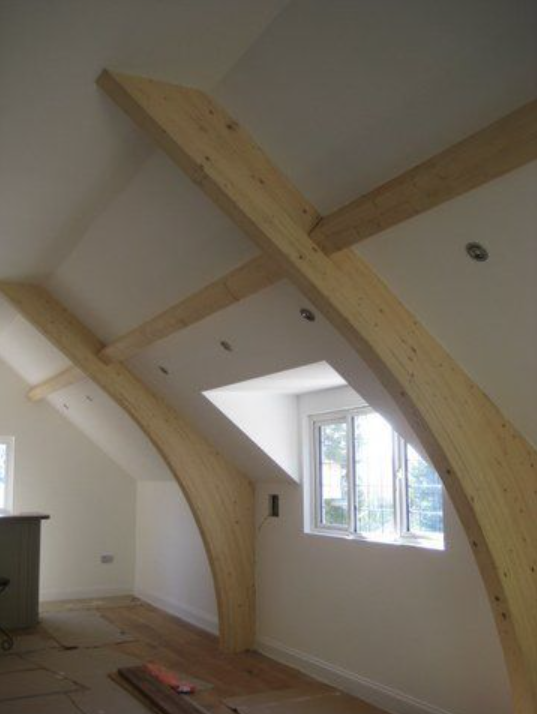
The example you linked to shows one of the compromises you'll need consider. The depth of the column is, on this build, greater than the thickness of the wall, so the plasterboard adjacent to the column has no insulation behind it and in January will be sitting a few mm off a concrete column that will be close to 0°C. And those exposed roof portals are attached to that column drawing out the heat from inside the building and possibly compensating. I do also like the industrial look this gives, but for me I'd want bring the portal frame within the thermal envelope and get a reasonable thickness of insulation around the outside. I'd then just live with the cold bridge from the base of the column to its concrete pad, as long as I kept warm moist air away from the lower parts of the column. When following PH principles, once you've added sufficient insulation and got the air tightness within target, the cold bridges are where you will leak your energy. Like for like, it has to be cheaper. You could perhaps spend some of the money you save on a Glulam portal frame to give a similar (but less industrial) internal appearance. ...and park them inside the thermal envelope.
-
That likely gives a little more freedom than a Class Q would do, but... The planning ties you down to what's in the submitted drawings. It's normal for the primary structure to be retained for a "Conversion", and as the planning included a structural survey my guess is that it's been stated the structure is capable of conversion and has been shown on the submitted drawings. Are the purlins also shown and are they called out as the original ones to be kept? On the submitted drawings, how much space has been provided from the outside face of the concrete portal frame to the outside of the rain screen for the walls and roof? Are all the columns within the external walls, or are there any that come down internally within the building, ie. is there a lean-too on any part of the portal frame that then positions the columns internally? The Columns of the portal frame are attached to concrete pads in the ground, which will sit at 8°C - 10° all year round, so the base of the columns will also be at that temperature. While reinforced concrete has a lower thermal conductivity than Steel, the columns will still act as a heat sink if they are exposed to the internal house temp and be a potential risk for condensation. Is it easy enough to get the portal frame and purlins outside of the thermal envelope? The haunches where the roof portals meet the columns can be a difficult area due to the extra depth of section in this area. What's your plan for the floor, are you keeping an existing solid floor are will you be installing new. This may also need some consideration on how it will dove-tail around the existing pads and be thermally broken from the portal frame, especially if you intend to install UFH. From where you are now a combination of SE and Architectural Technician would see you through if you plan a standard building regs type build. If you have aspirations of a higher performance building and are consider PassivHaus principles, then you'll need someone with that skillset to tackle some of the compromises brought about by the portal frame. For me, I'd consider approaching the LPA to see if they'd consider a knock-down and rebuild, and give yourself an easy route to a good thermal performance. If the LPA are insistent on the keeping the appearance there are lots of options.
-
Heat pump planning rules to be overhauled
IanR replied to Temp's topic in Air Source Heat Pumps (ASHP)
I guess this is the report the piece is referring to https://assets.publishing.service.gov.uk/media/6568b7b95936bb000d3167ef/ashp-planning-regulations-review-main-report.pdf Although I couldn't find the "one in four people living near a heat pump found the noise to be intrusive" comment. But, I haven't read the whole report. Contradicting that statement, within the Key Findings the report states: And goes on to conclude: There is a comment though regarding LPA's concern over noise complaints: -
Hello & welcome. What planning permission has the Barn got currently? Full planning for a Conversion, Outline planning (which I guess would be for a knock-down and rebuild) or Permitted Development Class Q Change of Use? Each will have different levels of restriction on what you can replace and on whether you can move the walls out a little to get the frame fully within the thermal envelope of the developed building. Assuming it's not OP for a knock-down and rebuild. Have you considered re-submitting planning to do so, using the planning you have as a fall-back? Is it a concrete, portal frame "shed". That's what I'm familiar with from Atcost. It's a lightweight frame, for a lightweight roof and wall cladding (unless the walls are on their own strip foundation), and the columns will typically have small foundation pads that can't take much more than the lightweight structure the portal frame is designed for. All this means you've got some compromises to consider on how you will insulate, and support your new walls and roof. Since it's a modern shed there's unlikely to be much architectural merit that the LPA can argue needs to be saved, and they may well be willing to let you build new, although likely in a similar style. I've completed my own conversion of a steel portal frame (cow) shed, under Class Q, and at the time my LPA wouldn't consider a knock-down and rebuild, although now there is plenty of case-law that they'd struggle to argue against. Mine could have been a far more efficient build had I been able to lose the original portal frame. With regards to next steps...if you have time, I'd not rush in. Consider your options and get a feel for what building methods you'd like to follow and what aspirations you have regarding energy performance and comfort. Once you know what you want, then find the professionals that can help you deliver it. One Caveat though is that if the Barn has Class Q, then you have 3 years from the Approval to complete the conversion, so there may be a time pressure.
-
2. Someone like: Dr. Rod Williams of Williams Energy Design https://passivehouse-international.org/memberSearchDetails.php?member_id=2349 No overlap with your Architect, Rod would do the thermal modelling and suggest/recommend improvements to you/your Architect. If you have some inherent design issues, say cold bridging at door thresholds, you'll need to decide who re-designs this area, who has the expertise in your chosen build method. 3. Full detail is required unfortunately. There's not a short cut. 4. Then you paying for it twice, and hoping you meet targets with a guestimate.
-
Early days in starting our barn conversion journey
IanR replied to fluffnstuff's topic in Introduce Yourself
The Structural surveys completed for planning or paid for by the applicant, who of course is paying for a survey that states the building is capable for conversion. If there's any doubt, I'd suggest you getting your own survey so that you can rely on it. My own LPA is very prescriptive about how much of the original building must remain within the new conversion, and have been known to put a stop notice on a conversion if challenges are met during the build that may change what was stated at the planning stage. What conditions are there on the OP? Brown field sites would normally require a contamination survey prior to commencement. It may get no further than a Stage 1, where there is a desktop search completed and a site walk-over. Has this already been done as part of the planning? If not, it maybe worth getting Stage 1 completed so you know if it highlights any risks that will need to be investigated further. The Stage 2 surveys can cost in the £5K - £10K range, so it's good to know if it needs to be budgeted for, and remedial actions could need a big chuck of budget. Next for me would be assessing the difficulties in getting utilities to the site. Difficult to get costs prior to you owning the site, but if you know your going to have to bring power and fibre 500m across fields, then you need a figure for it in your budget. Have you investigated the option for re-applying for planning to swap to a knock-down and rebuild? The LPA may consider it, unless the building has historic value. Converting agricultural buildings is typically a compromise that will either cost more to complete or perform poorer than an equivalent new build. -
It is. But, I'd assume that figure includes the change from gas to ASHP, for the average new build. If the average new build would achieve a SCOP of 2.5, then 40% points of the reduction is coming from the change in heating source. Still leaving a 35% - 40% improvement in building fabric performance, some of which has already been achieved with the 2022 Regs changes.
-
That seems completely over-Engineered. I know nothing of you build, but assuming it's not more than 2 storey, and you have reasonable ground conditions (>70 kPa/m² bearing capacity), then a very simple 100mm RC Raft with a 300mm Ring Beam should be achievable. Advanced Foundation Technology's standard Eco Raft is as per below and will get you close to PassivHaus performance. Slightly more complicated is their Eco Raft Double L, which is PassivHaus level performance, and can take a heavier super-structure. It would cost you nothing to get a ball-park cost: https://www.advancedfoundationtechnologylimited.co.uk/quick-quote-form/
-
Understanding insulation options and condensation implications
IanR replied to Alan Ambrose's topic in Heat Insulation
Interestingly, Oakwrights (where the image in the first post came from), have almost this solution for their PassivHaus option. They just don't include any insulation in the service void, and use Panelvent Sheathing instead of Egger. I have a friend with a beautiful, Oakwirghts' Framed home. It really is lovely. It has been a labour of love for him though to keep up with all the movement of the frame. Every year he goes around filling, caulking and redecorating. He's about 11 or 12 years in now, and it's still moving. At times there have been gaps between the Oak frame and the plasterboard that you could get you hand through. For the PassivHaus option, I assume the Oak Frame is independent from the I-Joist Frame, which seems quite an expensive option. @Alan Ambrose, What's your expectation of the Oak Frame? Will it be a green oak frame and will you be using someone like Oakwrights? Do you want the oak frame to be visible externally, at all? Do you want frame to be structural, or are you happy for it to just appear to be so. To combine a green oak frame with Passivhaus type aspirations is likely to lead to some redundancy, and therefore a higher cost, and maybe some compromises.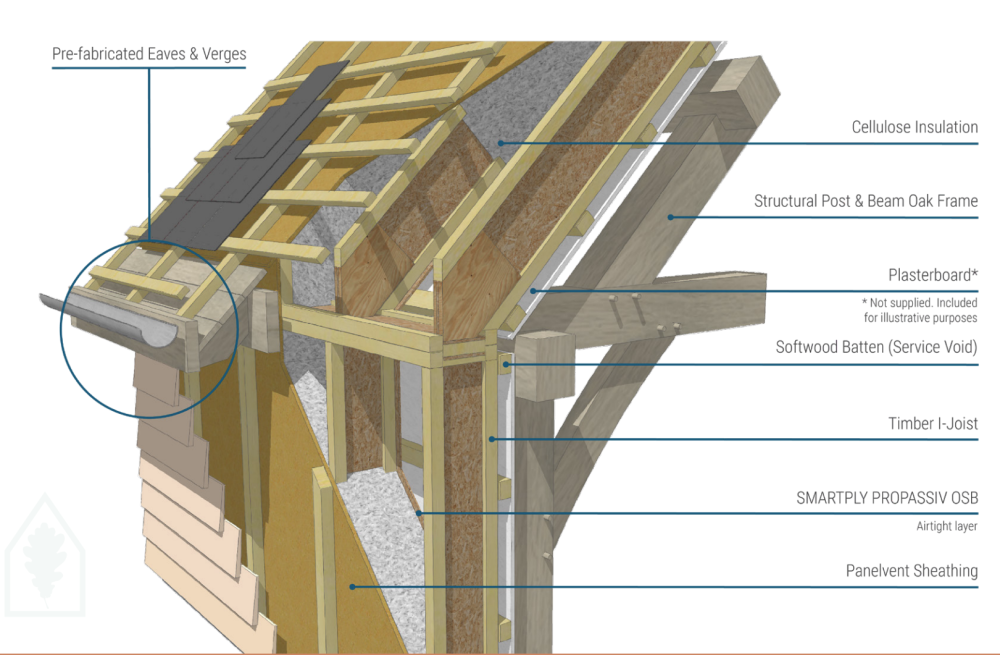
-
Yes, more like that. Maybe still some work to do on I-Joist spacing. 400 centres may reduce the performance a little. No, I'm thinking of the extra timber content that gets included once they actually Engineer the panels for your roof. Assuming the SIPs will be structural, there will be timber sections running the length of the SIPs to help take the load, and these create cold-bridges through the panel. I did have a SIPs structure costed for my own build and my experience was that no one tells you about the performance effect until the last minute. Random picture off the internet to show what I mean. The SIPs roof engineered for my build had quite a bit more timber that shown in the image, but I do have a shallow pitch and 6m spans.
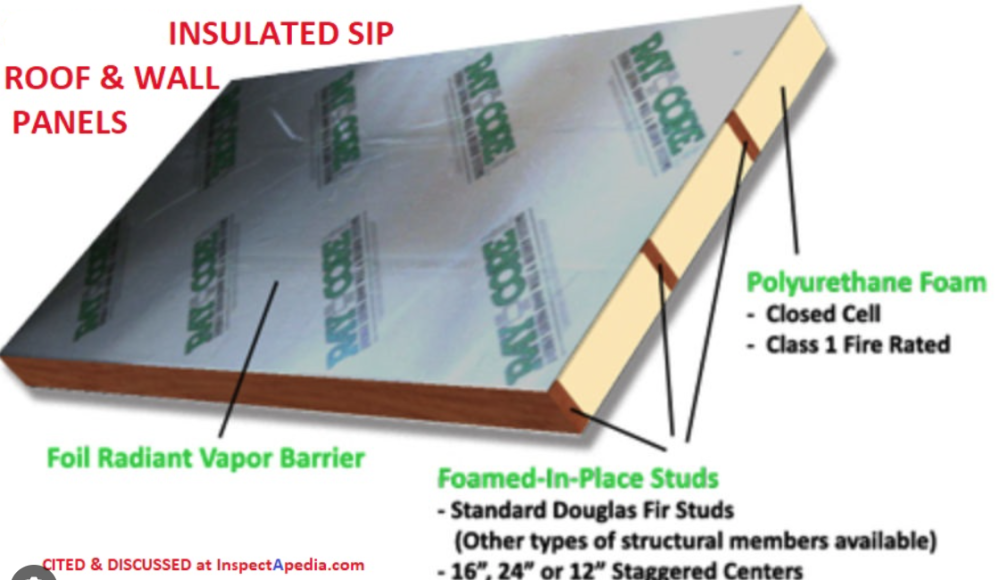
-
It's breaking the rule of having increasingly vapour open materials towards the cold surface, hence the condensation at the PIR. Unlike your section, SIP on the roof will have a lot more timber structure and therefore "cold bridging" within the SIP, and more condensation than shown, Why not just go with 300mm or 350mm I-Joists, full of cellulose and a fibreboard external layer. Without any cold bridging, it would perform better in practice.






