


IanR
-
Posts
1857 -
Joined
-
Days Won
6
Everything posted by IanR
-
You could possibly get a more "efficient" insulated raft from one of the companies that specialise. A 250mm raft reinforced with 2 layers of mesh sounds over-engineered. What build method are you going with for walls? and are you planning UFH installed within that 250mm? The following is a list of Insulated Raft Suppliers. I had an excellent experience with AFT Ltd. (Advanced Foundation Technology Ltd.) I found a lot of the EPS manufacturers, selling formers for insulated raft foundations, are tied to a particular Raft Supplier, so will only sell their formers via and Engineered package.
-
Indeed, hence me including However in 2025 that will not deliver anywhere near a 75% - 80% reduction in CO2, and will require "significant uplift in fabric performance as well".
-
Hopefully tangible details of the 2025 Future Homes Standard will start to emerge soon as the changes are pretty significant, and the industry needs to prepare. Reportedly, homes completed to the 2025 Buildings Regs will produce 75% - 80% less CO2 than the homes built to pre-2022 regs. If that's allowing for homes heated with today's Electricity mix v. Gas, there has to be a significant uplift in fabric performance as well. I'm not sure Architects are ready for it, let alone the volume builders.
-
 I followed the Potton PassivHaus case Study using Kingspan SIPs panels when it was being built 5 - 10 years ago. They were running a blog that was regularly updated. I remember they struggled a bit with the air tightness, failing the first air test they did, and later commenting that an internal membrane was required to get it below the 0.6 ACH target. I thought the blog was quite honest of them. SIPs are considered "airtight" in a standard building regs environment, but the shortfalls need to be mitigated for PassivHaus levels of airtightness.
 -
Once the landline number is ported to VOIP, it's no longer "attached" to a residential address. While it will work on a VOIP handset, connected to the house network, it will also work on any mobile phone that's connected to mobile data. Keeping the old landline number, that others are familiar with and for others identifying a location, is just convenient and can cost as little as a few pounds a month. I pay £4.99/month with 100 mins of inclusive UK landline/mobile minutes. VOIP also open up the opportunity for cheap International calls, if you have the need.
-
A cut 25% of the overall depth of the slab is enough to act as an initiator so that if it does crack, then it will (should) crack in the cut. But, do you need to control the cracking. You've mentioned a float finish and a self-levelling filler if needed, so there's no plans to polish the slab. It's probably not important where it cracks (if indeed it does). Just make sure you use a Ditra mat type un-coupler if you are putting tiles down.
-
With no steel in the slab, I'd assumed your UFH pipes would be stapled to the PIR, well away from the top surface.
-
Then I'd put an upstand of perimeter PIR around the edges, more for a thermal break, but it will also allow some movement. My guess is you haven't got much room for this, at best the thickness of the plasterboard and skirting. There's a chance it will crack at the internal corners of the doorways, where, if you need to control that, you could put a cut in at each door way about 25% the overall depth (30mm - 35mm), as soon as it has cured enough to walk on.
-
A little more info please. Are the external and load bearing walls sitting on the slab/raft, or do they go down to a traditional foundation with the slab poured in between them, leading to narrow sections at doorways. There's no issue pouring 105m² in one go, my own is 465m² without any expansion gaps and done in a single pour, but all walls come down on top of the raft.
-
You can use typical UK boxes, the fixings holes are on the same centres, but the UK boxes are slightly larger and Loxone switch plates won't fully cover them. I used UK boxes, but got some stainless escutcheons laser cut to make sure the aperture was fully covered.
-
For a VoIP direct WiFi (not DECT) handset, I like my Grandtsream WP810. https://www.netxl.com/wifi-phones/grandstream-wp810-portable-wifi-phone/
-
Looks like an old land drain. The butt joint with no connection is intentional, to let the water get into the "pipe" and guide it out to the ditch/burn. It probably started off roundish, but has become misshapen over time. You can just build back up the earth around it and lay the displaced pipe back into its position. Then reinforce the band with what ever you plan.
-
Yep, there will be play in the joints, making it less accurate to dig with. Pins and bushes can be replaced, but if a number of joints are worn it may not be economic to do so. Doesn't cause me an issue away from the house, but I wouldn't have used mine to dig the drains around the house, for instance.
-
The Fibre is overhead in my road, but for me it drops underground from the closest telegraph pole and then crosses a field in my duct and up into the house. The ONT box that terminates the fibre is roughly 100x100x20, and does need power. You'll need a new router, connected to the ONT with an Ethernet cable. The main providers will supply the router with a new connection. Mine didn't, so I use a Ubiquity EdgeRouter X https://www.netxl.com/network-routers/ubiquiti-edgemax-edgerouter-x-router/?utm_source=google&utm_medium=surfaces&utm_campaign=feed_click&utm_content=surfaces_across_google&gclid=CjwKCAjwkNOpBhBEEiwAb3MvvcIdPhzpxKESCAg8miSEVS1Odc1QhIfic9KuCVMScgeLWO5UL7PFzBoC4aoQAvD_BwE If you do supply your own router make sure it can through put the bandwidth you want. The ER-X for example will through-put 1Gb/s, but oddly not on its default settings and needs a couple of tweaks to get the most out of the connection.
-
I felt a cheap Backhoe loader was very handy to have around, although I still brought in the right size 360 machine for quite a few jobs. For the same age and condition the Case 580 are a little cheaper than the JCB 3CX and the Ford 550 are cheaper again. I paid £4.5K for mine, and it has needed a few hoses replacing. Smokes a bit but still loads of power. Good for clearing and grading as well as moving stuff around, but mine has very worn pins. If I was to buy again I'd go for 4 wheel drive, extending backhoe and a £10K budget. I can't tell you if they're easy to sell as I've always got another job in mind for it, but it seems there're are plenty of people looking for them, as I've had a couple of locals try and buy it off me.

-
Openreach are flexible, so using an existing duct shouldn't be a problem. That's what they did with mine, even dug a hole in the middle of a field as their rods weren't long enough to fish it through in one go. They also routed the ONT to my Node zero point, centrally in the house, unlike their website which states it has to be on the inside of an external walk. It took a few visits, but they did a good install in the end.
-
Shouldn't? Doh! yep it "shouldn't" be too difficult.
-
Are you using an insulated raft for the rest of the conversion. If not then it seems a lot of trouble to go to for a 3m x 5m area, when your glass "walls" aren't likely to be better than 0.5W/m²K U value. Are you thinking frameless glass? If it's framed the detailing should be too difficult. Have you got a link to the glazing you are considering, or a section?
-
The Conor Threshold: the Lancashire version
IanR replied to ToughButterCup's topic in Rainwater, Guttering & SuDS
What are you thinking will be the on top of the EPS upstand (circled red)? and what's the profile I've circled yellow? Also, is there a DPM running up the inside of the upstand with enough free length to lap over the top of the upstand? Is it still the plan to have tiles internally? Will there be a mat on the floor?, is it a "low" threshold? How much height have you got from the top of the raft/EPS to the underside of the moving door sash? What stage are you at with installing this? is the door frame in? Is there any rain cover over this door, or can driving rain hit it? How big is the flag stone area, before it drops 150mm to ground level?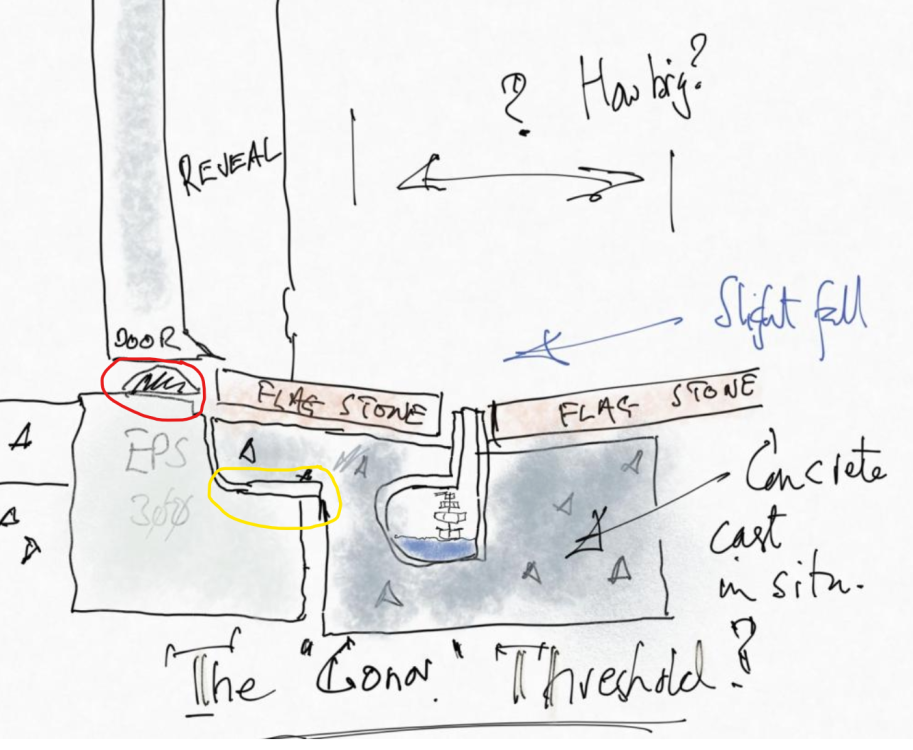
-
In England, if the septic tank has not been altered since 2015, and assuming there is no EA Permit, then the only additional rule you must now meet is that it must discharge to a correctly sized (to BS 6297:2007) drainage field. It can not discharge to a water course. If you are selling a property with a septic tank you must inform the buyer, in writing, all details about the system (General Binding rules sets that out) Since it's a criminal act to run a private sewage system and not meet the General Binding Rules, then when a property is sold that has a system that doesn't meet them, the parties should agree who will upgrade the system and make it a condition of sale. Do you or your neighbour have a copy of the "Conveyance of land lying to the north of the land in this title known as Mertesse dated 11 January 1971 ". They appear to have brought forward the reserved rights to the current title deed, but not necessarily the condition (covering 1/3 of costs). That 1971 Conveyance should have been sent to the Land Registry when your neighbours property was first Registered.
-
Please see my previous answers. What's "non-sealed" EPS? You're still not understanding the system. Talk to an experienced structural Engineer that understands and design insulated raft systems and their requirements, and, don't change the SE's details without their approval, otherwise their insurance wont cover you. There is, but not for the reasons you're assuming. With EPS on top of the DPM there is a risk of the concrete getting under the EPS if the ring beams are filled before the higher areas of EPS have been weighted, down with concrete on top. Happened to someone at the old place. The recommendation is to pour the concrete on to the higher EPS sheets and let it flow down into the ring beams. Don't pump the concrete directly into the ring beams. I don't believe Isoquick tends to have ring beams, so not an issue with their system.
-
No they're not. The 100mm thick areas are where there are no load bearing walls. Rafts constructed to take high loads everywhere are over-engineered and wasting the client's money. It's an optimised product for cost and performance. No DPM on the Type 1 is to avoid potential damage the DPM. You need the no-fines layer (which is just 30mm - 50mm thick) to stop water from thermally bypassing the EPS, as mentioned previously.
-
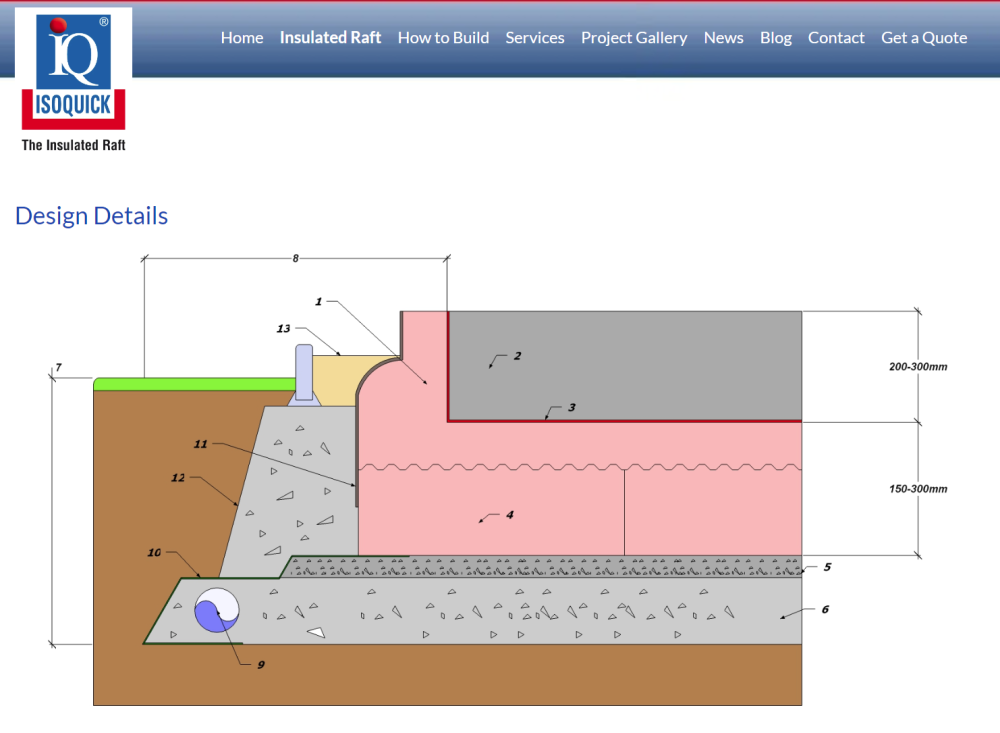
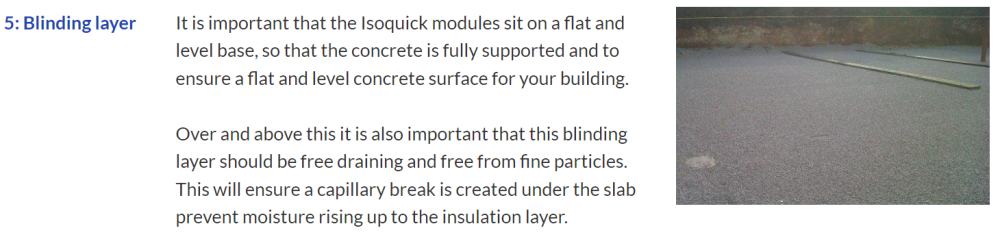
Layer 5 isn't Type 1, it's a "no fines" shingle/granite chippings layer and is typical for an insulated raft foundation and is only 30mm - 50mm thick. Layer 6 is more similar to what you refer, although in this case is Type 3. Water is not being encouraged to move under the foundation, it will do that if not mitigated against. Type 1 and Type 3 are porous. On Isoquick the DPM is between EPS and concrete. I assume at ~200mm thick they're not expecting the UFH to be pinned to the EPS, as tied to the mesh would position it closer to the surface. While Isoquick tend to go with a constant ~200mm thick raft, most others reduce this to 100mm thick for the majority and only go to +200mm at the ring beam, saving more concrete and further reducing the dig. Personally, my choice was cost & performance.
-
Ref. https://www.isoquick.co.uk/design-features
-
My experience in England, was that I had to be on my own meter, and the meter was at the road, so had to run a new connection to the main, install a new meter at the road, and a new pipe from meter to property (130m for me). Since I was running power, broadband and data to the road as well, I dug a trench. If you are doing water only and crossing mostly fields, could you find someone local that offers a mole plough installation. As an example from a google search: https://www.pe100plus.com/PE-Pipes/Technical-guidance/Trenchless/Methods/Installation/Mole-Ploughing-i1303.html





