


PeterW
-
Posts
18480 -
Joined
-
Days Won
207
Everything posted by PeterW
-

Paranoid about spontaneous failure of large skylight
PeterW replied to hendriQ's topic in Skylights & Roof Windows
Lead run off over the glass can deposit all the way across the glass - it leaves white streaks. So … given this is 4m by 1m, how was the architect planning the roofer insert that flashing too ..?? You need to be able to kneel in front of the wall to do it - as it stands you’ll need to stand on the glass to install it. Also, how will the rendering company render down to that flashing ..? It is incorrectly designed as the flashing just needs to cut into the blockwork by 30mm and then the render goes over the top with a bell cast or stop bead. None of that has been thought about and it really should have been from the outset. -
Paranoid about spontaneous failure of large skylight
PeterW replied to hendriQ's topic in Skylights & Roof Windows
So you have lead runoff over glazing ..? Your architect has remembered to tell you that will stain the glass then ..?? I would be making this into 3 standard panels, offset from the wall slightly so you can put some element of gutter behind it and redesigned with cost and safety in mind. This really is a glass of example of form over function - it’s not been thought through at design stage and you now have an expensive issue to resolve. -
Paranoid about spontaneous failure of large skylight
PeterW replied to hendriQ's topic in Skylights & Roof Windows
I don’t think this has been well designed or thought out tbh, and it’s a folly that looks good but no-one has actually worked out how to deliver as I think you’re now finding out. The weight of the unit won’t be your issue, it will be the flex strength of the glass that becomes the limiting factor. I’ve installed glass roof panels on conservatories and they bend when you install them in a very unnerving manner…! Glass doesn’t have a great strength when placed under tension which is what happens when it bends, and this will bend. How you handle and lift a unit that size will be a significant challenge. I’m assuming that this is being installed perfectly flat, at which point you also need to ensure that it’s got self cleaning coating on the outer as it will very quickly become dirty. You will also have to stop anyone ever standing on it, and also think about where it could be impacted from above (roof tiles, nearby trees etc) Also I’ve assumed you’ve calculated the heat loss in for this ..? Has the insulation in the roof - and the heat loss of the room - been adequately compensated for this level of glazing in the roof itself ..? -
RED (Renewable energy devices) ASHP Brand?
PeterW replied to ashthekid's topic in Air Source Heat Pumps (ASHP)
Commercial units are invariably horizontal evaporator not vertical, and they last for decades and usually on top of buildings in some pretty harsh weather. There is a lot of background data for them to be able to draw on in this space. There is a school of thought that the vertical fan designs are quieter too but it depends on how the cowls surround the fan blades as the sound can be altered by the gap between the end of the blades and the cowl, tip speed and a whole host of other factors. -
Combi, Storage Combi or electric shower?
PeterW replied to Rachieble's topic in Boilers & Hot Water Tanks
What size is your cold supply to the house and what pressure have you got ..? That is your limiting factor, and you need to ensure you’ve got decent flow before you worry about heating it. Storage combi boilers are big beasts - where do you plan to install it ..? -
It can but will be inefficient. A2A will have a setup to support coil evaporators and not a gas / water heat exchanger. Those tend to need a slightly higher gas flow rate, and having a mix of multi splits on the same condenser will be a challenge.
-
Paranoid about spontaneous failure of large skylight
PeterW replied to hendriQ's topic in Skylights & Roof Windows
What thickness glass is this ..? Have you considered having this as 3 panels with slim glazing bars as it would be safer, cheaper and easier than one big panel. You’ll be picking the unit up with suction lifters so it will need a crane or handler to move this as a unit nearly 4m long will bow substantially. -
Air 2 Air ASHP insulated ducting
PeterW replied to sub7even75's topic in Air Source Heat Pumps (ASHP)
Says Fujitsu on it ..? Probably not inverter driven but split systems (assuming there is a big box in the attic somewhere..??) which will have the refrigeration pipe work to it are usually a bit more efficient. The good thing is that this sort of product is pretty easy to find a service engineer for as they are well supported - would probably be worth getting the gas pressure checked and the condenser /evaporator coils checked and cleaned. -
It isn’t … it’s water resistant.
-
Wooden flooring compatibility with UFH pipes
PeterW replied to Adsibob's topic in Wood & Laminate Flooring
I’d use carpet adhesive …! Spray both sides and it will not move once down -
Wooden flooring compatibility with UFH pipes
PeterW replied to Adsibob's topic in Wood & Laminate Flooring
I’d use 6mm everywhere as it will stop flexing on joints (ie where a joint is over a pipe) but also to stop damage to the cellecta panels when the floor is being laid. -
EPS and wires shouldn’t be in contact as the styrene in the EPS and the plasticiser in the cable outer becomes degraded.
-
Will be fine if it is PIR (not EPS)
-
Cutting slot for masonry hanger in old brickwork?
PeterW replied to Digmixfill's topic in Barn Conversions
Hangers should be built in, not mortared in after into slots as they cannot be guaranteed to be level or secure. Fix a rim joist or wall plate to the wall with resin bolts and then use timber to timber hangers -
Unvented Cylinder Installation. Spot the Problem!
PeterW replied to Iceverge's topic in Boilers & Hot Water Tanks
@Iceverge do the WC feeds in 10mm -
Agree - issue is that a lot of people do not understand how fire resistance is built up and what the classifications actually mean. You only need to look at the arguments that happen with stove surrounds and whether plasterboard is acceptable as a medium close to a stove, but what is also not understood widely is the fixing media is also part of the make up of the fire resistance. If you look at some of the new foam adhesives, they are not suitable for fire boards, not because they won’t bond them but because the foam will fail at a lower temperature than the rated standard for the board with skim. Speaking to a retired fire officer about this a while ago and he always said that if you had a fire in a cavity wall, you had bigger issues elsewhere as there should never be a source of ignition in that space ..! Long term I think that there is a wholesale rework needed of the regs - sadly it focused on what’s the hot topic (pardon the pun..!) and climate and energy is todays focus… who knows, in 5 years time when fires in timber framed buildings have increased due to things such as you highlight such as fire barriers behind rain screens and between compartments, then we may see a focus on saving lives not just todays pet subjects … Ireland seemed to have got this right a few years ago, with the zero carbon policies, and Wales seems to have gone a similar direction with sprinkler or mist systems (not convinced on this yet) but whilst the lobbying system in England allows the big house builders a loud voice that increasing standards will cost the purchaser - not that their profits couldn’t stand a hit - then the regulations will always be watered down to a minimum.
-
I’m not exploiting loopholes - it’s how the standard is applied in AD-B and used extensively. Grenfell - and a lot of the other issues with fire safety in multi unit buildings including terraces - highlighted the issues over this subject in that it can be misinterpreted, hence why I’m always clear to quote which version of the regs I am referring to. There is a great deal of opportunity to improve fire safety in the U.K. but sadly there is little impetus to do so - intumescent strips in doors or frames add very little cost but can save lives, and yet they are a very rare occurance unless a BCO insists. All of these items - such as increasing the number of smoke and heat alarms, to the introduction of sprinklers in lower rise buildings - should be reviewed and not just as a knee jerk reaction to when a major incident occurs.
-
NHBC isn’t the best standard by far ..!! And yes I agree but you design in access ..! There are loads of ways of sorting that, and for example the OP has a property that is raised above ground level so there are options on the vertical legs etc. I’d hazard a guess that BCO hasn’t been near site to see what they are suggesting - they are overstretched and using COVID as a reason in a lot of places but anything that isn’t a square box to min regs they are basically trying to ignore.
-
NHBC and Building Regulations are two different things. The AD-H only states suitable access for rodding should be provided, not that you cannot use a Y branch under a slab. Under a standard BRegs submission, if you can prove that you have that access then there is no requirement to not have 2 WC on the same branch.
-
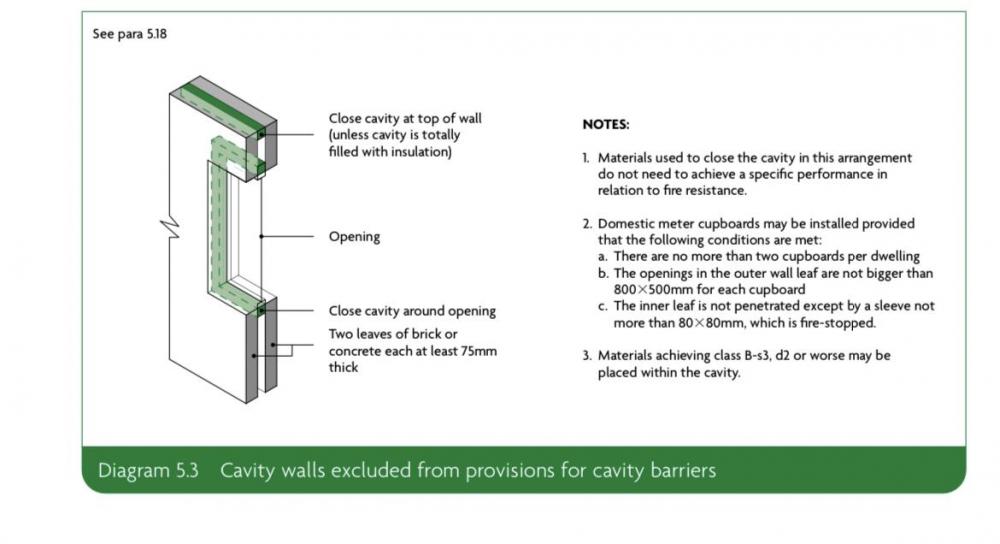
OK with all due respect you’re wildly out of date, and the advice you are giving is incorrect against current regulations. ADB (2020) is the latest version of the English Building Regulations and the section that you should be referring to is 5.3 onward that relates to compartmentation and the use of compartments. From that, the image below is from that section relating to 5.18 You’ll also note that note 1 states the following : Materials used to close the cavity in this arrangement do not need to achieve a specific performance in relation to fire resistance. A link to the full present version of the AD B is here https://assets.publishing.service.gov.uk/government/uploads/system/uploads/attachment_data/file/937931/ADB_Vol1_Dwellings_2019_edition_inc_2020_amendments.pdf Your reference to BS9999 is also in error - assuming you have read BS9999 you will note that it excludes domestic dwellings and the fire provision for those is in BS9991 BS 9999 is not applicable to the following types of buildings, which are covered in BS 9991: dwellings (single-family dwelling houses, self-contained flats or maisonettes); and residential accommodation blocks, eg for students or hospital staff, with individual bedrooms and the provision of kitchen/sanitary facilities constructed within a fire compartment. Fire safety is not something that entertains me it all - but if you want to quote documents then please ensure they are correct, and the version is up to date.
-
Are you qualified or is this your opinion on this ..? Reason I ask is English and Welsh building regs do not require the cavity closer to be fire rated. The plasterboard finish layer provides the necessary fire resistance in the construction. Well don’t post a table that only has part of the information - post the link to the document if you want to refer to something else. There is no ignorance of English Building regulations - I have the full set as reference.
-
But your post answers it’s own question - they don’t need to be fireproof. Item 10 Note 5 refers to the cavity closure being formed by a window or door frame - neither of which are required to meet any 30 minute fire resistance. I think you’re referring to cavity barriers in timber frame buildings where there is a clear cavity behind the brickwork. Using full fill fibre or PIR, the chance of fire spread in a block / brick cavity is negligible.
-
Is this a Nu-Heat overlay system ..? Mark and disconnect all the loops and then take the manifold off the wall. Strip it down on a bench - take the ends off and all the flow regulators out and then flush it with lots of clean water. If you can get a hose on both ends, flush the loop through with mains water and see if you get a better flow - it may be the manifold.
-
Yes they can. Ask them where in the building regulations it states that …? Regularly spec a single run with a 45 degree branch and rest bend coming up through the slab.
-
Attempting a straw bale, off-grid passive house in Somerset
PeterW replied to Smallholder's topic in Introduce Yourself
@Smallholder why not aim for EnerPhit rather than full Passiv..? As @SteamyTea said, you will struggle with air tightness on straw with lime plasters etc, so will end up with internal membranes such as Intello so you’ll start to lose some of the ethos of why use bales IMHO.- 62 replies
-
- 1
-

-
- straw bale
- off-grid
- (and 8 more)
