PeterW
-
Posts
18480 -
Joined
-
Days Won
207
Everything posted by PeterW
-
This tech has been around for decades ..! It’s used in every major building programme, every office and hotel etc. M&E - and specifically air conditioning and refrigeration - is something that is skilled and technical role that is continually evolving. There are big organisations in this space who do offer long term apprenticeship training and also are reputable. The issue is that it is being used in small scale deployments and as a replacement for traditional boilers. The problem has become that the ASHP providers are punting their products as boiler replacements and not actually managing the expectations that these are very different beasts. It’s a bit like how combi boilers were punted around as panacea for poor hot water pressure and capacity from “traditional” tank and header, which just replaced it with endless flow but at lower flow rates. What they are not doing is addressing the design issues up front, and like what happens when a proper heat loss calculation isn’t done. Plumbers tend to be creatures of habit, and will fit what they know. They also err on the side of caution, and will overspec a boiler for example as they know they will get a call out if it’s not powerful enough so will over cure. The issue is that ASHP has a power limitation and you’re maxing out at 16kW single phase so they can’t do the usual trick of oversize just in case as they need to go 3 phase and that’s not like going from a 22mm to 28mm gas feed. The broad issue is that anyone can get “certified” by an ASHP vendor as an installer by going on their courses. I’ve tried (unsuccessfully) to get a couple of the big manufacturers to provide design specific training and got blank looks. They don’t see it as an issue as you “size them according to heat loss” and their training focuses entirely on how to install and then configure the controllers. The troubleshooting for one of them is pretty much limited to RTFM and then call the vendor who sends a new controller out ..! This is about taking a consumer product to market using a skill base that is not fully understanding the nuances of how to design it correctly in the outset.
-
Not really as not servicing a pressure vessel safety system is a recipe for failure .. should only be £50 or so anyway.
-
its the G3 check on the UVC (if fitted) that is more important
-
You mean like Gas Safe..?? Which is now turning into a nightmare as they changed the certification from a 2 day ACOPS training to 2 courses and 2 years experience ..!!
-

Do retrofit ASHPs need larger pipes to the rads?
PeterW replied to Ferdinand's topic in Air Source Heat Pumps (ASHP)
Depends on tank size tbh but most internal coils are 22 or 25mm so 28mm up to the tank gets an increased flow through the coil and that’s about it. I always site the valves in one place and then spur off to the different circuits, so would be 28mm flow and return to one location and then 22mm everywhere else so that allows multiple flows (ie tank and heating at the same time) Buffer should be used for high temperature feeds to UFH to stop short cycling, you can drop the ASHP temp to closer to the floor flow temp and not buffer it but it can cause problems with larger ASHP that can’t modulate down. -
Of what thickness..? Floor..? Wall..? Roof..? Lots of variables which will impact this. Seconds&Co can be good sometimes but tbh if there is a big (ie £10k order) then your local merchant can usual be good. And go with their brand - Recticel, Kingspan, Celotex,Ecotherm are all just brands of PIR.
-
Do retrofit ASHPs need larger pipes to the rads?
PeterW replied to Ferdinand's topic in Air Source Heat Pumps (ASHP)
Using 28mm to run to manifolds and valves is good practice, keeping the runs under 10m is also worth doing which reduces flow restrictions. Other than that, anything less than 12kW should be happy on 22mm. -
Don’t use a space heater - it will introduce moisture. Get a couple of big industrial dehumidifiers, turn them on and shut the doors.
-
Do retrofit ASHPs need larger pipes to the rads?
PeterW replied to Ferdinand's topic in Air Source Heat Pumps (ASHP)
Wilo Yonos 25/1-6 does around 3.3 cubic metres / hour on full so would expect it is closer to 2 on a normal setting. In 15mm pipe that would equate to around 3.2m/s flow rate. -
Do retrofit ASHPs need larger pipes to the rads?
PeterW replied to Ferdinand's topic in Air Source Heat Pumps (ASHP)
Think some of those pipe sizes are a bit big but agree with the principle -
Why would she have a survey done ..??? Sounds odd … I’d smile and say that you’ve done nothing near that wall and carry on. And buy her some flowers and say sorry for the inconvenience of skips / dust / etc and when you’re finished she can come round for tea and see what you’ve been up to…. In reality, if yours was a knackered semi that you have improved then it’s likely you’ve increased her property value not decreased it.
-
Do retrofit ASHPs need larger pipes to the rads?
PeterW replied to Ferdinand's topic in Air Source Heat Pumps (ASHP)
it is not even double stack. There is a table of delta-T compensation values that most rad manufacturers provide. Stelrad call them operating factors in their documents https://www.stelrad.com/wp-content/uploads/2014/08/stelrad_technical_info.pdf -
Yep you will find it as bagged sharp sand. You do not want building sand, soft sand or plastering sand ..
-
Do retrofit ASHPs need larger pipes to the rads?
PeterW replied to Ferdinand's topic in Air Source Heat Pumps (ASHP)
Flow rate to rads is a function of the heat transfer and pump speed. I would just turn up the pump speed but the pipework won’t be a limiting factor. The pipework is just providing heat input. The issue here @Ferdinand is the rate of transfer of heat to the room which is a function of the delta T between radiator surface temperature and room temperature. It is also psychological issue as people think radiators need to be “hot” to work. -
Options for Replacing garage roof
PeterW replied to TonyT's topic in General Self Build & DIY Discussion
Flat or pitched ..? -
From memory (but not a currently registered gas fitter ..!!) if you use tracpipe it can be put in ceiling and floor voids as it is ventilated at either end and the outer shell holds the inner pipe.
-
tell the designer to back off ..?? Unless they can give you the legal position, then it’s all their own opinion.
-
This is not in the building regulations and an induction hob poses less of a heat risk than a gas hob, and they are probably trying to protect the edges of the cabinet.
-
MF Door Reveals & Lining Kit Suggestions
PeterW replied to MortarThePoint's topic in Doors & Door Frames
Ok so you’ve quoted a supplier and not the actual regulations, and a single supplier at that too. There are varying regulations on pipework that are allowable, and it covers the 4 main “plastic” pipes in various Standards Depending on the supplier, the underground products may be UPVC or PP - Polypipe only manufacture in UPVC for example for any drainage product where others use a mix of PP, PE and UPVC depending on the product range. It’s also worth noting that a significant amount of the standard relates to dimensions of fittings, wall thicknesses and other physical standards. The actual material used is around 4 paragraphs in the standard and relates to minimum amount of virgin polymer to re-grind and other additives.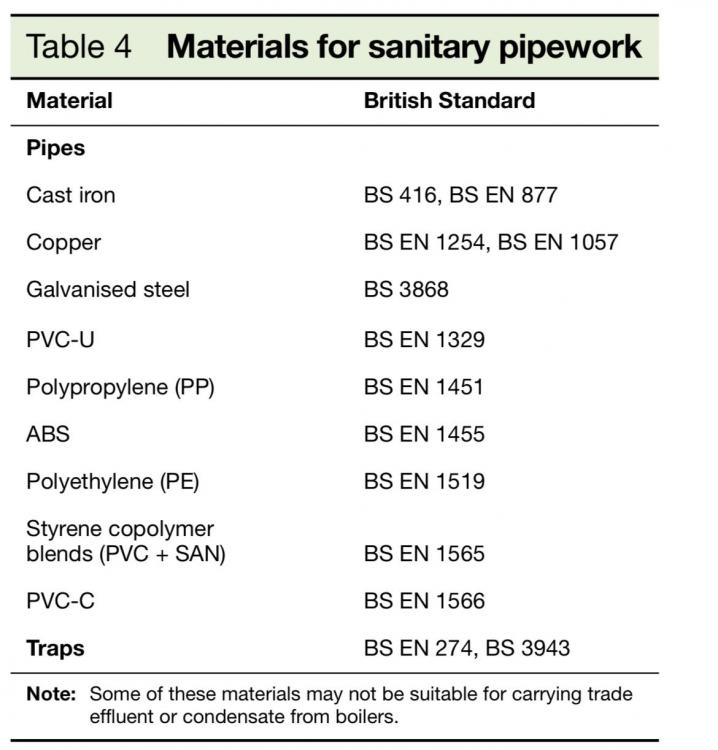
-
MF Door Reveals & Lining Kit Suggestions
PeterW replied to MortarThePoint's topic in Doors & Door Frames
Why..? As long as they are boxed in and not exposed to direct sunlight then they are fine. They should not be used externally. -
Cavity closer does stop them - it’s how we do it with them wedged in place.
-
Yep but you can’t blow bead in then as the subs will stick. Closer meets the building regs requirements for insulation and DPC
-
You can’t close the cavity with brick or block or you create a cold bridge. Also, blown bead needs a properly sealed closer in place to stop the beads coming out at the window frames - it’s easier to use a plastic/ foam closer over the 3 sides and then fit the window and the internal cill to that.
-
£350 is reasonable to me as the strip clean and sanitise of the indoor units takes a reasonable amount of time.
-
Does the sink have a hidden overflow ..? And when he replaced the waste did he take the whole thing apart including take the silver waste out ..? What may be happening is that the silver waste tube has a slot cut in it and it’s not properly sealed to the sink from the top to start with. Water will be coming down the side of the thread and under the nut through any hairline crack in the overflow porcelain. Happens when they get out on the floor on their waste outlets as the porcelain at that point can be quite thin.