


PeterW
-
Posts
18480 -
Joined
-
Days Won
207
Everything posted by PeterW
-
Not what I would be using. You want something solvent based that goes off quick so it bonds and doesn’t come off. CT1 isn’t the answer there.
-
Ok so do a quick web search .. https://www.cityplumbing.co.uk/Daikin-Altherma-EDLQ07CV3-7kW-Small-Monobloc-Air-Source-Heat-Pump £2,600 inc https://www.cityplumbing.co.uk/Daikin-EKHWSU300B3V3-Unvented-300L-Heat-Pump-Cylinder-%2B-Ekuhwbb/ £1,200 inc (although it’s 300 litre) So my estimate was 10% out and that’s list price before discounts.
-
And more suitable as you only need a construction adhesive here. No moisture or sealing, no real need for a hybrid polymer adhesive. Why do you think you should need CT1..?
-
Don’t use CT1, just use solvent based no nails type adhesive at £1.50 a tube if you are doing it onto OSB.
-
So the installer is whining that a £250 buffer and £100 pump will be coming off their £5k budget for the install ..???! My heart bleeds... You have less than £5k of kit in there - the ASHP and tank are change of £4500 and I’m giving a generous £1000 for other bits which is well over the top. As I said .. this is a government backed money making scheme for installers ...
-
Doubt that will fit - look how close it comes under the first floor windows
-
Possibly ... if you know the minimum input an ASHP can modulate down to, ignore the heat curve based on external temperatures, then you could model something. One of the issues normally is the binary response of thermostats and their hysteresis. It may be worth implementing a hi/lo type setting that only cuts in when the buffer goes below a fixed temperature and then off when it hits the high with a 10-12°C variation. That should stop short cycling but will increase temperature fluctuation in the rad flows.
-
Insulation is fine as it has 40mm kooltherm backing on the plasterboard under the rafters. You could increase the TP10 to 150mm and reduce the insulated plasterboard to 20mm to reduce the cold bridging but it’s fine as it is.
-
Microbore isn't an issue if you manage the flow rates, and a buffer will help here no end. The ASHP will push heat into the buffer (I would go minimum 100 litres) and then the heating system pulls it out. Parasitic (or syphonic) losses are a misnomer. the heat is lost into the house so its not a problem in reality. Not really worth it - use a buffer It is a closed system so won't help. Pumps on the ASHP >> Buffer and then Buffer >> Heating are what is needed Nope unless you massively increase the size of the rads
-
 I don’t think you’re using the extension to the best of its ability - I would put the bedroom out at the back, and create a large L-Shape of kitchen / dining / lounge and put a small en-suite into the bedroom. You will need to do some work with the extension to get some light in but I would say it will be a better use of space. Which way is north on your plans ..?
 -
Normal bolts will do. They won’t rust in the resin and they are stronger. Fischer resin is really good - you need to get a blower though to clean the holes out and wear eye protection as you will blow dust into your eyes...
-
Acrylic eggshell will do it and it’s a semi Matt finish.
- 1 reply
-
- 1
-

-
Correct - that’s the padstone you should be using. You’ll need to jack up the frame to get the old one out, clean up the mortar beds and reset the new padstone. Then when it’s gone off (you can use rapid set but be careful) you will need to drill and bond the studs, wedge the base so it’s perfectly square and then pour or inject structural grout into the gap between the flange and the padstone.
-
If it’s only 11sqm then 4 standard sheets will do with a few thin offcuts under the joints.
-
Ok so the constant cycling of on/off heat/cool on the joints in refrigeration systems can cause fracturing of the connections and failure of the refrigeration circuits. These then tend to then run hotter and harder resulting in burnouts of compressors and pump failures, or shuttle valves due to other issues. Next off will be running control circuits. Not too difficult to put a second pump and buffer in somewhere and assuming this is all being piped as standard S Plan..? Will need to understand that to add a buffer
-
Help- Traditional Construction or Non traditional PRC
PeterW replied to Bradley's topic in Surveyors & Architects
Who is the surveyor registered with ..? If they are registered with RICS then you can complain by their complaints process. I would get a structural engineer to survey urgently, then send the bill to the surveyor. -
What paint type for a cavity wall meter box.
PeterW replied to epsilonGreedy's topic in Electrics - Other
What colour do you want it ..? Spray looks best, light sand with 120 wet and dry then prime and a couple of top coats. Take the door off if possible to get a better finish. -
Help- Traditional Construction or Non traditional PRC
PeterW replied to Bradley's topic in Surveyors & Architects
There is your key. Contact the surveyor, basically provide the two previous reports and state that you believe they have made an error. Ask that at their cost they re-asses the property, and state that if you incur any costs due to their negligence then you will seek redress. Do it by phone, follow up in writing recorded delivery. Should focus the mind. -
Also know as grano in other regions..!
-
You can add the buffer later but is this all assuming a single circulation pump running it..? If so your buffer becomes a problem as it will allow your ASHP circulation pump to push water round the buffer and back to the heat pump at which point it will switch off and the house won’t be hot as it’s going the route of least resistance. With UFH this is managed by the UFH having its own circulation / blending pump which is triggered by the timer and room stat, and the ASHP circuit pump triggered by the buffer stat. This means the ASHP stops when the buffer is satisfied, and not necessarily when the floor is at temperature (ie when a single circuit remains open) TBH this is why these retrofit schemes don’t work, and significant problems occur. They are not designed to cope with a radiator based system that isn’t designed correctly, and you’ll find that whilst the heat pump “may” work in your scenario, it will have a seriously shortened life which will only come to light after the scheme has ended. It is essentially a energy efficiency scheme designed by an accountant.
-
Are you talking about breaking into a main sewer run ..? If so, and depending on the sewerage provider, you can’t use a saddle. You can only use a saddle above 300mm, you need to use a 45 degree branch running into the flow, and it has to enter above the centre line of the sewer. You also can’t do this yourself. You need to use an approved contractor.
-
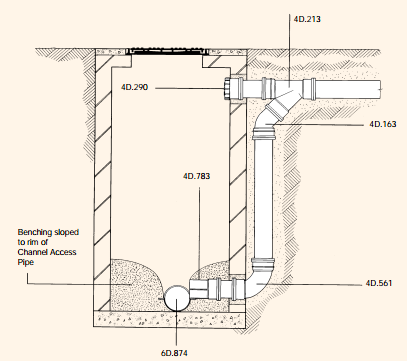
Internal backdrop (which that image is) are not normally allowed and they prefer the use of external back drops and the use of cored access into the channels. The downside with these use of external backdrops into existing chambers is that they sometimes have concrete encasement to the rings which means you need big access holes to core into the chamber. That picture is amusing as it wouldn’t pass any BRegs inspection : - None of the pipework is strapped / retained - The bottom bend is a double socket - it should be a rest bend with plain end - The coring through has not been sealed / made good - The tee isn’t capped / secured (debatable/dependent on the BCO) - It cannot be rodded as the tee obstructs the end of the main run There are much better images and methods..!! This is a good example.
-
Can I check then that they are not re-sizing any of the rads ..? The current ones will be sized for DeltaT 50°C (water flow to room temperature) and you’re going to at best DeltaT 30°C with an ASHP so the operating factoring is 0.515 on the output. They may want to replace the bathroom rads as they will be small but adequate now, when they have half the output that may not be the case. Have they provided a room by room heat loss calculation ..??
-
I would question if 1 and 3 are large enough to clear the rain in a storm without overflowing. Definitely need independent downpipes but you will need deep flow guttering on all of that. 2 would look ok if you brought it down the corner post with its own downpipe if possible.
-
There is no mesh / bar shown between the pit base and the main deck - you need to add that if you are casting in more than one go.
