Declan52
-
Posts
4449 -
Joined
-
Last visited
-
Days Won
10
Everything posted by Declan52
-
Cut a sheet of 12mm ply/ OSB, whatever you can get cheaper, in half and use 2*2 driven into the ground to act as support posts. Depending on your skills you could insert some threaded rod into through the ply into the gap so when you pour the concrete the rods will be fixed onto which you can slide your posts. Will require a bit more work in setting it all out so it suits the lengths of D rail you are going to use.
-
It all depends on your own site. I have seen piles over 30m deep and some 5m deep. http://mapapps2.bgs.ac.uk/geoindex/home.html Load this up and find your site and see if there are any boreholes close by. When you open it up and find your location then click the symbol at the bottom left corner then boreholes and click them. If you see a dot near your site click on it and it will bring up any info about that job.
-
It all depends on the site. How big it is will dictate how many holes need done. Then you have to look at the previous history of the site. Has there been something there that might need to be investigated for possible contamination. The main cost of site investigation is the mobilization costs. Once the rig is there its not much more to do another few holes. With a terrier rig, pretty small but will do most jobs, you could do 6/8 holes in a day down to 10m and collect a few samples from each hole. If your looking at depths of 20m + then your into big rigs with bigger gear so will be much slower and more expensive. Has there been any building in the fields beside your site recently. This will be the best indication of how deep you need to go.
-
You have energy store in Lisburn, homeseal ni in magherafelt, alpha insulation and pcdynes insulation both in Dungannon. There are a few more as well. Get them all out to price it up and that will give you a chance to talk to them and compare what they are offering.
-
If it was me I would want to know exactly how much I was going spend on piles which means getting a proper site investigation done. Once you have this then you might think no it's going to cost to much or yep that's a good price and proceed. @Bitpipe the wacking of the rods is called dynamic probing and will give an indication of the bearing strength of the ground. You measure out 100mm sections and count how many blows it takes to drive the rod that depth. The more blows the better. But as it's just a beating session there is no way of knowing what is actually down there so that's why they take the cores.
-
The first survey is just a general investigation into what's below the ground. A geotechnical investigation will involve a full site investigation using a drilling rig to perform a series of tests at different depths to give you a set of figures from which you can work out the bearing strength of the ground. From this your piling company will be able to say you need X amount of piles to be driven in at least 8/9/10m whatever it will be. They can then work out a more exact quote knowing how many and how deep they need to go.
-
@Russell griffiths did you not use something similar in your founds.
-

Which pointing finish for an internal brick wall?
Declan52 replied to epsilonGreedy's topic in Brick & Block
Soft brush then a sponge. -
Have driven a few all terrain forklifts, none of this type though and they are pretty good for what they can do. The lack of jack legs to help level the machine up is a pain. Glue a spirit level to the top of the dash and don't take any chances.
-
The vermiculite is used to insulate around the flue so is needed. It's used because it can withstand the high temps that you would get around the flue. Can you get a ladder out and check the top off the stack to see if water has penetrated the seal at the top and is working it's way down.
-
choose decrement delay over u-value for room in roof?
Declan52 replied to MarkyP's topic in Heat Insulation
What about cross 50mm battens underneath the rafters to give you a depth of 240mm and get one of the spray foam type insulations. Will completely fill the voids and make it super airtight. Just another option for you to price up. -
Always aim high for 50% off. If you don't ask you won't get.
-
He doesn't want to sue them, he wants to get them to offer a discount as they supplied faulty goods. So if they don't get a big enough discount then they get told to take it back and replace with the correct sized sheets. They won't want to come and collect it so will do a deal. Either way Russell either gets cheaper sheets or the correct sized sheets so wins with either outcome.
-
Half price or take it away. That will cover any loss from the extra work.
-
Nothing as nice as sitting in front on my stove watching nice blue chep pallets burn away giving of that lovely greeny yellow haze.
-
You should have waved.
-
Is the lounge rad a single or double. If it's a single is an easy swap to a double.
-
A long pole jointer will be better for jointing them up. It will keep the lines smoother and less of the ups and down marks that guy left on the video. Something like this. https://www.ebay.co.uk/itm/Ramboo-Pole-Jointer-12mm-1-2-Brick-Block-Slad-Runner-Solid-Round-Heavy-Steel-/271084404645
-
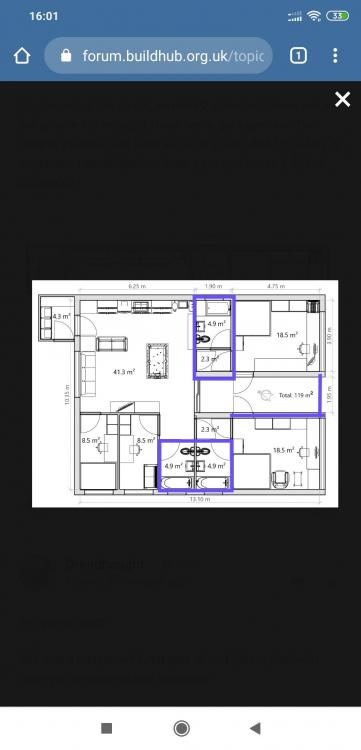
You have 3 small bathrooms each of which looks to small. By removing the really small corridor at each you could have 2 much bigger bathrooms . You can buy heavy doors,oak or walnut which will be better for keeping sound out of your offices. Move the front door to the end of the Wall so it's a square. You will save a fortune in terms of doing the roof plus you won't need to buy 2 external doors for your offices.
-
So it's either remove the plasterboard and upgrade and fix what's between the joists. Pretty messy work. Or put another layer of insulated plasterboard over what you already have. How much head room so you have to the ceiling. Could you afford to loose 65mm for a 50mm insulation backed sheet of PB or 115mm for a 100mm backed sheet. Have you got access to the wind tunnels at each side??
-
External door no longer sealing against frame
Declan52 replied to newhome's topic in Doors & Door Frames
Have you got a long straight piece of timber to check to see if the door has twisted slightly. If it has you can bend it back with a little force. -
So they have ruled that the building will be within their hse requirements so are you not looking at it from the wrong point of view. Your issue is that a lorry delivering wood chip could potentially hit the cable. So your easiest option would be to change your chosen fuel. If you really want biomass then use pellets. They can still come in bulk deliveries but are blown in so the height won't be an issue. I'm not sure wood chip can be blown in but would cost nothing to phone round and ask. Or change to either gas if possible, oil if not or if your house will be suitable then go for an ashp.
-
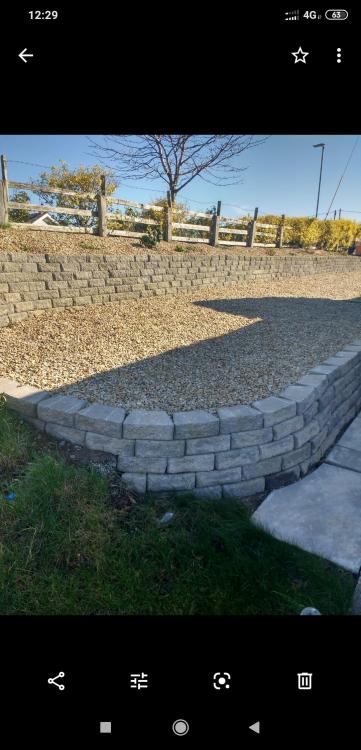
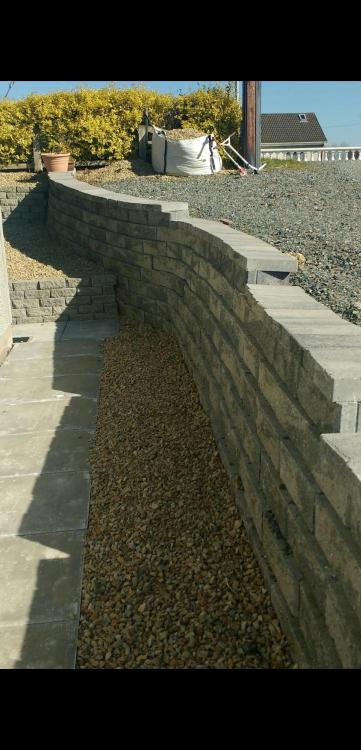
It would be the quickest method by far off doing a small retaining wall. I done that large wall in a few hours. It's about 15m long by 1.2m high. Once you go over that height then you need to be backfilling as you go which will really slow you down plus building in the membrane. You could step it so have 2 walls at 1.2m. much the same as I done with my front garden but move them closer together.
-
They make it pretty close to me so my price won't be anywhere close to what you will get charged. I done my 5+ years ago as well . There are plenty of companies who do this type of block. I got mine from this one. https://ag.uk.com/retaining-wall/anchor-diamond/
-
Do you mean this type of retaining wall??? If so they are pretty easy to build. They require no concrete just a well compacted hardcore base. And then it's just lift and set down and lift and set down. The back of the blocks have a lip so they can't push of the bottom block. Depending on how high you need to go will dictate the size of the blocks you need. The small ones in my front garden can go to 0.9m and that's it. The bigger ones can go to a few metres if you build in membranes along the way. Like all walls like this you need a drain at the back to get rid of any water plus plenty of clean stone like pea gravel to backfill it all in.