


joth
-
Posts
2918 -
Joined
-
Last visited
-
Days Won
5
Everything posted by joth
-
Ironically right now I'm selling my PV to the grid for twice what I buy it for overnight (15p Vs 7.5p) so it's better value for me to export as much as I can during the day and buy it back overnight to run the ASHP. This calculus will obviously vary as the tariffs change in future. I technically could make profit by discharging and refilling the battery each night too. 75p for an entire fill of the 10kWh battery probably not worth it for the degradation on the battery. (And definitely not from a needless configuration hassle point of view)
-
If you run the ASHP from octopus Go overnight, it's 7.5p/kWh primary energy so 2.5p/kWh of delivered heat. Giving: Winner: ASHP 75% lower cost than oil. (This only works on a highly efficient well insulated build where you can fully satisfy heating demand in 4hours of overnight usage, or with a very large house battery)
-
Exactly how long a blackout are you expecting? Our house is fine with the heating turned off for 20hours each day, and that was a retrofit. On a new build you should be able to last even longer. If that worries purchase a 3kW backup generator to power the heatpump, this will be cheaper to operate (thanks to the 300% cop of a heatpump) and also allow to run other home comforts like fridge/freezer during the event of an apocalypse
-
The Loxone server (in our house, not in the cloud) knows the time of year, the indoor and outdoor temperature, the forecast max temperature for the next 24 and 48 hours, and how much active heating and cooling has been used in the last day. I wrap these up in some logic to create a estimate of the risk of house overheating and if that's too high I don't turn on the towel rads (or ensuite UFH) The trigger to turn on is from a temperature sensor on the shower (or bath) detecting it's in use. That triggers the shower niche lighting to turn up a bit too
-
Its for lazy sods like me who cant be bothered to get out of their armchair to turn on the light when it gets too dark to read the paper 🙂 LOL. But to the question: It's been said many times already in this thread but I'll repeat it once more: if you're getting your phone out to control stuff, you're completely failing at home automation. The point of automation is it automatically does stuff without manual intervention. For example in my house: - windows automatically open when it's hot or the house is in risk of overheating, and it's cool outside and the indoor lights are off (to avoid attracting bugs in), so long as it's not raining or forecast to rain imminently. - the blinds automatically close on the sunny side of the house if there's a risk of overheating. And they close at night. But if closed in the day in winter, the slats are automatically altered to maximize solar gain while preserving privacy. - the heating and hot water is automatically turned down a notch when the house is unoccupied, and the mains water stopcock turned off to avoid risk of damage should there be a leak. - the hotwater cylinder is automatically boosted to a higher temperature (more stored energy) the more guests we have staying over. - the patio lights automatically turn on when the nearby door is opened. - hallway and bathroom night lights automatically turn on as you move about at night. - the relevant towel radiators automatically warm up whenever a shower or bath is used. - the ensuite electric UFH automatically comes on and the bedroom lights slowly fade up 5mins before my wake-up alarm goes off. And 10mins after the alarm the curtains automatically open. - excess PV generation is automatically sent to immersion, towel rads, ASHP etc depending on needs Etc. Etc. Etc. Those were off the top of my head, I think it's not even halve of what I've programmed The important bit about all that is it's all easily defined in a single software stack, so I can change preferences on it with rewiring or fiddling with mechanical timers or anything. And none of this requires arsing about on a phone. And it works without any internet connection (well except forward looking weather forecast data). I really don't want to persuade a single person they need any of that unless they already know they want it. But at least try and understand the utility of it for those that do chose to persue it. This has absolutely nothing to do with "what new problem can I dream up to solve if I buy a raspberry pi" and everything to do with "how do I want my home to assist and facilitate the preferences of the occupants living in it".
-
 Sounds like a body hair removal treatment for men of a certain age about to go on their beach holiday 😂
 -
The issue is the retrofit market, and dealing with people that have kept their old boiler on life support for years (via a poor value BG service plan most often) and then it terminally dies in the middle of winter and they make a snap decision to install a heatpump tomorrow, but with minimal disruption please as we just redecorated. At best the conversation about new rads gets someway before being abandoned due to them being obsolete given the aspirations to install UFH in the remodeling project that's always a couple years away... While there's absolutely nothing right about this decision process the truth is it's going to play out hundreds of thousands of times over the next decade. So manufacturers are bound to try and position their ashp as the perfect drop in for an ancient system boiler. For new builds or well designed deep renovations it's a completely different ball game. But while these high quality projects are the norm on this forum, they're the exception nationally, which is where the heatpump manufacturers will be increasingly spending their marketing
-
Motion/PIR sensor with additional contacts?
joth replied to Crowbar hero's topic in Networks, AV, Security & Automation
-
Power requirements for external swimming pool and pool house
joth replied to Thorfun's topic in Electrics - Other
If it's a TT system with local earthing rod on an outbuilding, you specifically do NOT want to bond the earth back to the main building, it needs to be isolated. (The SWA armour should be earthed at the main supply end only, to protect the cable itself but not the outhouse). Earthing rods are cheap, but testing the quality of the earthing and moving it around if it's in a poor location can become an expensive job. -
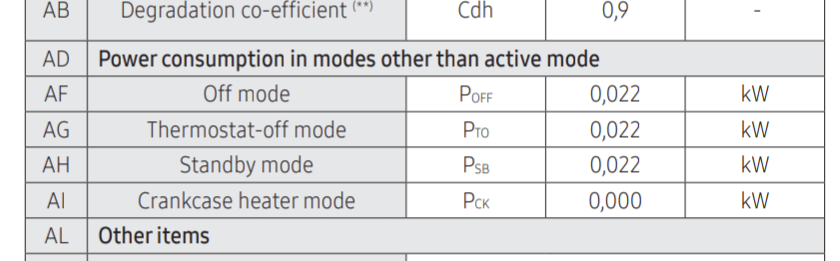
Type in the model number from top of this thread... (That's the 12kW model no) AE120BXYDEG/EU Here's the standby power consumption. 22W is OK. not the best, but very far from the worst. Been looking for some indication of this but not found anything yet....
-
Motion/PIR sensor with additional contacts?
joth replied to Crowbar hero's topic in Networks, AV, Security & Automation
This is more or less what I did. Mains PIR driving a 240V primary relay with 24V on the secondary in a cabinet. Problem was the relays were dreadfully noisy and banged away all night whenever wildlife passed by So I replaced them with cheap mains to 5V switched mode power supply (i.e. any old usb charger) which is silent. But still too many false triggers, so now all driven by Frigate image recognition running off the CCTV cameras 🙂 -
Which reminds me, Loxone has ~pretty good modbus TCP support, so in theory I can integrate SolarEdge inverter directly to Loxone without any external server/software. Fronius seems to have good prior art for this: https://loxwiki.atlassian.net/wiki/spaces/LOXEN/pages/1316061809/Fronius+Hybrid+with+Modbus+TCP#FroniusHybridwithModbusTCP-b.BatteryCharging%2FDischargingOptions
-
This thread touched on running Willis heater without TMV protection and apparently yes they can be turned right down to 30°C so as long as you trust it, seems that would be fine. Then nice thing with this setup is it only needs the secondary UFH circ pump to run, the primary pump through the boiler can be shutoff completely. You could put a normally-closed manifold valve on that special zone, wired in parallel to the Willis? This will shut off that loop when in normal (boiler) operation which might help avoid it messing with the UFH balancing in normal use. Otherwise a bunch of boiler output will shortcut via the Willis loop and may introduce boiler short-cycling.
-
Newbie question about how power is supplied from grid if using solar
joth replied to Danny42's topic in Photovoltaics (PV)
Yes it is G99 compliant. It's disabled in firmware, and as well as firmware change I believe needs additional external hardware to enable the off-grid failover. I've really not looked into it as it's really not something I currently care that much about. (But ask me again when we start the winter of discontent rolling blackouts) -
Newbie question about how power is supplied from grid if using solar
joth replied to Danny42's topic in Photovoltaics (PV)
The second looks to be based in Pakistan. Not going to the most authoritative source to learn about UK compliant equipment. -
Newbie question about how power is supplied from grid if using solar
joth replied to Danny42's topic in Photovoltaics (PV)
Caveat on this is if it has an automatic grid disconnection switch or a separate non-grid tied battery-backed AC output then it can remain powered. But, this is orthogonal feature it may or may not have depending on both technical and regulatory constraints (For example my SolarEdge SE-8000H hybrid invert supports this technically, but it is not legal to use in the UK as it doesn't yet have the necessary certifications) -
Solic Boosting Water or ASHP
joth replied to canalsiderenovation's topic in Boilers & Hot Water Tanks
No, the Solic boost just boosts the immersion at full power for 90mins or whatever. As to which is best, do you mean least cost or least CO2, or something else? Generally the ASHP should be at least COP2 doing hot water, so in terms of absolute amount of electricity used you're always best using the ASHP rather than the immersion. FWIW now I have a house battery, I've turned off my PV divert to immersion completely, and do 100% of DHW from ASHP early afternoon (when it has best chance to be coming directly from PV, and moreover when it's likely to have the best COP due to highest outdoor temperature) -
It's the wrong side of the themostatic mixing valve, so there's a risk it would damage floor finishes via overheating. [I had similar ideas about breaking the mold by putting a buffer tank on a spare manifold port] Check your boiler doesn't do something weird if the return flow into it is hotter than the set-point temperature. Seems unlikely but who knows. Otherwise, you could put the Willis heater on the flow rather than the return? Feels safer to me (i.e. Willis can "top up" the boiler temperature, much like they are sometimes used to boost up an ASHP output in very cold climates) Check if you can put 2x Willis on a single 32A MCB? A pair of fused spur switches (one per Willis) fed by 4mm2 T&E from a single MCB seems legit, but IANAE..
-
Newbie question about how power is supplied from grid if using solar
joth replied to Danny42's topic in Photovoltaics (PV)
Really these are orthogonal issues. e.g. what about a grid-tied hybrid system? In principle all four exist of "grid tied", "grid tied hybrid", "off-grid", and "off-grid hybrid". - Whether something can or can't be grid tied or have batteries is both a technical and a regulatory question, and regulations vary by country, so be very cautious trying to find a universal globally accepted nomenclature by reading online articles that may be written for different countries and regulatory constraints. Generally grid tied means it is not "off grid only" system - i.e. has the necessary circuitry to synchronize the waveform to the grid, and has necessary safety features to work on the grid of a given country. It may also support grid failover (in case of a blackout) but that's something else again. A hybrid inverter can simultaneously support battery and PV and DC inputs. But if you have a non-hybrid grid tied inverter you can still add batteries using its own inverter -- a so-called AC coupled system. Your requirements can be met with either of "grid tied PV and a separate AC coupled battery" or "grid tied hybrid inverter supporting both PV + DC coupled battery". There's some regulatory and power efficiency gains in going for the latter, but (currently) some cost savings and flexibility in sourcing the former. -
Deciding how to use our new 3 phase connection
joth replied to Ben Weston's topic in Consumer Units, RCDs, MCBOs
Just a small note: even if your inverter were on phase A and your house consumption on phase B you'd still get the financial benefit of self-consuming any PV generated at the time yuor appliances are in use, due to "polyphase net metering" implemented in 3 phase smart meters. You would of course need a 3ph meter to achieve that! But what you have now is perfectly sensible use of a 3ph supply head too. Just slap a single phase meter on it and sit comfortable knowing you have more options in the future should you require it. -
Worth installing PV on entirely West facing roof
joth replied to Huckleberrys's topic in Photovoltaics (PV)
Before going DIY bear in mind Octopus Outgoing is now offering 15p/kWh for exports and who knows this could increasing again over the lifetime of the panels, and you'll only get that payment if you go MCS install. The old rule of thumb is 50% of annual generation is exported which would be £260 of payments per year. Obviously some on here manage to self use far more than 50% and if you get a battery the calculus shifts again. In terms of the original question, 3500kWh per year from 4kW of panel is a good yield, we only get about that on our SW roof due to tree shading. -
Deciding how to use our new 3 phase connection
joth replied to Ben Weston's topic in Consumer Units, RCDs, MCBOs
Sounds like you have too many free variables to mathematically derive an answer to the question originally posed. I'd suggest making some decisions about what your functional requirements are, and only after that determine how to use 3ph best to fullfil them. In the meantime yeah having all 3ph pulled into house and (especially) garage and wherever the EVs and the inverter will be is obviously the best future proofing, but with a centrally located kiosk it doesn't sound horrendous to change that if you come in late with those key requirement choices. -
Deciding how to use our new 3 phase connection
joth replied to Ben Weston's topic in Consumer Units, RCDs, MCBOs
How much solar? What EV / chargers? What's the relative layout and effort to make changes later? I'd put 3ph into a central location that makes it easy to get to all the different places you need it (esp EV chargers, outbuildings, as well as house itself). If the kiosk is central then what you have now is fine. -
Local Electricity Bill... or fight to improve SEG
joth replied to Benguela's topic in Photovoltaics (PV)
Octopus Go is 18p/day, going up to 38p/day in 2 days time (on the contract editions I'm on). SEG and Outgoing don't have any standing charge, as they are export not import contracts. -
Local Electricity Bill... or fight to improve SEG
joth replied to Benguela's topic in Photovoltaics (PV)
Just to throw the cat among the pigeons I just got this from them about Octopus Outgoing: I'm seriously starting to ponder if there's a legal way for me to be on Octopus Outgoing and my neighbour on Octopus Go, and we share a DC coupled battery with charging coming from the Go side and discharge via a pair of inverters into each house, and any excess solar getting exported out by the Outgoing side.

