


Mr Punter
-
Posts
8220 -
Joined
-
Last visited
-
Days Won
24
Everything posted by Mr Punter
-
But if you cut it back so it finishes behind the plinth it won't be seen. Just mark the cut level with the bottom of the doors.
-
My favoured solution would be to remove both decor panels and move the appliance housing to leave a 604mm space for the dishwasher. Put brackets on the end of the appliance housing to support worktop. support worktop. After the worktop is fitted, cut down the tall decor panel to clad the upper part of the housing. Or just leave it all as is.
-
It looks fine. Does the socket on the left have enough cable?
-
I have used a hole saw on steel beams, but only 40mm or so. You may get up to 60mm with a mag drill but I don't think it will fit. I would be pretty pissed off with your so-called professionals leaving you with such a ball-ache of a job. Lazy bastards.
-
Porcelain paver upstands & celcon blocks
Mr Punter replied to WWilts's topic in Landscaping, Decking & Patios
I think you will need to render the blocks first or at least get a slurry coat on them.- 1 reply
-
- 1
-

-
That is annoying as they normally flag this on the planning consent and it appears as a condition. I thought it was normally Environmental Health who deal with this via planning.
-
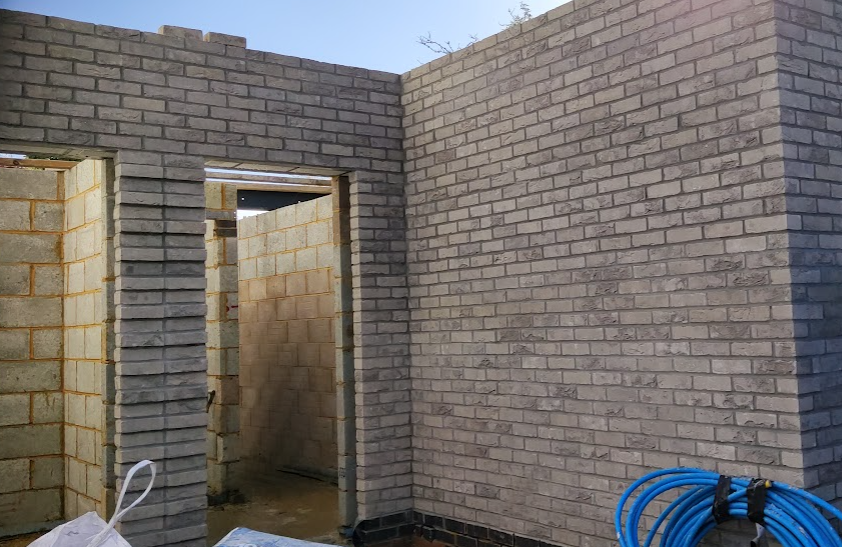
I thought about it but price and availability ruled it out. It is already a palaver having 2 different sand colours so mixer needing thorough washout if they change from blockwork to face work.
-
Workability mainly. Stopped the bricklayer whining.
-
I am currently paying about £4.60 a metre plus VAT for 9 x 2 C24 from local merchant. Similar price from Jewsons. Timber seems to still be falling in price.
-
The sand was from Kernow Mixers in Cornwall. Mix is something like 1:1/2:4 cement:hydrated lime:sand.
-
These are expensive to install. They have been popular in student kitchens etc. A full sprinkler system may be less expensive and cover the whole building.
-
Has anyone (like plumbers) been working on site. They may have leaked some water and not told you? There is what looks like a length of pipe dangling down. Plumbers are to blame for most things.
-
New concrete floor with 26mm deep puddle! Ideal for Ducks!
Mr Punter replied to Warrentdo's topic in Floor Structures
Another vote for sand. You could do sand / cement or levelling compound but it is more work and money. It is probably about 4 wheelbarrows full. -
It is quite unusual to get this on a new house as they attempt to have stepless access but I guess the topography dictated it. Would a ramp work or is there not enough space? I doubt there would be a planning issue unless this is a conservation area.
-
Fascias, soffit and downpipes/gutter replacement
Mr Punter replied to TryC's topic in Roofing, Tiling & Slating
That sounds quite expensive. I would have thought that £2,000 would be doable, plus the cost of the scaffold. Maybe get another couple of quotes. -
I have used Polarwall in a basement a while ago and since then they also have a BBA certificate that covers this. The staff there are very helpful and may be able to put you in touch with a contractor.
-
Mixing large amounts of Concrete on site...
Mr Punter replied to Mulberry View's topic in General Self Build & DIY Discussion
Then that is what you should do. -
How to get an extra 2 SAP Points?
Mr Punter replied to Andeh's topic in General Self Build & DIY Discussion
5 is fairly poor for airtightness. 3 is easily achieved. 1.6 for the glazing units is really very poor. Can you ask your SAP person for suggestions? Sometimes extra boiler controls can make a difference to the score. I assume you need the points for a mortgage? I see some of the housebashers doing waste water heat recovery so I guess it must be a fairly cheap win. You can get an airtightness test done once the windows and doors are in and sealed. Probably change of £200 and you can identify any weak points. Do it before you plasterboard. -
The big rolls are good value - less than 50p/m2. I have seen some Terram equivalents from reputable suppliers so they may be worth a go.
-
That lead must weigh a fair bit. What is underneath to support it?
-
Prices of building materials moving forwards
Mr Punter replied to James Frome's topic in Costing & Estimating
I have just had an updated quote for trusses on a job that has been on hold. Gone from £2,200 to £3,300 in 23 months. I think I will shop around. -
Where you have a door you can either reduce the cavity to 50mm or leave out the inner leaf and just have an upstand of 50mm insulation and run the concrete up to this.
-
Flow Screeding costs ballpark + advice
Mr Punter replied to crispy_wafer's topic in Floor Structures
At 150 ctrs and 70mm screed depth the 16mm O/D pipe will be 2.5% of the volume. I think @Canski's site manager was trying to cover his bad estimating. -
Weeping Willow, should it stay or should it go?
Mr Punter replied to MDC's topic in Landscaping, Decking & Patios
Yes, clay, which is what caused the heave. Probably silty clay and variable strata. The house is on a hill but about 70 metres from a river. They had to pile down to rock. -
Weeping Willow, should it stay or should it go?
Mr Punter replied to MDC's topic in Landscaping, Decking & Patios
My brother has a few willows in his garden. His house is on clay soil and was piled about 25m deep. He had an orangery fitted and just used a raft foundation. A couple of years later disaster. The orangery has now been removed, having settled so the doors would not open and it was causing damage to the house.

