


Mr Punter
-
Posts
8303 -
Joined
-
Last visited
-
Days Won
24
Everything posted by Mr Punter
-
Countries adopting the Euro managed similar price hikes at the time.
-
DIY ICF Construction - Bracing
Mr Punter replied to Conor's topic in Insulated Concrete Formwork (ICF)
Some I have seen where you can spray retarder on the top after pouring then jetwash this off when you are built up ready to do the next pour. Sounds impractical to me. -
DIY ICF Construction - Bracing
Mr Punter replied to Conor's topic in Insulated Concrete Formwork (ICF)
I would not recommend this. With ICF you cannot see voids. You will not be able to see the water bars. Normal concrete is fairly waterproof in any case. If the external tanking is correctly applied and guaranteed it should work without waterproof concrete. -
Change Granted Planning Permission to individual plots
Mr Punter replied to Richard Willetts's topic in Introduce Yourself
Serviced plots are def preferable. Nobody will want to dig up the main road for each service. It will cost about £10k per plot but will be well worth it for the buyers. Just having mains drainage connection, water and power makes the site welfare facilities so much better. Get in touch with the utils ASAP to work out how best to arrange them. -
That being the case you will probably need a full planning application for the change of use.
-
A few points: The flat roof above the dining has not been designed with a fall and one is required. This may mean a step up to the balcony area from the hall. Price the terrace separately as it is likely to be very expensive once balustrade and paving is added. There is lots of East facing glazing to bed 1 so the sun will be there first thing (although in Scotland this is not a given). Curtains will be very hard to achieve and you may well get overheated in the morning. Unless you have mountains looking up I would go for normal windows or at least price them in comparison. Windows are much costlier than walls and far worse at insulating. Get the facing materials priced for comparison. I imagine the stone is fairly pricey so you could reduce it where the external fan units are. There seems to be some metal cladding, which can also be expensive. Look at any other local materials and get prices for these too. As per earlier, you could finish the roof in concrete tiles and save a fortune. Make the downstairs shower wheelchair accessible and fit the walls out for future grab rails, seat etc. Consider making it a wet room.
-
Change Granted Planning Permission to individual plots
Mr Punter replied to Richard Willetts's topic in Introduce Yourself
Perhaps be a bit wary if you sell off the plots individually. You may want to bind the buyer to build as per approved plans or complete works by xxx, otherwise they could apply for consent for additional units, flats / HMOs, never finish the works etc which could impact the value of the rest of the scheme. I don't think planning should be too much of an issue as the consent runs with the land. It is not uncommon to have several developers working on a site with a single planning application. It may be that each buyer will need to get some conditions signed or part signed off and you would undertake to get others, such as archaeology, contamination, access etc. -
Extractor not staying on (on lighting circuit)
Mr Punter replied to gravelld's topic in Electrics - Kitchen & Bathroom
@ProDave what is a CPC and EICR? Could not find it in the glossary but maybe they are more specialist acronyms. -
What was it before December 2018?
-
The dims on the drawings are to the outside of the timber frame but the walls shown include the thickness of the battens and cladding.
-
You can normally change office to resi under Permitted Development rights if the building is not listed and you do a mini planning application. The windows will not affect this. You will still need building regs before you start and if you are splitting this into flats there may be quite a bit of work required.
-
Get a person with a Total Station to do this.
-
I think water will be the biggest challenge. If you have reasonable amounts of rainfall and you mow regularly and remove the cuttings it will look fine.
-
If you post up the plans we can see if there are any easy wins by tweaking. Regarding access, you will need to get concrete and muckaway lorries in or costs will rise. Most timber frame can be unloaded and erected with a telehandler. Can you have concrete roof tiles? Cheap to buy and lay, very durable and look pretty good.
-
Is that a basement? I see you have floor cassettes but it did not look like they were used until later. I really like the roof system. Is that also pre-insulated?
-
What to treat doors when the manufacturer says "do not oil"?
Mr Punter replied to ProDave's topic in Doors & Door Frames
Was there a fair difference in the cost to have them fully finished? -
Getting a Valuation for Land with Planning Permission
Mr Punter replied to Pemu's topic in Costing & Estimating
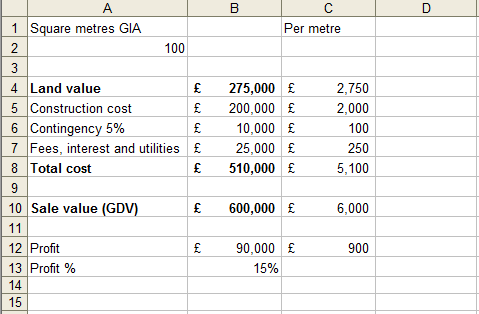
I use Excel's goal seek feature to obtain the residual land value based on the required developer profit. In the example below I use the feature to set the value of B13 to 15% by changing B4.
-
In my limited experience the Virtual Freehold (999 year) leases I have seen only have a peppercorn rent. The £12 a year is a low ground rent and not a peppercorn. You will be bound by all the terms of the lease, which gives the freeholder more control than would be the case of, say, a covenant in the title. Could you negotiate and offer half? Bear in mind that fees (legal, land reg, lender consent) can be fairly high for this sort of transaction. Don't focus on the 100 times bit. £1,300 for freehold title would certainly be worth it to me. I would go as far as saying that if there were 2 identical properties in you road I would pay an extra £5k for the freehold one.
-
Cost and Complications from Drain Re-routing
Mr Punter replied to Pemu's topic in General Construction Issues
You often get a key with the sewer plan showing the manhole depth and the pipe size and type. I doubt the one in the garden is more than 150mm diameter. Can you lift a lid and have a look? It looks like you could just put in a couple more inspection chambers to re-route this and it should not cost a fortune. -
I have bought Compriband from an eBay shop at a decent price. Keep it in the fridge before you fit it, especially in summer, as otherwise it can expand too quickly.
-
Polished concrete floor recommendations
Mr Punter replied to Bumble's topic in House Extensions & Conservatories
Bet the hairdo wasn't cheap @lizzie- 9 replies
-
- 1
-

-
- polished concrete
- floors
- (and 1 more)
-
It is not just the ground rent and there may be other restrictions on what you can do and what you have to pay. Sometimes for example you need freeholder consent to develop and they will often charge a hefty fee to grant this. Are there any service charges?
-
The rear porch is bonkers and you are well shot of it. With a house of this age you need to be very careful of asbestos, especially if you plan to demolish. Why the sea of tarmac at the back? Is that the only parking? It would be good to have the back garden feel a bit more private.
-
Get a powerful jetwash to clean all the laitance and loose material. I am not sure where your DPM and insulation is going. You could just have a screed to level it, some insulation and 22mm chipboard floating floor. If you have tiles in the room they may get broken with weights / equipment, so vinyl would be better.
-
K-Rend Bead Thickness and Fixing Instructions
Mr Punter replied to Triassic's topic in Plastering & Rendering
The bead size depends on the render system. With carrier boards there is often a base / mesh coat of about 5mm and top coat 5-8mm. I hope it is not through coloured. I don't really like the bell cast drip at the bottom. I prefer it flush.
